Clarimond(e)

  • Origin: Occitanian
  • Meaning: uncertain
  • Gender: Female
  • Eng pron: (KLAIR-e-mund)

A Medieval Occitanian name first recorded in 12th-century French chivalric literature, Clarimond (also found as Clarimonde, Claramonde, or Claramunda) is either a diathemic compound of the Latin clārus (“bright, light, clear”) and the Old High German mund (“protection”), or derived from an Occitanian phrase meaning “bright world; clear world”

In the 12th-century chanson de geste, Huon de Bordeaux, the name appears in its earlier form as Esclarmonde borne by a Saracen princess who converts to Christianity and marries the hero Huon. Similar formations (Florimond, Rosamond, Alemond) were fashionable among the knightly and aristocratic classes of the High Middle Ages. The 1889 opera by Jules Massenet, Esclarmonde, is loosely based on the character from Huon de Bordeaux.

Historically, Esclarmonde and its variants were borne by at least four noblewomen of the House of Foix, the most famous being Esclarmonde de Foix (d. 1215), sister of Count Raymond-Roger de Foix, who was noted for her learning and association with the Cathar movement in southern France.

Though rare, Clarimond saw occasional use in 17th-century England, likely revived through renewed interest in medieval romance literature. Clarimonde was also occasionally found in 18th-19th-century Acadia, and was used by the closely related Cajuns in Louisiana.

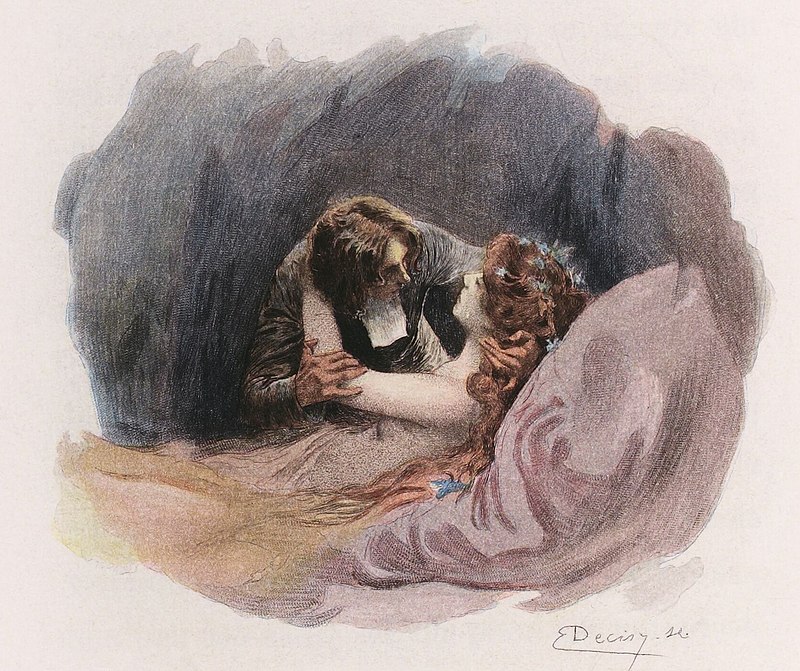
In 1836, French writer Théophile Gautier reintroduced the name in his celebrated vampire novella La Morte Amoureuse (Clarimonde in French; The Beautiful Vampire in English). Gautier’s heroine—a sensual courtesan who blurs the line between life and death—cemented Clarimonde’s association with Gothic beauty, nocturnal allure, and eternal fascination, making it an especially fitting name for Halloween

Other forms include:

  • Esclarmonda (Catalan, Occitanian)
  • Clarimond (English)
  • Clarimonde (French)
  • Clarimunda (Late Latin, Spanish)
  • Esclarmonde (Old French)
  • Clarmonda (Occitanian)
  • Clarmontina (Occitanian)
  • Mondina (Occitanian)
  • Esclaramunda (Spanish)

Sources

Gǫndul, Göndul

  • Origin: Old Norse
  • Meaning: “magic, magic wand; magical animal werewolf.”
  • Gender: Female

The name is either derived from the Old Norse gandr (magic wand; magic staff), or the Old Norse gǫndul meaning, “magical animal; werewolf.”

In Norse Mythology, this is the name of one of the Valkyries. She appears in several early sources, including the Heimskringla, in which it is written:

“Gǫndul and Skögul sent out / to choose among kings.”
Their presence seals Hákon’s fate, and they greet him after death — both destroyers and honour-givers.”

In the Poetic Edda, specifically Hákonarmál, she is again one of the Valkyries who welcome Hákon to Valhalla, confirming her dual role as harbinger of death and divine escort.

In the Norse sagas and Skaldic poetry, gǫndul can also function as a kenning (poetic metaphor) for “valkyrie” or “battle-witch,” used interchangeably with other names like Skögul, Hildr, and Mist.

Its rarely used these days in Nordic countries, but whose to say it won’t become popular with the rise of other Norse myth names. However, in modern Icelandic, it may sound a touch to close to the Icelandic slang term, göndull (cock, dick, penis), which yes, shares the same etymology as the name, referring to a staff or a wand, but other Nordic languages wouldn’t have the same associations.

Sources

Heka, Hik

  • Origin: Ancient Egyptian
  • Meaning: “magic.”
  • Coptic: ϩⲓⲕ
  • Gender: Male

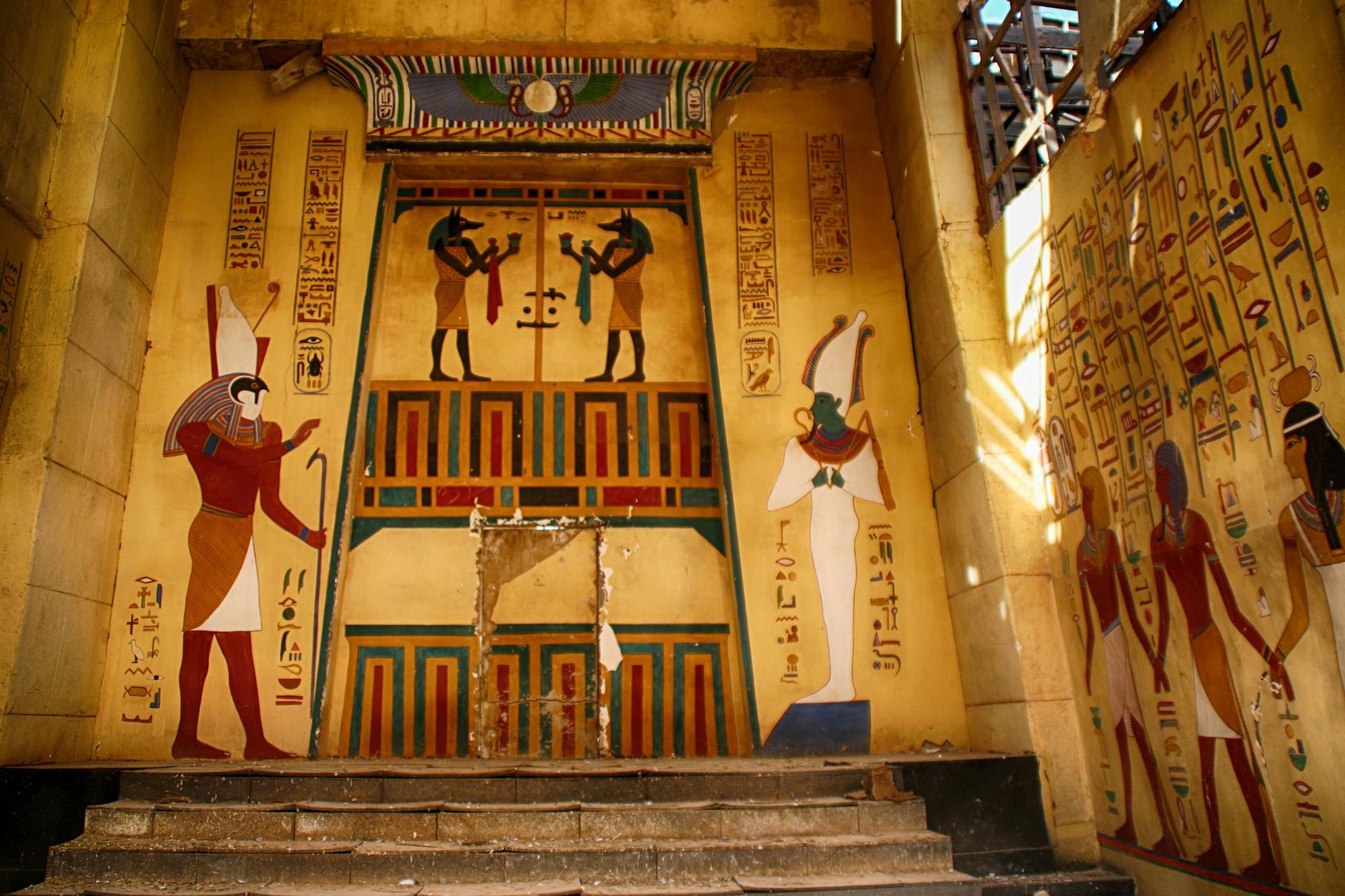
The Ancient Egyptian word and name Heka (transliterated ḥkꜣ, later Hkȝ) literally means “magic,” “sorcery,” or “divine power.” It derives from the root ḥk — “to work magic” — and the ending ꜣ (the Egyptian aleph) which functions as a nominal element.

In Egyptian cosmology, heka was not mere illusion or trickery, but a primordial creative force — the divine energy that allowed both gods and humans to act, heal, and give life. The term is thus best understood as “creative power made manifest,” and shares a root with the Ancient Egyptian ka, roughly translating to “soul.”

Heka was also deified as a god embodying magic itself. He appears as a male deity in Old Kingdom Pyramid Texts (c. 2500 BCE) and remained important through the Greco-Roman period.

In theology, Heka was said to have existed before all other gods — the power through which even the creator gods shaped the universe. The Coffin Texts describe him as:

“I am Heka, the magic, the child of Atum… before the gods came into being, I was.”

In later periods, he was depicted as a man holding two entwined serpents, sometimes accompanying deities such as Khnum and Neith, and invoked by priests and physicians in medical papyri. His power was integral to Egyptian medicine and ritual; magic (heka) was considered a sacred technology given by the gods for healing and protection.

The Coptic form is Hik, it is not used as a name among contemporary Copts but may make an interesting revival.

It is speculated that Hecate’s name and cult may have its roots in the Ancient Egyptian god.

Sources

Nyx, Nox

  • Nyx: Greek; Nox: Latin
  • Meaning: “night”
  • Gender: Female
  • Eng (NICKS); Eng (NOCKS)

The Greek name Nyx (Νύξ) means “night.” It comes directly from the Proto-Indo-European root nókʷts, the same ancient word that produced Latin nox, Sanskrit nakta (नक्त)*, and Old English niht → modern English night.

Thus, Nyx and Nox are linguistic sisters — two ancient words expressing the same primordial idea: darkness, mystery, and the cosmic night from which creation emerges.

In Greek mythology, Nyx is the goddess and personification of the Night and Nox the Roman counterpart.

She is said to have arisen directly from Chaos, the void before creation, and is counted among the Protogenoi — the primal deities who gave birth to the cosmos itself.

Nyx was both feared and revered by the Olympians. Even Zeus, king of the gods, hesitated to cross her.

Hesiod’s Theogony (c. 700 BCE) describes her as a shadowy figure dwelling in the western lands of perpetual darkness, near the gates of Tartarus.

In recent years, Nyx has appeared more often as a middle name, to fill a void for a longer first name. Its Latin form of Nox may make an appealing choice for those seeking gender-neutral sounding female names, sounding similar to the trendy male name Knocks. It has recently come into use in the Netherlands as a male name for unknown reasons.

Sources

Bricta, Brixia, Brixta

  • Origin: Gaullish
  • Meaning: “magic, spell, incantation.”
  • Gender: Female

Bricta (also spelled Brixta) is an ancient Gaulish female name derived from the Celtic root brict– or brixt-, meaning “magic, spell, incantation.” It shares its etymology with the modern Spanish word bruja. It may also share an etymology or be linked with Bridget.

Bricta is historically attested as the name of a Celtic goddess worshiped in Gaul, particularly in the region of Luxovium (modern Luxeuil-les-Bains, France). In inscriptions, she appears alongside the local healing god Luxovius, who presided over the sacred thermal springs of the area.

This pairing suggests that Bricta was his consort or counterpart, a water and healing deity, perhaps embodying purification, fertility, and the magical powers of sacred springs.

Bricta is a bit clunky but there is something magical sounding about Brixta. Perhaps a modern and fresher take on Brenda.

The name has also appeared as Brixia.

I often wonder how this name would have survived into modern French, Brixie?

Sources

Zintis, Zinta

  • Origin: Latvian
  • Meaning: “witchcraft, wizardry, magic, charms”
  • Zintis (m); Zinta (f)

From the Latvian word, zinte, meaning, “witchcraft, wizardry, magic, charms.” As a female given-name, it was first recorded in 1922. Its designated name-day is April 6th.

The male form of Zintis came into use in 1940. Its designated name-day is January 7th.

Zintis itself is a Latvian slang term meaning “imp” or “devil.”

Its designated name-day in Latvia is April 6th.

Sources

Mahtab

  • Origin: Persian مهتاب
  • Meaning: “moonlight.”
  • Gender: Female, unisex in Southeast Asia
  • Pron: MAH-tawb

The name is from the Persian word, مهتاب (mahtab), meaning “moonlight.” It is a poetic female name that has spread throughout the Persianate world. It is occasionally used on males in Southeast Asia.

Notable Bearers

  • Mahtab Singh (1782-1813), was the first wife of Ranjit Singh, founder of the Sikh Empire.
  • Mehtab Kadın (1830-1888) (Turkish form), was the name of the consort of Sultan Abdulmejid I of the Ottoman Empire.
  • Mahtob Mahmoody (b. 1979): Iranian-American author and daughter of Betty Mahmoody, whose story inspired Not Without My Daughter (1991), starring Sally Field.

Its Turkish form of Mehtap was among the top 100 girls’ Turkish names between 1980-1993, and peaked at # 58 in 1983.

International Variations

  • Mehtəb (Azeri)
  • Mahtob Маҳтоб (Tajik, Uzbek)
  • Mahitab (Turkish – Ottoman)
  • Mehtap (Turkmen, Turkish)

Sources

Dalbit

  • Origin: Korean 달빛
  • Meaning: “moonlight.”
  • Gender: Unisex

From the Korean word 달빛 meaning, “moonlight,” it is a unisex name that is slightly more common for girls.

Sources

Numan

  • Origin: Arabic نُعْمان
  • Meaning: “blood; red; bliss; anemone flower.”
  • Transliterations: Nu’man; Nouman (Maghrebi Arabic; Persian); Noman নোমান (Bengali, Tatar, Urdu)
  • Gender: Male
  • Pron (NOO-mahn)

The name comes directly from the Arabic word نُعْمان (nu’man), which is a poetic term describing “blood” as in a type of blood that brings vitality and beauty. It is also the word for the colour crimson and the anemone flower. It is ultimately from the root n–ʿ–m (ن ع م), which shares the same root with Naim نعم (comfort, tranquility, luxury, ease).

Numan ibn al-Munḏir (d. 602 CE) was one of the last Lakhmid kings of al-Ḥīrah, a pre-Islamic Arab Christian kingdom in southern Iraq. He is remembered in Arabic literature for his eloquence and patronage of poets.

In early Islamic history, Numan ibn Bashir al-Ansari (d. 684 CE) was a Companion of the Prophet Muḥammad and a prominent figure in the first Islamic century.

Sources

Sarangerel

  • Origin: Mongolian Сарангэрэл
  • Meaning: “moonlight.”
  • Gender: Female

The name comes directly from the Mongolian word сарны гэрэл (saran gerel), meaning, “moonlight.”

Sources