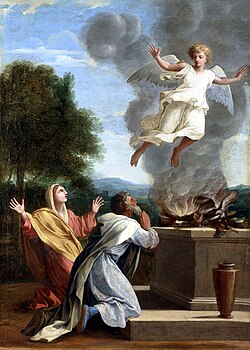
Manoah appears in Judges 13, described as a man from Zorah of the tribe of Dan. His wife is unnamed, but together they become the parents of Samson after an angelic visitation.
The name itself is derived from the Hebrew root נוּחַ (nuach) meaning “to rest, to settle, to repose, to be at ease.”
Between the 18th-century to early 20th-century, Manoah experienced some use in the U.S. and England. Common short forms were Manny, Menno and Noah.
In 2023, it appeared in the Netherlands charts for the most popular male names, though it did not rank in very high, coming in at #422.
Anglo-Saxon variation: Herefrið; English form: Herefrith
German pron: HER-freet
The name is composed of the Germanic elements heri (army) and fridu (peace).
It is currently very rare in contemporary German-speaking countries, a notable bearer being German political scientist, Herfried Münkler (b. 1951).
Herefrið is the Anglo-Saxon version, written as Herefrith in Modern English. It was borne by a 9th-century Bishop of Winchester and an Abbott of Lindisfarne recorded in the works of the Venerable Bede.
It’s designated name-day in Austria is November 9th.
The name is the modern English form of the Anglo-Saxon female name, Eahlswiþ, which is composed of the Anglo-Saxon elements, eahl (temple) and swiþ (strong).
The most famous historical bearer is Ealhswith (Elswith), Queen of Wessex and wife of King Alfred the Great (d. 902). She was the mother of Edward the Elder and Æthelflæd, Lady of the Mercians, and is remembered for her wisdom, learning, and piety.
Her name appears in multiple forms across medieval chronicles: Ealhswith, Ealswitha, Aelswith, Aelswitha, Alswith, Elswith, Elswitha, and Elswyth.
The name gained renewed attention through the popular Netflix/BBC historical drama The Last Kingdom (2015–2022) and its sequel film Seven Kings Must Die (2023), based on Bernard Cornwell’s The Saxon Stories series.
Since 2022, at least 11 girls have been bestowed the name Elswyth in England & Wales.
While Ealhswith fell out of use after the Norman Conquest, Elswith or Elswyth has occasionally been revived in historical fiction and modern England as a rare, archaic revival, akin to Edith and Ethel. It fits within the current trend toward names that blend mythic, Old English, and Celtic sounds, offering an even more unique alternative to trending names such as Eloise,Elowen and Ella.
From the Biblical Hebrew קוּםqum (to rise) and אֵל ‘el (God).
It is borne by at least three Biblical figures, including the nephew of Abraham in Genesis 22:21, a leader of the tribe of Ephraim in Numbers 34:24; and the ruler of the tribe of Levi in Book of Chronicles 27:17.
It was in use in 19th-century America among Protestant families with the short form of Kem.
The name is of uncertain etymology. It has sometimes been linked to the ancient Greek word ἄλαρα (álara), said to mean “hazelnut” or “spear-shaft.”
In Greek mythology, Elara was a mortal princess of Orchomenus loved by Zeus. When she became pregnant, Zeus hid her deep beneath the earth to protect her from Hera’s jealousy. There she gave birth to their gigantic son Tityos (Τιτυός). Because of this myth, Elara is sometimes associated with the earth or the underworld. One of Jupiter’s moons, discovered in 1905 by Charles Dillon Perrine, was later named in her honor.
As a given-name in the English-speaking world, it does appear in records in the 19th-century, mainly in the U.S. Recently, it has appeared in England & Wales Top 900 girls’ name, coming at #467 (2024).
With its celestial link and mythological depth, Elara feels like a luminous and romantic alternative to other El- names such as Elena, Eleanor, and Elodie. Its lunar connection gives it a quietly modern yet timeless appeal.
The name Hephzibah (Hebrew חֶפְצִי־בָהּ, Ḥefzī-bāh) means “my delight is in her.” In the Hebrew Bible, it appears as the name of the wife of King Hezekiah and the mother of King Manasseh (2 Kings 21:1; 2 Chronicles 33:1).
In Isaiah 62:4, Hephzibah is also used symbolically as a poetic name for restored Zion, representing the renewed favor of God toward His people
The name was occasionally used among medieval Jewish communities, where it appears in apocryphal and mystical writings such as the Apocalypse of Zerubbabel and the Zohar. In these texts, a legendary warrior woman named Hephzibah fights the enemies of Israel in the messianic age, slaying wicked kings and defending Jerusalem.
Hephzibah enjoyed modest popularity among Protestant families in the 18th and 19th centuries, especially in colonial America and Puritan New England, where Old Testament names were widely favored. Common diminutives included Eppie, Hepsie, and Hepsy.
By the early 20th century, the name’s use had largely waned, surviving mainly as a literary or historical curiosity.
It was often utilized in 19th-century literature, being the name of a character in George Eliot’s Silas Marner (1861); and Nathaniel Hawthorne’s The House of the Seven Gables (c. 1851), which features Hepzibah Pyncheon, a proud but impoverished New England gentlewoman. Recently, it appears as the name of a witch in the Harry Potter series by J.K. Rowling.
An early notable bearer was American Bostonian Socialite, Hepzibah Swan (d. 1825, unknown birth date). A more recent notable bearer is American-Australian pianist, Hephzibah Menuhin (1920-1981).
It is also the name of several places in the United States.
With its mix of Biblical grace, Gothic Americana, and warrior-woman legend, Hephzibah carries both majesty and mystery. Its vintage nicknames—Eppie, Hepsie, Hepsy—soften its grandeur, making it unexpectedly wearable today.
Hephzibah, long slumbering in scripture and story, may be ready for revival.
Sources
Withycombe, E. G. The Oxford Dictionary of English Christian Names. Oxford: Clarendon Press, 1950.
A poetic rarity, it is from the ancient Greek λαλαγέω (lalageo) meaning “to babble; to prattle.”
The most famous bearer of the name appears in Horace’s Odes (Book I, 22), in which it is the name of the poet’s idealized beloved.
Edgar Allan Poe later used Lalage as a tragic heroine in his 1835 play Politian, reinforcing its Romantic aura.
The name experienced some usage in the 19th-century throughout the English-speaking world. A notable bearer is British educator and feminist, Lalage Brown (b. 1927).
A name forever haunted by legend and scripture, Ichabod carries an aura of solemnity and old-world eeriness. Though seldom used today, its deep Biblical roots and literary afterlife make it a quintessential Halloween name with legitimate historical pedigree.
The name appears in the Old Testament (Hebrew: אִי־כָבוֹד, ’I-Kavod), meaning “no glory” or “the glory has departed.” It is first recorded in 1 Samuel 4:21, where Phinehas’s wife, upon hearing of the Ark of the Covenant’s capture and her husband’s death, names her newborn son Ichabod to mark Israel’s loss of divine favor.
In the English-speaking world, the name came into use in the 17th-century, mainly among Puritan families.
In colonial America, one of the best-known bearers was Reverend Ichabod Wiswall (1637–1700) of Massachusetts.
The name’s haunting reputation was sealed by Washington Irving’s 1820 short story “The Legend of Sleepy Hollow.” Its lanky, superstitious schoolmaster, Ichabod Crane, pursued by the Headless Horseman, transformed the Biblical lament into a symbol of American Gothic folklore.
Irving is believed to have drawn the name from a real historical figure, Colonel Ichabod Bennett Crane (1787–1857), an officer in the U.S. Marine Corps whom the author reportedly met while stationed at Fort Pike, New York. The coincidence of name and temperament lent the fictional character an extra layer of realism — and ensured that Ichabod would forever echo through ghostly New England legend.
It is borne by several other famous early American personages,
Traditional short forms in the 18th-19th centuries were Cabe, Bud, and Buddy.
The Greek name Nyx (Νύξ) means “night.” It comes directly from the Proto-Indo-European root nókʷts, the same ancient word that produced Latin nox, Sanskrit nakta (नक्त)*, and Old English niht → modern English night.
Thus, Nyx and Nox are linguistic sisters — two ancient words expressing the same primordial idea: darkness, mystery, and the cosmic night from which creation emerges.
In Greek mythology, Nyx is the goddess and personification of the Night and Nox the Roman counterpart.
She is said to have arisen directly from Chaos, the void before creation, and is counted among the Protogenoi — the primal deities who gave birth to the cosmos itself.
Nyx was both feared and revered by the Olympians. Even Zeus, king of the gods, hesitated to cross her.
Hesiod’s Theogony (c. 700 BCE) describes her as a shadowy figure dwelling in the western lands of perpetual darkness, near the gates of Tartarus.
In recent years, Nyx has appeared more often as a middle name, to fill a void for a longer first name. Its Latin form of Nox may make an appealing choice for those seeking gender-neutral sounding female names, sounding similar to the trendy male name Knocks. It has recently come into use in the Netherlands as a male name for unknown reasons.
Derived from the ancient Greek male name Πτολεμαῖος (Ptolemaios), which in turn comes from πτόλεμος (ptólemos), meaning “war” or “battle.”
The word ptólemos is an older Aeolic dialectal form of πόλεμος (pólemos), the standard Classical Greek word for “war,” sharing the same root with the English word, “polemic.”
Ptolemy I Soter (367–283 BCE) was a general of Alexander the Great and later became Pharaoh of Egypt, founding the Ptolemaic Dynasty (323–30 BCE). This dynasty ruled Egypt for nearly three centuries and ended with Cleopatra VII, the most famous bearer of the family’s legacy.
Claudius Ptolemaeus (Ptolemy) (2nd century CE) was the famed Greek astronomer, mathematician, and geographer of Alexandria, whose Almagest shaped Western astronomy for over a millennium.
According to the Book of 1 Maccabees (135/4 BC), Ptolemy of Jericho betrayed his father-in-law, Simon the High Priest, by murdering him and his two sons while they slept as guests under his roof. This act of treachery is used in Dante Alighieri’s The Inferno, in which the ninth circle of Hell is called Ptolomea after him, a frozen realm reserved for those who betray their guests.
Ptolomy is also the name of an early Christian saint.
In the English-speaking world, Ptolomy has been used on and off since the 18th-century. It appeared in the U.K’s top 500 boys’ names in 2004, ranking in at #906.
A modern bearer is American author, Ptolemy Tompkins. Celebrity couple Gretchen Mol and Tod Williams bestowed this on their son in 2007.
Common English short forms include: Tollie, Tolly, and Tal.