Eng Pron: (THANTZ); Germ pron: (TAHN-seh; TAHN-ko)
A popular Old Germanic name element, derived from the Old High German “thanc,” meaning “to thank.” Some early records list Thance as a male name, more likely pronounced the German way, it may make a unique alternative to Vance when pronounced the English way.
The name later evolved into Tanco, Tanko, Danco and Danko.
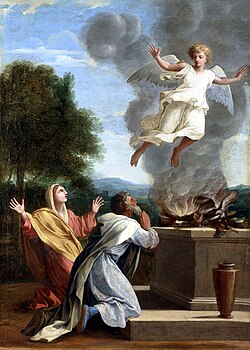
Manoah appears in Judges 13, described as a man from Zorah of the tribe of Dan. His wife is unnamed, but together they become the parents of Samson after an angelic visitation.
The name itself is derived from the Hebrew root נוּחַ (nuach) meaning “to rest, to settle, to repose, to be at ease.”
Between the 18th-century to early 20th-century, Manoah experienced some use in the U.S. and England. Common short forms were Manny, Menno and Noah.
In 2023, it appeared in the Netherlands charts for the most popular male names, though it did not rank in very high, coming in at #422.
Anglo-Saxon variation: Herefrið; English form: Herefrith
German pron: HER-freet
The name is composed of the Germanic elements heri (army) and fridu (peace).
It is currently very rare in contemporary German-speaking countries, a notable bearer being German political scientist, Herfried Münkler (b. 1951).
Herefrið is the Anglo-Saxon version, written as Herefrith in Modern English. It was borne by a 9th-century Bishop of Winchester and an Abbott of Lindisfarne recorded in the works of the Venerable Bede.
It’s designated name-day in Austria is November 9th.
Poetic, bold and well, grim, it is an obsolete Medievel gem which is composed of the Germanic elements, ebur (boar) and grim (bold; fierce; grim).
Source
S.L. Uckelman. “Evergrim”. In S.L. Uckelman, ed. The Dictionary of Medieval Names from European Sources, Edition 2023, no. 1. http://dmnes.org/2023/1/name/Evergrim.
Craft is a Latinate form of the German, Kraft (power; strength). It was in use as a male given-name in Medieval Germanic countries but is today obsolete. A variant Latinate form is Crafto.
This may make the perfect name for a Halloween baby.
Sources
S.L. Uckelman. “Craft”. In S.L. Uckelman, ed. The Dictionary of Medieval Names from European Sources, Edition 2023, no. 1. http://dmnes.org/2023/1/name/Craft.
Socin, Adolf. Mittelhochdeutsches Namenbuch: Nach oberrheinischen Quellen des 12. und 13. Jahrhunderts. Basel: Helbing & Lichtenhahn, 1903. Digitized by the Bavarian State Library. Accessed October 29, 2025. https://www.digitale-sammlungen.de/en/view/bsb10931113
The name is from the Old German, magin, magen (powerful) and wulf (wolf).
The name was borne by a 9th-century saint, a godson of Charlemagne, who according to legend found his monastery on the spot where he saw a stag appear with a cross between its antlers.
It is also a German surname, in which case, it is a patronymic derived from the given-name.
The designated name-day is October 5th.
Usage
The name is used in Dutch-speaking countries, German-speaking countries and Nordic countries, though nowadays, it is rather old fashioned.
German Diminutives
Meino
International Variations
Melf (Frisian)
Meinolph (German, alternate spelling)
Meinolphus (Latin)
Maganulf, Maginulf, Meginulf (Old German)
Magnulf (Old Norse)
Sources
S.L. Uckelman. “Meinulf”. In S.L. Uckelman, ed. The Dictionary of Medieval Names from European Sources, Edition 2023, no. 1. http://dmnes.org/2023/1/name/Meinulf.
Derived from the ancient Greek male name Πτολεμαῖος (Ptolemaios), which in turn comes from πτόλεμος (ptólemos), meaning “war” or “battle.”
The word ptólemos is an older Aeolic dialectal form of πόλεμος (pólemos), the standard Classical Greek word for “war,” sharing the same root with the English word, “polemic.”
Ptolemy I Soter (367–283 BCE) was a general of Alexander the Great and later became Pharaoh of Egypt, founding the Ptolemaic Dynasty (323–30 BCE). This dynasty ruled Egypt for nearly three centuries and ended with Cleopatra VII, the most famous bearer of the family’s legacy.
Claudius Ptolemaeus (Ptolemy) (2nd century CE) was the famed Greek astronomer, mathematician, and geographer of Alexandria, whose Almagest shaped Western astronomy for over a millennium.
According to the Book of 1 Maccabees (135/4 BC), Ptolemy of Jericho betrayed his father-in-law, Simon the High Priest, by murdering him and his two sons while they slept as guests under his roof. This act of treachery is used in Dante Alighieri’s The Inferno, in which the ninth circle of Hell is called Ptolomea after him, a frozen realm reserved for those who betray their guests.
Ptolomy is also the name of an early Christian saint.
In the English-speaking world, Ptolomy has been used on and off since the 18th-century. It appeared in the U.K’s top 500 boys’ names in 2004, ranking in at #906.
A modern bearer is American author, Ptolemy Tompkins. Celebrity couple Gretchen Mol and Tod Williams bestowed this on their son in 2007.
Common English short forms include: Tollie, Tolly, and Tal.
The name Prosper comes from the Latin Prosperus, meaning “fortunate,” “successful,” or “prosperous.” It is derived from the Latin verb prōspere, “to cause to thrive, to be favorable,” ultimately from pro- (“forward”) and spēs (“hope”).
Saint Prosper of Aquitaine (c. 390–455) was a Christian writer and theologian who defended the doctrines of Saint Augustine. His influence made Prosper a well-established saint’s name in medieval France, especially in Aquitaine and Provence.
In France, the name was relatively common at the turn of the 20th-century, ranking in at #96 in 1902. In the USA, it never ranked as high but did make it to the Top 1000, peaking at # 886 in 1881.
Several other early Christian saints and bishops also bore the name.
The most famous literary bearer is Prospero, the magician-duke in William Shakespeare’s The Tempest (1611).
The Puritans occasionally used Prosper as well.
The designated name-days include: June 25th (Denmark & France), September 2nd (Croatia), June 23rd (Poland).
S.L. Uckelman. “Prospero”. In S.L. Uckelman, ed. The Dictionary of Medieval Names from European Sources, Edition 2023, no. 1. http://dmnes.org/2023/1/name/Prospero.