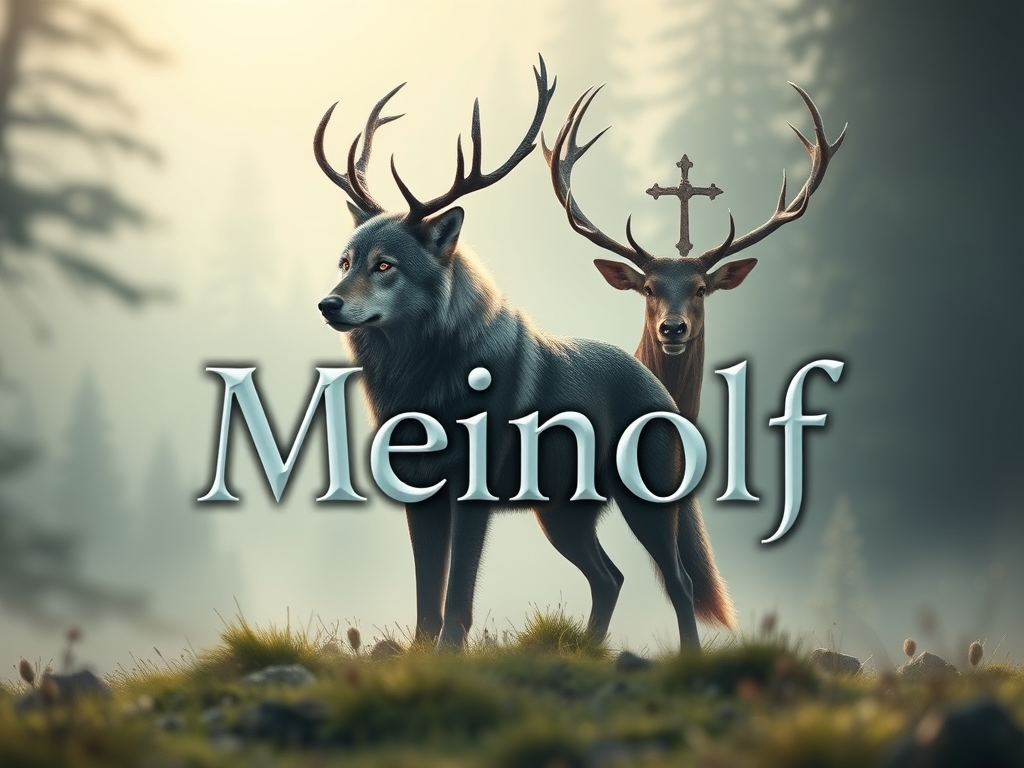
Meinolf

  • Origin: German
  • Meaning: “powerful wolf.”
  • Gender: Male
  • (MY-nulf)

The name is from the Old German, magin, magen (powerful) and wulf (wolf).

The name was borne by a 9th-century saint, a godson of Charlemagne, who according to legend found his monastery on the spot where he saw a stag appear with a cross between its antlers.

It is also a German surname, in which case, it is a patronymic derived from the given-name.

The designated name-day is October 5th.

Usage

The name is used in Dutch-speaking countries, German-speaking countries and Nordic countries, though nowadays, it is rather old fashioned.

German Diminutives

  • Meino

International Variations

  • Melf (Frisian)
  • Meinolph (German, alternate spelling)
  • Meinolphus (Latin)
  • Maganulf, Maginulf, Meginulf (Old German)
  • Magnulf (Old Norse)

Sources

Peik

lawson_peikGender: Masculine
Origin: Swedish/Finnish/Frisian
Meaning: debated
(PAKE) or (listen to the first syllable of peikko here http://www.forvo.com/word/peikko/)

The name is prevalent in Finland, particularly among Swedish speakers. It is believed to be either from the Finnish word poika meaning “boy” or the Finnish word peikko meaning “troll.” In Finnish-Swedish folklore, the name figures quite a bit among male characters. It also the name of the title character in the popular Norwegian childrens’ series by Barbra Ring, in which case, it is used as a diminutive form of the double name Pavel Benedict. It is coincidentally a Frisian diminutive form of Paul (Pay). Its designated name-day is October 8.

Bror

Bror_Gender: Masculine
Origin: Swedish/Norwegian
Meaning: “brother.”

The name, which in modern Swedish and Norwegian still means brother, is from an Old Nordic name, Bróðir meaning “brother.” It was originally bestowed on a second son. It was very common in the 19th-century, and is now considered rather dated in Scandinavia. There is a more unusual Latinized Danish form, Broderus. Its designated name-day is October 5. The name was borne by Bror von Blixen-Finecke (b.1886-1946) a key subject in the novel, (written by his wife Karen Von Blixen) Out of Africa. Other forms of the name include the Dutch Broder, German Bruder, the East Frisian Broer; the diminutive is Brörke (Credit goes to Capucine for suggesting the latter four variants).

Dúfa

Gender: Feminine
Origin: Old Norse/Icelandic
Meaning: “pitching one; pigeon; dove.”
(DOO-vah).

In old Norse the name means “pitching one.” It was the name of one of the nine daughters of the sea goddess Rán. In modern Icelandic, the name is interchangeable with the word for dove or pigeon. It is still a common female first name in Iceland.

Another offshoot of the original old Norse form is the Frisian Dufina (doo-FEE-nah) and the Dutch Dyveke.

Ysbran

Gender: Masculine
Origin: Frisian
Meaning: “ice sword”

The name is of Frisian origin and is derived from the ancient Germanic elements is meaning “ice” and brand meaning “sword”, hence: “ice sword.”

Aother name with the same elements is Isbert (bright ice; as bright as ice); and a variation of Ysbran is Ysbrand.