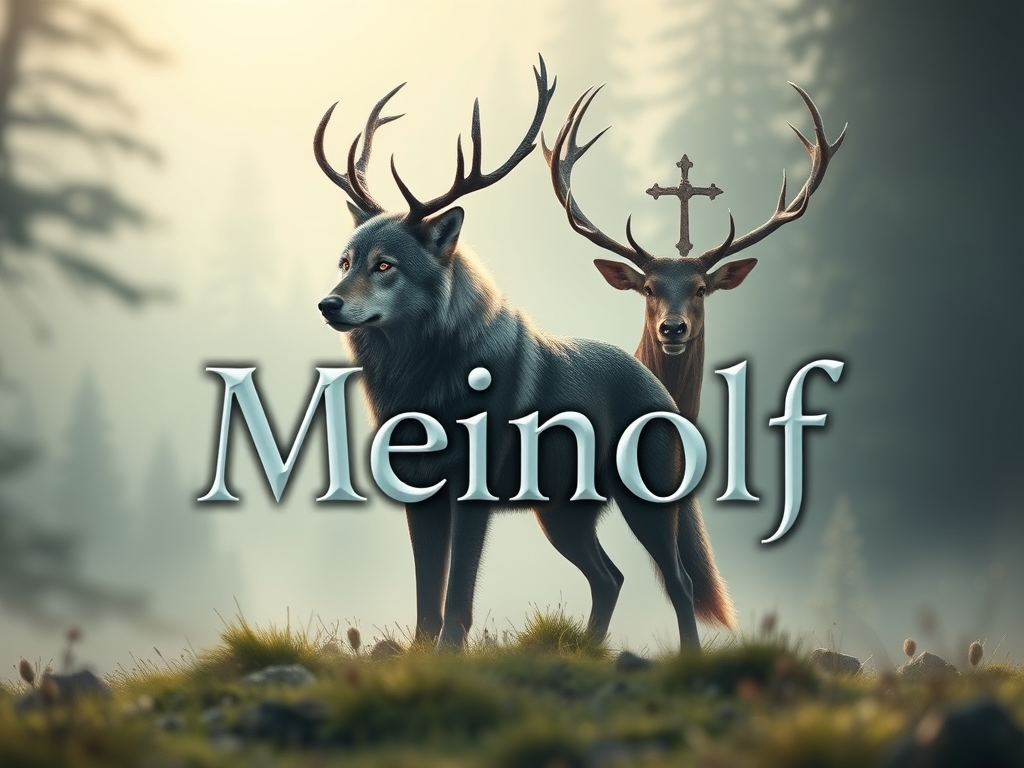
Meinolf

  • Origin: German
  • Meaning: “powerful wolf.”
  • Gender: Male
  • (MY-nulf)

The name is from the Old German, magin, magen (powerful) and wulf (wolf).

The name was borne by a 9th-century saint, a godson of Charlemagne, who according to legend found his monastery on the spot where he saw a stag appear with a cross between its antlers.

It is also a German surname, in which case, it is a patronymic derived from the given-name.

The designated name-day is October 5th.

Usage

The name is used in Dutch-speaking countries, German-speaking countries and Nordic countries, though nowadays, it is rather old fashioned.

German Diminutives

  • Meino

International Variations

  • Melf (Frisian)
  • Meinolph (German, alternate spelling)
  • Meinolphus (Latin)
  • Maganulf, Maginulf, Meginulf (Old German)
  • Magnulf (Old Norse)

Sources

Farkas

Gender: Masculine
Origin: Hungarian
Meaning: “wolf.”
FUR-kush

The name comes directly from the Hungarian word for wolf, it also appears as surname. The name is considered a cognate of the German Wolfgang. Its designated name-day is October 31. The name was borne by Farkas Bolyai (1775-1856) a Hungarian mathematician.

Brynolf

  • Gender: Masculine
  • Origin: Old Norse
  • Meaning: “armour wolf.”
  • (BRIN-nulf)

The name is composed of the Old Norse elements brynjir meaning “armour” and ulf meaning “wolf.” The designated name day is August 16 and it was borne by Swedish track and field athlete, Brynolf Larsson (1885-1973). The name might be an appealing, formal option for the trendy and unisexual nickname name Brynn/Bryn.

Loup, Lope, Lupe, Lupita

Gender: Masculine
Origin: Latin
Meaning: “wolf.”
(LOO)

Loup is an unusual yet legitimate French name, which comes directly from the French word for wolf. It ultimately derives from the Latin, Lupus. It was the name of an early French saint, a bishop of Troyes, who spared his city from marauding Huns.

The name was also borne by 3 Dukes of Gascony.

Currently, Loup is the 353rd Most Popular Male Name in France (2018).

Lupus was used as the pen-name for the 10th-century Anglo-Saxon Bisoph of York, Wulfstan I.

In Spanish, it is Lope, the progenitor of the common surname, Lopez, Lopes. It is believed that Lope was a Medieval Spanish calque of the Basque Medieval Male Name, Otxoa, which is from otso (bear). A notable bearer was the 17th-century Spanish Baroque, Lope de Vega.

Other male forms include:

  • Wulf (Anglo-Saxon)
  • Llope (Asturian)
  • Ochoa/Otsoa/Otxoa (Basque)
  • Llop (Catalan)
  • Wolf (English/German)
  • Lop (Gascon)
  • Farkas (Hungarian)
  • Lupo (Italian/Neopolitan/Spanish)
  • Lupicino (Italian)
  • Lobo (Ladino)
  • Lope (Medieval Spanish)
  • Úlfr (Old Norse)
  • Łup (Polish, obscure)
  • Ulf (Scandinavian)
  • Vuk (Serbo-Croatian)
  • Leu (Welsh)
  • Velvel (Yiddish)

Though it has an identical etymology, its Latin-American unisex form of Lupe is most likely a contraction of Guadalupe, which is a place-name (water wolf), used in honour of Our Lady of Guadalupe.

It’s offshoot of Lupita has become a well-established independent given-name. A notable bearer is Lupita Nyong’o.

Other feminine forms include:

  • Wulfa (Anglo-Saxon)
  • Lupa (Asturian/Italian/Spanish)
  • Wolfa (German)
  • Loba (Ladino)
  • Velvela (Yiddish)
  • Ylva (Scandinvian)

The name day in France is July 30.

Sources

Fáilbhe

Gender: Masculine
Origin: Gaelic
Meaning: “wolf slayer; spritely.”
Ir/Scotch (FAWLV-yeh); Eng (FAL-vee).

The name is sometimes anglicized as Falvy. The name was borne by an early Scottish saint, Saint Failbhe the Little. He was the abbot of Iona and died around 754 C.E. The designated name day is July 11.