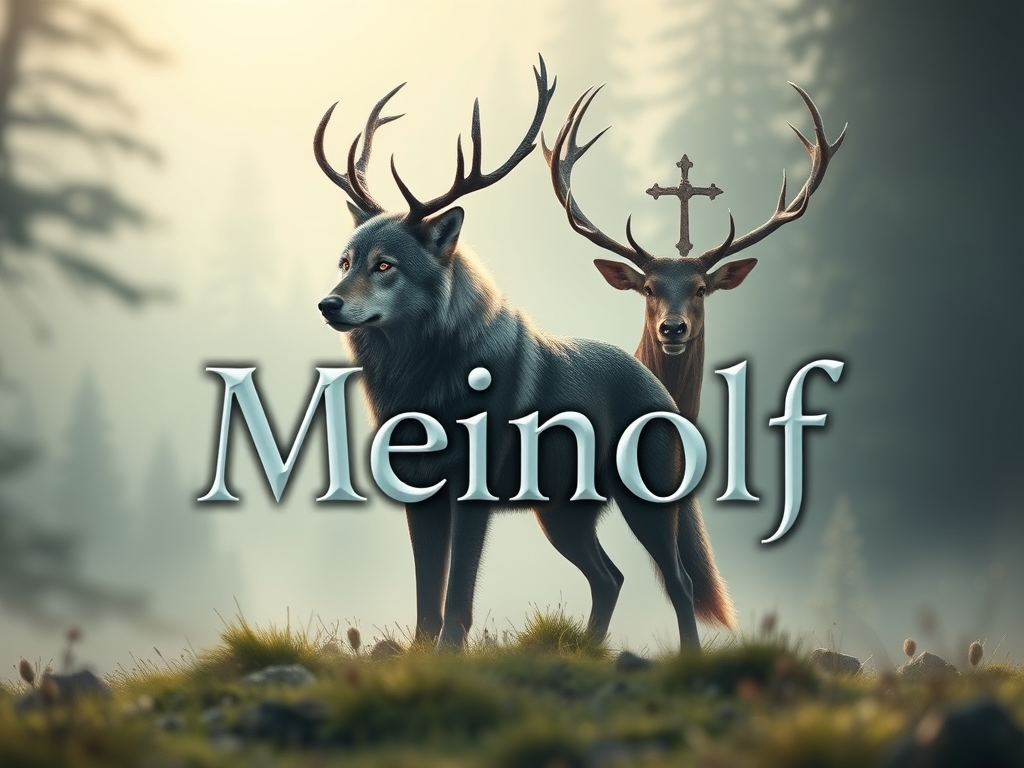
Meinolf

  • Origin: German
  • Meaning: “powerful wolf.”
  • Gender: Male
  • (MY-nulf)

The name is from the Old German, magin, magen (powerful) and wulf (wolf).

The name was borne by a 9th-century saint, a godson of Charlemagne, who according to legend found his monastery on the spot where he saw a stag appear with a cross between its antlers.

It is also a German surname, in which case, it is a patronymic derived from the given-name.

The designated name-day is October 5th.

Usage

The name is used in Dutch-speaking countries, German-speaking countries and Nordic countries, though nowadays, it is rather old fashioned.

German Diminutives

  • Meino

International Variations

  • Melf (Frisian)
  • Meinolph (German, alternate spelling)
  • Meinolphus (Latin)
  • Maganulf, Maginulf, Meginulf (Old German)
  • Magnulf (Old Norse)

Sources

Hansa

The name can have a few origins and meanings. It is primarily an Indian name that comes from the Sanskrit हंस (hamsa), which originally referred to an aquatic bird of passage. The hamsa is described as a mythical bird with knowledge in the Rig Veda and also as the main means of transport for the gods Brahma, Gayatri, Saraswati, and Vishvakarma in Hinduism. In the Ramayana, the hamsa was the bird that carried love letters between Damayanti and Nala. According to Indian legend, arayanna (heavenly hamsa swans) are said to live in the Himalayas where they eat pearls and are able to separate milk from water.

The hamsa bird is also associated with the concept of soham (that I am), as when it is said fast, hamsa starts to resemble soham. The latter is linked with the Brahman, and thus the bird is often associated with the cycle of samsara.

The hamsa bird has also been a popular motif in Indian art for centuries.

Over the centuries, it has interchangeably been translated as a swan, flamingo, goose or duck. It is ultimately from the Proto-Indo-European root word *ǵʰh₂éns, which is also the progenitor of the English word goose, German gans (goose), and the Latin anser (goose).

In India, as a given-name, it is used among all languages groups. The name is primarily used on females but has occasionally been given to males.

The name is also German and Scandinavian female name, being a contracted form of Johanna. Other forms are Hansina and Hansine.

Sources