
- Origin: Shona
- Meaning: “to be thankful.”
- Gender: Unisex
- TEN-dye
From the Shona word tenda or kutenda (to give thanks), it is technically unisex but slightly more common for boys.
Sources
From the Shona word tenda or kutenda (to give thanks), it is technically unisex but slightly more common for boys.
Sources

The name comes from the Tswana word for gratitude.
Sources

A popular Old Germanic name element, derived from the Old High German “thanc,” meaning “to thank.” Some early records list Thance as a male name, more likely pronounced the German way, it may make a unique alternative to Vance when pronounced the English way.
The name later evolved into Tanco, Tanko, Danco and Danko.
Female forms include: Tenca and Thenca.
Source

The name is from the Igbo meaning “thanks; gratitude.”
Sources

The name Prosper comes from the Latin Prosperus, meaning “fortunate,” “successful,” or “prosperous.” It is derived from the Latin verb prōspere, “to cause to thrive, to be favorable,” ultimately from pro- (“forward”) and spēs (“hope”).
Saint Prosper of Aquitaine (c. 390–455) was a Christian writer and theologian who defended the doctrines of Saint Augustine. His influence made Prosper a well-established saint’s name in medieval France, especially in Aquitaine and Provence.
In France, the name was relatively common at the turn of the 20th-century, ranking in at #96 in 1902. In the USA, it never ranked as high but did make it to the Top 1000, peaking at # 886 in 1881.
Several other early Christian saints and bishops also bore the name.
The most famous literary bearer is Prospero, the magician-duke in William Shakespeare’s The Tempest (1611).
The Puritans occasionally used Prosper as well.
The designated name-days include: June 25th (Denmark & France), September 2nd (Croatia), June 23rd (Poland).
International Variations
Female Forms
Diminutives
Sources

The name comes directly from the Sanskrit word for faith, belief, devotion or trust. It is ultimately from the Indo-European root *ḱred-dʰeh₁ (to believe; to put one’s heart into another). It shares the same root as the word creed and the Latin credo.
In Hinduisim, shraddha is a funerary ritual that is used to honour one’s deceaded forbears, especially deceased parents.
A notable bearer is Indian actress and singer, Shraddha Kapoor (b. 1989). Other notable bearers include the Indian actresses, Shraddha Arya (b. 1987); Shraddha Sinath (b. 1990) and Shraddha Das (b. 1987)
Sources

The name is from the Arabic word meaning “innocent; sinless.” It was the sobriquet of a Shia Muslim saint by the name of Fatimah bint Musa, known as Fatimah al-Masumah (circ. 7th-century CE). She was the daughter of the seventh Twelver Shi’a Imam, Musa al-Kadhim and the sister of the eight Twelver Shia Imam, Ali al-Rida. Her shrine, which is located in Qom, Iran, is an important point of pilgrimage for many Shi’a Muslims.
The name was also borne by Masuma Sultan Begun (d. 1509), the Queen Consort of the Ferghana Valley & Samarkand & the fourth wife of Emperor Babur, founder of the Mughul Dynasty.
A variant transliteration is Massouma.
Other forms of the name include:
Sources
 Gender: Feminine
Origin: Biblical Hebrew
Meaning: “grace.”
(ANN; AHN). (ANN-uh; AHN-nah). (HANN-uh; HAHN-nah)
Anne is possibly one of the quintessential classic English and French female names. Prior to the 18th-century, it seems that every other girl born in England was either named Anne, Jane or Mary. There were several British and French queens who bore this simplistic moniker, including the ill fated Anne Boleyn, the mother of Elizabeth I. The history of Anne is rather long and complicated.
It was foremost popularized through the cult of St. Anne, a legendary figure who was said to be the mother of the Virgin Mary and the grandmother of Christ.
In Brittany, the name became especially popular because it happened to coincide with the name of an ancient Celtic goddess, her cult being replaced by St. Anne’s. In fact, it was borne by one Breton Princess, Anne of Brittany.
The name was introduced into Britain by the French-Normans after the invasion in 1066. Previously, there had been a minor Saxon king named Anna, but in this case the name is related to the Saxon arn (eagle). Anna and Anne are still occasionally used as male given names in Friesland.
Other than the apocryphal saint, the name Anne can be traced directly back to the Bible. In the New Testament, it is the name of a prophetess who predicts the Crucifixion of Christ.
Anna (Αννα), is the Greek translation of the early Hebrew Channah חַנָּה, usually transliterated as Hannah, meaning “grace.”
Hannah is borne in the Old Testament by the faithful mother of the prophet, Samuel.
Hannah has always been popular among Jewish families, but was virtually unheard of among non-Jews before the Reformation, except in some cases where it may have been used as a diminutive form of Johanna, spelled Hanna.
It was the Byzantines who had introduced the Anna form to the world, making it popular throughout Eastern and Southern Europe. It was a very popular name among the Byzantine royal family and it was borne by the majestic Anna of Byzantium.
Anna may be the more melodic form of the bunch, but Anne’s minimalistic qualities are charming. Short, to the point, no frills. It’s not a bad name, though it does lack some spice, which is why parents are probably more attracted to its more exotic alternatives. In fact, Anne only comes in at # 608 in the top 1000 female names of the United States. It is safe to say, however, that she is very much loved in the middle name spot.
Anna is currently one of the most popular female names in Europe and abroad. Her rankings are as follows:
Of course, how could we ever forget the popular diminutive forms of Annie and Nan.
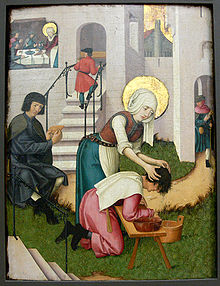 The name is possibly derived from the Latin, verus, meaning “true.” Others have suggested that the name may actually be of some unknown Egyptian source.
The name was borne by a 3rd-century Egyptian saint who found her way to Switzerland while marching along with the Theban legions. She is considered the patron saint of hairdressers as she was known for converting young native Swiss women to Christianity while washing and styling their hair. There is a shrine dedicated to St. Verena in Zurich, Switzerland.
The name has been popular in Germany and Switzerland and has even experienced some usage in the United States during the 18th and 19th-centuries, no doubt, brought over by German immigrants. It is also an especially common name among Mennonite, Hutterite and Amish families and is a popular name among Egyptian Christians.
It is also the name of a fictional goddess in the popular fantasy/video game series Warhammer. She is the goddess of healing and learning and is based on both Minerva and Athena.
Currently, Verena is the 383rd most popular female name in Germany, (2011).
Other forms of the name include:
Origin: Lithuanian
Meaning: “patient hope.”
(kahnt-VIHL-as; kahnt-VIL-ay)
The names are composed of the Lithuanian elements -kant (kantus, kantrus) meaning “patient” and vil-(viltis) meaning “hope.” Kantvilas is masculine and Kantvilė feminine. Their designated name-day is December 28.