Remedios, Remei, Remedy

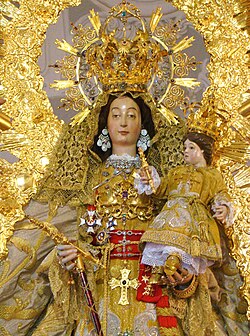
Our Lady of Remedies

Remedios is a Spanish given name—technically unisex but used almost exclusively for girls—meaning “remedies” or “cures.” It derives from a Marian title, Nuestra Señora de los Remedios (“Our Lady of Remedies”).

The devotion to Our Lady of Remedies originated with the Trinitarian Order in the late 12th century, and it spread widely in Spain after the Reconquista. By the time of the Spanish explorations of the Americas, the Virgin under this title had become a favored patron of soldiers and conquistadores.

It is the name of a character in Gabriel Garcia Marquez’s 1967 novel, One Hundred Years of Solitude.

It is borne by Spanish Flamenco singer, Remedios Amaya (b. 1962) and Spanish painter, Remedios Varo (1908-1963).

Its also the name of several places in Latin America.

Its Catalan form is Remei and Remédios its Portuguese form.

Remedy is a potential English form but has only been in use as a given name since the 20th-century.

Common Spanish diminutives include: Remi, Remita, Medi, Medis, Mecha, Chío, and Chita.

Sources

Arantzazu, Arantza, Arancha

  • Origin: Basque
  • Gender: Female

The name comes from the Sanctuary of Arantzazu located in Oñati, Spain. According to legend, the Virgin Mary appeared to Rodrigo de Balanzategui in 1468, to which he exclaimed “Arantzan zu?!” (thou, amongst the thorns?!). It ultimately comes from the Basque meaning, “place of hawthorns.”

Our Lady of Aránzazu is the patron saint of Guipúzcoa.

Aránzazu is it’s Galician and Spanish rendition.

Arantza is a diminutive used as an independent name and may also just be used in reference to the Basque word for a hawthorn.

Arancha is its Spanish form and Aranza is its Galician form.

Arantza’s designated name-day in Spain is September 9th.

Sources

Indalecio

Indalo Symbol of Almeria, Spain
  • Origin: unknown
  • Meaning: unknown
  • Gender: masculine

The name is of debated origin and meaning. It is argued to be derived from an unknown Iberic phrase indal eccius meaning, “messenger of the Gods,” though this etymology seems dubious. It has also been linked with the Basque element, inda meaning “strength.” It has been associated with the neolithic Indalo symbol found in Almería, Spain, now used as a good luck symbol and a popular motif found throughout the town. It was born by St. Indalacio of Almería of the 1st-century C.E. who was said to have evangelized the town of Almería and thus became its first bishop. He was later martyred by the pre-Christian Iberians.

The name is rare but does continue to experience usage in Almería and to a lesser extent, the rest of the Spanish-speaking world, a notable bearer was the Spanish politician, Indalacio Prieto (1833-1962).

In Spain, the designated name day is May 15th.

A common short form is Idalo.

Other forms include:

  • Indalecio (Aragonese, Galician, Italian, Spanish)
  • Indaleki (Basque)
  • Indaleci (Catalan)
  • Indalezio (Italian)
  • Indalizio (Italian)
  • Indaletius (Late Latin)
  • Indalécio (Portuguese)

A feminine form is Indalecia.

Sources

Jediael, Jadiel

Photo by Kaushal Moradiya on Pexels.com
  • Origin: Hebrew ידיעאל
  • Meaning: “to be known by God.”
  • Gender: Masculine
  • Pronunciation: Eng (jeh-DIAL); Port (ZHAH-dee-EL); Sp (YAH-dee-EL)

The name is composed of the Hebrew words ידע (yada’) meaning, “to know,” and אל (‘el) meaning “God.”

It is borne by three minor characters in the Old Testament, mentioned in 1 Chronicles 7:6, 1 Chronicles 11:45 and 1 Chronicles 26:2.

In recent years, its Spanish and Portuguese offshoot of Jadiel and Yadiel have been popular in Latin America. It may have been popularized by Puerto Rican reggaeton singer, Jadiel (born Ramón Alberto González Adams, 1985-2014).

Jadiel has appeared in the Brazilian Top 1000 names between 1980-2000. Jadiel has been in the U.S. Top 1000 since 2008 and currently ranks in at #878 in 2022. Yadiel appeared in the U.S. Top 1000 between 2008-2021, peaking at #850 in 2009.

Other forms include:

  • Jadiel (Brazilian Portuguese, Spanish)
  • Yadiel (Brazilian Portuguese, Spanish)
  • Yadiele (Brazilian Portuguese)

Sources

Álvaro, Alvaro

Photo by Maria Pop on Pexels.com
  • Origin: Germanic
  • Meaning: debated
  • Gender: masculine

The name is of unknown origin or meaning, the consensus is that it is Germanic but which Germanic language it originates from is up for debate. Since it first occurred in Spain, the most likely is that it is of Gothic origins, possibly composed of the Germanic elements *allaz “all, whole, every”‘ and wart “‘guard, ward.” The second element may also stem from wars (cautious, guarded). Others have related it to the Old Norse, Hallvadr (hall-guard) or Alfarr (elf-warrior), but this is less likely.

The name has been in use in the Iberian peninsula since Medieval times, it was borne by Álvar Fáñez (12th-century), a vassal of El Cid and the subject of the Spanish epic poem, El Cantar de mio Cid.

It is the progenitor of the Spanish surname, Alvarez/Álvarez and the Portuguese, Alves.

Álvaro is the 10th most popular male name in Spain as of 2022. His rankings in other countries/regions are as follows:

  • #22 (Galicia, Spain)
  • #69 (Catalonia, Spain)
  • #97 (Chile, 2021)
  • #99 (Basque Country, Spain)
  • #188 (Mexico, 2021)
  • #794 (United States)

Usage/Forms

  • Àlvar (Catalan)
  • Álvaro (Portuguese, Spanish)
  • Álvaro (Galician)
  • Alvar (German, Scandinavian)
  • Alvaro (Italian)
  • Alvarus (Latin)
  • Alwar (Polish)

Feminine forms include, Álvara (Portuguese, Spanish), Alvara (Italian, Scandinavian).

Sources

Darwin

Photo by Pixabay on Pexels.com
  • Origin: Anglo-Saxon or Frankish
  • Meaning: “dear friend; or “spear friend.”
  • Gender: masculine
  • Historical Use: England, Medieval France (see French forms)
  • Modern Usage: English-speaking countries, Spanish-Speaking Countries, Brazil, Philippines

Contrary to popular belief, this is not from a surname, rather, the surname is from the first name. It is a Germanic dithematic name, derived from the Anglo-Saxon Deorwine, composed of the elements deór (wild animal, beast, deer) and wine (friend). Deór had a connotation of brave, compare the modern English words of deer and dire, both of which derive from the same element. It may also derive from the Frankish elements, daroth (spear, lance, javelin) and wini (friend). It was in use in both Medieval France and Anglo-Saxon England. The surname is actually from a patronymic, denoting someone who had a father named Darwin.

A notable bearer is Charles Darwin, English naturalist and writer, best known as the originator of the theory of biological evolution by natural selection (1809-1882). It is also the name of a city in Australia, which is the capital of the Northern Territory.

Darwin has been in and out of the U.S. Top 1000 Most Popular Male Names since 1881, it peaked at #297 in 1983. As of 2022, it was the 986th most popular male name.

Modern feminine forms include Darva and Darwina.

Darwin and Darvin has also experienced recent popular usage in Latin America.

Other forms include

  • Deorwine (Anglo-Saxon)
  • Daroinus (Late Latin)
  • Daroin (Medieval French)
  • Darwin (Modern English)
  • Darvin (Modern English)
  • Dárvin (Modern Spanish)

Sources

Faolán, Phelan, Fillin

  • Origin: Gaelic
  • Meaning: “little wolf.”
  • Gender: masculine
  • Gaelic (FWAY-lahn); Eng (FAY-len; FIL-lin)

The name is derived from the Gaelic, faol, meaning “wolf” and the diminutive suffix –án. It is borne by 3 Medieval Saints from Ireland, 2 who settled in Scotland and another that did missionary work in Frankish Brabant.

There is a Cathedral dedicated to St. Foillan of Brabant in Aachen, Germany.

It is the ancestor of several Irish and Scottish surnames, such as Fylan, Hyland, MacClellan, MacClelland, Mac Giolla Fhaoláin, McClellan, McClelland, Ó Faoláin, Phelan, Whalen & Whelan.

Fillan is also the name of a place in Norway, but the name is probably of a separate etymology.

Other forms include:

  • Foillan (Dutch, French, German)
  • Phillan (English)
  • Feuillien (French)
  • Folien (French)
  • Foilan (French)
  • Pholien (French)
  • Foillano (Italian)
  • Fillano (Italian)
  • Foilanus/Foillanus (Late Latin)
  • Fáelán (Old Irish)
  • Felano (Spanish)

Sources

Santos

Photo by Thgusstavo Santana on Pexels.com
  • Origin: Galician Spanish, Portuguese
  • Meaning: “saints.”
  • Gender: unisex
  • Pronunciation: SAHN-tose (Sp)

The name comes directly from the Iberian word for “saints,” since Medieval times, it was originally bestowed on children born on November 1st, the Feast of All Saints, it’s French equivalent being Toussaint. For females, the name was often used in conjunction with Maria, i.e. Maria de los Santos.

While its singular form of Santo is also used, I felt Santos deserved it’s own entry since it’s usage is specific to a Catholic Holiday.

For males, Santos has been in the U.S. Top 1000 Male Names since 1920, peaking at #539 in 1937, in 2019, he ranked in as the 966th most popular male name in the United States.

In the U.S, its use on females peaked in the 1920s, appearing in the U.S. Top 1000 Female Names between 1920-1929, peaking at #742 in 1924.

The name was borne by Confederate Colonel, Santos Benavides (1823-1891) & Mexican artist, Santos Balmori Picazo (1899-1992).

Santos is also the name of a municipality in São Paulo, Brazil.

Sources

Jasleen

  • Origin: Punjabi
  • Gurmukhi Script: ਜਸ
  • Hindi Script: जसलीन
  • Meaning: “absorbed in fame.”
  • Gender: unisex, but more often used on females within Sikh diaspora in English-speaking countries
  • Pronunciation: JAZ-leen

The name is composed of the Punjabi elements, ਜੱਸ (jasa) meaning fame and the verb ਲੀਨ (lina) “to be absorsed.” It is a Sikh Name based on the Sikh scriptures Guru Granth Sahib.

All Sikh names are gender neutral, but in the Sikh Community outside India, the name is exclusively used on females due to its identical sound to other Western names such as Jazlene, which is exclusively feminine.

Other forms include Jazleen & Jesleen.

The Latin American, Jaslene, is a modern invention, popularized specifically in Puerto Rico by American supermodel, Jaslene Gonzalez (b.1985); this name has since spread in occasional use to other non Spanish-speaking communities outside Puerto Rico. Other popular spellings include Jazlene & Jazline & the offshoots of Jaslyn/Jazlyn/Jazlynn. It is possible that the name is a borrowing from the aforementioned Sikh name; but perhaps is based off of names such as Jasmine and Jolene.

Jazlyn is currently the 504th most popular female name in the United States.

Jazlene & Jaslene appeared in the U.S. Top 1000 between 2008-2010.

Sources

Élodie

Gender: Feminine
Origin: Germanic
Meaning: debated
Fre (ay-lo-DEE); Eng (EL-o-DEE)

The name is of debated origin and meaning but is possibly derived from the Germanic elements ala meaning “other; foreign” and od meaning “riches, wealth.” Other sources list it as a derivative of the Franconian al-ôd meaning “inheritance, estate; property.”

It was also the name of an ancient Nubian kingdom and one of the first kingdoms to become Christian and is the name of a species of aquatic plant, also spelled Elodea.

The name was popularized by a 9th-century Spanish saint who was martyred with her sister Nunilona. In the 1980s, Élodie was very popular in France. In 2000, she ranked as high as # 39, now she only ranks in as the 215th most popular female name in France, (2010). But, she may sound fresh and appealing to anglophone parents; if you are curious as to how to best pronounce this in English, think Melody sans M.

Elodie has had some history of usage in the United States, though very sparse. She appears in the census records as early as the 18th-century; most Elodies seems to have been located in Louisiana, (no surprise there). Other interesting variations which appear in the American census records include: Eloda, Eloida, Elodia, and Elodi.

She appears in the U.S. top 1000 3 times, once in 1881, 1883 and then again in 1886. She has not been seen since.

Other forms of the name include:

  • Elodi (Basque)
  • Alòdia (Catalan)
  • Elodia (Corsican/Spanish)
  • Elodie (English)
  • Eloida (English)
  • Lodi (French: diminutive form)
  • Alodia (Italian/Polish/Spanish)
  • Aloida (Latvian)
  • Alodija/Aliodija (Lithuanian)
  • Alódia (Portuguese)

The name was borne by Elodie Lawton Mijatović (1825-1908) a British-Serbian author known for her books on Serbian history and culture as well as her prolific works translating books from Serbian-English and English-Serbian.  It is also borne by French actress Élodie Bouchez-Bangalter (b.1973), French singer Élodie Frégé (b.1982) and French-Canadian radio personality Élodie (Didi) Gagnon

Masculine forms include Alodius and Alodiusz (Polish).