Sterpeta

  • Origin: Italian
  • Meaning: “brushwood; bramble; thicket.”
  • Gender: Female
  • stehr-PEY-tah

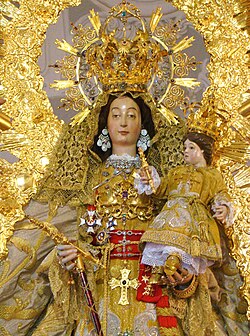
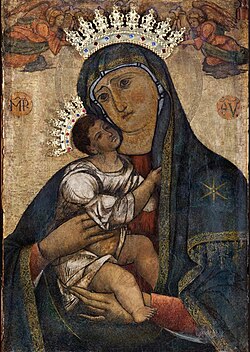
A rare vintage name from Southern Italy, Sterpeta is associated with the Virgin Mary, deriving from Madonna della Sterpeto – the name of a Marian shrine located near Barletta, in the province of Apulia (Puglia). The title Sterpeto itself comes from the Italian sterpeto, meaning “thicket,” “bramble,” or “brushwood,” referring to the rural area where the miraculous image was discovered.

According to local tradition, during a devastating plague in 16th-century Barletta, a perfectly preserved medieval icon of the Virgin Mary was found hidden in the cellar of an abandoned monastery. The townspeople carried the image in procession, and as soon as it was revealed, the plague ceased and the people were healed. In gratitude, the sanctuary of Madonna dello Sterpeto was built on the site, and devotion to the image spread throughout the region. Her feast-day is May 8th.

The personal name Sterpeta emerged as a devotional given name in honor of la Madonna dello Sterpeto, but its usage remained largely confined to Barletta, Foggia, and Bari in Puglia. The name gradually fell out of use in the 20th century and was last recorded in Italy in 2006.

With its strong regional flavor and deep Marian symbolism, Sterpeta is a distinctive relic of Southern Italian faith and folklore. It is a name that bridges miracle, memory, and devotion, and its meaning also links it to fall or autumnal themes.

Sources

Panagiotis, Panagiota

  • Origin: Greek
  • Meaning: “all-holy.”
  • Variants: Panayiotis; Panayiota
  • Grk (PAH-nah-YOH-tis; PAH-nah-YOH-tah)

Panagiotis is masculine and derived from the Greek, panagia Παναγία (all-holy), a title used in reference to the Virgin Mary in the Greek Orthodox Church.

Its feminine form is Panagiota.

It’s name-day on August 15th, the Assumption of the Virgin Mary.

In the English-speaking world, many Greek immigrants anglicized Panagiotis to Peter even though the two names are not related.

Male Diminutives

  • Panagis/Panayis (Παναγής)
  • Panos (Πάνος)
  • Panikos (Πανίκος)
  • Pit (Πιτ)
  • Notis (Νότης)
  • Takis (Τάκης)

Female diminutives are: Giota, Yiota (Γιώτα), and Nota (Νότα).

Sources

Remedios, Remei, Remedy

Our Lady of Remedies

Remedios is a Spanish given name—technically unisex but used almost exclusively for girls—meaning “remedies” or “cures.” It derives from a Marian title, Nuestra Señora de los Remedios (“Our Lady of Remedies”).

The devotion to Our Lady of Remedies originated with the Trinitarian Order in the late 12th century, and it spread widely in Spain after the Reconquista. By the time of the Spanish explorations of the Americas, the Virgin under this title had become a favored patron of soldiers and conquistadores.

It is the name of a character in Gabriel Garcia Marquez’s 1967 novel, One Hundred Years of Solitude.

It is borne by Spanish Flamenco singer, Remedios Amaya (b. 1962) and Spanish painter, Remedios Varo (1908-1963).

Its also the name of several places in Latin America.

Its Catalan form is Remei and Remédios its Portuguese form.

Remedy is a potential English form but has only been in use as a given name since the 20th-century.

Common Spanish diminutives include: Remi, Remita, Medi, Medis, Mecha, Chío, and Chita.

Sources

Arantzazu, Arantza, Arancha

  • Origin: Basque
  • Gender: Female

The name comes from the Sanctuary of Arantzazu located in Oñati, Spain. According to legend, the Virgin Mary appeared to Rodrigo de Balanzategui in 1468, to which he exclaimed “Arantzan zu?!” (thou, amongst the thorns?!). It ultimately comes from the Basque meaning, “place of hawthorns.”

Our Lady of Aránzazu is the patron saint of Guipúzcoa.

Aránzazu is it’s Galician and Spanish rendition.

Arantza is a diminutive used as an independent name and may also just be used in reference to the Basque word for a hawthorn.

Arancha is its Spanish form and Aranza is its Galician form.

Arantza’s designated name-day in Spain is September 9th.

Sources