A poetic rarity, it is from the ancient Greek λαλαγέω (lalageo) meaning “to babble; to prattle.”
The most famous bearer of the name appears in Horace’s Odes (Book I, 22), in which it is the name of the poet’s idealized beloved.
Edgar Allan Poe later used Lalage as a tragic heroine in his 1835 play Politian, reinforcing its Romantic aura.
The name experienced some usage in the 19th-century throughout the English-speaking world. A notable bearer is British educator and feminist, Lalage Brown (b. 1927).
A 19th-century gem and late 20th-century vampiric monikor, the name is of uncertain meaning but has its origins in Medieval Spain. It is likely of Visigothic origins, possibly derived from Gailawera or Geloyra, which stem from gails (happy) or (spear); and wers (friendly, agreeable, true).
It should be noted that Elvira (Latin: Iliberri or Iliberis) was an ancient Iberian and later Roman city located near present-day Granada, in Andalusia, southern Spain. However, in this case, it is likely derived from an Iberian source, meaning “new town.”
It was a popular female name among the royal family of Castille & León, producing two queens who bore this name, Elvira of Castile, Queen of León (965–1017) and Elvira of Castile, Queen of Sicily (c. 1100–1135).
It was later used in Mozart’s 1787 opera Don Giovanni (libretto by Lorenzo Da Ponte), in which Donna Elvira is one of Don Giovanni’s former lovers. This likely popularized the name outside of the Iberian peninsula.
By the turn of the 20th-century, Elvira was not unknown in the United States, though never overly popular, it peaked at #254 in 1914, but fell out the Top 1000 by 1981, the same year Elvira, Mistress of the Dark came on the scene.
The real Halloween link began in 1981, when actress Cassandra Peterson created the camp-horror TV hostess Elvira, Mistress of the Dark for a Los Angeles late-night show (Movie Macabre).
Dressed in a plunging black gown with a beehive of jet hair, Elvira presented old horror movies with sardonic humor — blending Gothic sex appeal, irony, and B-movie kitsch.
The character became a pop-culture icon: Halloween TV specials, films, pinball machines, comic books, and even perfume lines immortalized her as the Queen of Halloween.
Outside the United States, this name does not have such associations. In Sweden, it has been among the top 100 girls’ since 1998 and peaked at #25 in 2014. As of 2024, it came in at #40.
It’s a popular name in the Balkans, even spinning off a male form of Elvir (Bosnian and Albanian).
Other forms include:
Elbire (Basque)
Elvíra (Czech/Slovakian)
Elviira (Estonian, Finnish)
Elvire (French)
Elwira (Polish, also an alternate Swedish spelling, Sorbian)
Elvīra (Latvian)
Elvyra (Lithuanian)
Obscure Lithuanian male forms are the Lithuanian, Elvyras; the Polish, Elwir(o), and the Italian Elviro.
Name days: August 25 (Austria), July 16 (Croatia), February 10 (Hungary), January 25 (Spain), March 1 (Sweden), November 21 (Slovakia), August 13 (Latvia).
Sources
Withycombe, E. G. The Oxford Dictionary of English Christian Names. Oxford: Clarendon Press, 1950.
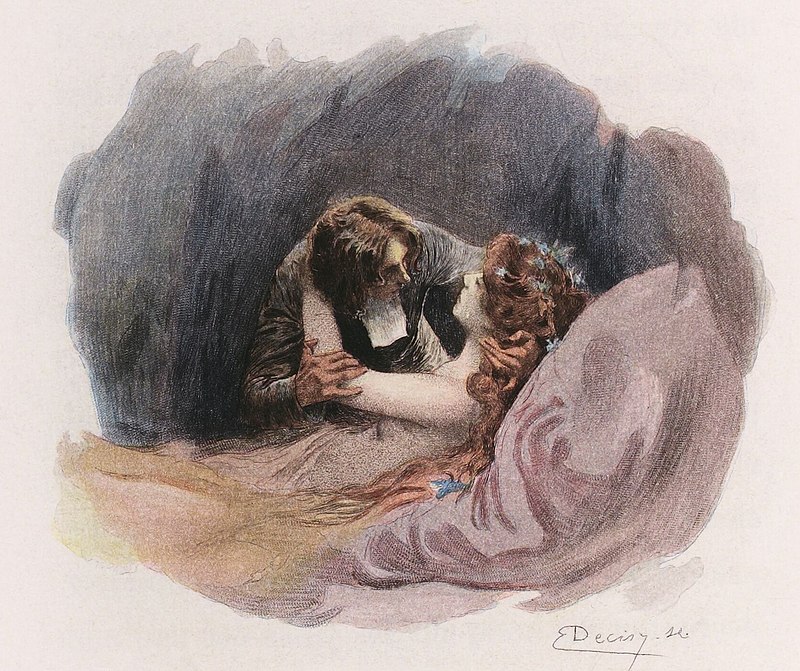
“Her head fell back, but she still wrapped her arms around me as if to hold me back.” Etching by Eugène Decisy [fr] after a watercolor by Paul Albert Laurens, 1904.
Origin: Occitanian
Meaning: uncertain
Gender: Female
Eng pron: (KLAIR-e-mund)
A Medieval Occitanian name first recorded in 12th-century French chivalric literature, Clarimond (also found as Clarimonde, Claramonde, or Claramunda) is either a diathemic compound of the Latin clārus (“bright, light, clear”) and the Old High German mund (“protection”), or derived from an Occitanian phrase meaning “bright world; clear world”
In the 12th-century chanson de geste, Huon de Bordeaux, the name appears in its earlier form as Esclarmonde borne by a Saracen princess who converts to Christianity and marries the hero Huon. Similar formations (Florimond, Rosamond, Alemond) were fashionable among the knightly and aristocratic classes of the High Middle Ages. The 1889 opera by Jules Massenet, Esclarmonde, is loosely based on the character from Huon de Bordeaux.
Historically, Esclarmonde and its variants were borne by at least four noblewomen of the House of Foix, the most famous being Esclarmonde de Foix (d. 1215), sister of Count Raymond-Roger de Foix, who was noted for her learning and association with the Cathar movement in southern France.
Though rare, Clarimond saw occasional use in 17th-century England, likely revived through renewed interest in medieval romance literature. Clarimonde was also occasionally found in 18th-19th-century Acadia, and was used by the closely related Cajuns in Louisiana.
In 1836, French writer Théophile Gautier reintroduced the name in his celebrated vampire novella La Morte Amoureuse (Clarimonde in French; The Beautiful Vampire in English). Gautier’s heroine—a sensual courtesan who blurs the line between life and death—cemented Clarimonde’s association with Gothic beauty, nocturnal allure, and eternal fascination, making it an especially fitting name for Halloween
Other forms include:
Esclarmonda (Catalan, Occitanian)
Clarimond (English)
Clarimonde (French)
Clarimunda (Late Latin, Spanish)
Esclarmonde (Old French)
Clarmonda (Occitanian)
Clarmontina (Occitanian)
Mondina (Occitanian)
Esclaramunda (Spanish)
Sources
Withycombe, E. G. The Oxford Dictionary of English Christian Names. Oxford: Clarendon Press, 1950.
The name is of unknown origin or meaning, the consensus is that it is Germanic but which Germanic language it originates from is up for debate. Since it first occurred in Spain, the most likely is that it is of Gothic origins, possibly composed of the Germanic elements *allaz “all, whole, every”‘ and wart “‘guard, ward.” The second element may also stem from wars (cautious, guarded). Others have related it to the Old Norse, Hallvadr (hall-guard) or Alfarr (elf-warrior), but this is less likely.
The name has been in use in the Iberian peninsula since Medieval times, it was borne by Álvar Fáñez (12th-century), a vassal of El Cid and the subject of the Spanish epic poem, El Cantar de mio Cid.
It is the progenitor of the Spanish surname, Alvarez/Álvarez and the Portuguese, Alves.
Álvaro is the 10th most popular male name in Spain as of 2022. His rankings in other countries/regions are as follows:
#22 (Galicia, Spain)
#69 (Catalonia, Spain)
#97 (Chile, 2021)
#99 (Basque Country, Spain)
#188 (Mexico, 2021)
#794 (United States)
Usage/Forms
Àlvar (Catalan)
Álvaro (Portuguese, Spanish)
Álvaro (Galician)
Alvar (German, Scandinavian)
Alvaro (Italian)
Alvarus (Latin)
Alwar (Polish)
Feminine forms include, Álvara (Portuguese, Spanish), Alvara (Italian, Scandinavian).
The name is composed of the Germanic elements al (all) and rikr (ruler). It was most notably borne by two Gothic kings, Alaric I and Alaric II. Alaric I was known for leading a rebellion against Rome and sacking it. His Gothic name was 𐌰𐌻𐌰𐍂𐌴𐌹𐌺𐍃 (Alareiks).
An historical curiosity, Alaric has never experienced much usage, however, it has been in the U.S. Top 1000 since 2017, and currently ranks in as 915th most popular male name.
Other forms include:
Alaric (Catalan, French, English, Occitanian)
Alarich (Czech, German, Slovak)
Alareiks (Gothic)
Alarico (Italian, Portuguese, Spanish)
Alaricus (Latin)
Alariks (Latvian)
Alarikas (Lithuanian)
Alaryk (Polish)
Alarih Аларих (Russian, Ukrainian)
Alarik (Scandivanian, Slovene)
Obscure feminine forms include Alarica, Alarika and Alarice.