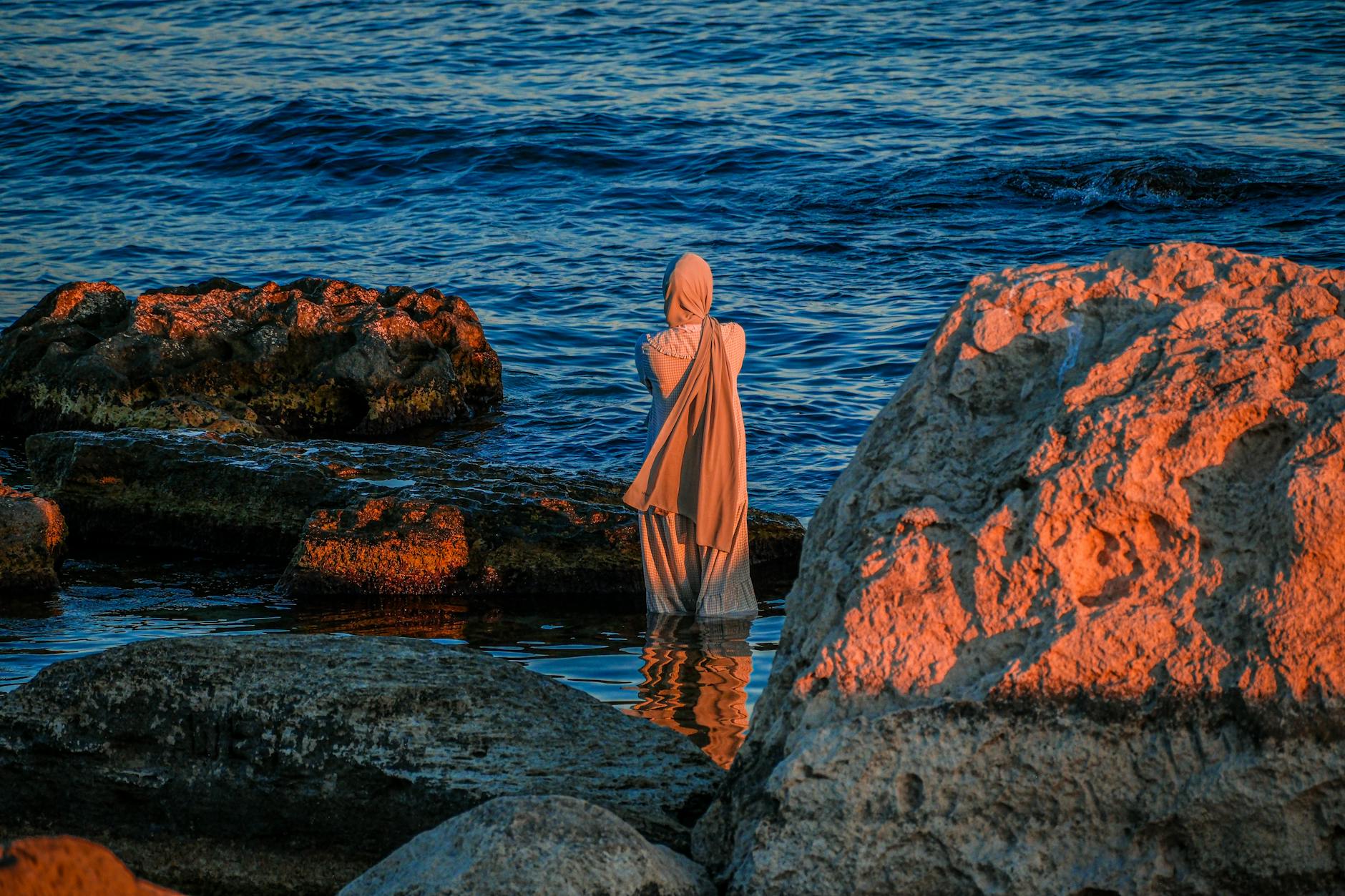
Ziri is an ancient masculine Berber name derived from the Tamazigt tziri, taziri, meaning, “moonlight.” Taziri or Thiziri (ⵜⵉⵣⵉⵔⵉ) is used as its female counterpart.
In history, Ziri was borne by Ziri ibn Manad, a 10th-century Berber king who founded the Zirid dynasty.
Naenia (nye-NEE-ah); More Common Nenia (nay-NEE-ah)
Naenia (also spelled Nenia) comes from the Latin word naenia, meaning “funeral song, dirge, lament.” In everyday Latin, naenia could simply mean a lullaby or simple song, but in a religious context it carried the specific sense of a funeral lament.
In Roman religion Naenia Dea was the personification—and later minor goddess—of funerary rites. She presided over the chants sung at funerals and was believed to ease the soul’s passage to the underworld. Varro (1st c. BCE) and later Christian authors such as Augustine mention her as a distinct deity. There was even a modest sacellum Naeniae (small shrine) outside the Porta Viminalis in Rome, emphasizing her association with burial grounds beyond the city walls.
From the Old Norse, Gandálfr, it’s a compound of gandr (“magic, charm, witchcraft; monster) supernatural being”) + álfr (“elf”).
Gandalf is listed in the Völuspá—one of the earliest poems of the Poetic Edda—as the name of a dwarf, not a wizard. Many dwarf-names in Tolkien’s The Hobbit and The Lord of the Rings come directly from this same list.
When creating the Grey Wizard of Middle-earth, Tolkien borrowed the ancient name wholesale, changing only the grammar from Old Norse Gandalfr to the more Anglicized Gandalf.
Cultural Impact: Since the publication of The Hobbit (1937) and The Lord of the Rings (1954–55), Gandalf has become one of the most recognized fantasy names worldwide.
Alua is a Kazakh feminine name derived from the Kazakh word алуа, which in turn comes from the Arabic halwā (حلوی) meaning “sweet, delicacy, confection.” In everyday Kazakh, alua refers to a type of soft, sweet candy or dessert, so the name carries the charming sense of “sweetness” or “beloved treat.”
There is a Lake Alua (Алуа)—a small endorheic salt lake in the Esil District, North Kazakhstan Region, about 8 km northwest of Yavlenka. Local lore tells of Zharylkamys and Alua, lovers whose clans opposed their union; the young man was killed near the lakeshore and Alua, in grief, took her own life. The lake is said to have been named for her; the tale is recorded in regional sources and reported via writer Sabit Mukano.
An ancient Irish Gaelic female name composed of the Gaelic elements, fionn (fair, white, bright), and sīabar (phantom; spectre; ghost). It is the Irish cognate of Gwynhyvar or Guinevere
In the Ulster Cycle of early Irish legend, Fionnabhair (often anglicised as Findabair or Finnabair) is the daughter of Queen Medb and King Ailill of Connacht. She plays a pivotal role in the epic Táin Bó Cúailnge (Cattle Raid of Cooley), where her beauty and political marriages are central to the plot.
Pronunciation
The two main Gaelic pronunciations depending on the dialect are fin-NOR and FINNA-vare.
Variations & International Variations
Fionnúiris another form. The name appears in early English translations as Findabair and Finnabair. Also, there is Fennor (rhyme with Lenore), the Latinate Finora, and Finvarra.
A Maori name drawn from the word reinga, meaning “the leaping-off place; the spirit world; the afterlife, in Maori tradition, the far-northern headland of Cape Reinga (Te Rerenga Wairua) is the sacred point where the spirits of the dead begin their journey back to the ancestral homeland of Hawaiki.
It is also the name of a species of spider endemic to New Zealand.
It is used as a unisex name.
A notable bearer is New Zealand netball coach, Reinga Bloxham Te Huia.