Eimyrja

  • Origin: Old Norse
  • Meaning: “embers.”
  • Gender: Female
  • Pron: (i-MEER-yah)

From the Old Norse word for “embers,” in Norse Mythology, this was the daughter of the jötunn known as Logi (fire), the latter who is considered the personification of fire, a long with his wife Glöð (glowing embers). He fathered another daughter Eisa (glowing ember), both of whom were said to be stunningly beautiful.

Its status as a given-name in most Scandinavian countries is a relic from the past but may appeal to parents drawn to authentic early Nordic names.

Sources

Eisa

  • Origin: Old Norse
  • Meaning: “glowing ember.”
  • Gender: Female
  • I-sah

The name comes directly from the Old Norse word meaning “glowing ember.” In Norse Mythology, this is the name of one of the beautiful daughters of Logi (fire), and Glöð (glowing embers).

Later, it came to be associated as a pet form of Elizabeth or a German form of Aise (short form of any Nordic name beginning in the Egg-, Agi– element.)

Note: the name can also be an Arabic form of Jesus.

Sources

Logi

  • Origin: Old Norse
  • Meaning: “flame; blaze.”
  • Gender: Male
  • LOH-gee

The name comes directly from the Old Norse word for “flame; blaze,” and is also used as a poetic word for a sword. It is born in Norse Mythology by Logi, a jötunn and the personification of fire. He was the son of Fornjótr. He is known for winning a meat eating competition against Loki.

A Swedish variation is Loge

It is a cooler and fresher alternative to Logan, with a spark.

Sources

Gǫndul, Göndul

  • Origin: Old Norse
  • Meaning: “magic, magic wand; magical animal werewolf.”
  • Gender: Female

The name is either derived from the Old Norse gandr (magic wand; magic staff), or the Old Norse gǫndul meaning, “magical animal; werewolf.”

In Norse Mythology, this is the name of one of the Valkyries. She appears in several early sources, including the Heimskringla, in which it is written:

“Gǫndul and Skögul sent out / to choose among kings.”
Their presence seals Hákon’s fate, and they greet him after death — both destroyers and honour-givers.”

In the Poetic Edda, specifically Hákonarmál, she is again one of the Valkyries who welcome Hákon to Valhalla, confirming her dual role as harbinger of death and divine escort.

In the Norse sagas and Skaldic poetry, gǫndul can also function as a kenning (poetic metaphor) for “valkyrie” or “battle-witch,” used interchangeably with other names like Skögul, Hildr, and Mist.

Its rarely used these days in Nordic countries, but whose to say it won’t become popular with the rise of other Norse myth names. However, in modern Icelandic, it may sound a touch to close to the Icelandic slang term, göndull (cock, dick, penis), which yes, shares the same etymology as the name, referring to a staff or a wand, but other Nordic languages wouldn’t have the same associations.

Sources

Freya

Gender: Feminine
Origin: Old Norse
Meaning “lady; mistress”
(FRAY-yah)

The name is derived from the proto-Germanic word, *frawjōn, which designates a woman of noble birth. The modern German word of Frau is a modern cognate. Many scholars argue whether Freya was originally the name of the goddess or a title used in reference to her; it has even been suggested that the goddess had an actual given that has been lost to history.

In Norse mythology, Freya was believed to be the most beautiful goddesses ever created. Scholars believe that Freya was essentially a fertility goddess who assisted in the growth of wildlife, agriculture and human reproduction; along with birth and life, she was also associated with death. In Norse legend, it was Freya who received half the slain warriors into her heavenly hall.

She is often times the subject of the poetic eddas along with her numerous epithets, which are as follows:

  • Vanadis (beautiful goddess)
  • Mardoll (sea bright)
  • Horn (flaxen)
  • Gefn (the giver)
  • Syr (sow) which illustrates Freya’s association with pigs and fertility.

Today the name has survived in modern Germanic lexicons; the English word Friday means “Freya’s day” likewise the same in German with Freitag; the Danish/Swedish/Norwegian Fredag and the Dutch Vrijdag.

There are a few plants named for the goddess, such as Freyja‘ Hair and Freyja’s Tears, and the chemical Vanadium is derived from her epithet, Vanadis.

Today, Freya, and its alternate forms are still very common throughout Scandinavia and she even appears in the British top 100. Her rankings are as follows:

  • # 8 (Freja, Denmark, 2010)
  • # 19 (England/Wales, 2010)
  • # 19 (Scotland, 2010)
  • # 41 (Freja, Sweden, 2010)
  • # 53 (Northern Ireland, 2010)
  • # 61 (Ireland, 2010)

Other forms include:

  • Frea (Anglo-Saxon/Lombard)
  • Fröe (Danish: obscure form)
  • Freya (English/Modern German/Dutch)
  • Froya (Faroese)
  • Freija (Finnish)
  • Frya/Frija (Frisian)
  • Freja (German/Scandinavian)
  • Fráujo (Gothic)
  • Frėja (Lithuanian)
  • Frieja (Low Saxon)
  • Frøya (Norwegian)
  • Freyja (Old Norse/Icelandic)
  • Frīa/Frija (Old High German)
  • Frowa (Old High German)
  • Fröa (Swedish: very obscure form)
  • Fröja (Swedish: very obscure form)
The designated name-day in Sweden is January 23rd.

Malte

Gender: Masculine
Origin: German/Scandinavian
(MAHL-teh)

The name is derived from the Germanic name, Helmold, which is composed of the elements helm (helmut) and wald (ruler).

Malte‘s appearance was first recorded during the 1400s in Eastern Denmark and its popularity reached Sweden and Norway.

As of 2010, its Danish form of Malthe was the 15th most popular male name in Denmark, while Malte was the 56th most popular male name in Sweden, (2010).

Other forms of the name include:

  • Malte (German/Scandinavian)
  • Malti (Danish)
  • Molte (Danish)
  • Molti (Danish)

Dagmar

Gender: Feminine
Origin: Old Norse
Meaning: “day maiden; bright day.”

Dagmar is from the Old Norse elements dag meaning “day” and maer meaning “maid.” Some modern Danish folk etymology link the name to dag meaning day and meri meaning “bright.” It has also been linked to the old Slavonic name, Dragomir meaning “dear peace, beloved peace.”

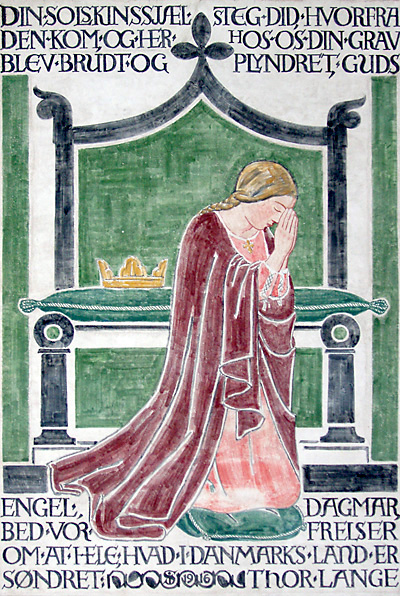
The name was borne by Dagmar of Denmark (1186-1212), also known as Markéta of Bohemia, Princess Dagmar of Denmark (1890-1961), Maria Federovna, also known as Dagmar of Denmark (1847-1928), Empress Consort of Russia.

Dagmar is also used in Iceland, Finland, Estonia, the Netherlands, Sweden, Norway, Germany and the Czech Republic.

Other forms of the name include:

  • Dagmara (Czech/Lithuanian/Polish/Slovak/Slovene)
  • Dakmari/Dakmar (Finnish)
  • Takmar/Takmari (Finnish)
  • Dagmár (Old Norse)
  • Dagmey (Old Norse)
  • Dagmor (Old Norse)
  • Dammei (Norwegian: dialectical form from Austlandt)
  • Dargmara (Vendish)

Diminutive forms are Dagmaruška, Dáša, Daška, Dašenka, Dašička (Czech), Dagmarka (Czech/Polish), Didi (Scandinavian), Dada and Dadka (Slovakian).

Designated name-days are:

May 24 (Germany), September 27 (Denmark, Norway and Sweden), November 26 (Estonia), December 12 (Poland), December 20 (Czech Republic),

Svante, Svätopluk, Svatopluk, Świętopełk

Gender: Masculine
Origin: Old Slavonic
Meaning: “mighty army; mighty regiment.”

An old Slavonic name most notably borne by a 9th-century Moravian prince, Svätopluk, (the Slovakian rendition), appears on the Slovakian name-day calender for November 15. Though today it is a very rare name in Slovakia, it did rank in as the 95th most popular male name, (in the form of Svatopluk), in it neighbor country, the Czech Republic, for 2006. In the Czech Republic, its designated name-day is February 23rd. Its Polish form of Świętopełk, is also extremely unusual today, though it does boast two name days, June 1 and September 25.Slovakian diminutives are, Sväto, Svaťo, Svätoš, Sväťo.

There is a popular folklore attributed to Svatopluk I of Moravia. When the king knew he was about to die, he gave each of his three sons a twig and had them break it, which was easy for all of them to do, but then Svatopluk asked his sons to break the twigs a second time, and this proved to be even more difficult. The king was trying to prove to his sons that it is difficult, yet necessary to keep a kingdom united.

Other forms of the name include:

  • Svend (Danish)
  • Vante (Finnish)
  • Sventopolcus/Sventopelcus (Late Latin)
  • Światopełek/Świętopałk/Świętopełek/Wszetopełk (Polish)
  • Svjatopolk/Svyatopólk (Russian/Ukrainian)
  • Svante/Svantepolk (Swedish/Norwegian/Danish: name-day in Sweden is December 5. Svante was the 97th most popular male name in Sweden for 2007)
  • Swante (Swedish)

Notable Czech bearers are:

  • Svatopluk I, Great Prince of Moravia (c. 894)
  • Svatopluk II, Prince of Nitra (c. 9-10 centuries)
  • Svatopluk of Bohemia (1107-1109)
  • Svatopluk Inneman, Czech director (1896-1945)
  • Svatopluk Benes, Czech actor (1918-2007)
  • Svatopluk Havelka, Czech composer (1925-2009)
  • Svatopluk Skopal, Czech actor (b.1952)

Famous Polish bearers include:

  • Prince Świętopełk of Poznań (979-992)
  • Świętopełk II the Great, Duke of Gdańsk Pomerania (1220-1266)
  • Świętopełk Karpiński, Polish poet and satirist (1909-1940)

It was also borne by one Kievan duke, Svyatopolk I of Kiev.


Axel

Gender: Masculine
Origin: Scandinavian
Meaning: debated

The name has long been considered a Danish form of the Biblical Absalom (father of peace), the usage of Absalom as a cognate of Axel was first used by the bishop Absalom Hvide (1128-1201), it has been suggested that Absalom was merely the closest sounding Christian equivalent to the Old Norse Áskell (god cauldron; god helmet), which was the Bishop’s true name, and that Axel and Absalom were considered one and the same thereafter. Other sources suggest that it is related to an old Germanic source meaning “shoulder” which would signify strength.

The name is in prevalent usage throughout Scandinavia and is used in German and Spanish-speaking countries and is occasionally used in the United States and France. It was the 16th most popular name for boys  in Sweden in 2007.  In France, it was the 27th most popular name for boys in 2006. In the United States it ranks in at # 272 as of 2008.

The designated name-day in Denmark and the Faroe Islands is October 30.

Other forms of the name include:

  • Aksel (Danish, Faroese, Norwegian, Yiddish)
  • Axelen/Axeln/Axilan/Axlan (Danish)
  • Aksal (Faroese)
  • Akseli (Finnish)
  • Áksel (Saami)
  • Acke (Swedish diminutive form)

Feminine forms include

  • Axeline (Danish)
  • Axelle (French)
  • Akseliane/Akseline (Norwegian)
  • Axelia/Axelina (Swedish)

Ursula

ursulaBritishMuseumGender: Feminine
Origin: Latin
Meaning: “little she-bear; she-cub; little female bear.”
Eng (ERS-uh-LAH)

The name is of Latin origin but is suggested that is may be a latinization of the old Germanic female name Yrsa meaning “bear” and was popularized by a medieval Christian saint said to be martyred in Cologne. Not much is known about the saint, other that she was martyred under Huns along with 11,000 other virgins, which is now believed to be a misprint from the written source of the legend. What is known for sure is that there was a basilica built in honour of a virgin Christian martyr in Cologne and from this arose several different legends referring to a St. Ursula and St. Cordula. According to the legend, St. Ursula was a British princess who was sent by her father to Germany to marry a prince, along with her, were sent 11,000 maidens, however,  her ship was taken off course due to a storm and instead ended up in France where she then decided to do a pan-European Christian pilgramage before meeting her future husband. She made a pilgramage to Rome where she tried to pursuade the pope to do a pilgramage with her and her 11,ooo companions. When she reached cologne she and her companions were massacred by the Huns.

The legend is based off of a 4th century inscription written in the Basilica which was built in the saint’s honour. It is believed that the 11,ooo handmaidens was confused with a female martyr named Undecimilia, Undecimila or Xemilia and that the abbreviation XI.M.V was misread as a number. The same saint has also been referred to under the names Pinnosa or Vinnosa. The name was quite prevalent in Great Britain before the Reformation and went out of usage afterwards. The name is also borne by Swiss actress Ursula Andress (b. 1936). It has also appeared in popular culture as the name of the evil sea-witch in Disney’s the Little Mermaid and as the name of the wife of Nigellus Phineas Black in the Harry Potter Series.

In Poland, the name is associated with a great piece of Polish Literature written by Jan Kochanowski. Known as Laments (Treny) 1580, they are a series of 19 elegies which talk about the author’s grief after the death of his two and half year old daughter Orszola (Urzula) which he refers to as the Slavic Sappho.

Other forms of the name are (divided alphabetically by nationality):

  • Orsula (Corsican)
  • Uršula (Croatian/Czech/Slovakian/Slovenian)
  • Yrsa (Danish/Faroese/Icelandic/Norwegian/Swedish)
  • Orsel (Dutch)
  • Ursule/Ursuline (French)
  • Ursula/Ursel (German/Dutch/Estonian/Finnish/Spanish: German diminutive forms are Ulla, Uli and Uschi)
  • Orsolya (Hungarian: or-SHOH-lah was the 56th most popular female name in Hungary in 2006)
  • Úrsúla (Icelandic)
  • Orsina/Orsola/Orsolina (Italian)
  • Ursa (Latin)
  • Urzula (Latvian)
  • Uršulė (Lithuanian)
  • Urszula/Orszola/Warszula (Polish: Latter two forms are older forms and are rarely used. Diminutive form is Ula and Urszulka. Older diminutive forms are Ulicha and Ulita)
  • Úrsula (Portuguese)
  • Ursetta/Ursina/Urschla (Romansch)
  • Urška (Slovenian: originally a diminutive now used as an independent given name, it was the 51st most popular female name in Slovenia in 2005)
  • Orscheli (Swiss-German: ORSH-lee)

There are a few male equivalents which include:

  • Orso/Orsino/Ursio/Ursino (Italian)
  • Urs (German)
  • Ursinus/Ursus (Latin)
  • Ursyn/Ursycjusz (Polish: very rare)
  • Ursin/Urosin (Romansch)