Zechariah, Zachary

St. Zachary Gender: Masculine
Origin: Hebrew  זְכַרְיָה
Meaning: “God remembers.”
Eng (zek-e-RIE-ah); (ZACK-e-REE)

Zachary is an English form of the Hebrew Zechariah, a theophoric name that means “God remembers; Yahweh remembers.”

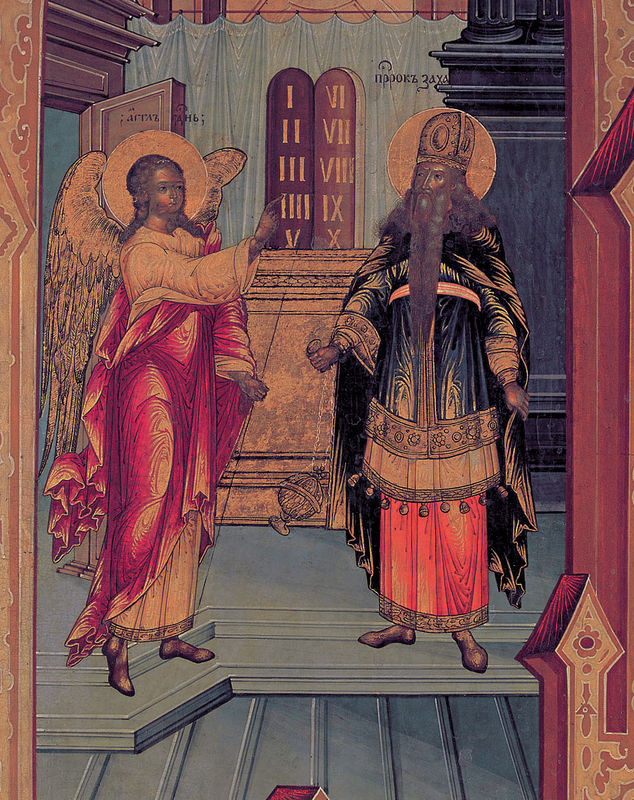
The name is borne by several characters in both the Old and New Testament. In the Old Testament, it was borne by a prophet who authored the Book of Zechariah and in the New Testament, it was borne by the father of John the Baptist.

In the Qu’ran, the father of John the Baptist is viewed as a prophet and also as the protector of Mary, the mother of Jesus.

The name also appears as Zacharias, a Greek rendition, in some versions of the New Testament.

In the English speaking world, the name has been in usage since Medieval times. In Eastern Europe, especially in Orthodox dominated countries, it has always been a common name.

Currently, Zachary is the 61st most popular male name in the United States, (2010). In 1994, he ranked as high as # 12.

In other countries, his popularity is as follows:

  • # 51 (Australia, NSW, 2010)
  • # 51 (England/Wales, 2010)
  • # 55 (Canada, BC, 2010)
  • # 331 (Zacharie, France, 2009)
  • # 446 (France, 2009)

Other forms of the name include:

  • Sagarias (Afrikaans)
  • Zakariyya زكرياء (Arabic/Assyrian/Circassian/Coptic/Ethiopian/Lebanese/Syrian)
  • Zacharij/Zachari Захари (Bulgarian)
  • Zacaries (Catalan)
  • Zekarija Закария (Chechen/Kazakh)
  • Zakaria ზაქარია (Coptic/Ethiopian/Georgian/Kurdish)
  • Zaharije Зaxapиje (Croatian/Serbian)
  • Zachariáš (Czech/Slovak)
  • Zachary (Czech/English/French/Polish)
  • Zacharias (German/Scandinavian)
  • Sakarias (Faroese/Norwegian/Swedish)
  • Sakari (Finnish: Sakke is a diminutive form)
  • Saku (Finnish)
  • Zacharie (French)
  • Sagaire/Sagairi (Gaelic)
  • Zacharias Zαχαριας (Greek)
  • Zakariás (Hungarian)
  • Zakeus (Hungarian)
  • Zekarja (Hungarian)
  • Zaccaria (Italian)
  • Zaccheo (Italian)
  • Cherian (Malayalam)
  • Sakaria (Malayalam)
  • Scaria (Malayalam)
  • Zaxaria Захарїа (Old Church Slavonic)
  • Zachariasz (Polish)
  • Zacarias (Portuguese)
  • Zaharia (Romanian)
  • Zaccaria(s) (Romansch)
  • Zachar Захар (Russian)
  • Sachairi (Scottish-Gaelic)
  • Zacarías (Spanish)
  • Zakarya (Swahili)
  • Zekeriya (Turkish)

The name is also borne by several saints as well as by one Roman Catholic pope and a Coptic pope.

Zaharina Захарина is a Bulgarian feminine form and Zara is its pet form.

Other notable bearers include an 8th-century Nubian king, a 9th-century Khazar king, and American president, Zachary Taylor (1784-1850)

Sources

  1. http://www.askoxford.com/firstnames/zachary?view=uk
  2. http://www.behindthename.com/php/find.php?name=zachary
  3. http://www.svenskanamn.se/
  4. http://bibref.hebtools.com/?book=%20Matthew&verse=23:35&src=!

Rebecca

Gender: Feminine
Origin: debated
Meaning: debated
Eng (re-BEK-ka)

Rebecca is the English form of the Biblical Hebrew רִבְקָה (Rivqah), which possibly means “snare” or “noose” possibly referring to captivation or beauty, but may also be of an unknown Aramaic source.

The name is borne in the Bible by the Aramean wife of Isaac and the mother of Jacob and Esau. She is considered a Jewish matriarch.

In the English speaking world, the name was seldom used until the Protestant Reformation, where it became an exceedingly popular name. Pocahantas even took this as her Christian name upon her baptism.

Currently, Rebekka is the 3rd most popular female name in Faroe Islands, (2010). Her rankings in other countries are as follows:

  • # 20 (Rebecca, Italy, 2010)
  • # 24 (Rebeka, Hungary, 2010)
  • # 37 (Rebecca, Northern Ireland, 2010)
  • # 38 (Rebecca, Scotland, 2010)
  • # 48 (Rebecca, Ireland, 2010)
  • # 75 (Rebeka, Slovenia, 2010)
  • # 75 (Rebecca, Sweden, 2010)
  • # 82 (Rebecca, England/Wales, 2010)
  • # 137 (Rebecca, United States, 2010)
  • # 290 (Rebecca, Netherlands, 2010)
  • # 304 (Rebecca, France, 2009)
  • # 404 (Rebekah, United States, 2010)

Other forms of the name include:

  • Rafqa ﻪﻔﻴﻓﺍﺭ (Arabic/Syriac)
  • Rebeka Ребека (Bosnian/Bulgarian/Czech/Hungarian/Lithuanian/Polish/Slovak/Slovene)
  • Rebeca (Catalan/Ladino/Portuguese/Romanian/Spanish)
  • Rebekka (Dutch/Ethiopian/Finnish/German/Scandinavian)
  • Rebecca (English/Italian/Scandinavian)
  • Becca (English)
  • Reba (English)
  • Rebekah (English)
  • Rébecca (French)
  • Rebèque (French)
  • Rebekah (Greek: Biblical)
  • Revekka Ρεβέκκα (Greek: Modern)
  • Rifqa (Hebrew: Biblical)
  • Riva/Rivka רִבְקָה, רבקה אמנו (Hebrew: Modern)
  • Réba (Hungarian)
  • Ribka (Indonesian)
  • Ryfka (Polish-Yiddish)
  • Rebecke (Plattdeutsch)
  • Revekka Реве́кка (Russian)
  • Reveka (Serbian)
  • Rebecka (Swedish)
  • Rifka/Riwka (Yiddish)

The name was the subject of the 1938 British novel of the same name, written by Daphne du Maurier. It is also borne by a 19th-century Lebanese Christian saint. The designated name-day is March 23 (France).

Common English diminutive forms include: Becca, Beck, Becky, Bex, Reba and Rebi.

Sources

  1. Genesis 22:20-23
  2. http://www.ou.org/torah/ti/5764/toldot64.htm
  3. http://www.behindthename.com/name/rebecca
  4. http://www.askoxford.com/firstnames/rebecca?view=uk

Eva, Eve

Gender: Feminine
Origin: Hebrew
Meaning: “life.”
Eng (EEV); (EE-vuh); Germ/Sp/Pol (EV-ah)

The name is borne in the Bible and in the Quran by the first woman created by God. She and her husband were expelled from the Garden of Eden after eating from the Tree of Knowledge.

The name is believed to be derived from the Hebrew roots חַוָּה, Ḥavvāh, from the Hebrew root ḥāyâ meaning “life” and the Semitic element, ḥyw “to live.” Both the Hebrew word chavah meaning “to live” and chayah meaning “to breath” share the same root.

Despite Eve’s fall from Grace in the Bible, the name was always in usage among Jewish, Christian and Muslim communities. In England, its usage can be traced back to the 12th-century. Its Latinate form of Eva, has always been a classic in continental Europe, especially in Germany, Poland, Slovakia and the Czech Republic.

As of 2010, Eva was the most popular female name in the Faroe Islanda and in Slovenia. Eve, Eva and all her various forms’ rankings in other countries are as follows:

  • # 3 (Iceland, 2010)
  • # 4 (French-speaking, Switzerland, 2010)
  • # 5 (Netherlands, 2010)
  • # 7 (Ieva, Lithuania, 2010)
  • # 10 (Armenia, 2010)
  • # 10 (Evie, England/Wales, 2010)
  • # 14 (Northern Ireland, 2010)
  • # 15 (France, 2009)
  • # 17 (Scotland, 2010)
  • # 20 (Belgium, 2009)
  • # 24 (New Zealand, 2010)
  • # 26 (Australia, NSW, 2010)
  • # 29 (Croatia, 2010)
  • # 31 (Evie, Scotland, 2010)
  • # 33 (Evie, Australia, NSW, 2010)
  • # 37 (England/Wales, 2010)
  • # 44 (Eevi, Finland among Finnish-speakers, 2010)
  • # 44 (Ireland, 2010)
  • # 46 (Austria, 2010)
  • # 47 (Canada, BC, 2010)
  • # 48 (Spain, 2010)
  • # 55 (Catalonia, 2010)
  • # 55 (Éabha, Ireland, 2010)
  • # 56 (Eve, Northern Ireland, 2010)
  • # 59 (Eve, Ireland, 2010)
  • # 86 (Norway, 2010)
  • # 91 (United States, 2010)
  • # 92 (Eve, England/Wales, 2010)
  • # 99 (Eve, Australia, NSW, 2010)
  • # 201 (Eve, France, 2009)
  • # 589 (Eve, United States, 2010)
  • # 705 (Evie, United States, 2010)

Other forms of the name include:

  • Eva Ева ევა
    (Afrikaans/Albanian/Armenian/Basque/Belarusian/Bosnian/Catalan/Croatian/Czech/Dutch/Faroese/French/Frisian/Galician/Georgian/German/Icelandic/Italian/Portuguese/Romansch/Spanish/Scandinavian)
  • Evis (Albanian)
  • Mahalet/Mahlet (Amharic)
  • Hawa حواء Хауа (Arabic)
  • Yeva (Armenian)
  • Həvva (Azeri)
  • Yeva Ева Эва (Belarusian/Russian/Ukrainian)
  • Yevga Евга (Belarusian)
  • Hava (Bosnian)
  • Evy (Danish/Norwegian/Swedish: initially a diminutive form, occasionally used as an independent given name)
  • Eveke (Dutch: initially a diminutive form, used as an independent given name, EV-eh-ke)
  • Eve (English/Estonian/Walon)
  • Evie (English)
  • Hawat/Hewa (Egyptian/Coptic)
  • Eeva (Estonian/Finnish)
  • Eevi (Estonian/Finnish)
  • Evi (Estonian)
  • Ivi/Iivi (Estonian)
  • Iivika (Estonian)
  • Ève (French)
  • Eefje, Eefke (Frisian)
  • Hawwa ሕይዋን (Ge-ez)
  • Eua Ευα (Greek)
  • Chava חַוָה (Hebrew: Modern: KHAH-vah, gutteral CH sound)
  • Éva (Hungarian: AY-vaw, diminutive form is Évike)
  • Hawa (Indonesian/Malayalam)
  • Éabha (Irish-Gaelic)
  • Ieva (Latvian/Lithuanian: YEH-vah)
  • Evuzus (Malaysian)
  • Aaue (Manx)
  • Èva (Occitanian)
  • Ewa (Polish: EH-vah, diminutive forms are Ewka, Ewunia and Ewusia)
  • Evá (Sami)
  • Evelia (Spanish)
  • Evita (Spanish)
  • Eba (Tagalog)
  • Havva (Turkish)
  • Efa (Welsh)

Italian masculine form is Evo.

Traditionally, in most European countries, the name-day for Adam and Eve is December 24.

Yvonne

Gender: Feminine
Origin: French
Meaning: “yew.”
(ee-VAHN)

The name is a feminine form of an obscure Medieval French male name, Yvon, which is derived from Yves, a French form of Ivo meaning, “yew tree.”

The name was introduced into the English-speaking world at the beginning of the 20th-century. The highest she ranked in U.S. naming history was in 1937, when she was the 77th most popular female name. As of 2010, she did not even rank into the U.S. top 1000.

Her usage has spread elsewhere, including Scandinavia and Eastern Europe. In Eastern Europe, the name was slavicized to Ivona.

As of 2009, Ivona was the 38th most popular female name in Croatia.

Notable bearers include Yvonne de Carlo (1922-2007)

Other forms of the name include:

  • Yvonne (Afrikaans/Dutch/English/French/Italian/Scandinavian)
  • Ivona Ивoна (Czech/Croatian/Macedonian/Serbian/Slovakian/Slovene)
  • Yvaine (French: medieval form)
  • Ivonn (Hungarian)
  • Iwona (Polish)
  • Ivone (Portuguese)

Arthur

Gender: Masculine
Origin: Debated
Meaning: Debated
Eng (ARE-ther)

The name is of debated origin and meaning. Several theories have been attributed to the name’s origins, one is that it is derived from an obscure Roman cognomen, Artorius, which is believed to be of Etruscan origins of unknown meaning. Another theory is that it is derived from an ancient Brittonic name, *Arto-rīg-ios , meaning “bear-king.” An even less likely alternative is that it is connected with Welsh Artgwr (bear-man). A newer and yet unlikely suggestion is that it is related to the Greek Arcturus,  that is, the name of the brightest star in the Constellation Boötes, meaning “bear guardian.”

The name was borne by a mythical British king who is the topic of several medieval romances. His existence has never been proven, yet his legacy has left an indelible mark in Western Europe, especially in England and France. The name’s usage among the general populous can be traced all the way Medieval England. It surged in popularity in the 19th-century when English Romanticism had become popular.

As of 2008, Arthur was the 6th most popular male name in Belgium. His rankings in other countries are as follows:

  • # 4 (Brazil, 2010)
  • # 10 (Arturs, Latvia, 2010)
  • # 15 (France, 2009)
  • # 23 (Arttu, Finland, 2010)
  • # 82 (England/Wales, 2010)
  • # 99 (Arturo, Spain, 2010)
  • # 288 (Netherlands, 2010)
  • # 389 (United States, 2010)
  • # 420 (Arturo, United States, 2010)

Other forms of the name include:

  • Artur Артур Արթուր (Albanian/Armenian/Basque/Belarusian/Bosnian/Bulgarian/Catalan/Croatian/Czech/Estonian/Galician/German/Kazakh/Picard/Polish/Portuguese/Romanian/Romansch/Russian/Serbian/Slovak/Slovene/Ukrainian)
  • Dury (Alsatian)
  • Arturu (Asturian/Maltese)
  • Artús (Asturian/Catalan)
  • Artza (Basque)
  • Arzhur (Breton)
  • Artuš (Czech/Slovak)
  • Arthur (Dutch/English/Flemish/French/German/Scandinavian/Welsh)
  • Arto (Finnish)
  • Arttu (Finnish)
  • Artturi (Finnish)
  • Atte (Frisian)
  • Arturo (Galician/Italian/Spanish)
  • Arthoúros Αρθούρος (Greek)
  • Artúr (Hungarian/Icelandic/Irish)
  • Artù (Italian)
  • Arturi ართური (Georgian)
  • Arturs (Latvian)
  • Artūras (Lithuanian)
  • Turu (Maltese)
  • Èrthu (Norman)
  • Artús (Occitanian)
  • Artair (Scottish)
Diminutives include:
  • Arturek (Czech/Polish)
  • Tuur (Dutch)
  • Art (English)
  • Artie (English)

Feminine forms include the Italian: Artura and Arturina

Anna, Anne

Gender: Feminine
Origin: Biblical Hebrew
Meaning: “grace.”
(ANN; AHN). (ANN-uh; AHN-nah). (HANN-uh; HAHN-nah)

Anne is possibly one of the quintessential classic English and French female names. Prior to the 18th-century, it seems that every other girl born in England was either named Anne, Jane or Mary. There were several British and French queens who bore this simplistic moniker, including the ill fated Anne Boleyn, the mother of Elizabeth I. The history of Anne is rather long and complicated.

It was foremost popularized through the cult of St. Anne, a legendary figure who was said to be the mother of the Virgin Mary and the grandmother of Christ.

In Brittany, the name became especially popular because it happened to coincide with the name of an ancient Celtic goddess, her cult being replaced by St. Anne’s. In fact, it was borne by one Breton Princess, Anne of Brittany.

The name was introduced into Britain by the French-Normans after the invasion in 1066. Previously, there had been a minor Saxon king named Anna, but in this case the name is related to the Saxon arn (eagle). Anna and Anne are still occasionally used as male given names in Friesland.

Other than the apocryphal saint, the name Anne can be traced directly back to the Bible. In the New Testament, it is the name of a prophetess who predicts the Crucifixion of Christ.

Anna (Αννα), is the Greek translation of the early Hebrew Channah חַנָּה, usually transliterated as Hannah, meaning “grace.”

Hannah is borne in the Old Testament by the faithful mother of the prophet, Samuel.

Hannah has always been popular among Jewish families, but was virtually unheard of among non-Jews before the Reformation, except in some cases where it may have been used as a diminutive form of Johanna, spelled Hanna.

It was the Byzantines who had introduced the Anna form to the world, making it popular throughout Eastern and Southern Europe. It was a very popular name among the Byzantine royal family and it was borne by the majestic Anna of Byzantium.

Anna may be the more melodic form of the bunch, but Anne’s minimalistic qualities are charming. Short, to the point, no frills. It’s not a bad name, though it does lack some spice, which is why parents are probably more attracted to its more exotic alternatives. In fact, Anne only comes in at # 608 in the top 1000 female names of the United States. It is safe to say, however, that she is very much loved in the middle name spot.

Anna is currently one of the most popular female names in Europe and abroad. Her rankings are as follows:

  • # 1 (Austria, 2010)
  • # 1 (Estonia, 2011)
  • # 2 (Hungary, 2010)
  • # 3 (Ana, Georgia, 2010)
  • # 3 (Iceland, 2010)
  • # 4 (Ana, Croatia, 2010)
  • # 4 (Czech Republic, 2010)
  • # 4 (Germany, 2011)
  • # 4 (Ukraine, 2010)
  • # 5 (Faroe Islands, 2010)
  • # 5 (Ana, Portugal, 2010)
  • # 6 (Armenia, 2010)
  • # 6 (Ane, Greenland, 2002-2003)
  • # 6 (Ana, Romania, 2009)
  • # 6 (Ana, Serbia, 2010)
  • # 7 (Latvia, 2011)
  • # 7 (Russia, 2011)
  • # 8 (German-speaking Switzerland, 2010)
  • # 9 (Denmark, 2011)
  • # 10 (Netherlands, 2010)
  • # 10 (Northern Ireland, 2010)
  • # 10 (Norway, 2010)
  • # 11 (Italy, 2010)
  • # 12 (Ireland, 2010)
  • # 14 (Poland, 2010)
  • # 16 (Catalonia, 2010)
  • # 26 (Canada, B.C., 2010)
  • # 28 (Italian-speaking Switzerland, 2010)
  • # 28 (United States, 2010)
  • # 29 (Scotland, 2010)
  • # 40 (France, 2009)
  • # 46 (French-speaking Switzerland, 2010)
  • # 53 (Belgium, 2009)
  • # 63 (England/Wales, 2010)
  • # 71 (Australia, 2010)
  • # 81 (Sweden, 2010)
  • # 83 (Spain, 2010)
Other forms of the name include:
  • Anneen (Afrikaans/Low German)
  • Anna Анна (Afrikaans/Albanian/Armenian/Breton/Bulgarian/Catalan/Corsican/Czech/Dutch/English/Estonian/Faroese/Finnish/French/Frisian/German/Greek/Hungarian/Icelandic/Italian/Latvian/Limburgish/Maltese/Polish/Russian/Ukrainian/Scandinavian/Slovak)
  • Anne (Basque/Dutch/English/French/Scandinavian)
  • Gánna Га́нна (Belarusian)
  • Annaig (Breton)
  • Annick (Breton)
  • Maina (Breton)
  • Mannaig (Breton)
  • Mannick (Breton)
  • Naig (Breton)
  • Ana Ана ანა (Bulgarian/Croatian/Galician/Georgian/Lombard/Macedonian/Portuguese/Romanian/Samogaitian/Serbian/Slovene/Spanish/Venetian)
  • Jana (Croatian/Ladino)
  • Aneta (Czech/Polish/Samogaitian/Slovak)
  • Aina (Catalan)
  • Anica (Croatian/Serbian/Slovene)
  • Ane (Danish)
  • Anika (Danish)
  • Anneke (Dutch)
  • Anneken (Dutch)
  • Annika (Dutch/Finnish/German/Latvian/Scandinavian)
  • Anka (Dutch/Frisian/German)
  • An(n)ke (Dutch/Frisian)
  • Anouk (Dutch/French)
  • Ans (Dutch)
  • Enneke (Dutch)
  • Enneken (Dutch)
  • Anita (English/German/Polish/Spanish)
  • Annette (English/French/German)
  • Anissa (English)
  • Annelle/Annella (Estonian)
  • Anete (Estonian/Latvian)
  • Anett (Estonian)
  • Anu (Estonian)
  • Anni (Finnish)
  • Annikki (Finnish)
  • Anniina (Finnish)
  • Annukka (Finnish)
  • Niina (Finnish)
  • Anaïs (French/Provençal)
  • Annouche (French)
  • Ninette (French)
  • Ninon (French)
  • Ninouk (French)
  • Anje (Frisian)
  • Ankea (Frisian)
  • Antje (Frisian)
  • Antjen (Frisian)
  • Anute (Fruilian)
  • Anano (Georgian)
  • Annchen (German)
  • Annel (German)
  • Annele (German/Latvian)
  • Anneli(e) (German/Finnish/Swedish)
  • Annet (German)
  • Anina (German)
  • Anja (German/Slovene)
  • Anouschka (German/Italian/Russian)
  • Annaki (Greek)
  • Annoula (Greek)
  • Noula (Greek)
  • Anikó (Hungarian)
  • Annuska (Hungarian)
  • Panni (Hungarian)
  • Áine (Irish)
  • Ánna (Irish)
  • Annarella (Italian)
  • Annella (Italian)
  • Annetta (Italian)
  • Annettina (Italian)
  • Nona (Italian/Romansch)
  • Ance (Latvian)
  • Annija (Latvian)
  • Anninya (Latvian)
  • Ona (Lithuanian)
  • Annamma (Malayalam)
  • Annam (Malayalam)
  • Onnee (Manx)
  • Âone (Norman)
  • Aenna/Aenne (Old High German)
  • Annehe (Old High German)
  • Änna/Änne (Old High German)
  • Neta (Piedmontese)
  • Noto (Piedmontese)
  • Anke (Plattdeutsch)
  • Anneke(n) (Plattdeutsch)
  • Analia (Romansch/Spanish)
  • Annina (Romansch)
  • Annotta (Romansch)
  • Anca (Romanian)
  • Anicuta (Romanian)
  • Anėta (Samogaitian)
  • Anėkė (Samogaitian)
  • Annag (Scottish)
  • Ghianna (Sicilian)
  • Janna (Sicilian)
  • Nanna (Sicilian)
  • Anniken (Swedish)
  • Ann (Welsh)
  • Nan (Welsh)
  • Nanno (Welsh)
  • Nanw (Welsh)
  • Aana (Wolof)
As for the Hannah forms

Hanna without an H is the prefered form on Continental Europe, usually pronounced (HAHN-nah) and in French like Anna. Hanna and Hanne (HAHN-neh) are also used as diminutive forms of Johanna/Johanne in the Netherlands, Sweden, Norway, Denmark and Germany. There is the Hungarian Hajna pronounced (HOY-no). The Czech/Slovak form of Hana nickname Hanka. There are the Yiddish forms of Heyna, Hayna, Hejna (all pronounced like HAY-nah) including the diminutive forms of HenaHende, Hendel and Henye.  The Polish diminutive form of Hania, which might make an interesting alternative to Anya or Hannah. Hannah, Hanna and Henna are all used in the Middle East.

Of course, how could we ever forget the popular diminutive forms of Annie and Nan.

Paul

Gender: Masculine
Origin: Latin
Meaning: “short; small; humble; few.”
Eng (PAWL)

The name is derived from the Latin Roman family name, Paulus, which could translate as meaning, “small, short; humble; few.”

Paul and his various forms has to be one of the most common male names used throughout the Christian world. It has been used equally among Orthodox Christians, Roman Catholics and Protestants.

Its most famous bearer was Paul of Tarsus, whose real name was Saul. St. Paul, as referred to by the Roman Catholic and Eastern Orthodox Churches, is attributed as being the author of much of the New Testament.

The name was borne by several popes, royals and saints thereafter.

Currently, its Germanic form of Paul is the 8th most popular male name in Germany, (2011). His rankings in other countries are as follows:

  • # 13 (Austria, 2010)
  • # 22 (France, 2009)
  • # 41 (Romania, 2009)
  • # 90 (Ireland, 2010)
  • # 130 (Scotland, 2010)
  • # 178 (United States, 2010)
  • # 485 (Netherlands, 2010)
His foreign equivalents rankings are as follows:
  • # 3 (Pablo, Spain, 2010)
  • # 4 (Páll, Faroe Island, 2010)
  • # 4 (Pau, Catalonia, 2010)
  • # 17 (Paweł, Poland, 2010)
  • # 26 (Pablo, Chile, 2010)
  • # 29 (Pavel, Czech Republic, 2010)
  • # 31 (Pablo, Catalonia, 2010)
  • # 44 (Pau, Spain, 2010)
  • # 91 (Pál, Hungary, 2010)
  • # 144 (Pablo, France, 2009)
  • # 202 (Paolo, France, 2009)
  • # 361 (Pablo, United States, 2010)

Other forms of the name include:

  • Pali (Albanian)
  • Paulë (Albanian)
  • Boulos/Bulos بولس (Arabic)
  • Faulus (Aramaic)
  • Boghos Պողոս (Armenian)
  • Poghos Պողոս (Armenian)
  • Paul (Basque/Dutch/English/Estonian/German/French/Romanian/Scandinavian/Silesian)
  • Paweł Павeл (Belarusian/Polish)
  • Polus (Berber)
  • Paol (Breton)
  • Pavel Павел (Bulgarian/Czech/Russian/Slovene)
  • Pavolo (Calabrian)
  • Pavulu (Calabrian)
  • Pau (Catalan/Occitanian)
  • Pawl (Cornish/Welsh)
  • Paulu (Corsican/Sardinian/Sicilian)
  • Pavao (Croatian)
  • Pavle პავლე Павле (Croatian/Georgian/Macedonian/Serbian)
  • Pavo (Croatian)
  • Palle (Danish)
  • Poul (Danish)
  • Pauwel (Dutch)
  • Paavel (Estonian)
  • Paavo (Estonian/Finnish)
  • Páll (Faroese/Icelandic)
  • Paavali (Finnish)
  • Pauli (Finnish)
  • Pol (Flemmish/Romansch)
  • Paale (Frisian)
  • Pals (Frisian)
  • Paulus पौलुस (Frisian/Hindi/Latin)
  • Pay (Frisian)
  • Powles (Frisian)
  • Pouw (Frisian)
  • Pauli (Fruilian)
  • Pódhl (Gaelic)
  • Pól (Gaelic)
  • Paulo (Galician)
  • Pavlos Παυλος (Greek)
  • Pāl पॉल (Hindi)
  • Pál (Hungarian)
  • Pósa (Hungarian)
  • Paolo (Italian/Portuguese)
  • Paolino (Italian/Portuguese)
  • Paulinus (Latin)
  • Pāvils (Latvian)
  • Paulius (Lithuanian)
  • Povilas (Lithuanian)
  • Paol (Lombard)
  • Paulose (Malayalam)
  • Pawl (Maltese)
  • Pawlu (Maltese)
  • Payl (Manx)
  • Paora (Maori)
  • Pål (Norwegian/Swedish)
  • Pavel (Romanian)
  • Paulin (Romansch)
  • Polet (Romansch)
  • Polin (Romansch)
  • Pulegn (Romansch)
  • Pàl (Scots-Gaelic)
  • Pawůł (Silesian)
  • Pavol (Slovak)
  • Pawoł (Sorbian)
  • Pablo (Spanish)
  • Paoro (Tahitian)
  • Pàul (Tuscan)
  • Pavlo Павло (Ukrainian)

For a Reference a Female forms See Paula and Paulina (soon to come)

Hans

Gender: Masculine
Origin: German
Dan/Germ/Swe/Nor (HAHNZ)

The name is a household German favorite and in the English-speaking world, is often used to designate an average German male.

It is from a diminutive form of Johannes, but has exclusively been used as an independent given name in German-speaking countries and in Scandinavia since at least the 19th-century.

The name would roughly be the German cognate of Jack.

Up until the 1950s, Hans was among the 10 most popular male names in Germany, in recent years, it has been viewed as a dated name, but like other vintage names, seems to be catching on again. It is currently the 245th most popular male name in Germany, (2011).

Another form is Hansel.

A Danish feminine form is Hansine.


Saskia

Gender: Feminine
Origin: German/Dutch
Meaning: “Saxon.”
Germ/Dutch (SAHS-kee-ah)

The name is derived from the Germanic element, sachs, meaning “Saxon.”

The name is most famously borne by Saskia van Uleynburgh (1612-1642) the wife of Rembrandt. She was often the subject of many of his paintings.

Currently, Saskia is the 183rd most popular female name in Germany, (2011).

Due to many early Dutch settlers, the name has had some usage in the United States, especially among the East Coast elite. It is also prevalent in South Africa.

It is currently borne by Princess Saskia of Hanover (b.1970).

Sáskie is a Czech form.


Adrian

Gender: Masculine
Origin: Latin
Meaning: “from Hadria”

The name is derived from the Latin Hadrianus, a Roman cognomen meaning, “from Hadria.” Hadria was a small town in the North of Italy. It gave its name to the Adriatic Sea.
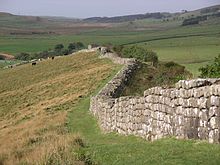
The name was borne by Publius Aelius Hadrianus (76-138 CE), known in the modern world as Emperor Hadrian, he is most famous for the wall he built across Great Britain, known as Hadrian’s Wall.
The name remained common throughout Europe, and is fairly popular across the Western World till this day. It was borne by several saints and popes, including the first and only English pope, Adrian IV, as well as the only Dutch pope, Adrian VI.
Currently, Adrian is the 6th most popular male name in Spain, (2010) and the 7th most popular in Norway, (2010). His rankings in other countries are as follows:
  • # 29 (Catalonia, 2009)
  • # 33 (Poland, 2010)
  • # 43 (Germany, 2011)
  • # 48 (Austria, 2010)
  • # 49 (Croatia, 2010)
  • # 51 (France, Adrien, 2010)
  • # 56 (United States, 2010)
  • # 60 (Sweden, 2010)
  • # 63 (Hungary, 2010)
  • # 81 (Belgium, Adrien, 2009)
  • # 455 (France, Adrian, 2009)

Other forms of the name include:

  • Ad (Afrikaans/Limbergish)
  • Adriaan (Afrikaans/Dutch)
  • Adrianus (Afrikaans/Latin)
  • Arrie (Afrikaans)
  • At (Afrikaans)
  • Daan (Afrikaans)
  • Jaans (Afrikaans)
  • Adrian Адриан (Albanian/Bulgarian/Croatian/Dutch/English/Finnish/Polish/Romanian/Russian/Scandinavian/Ukrainian)
  • Ardian (Albanian)
  • Adrianu (Asturian/Corsican/Sicilian)
  • Adiran (Basque)
  • Adrijan (Bosnian/Croatian/Serbian/Slovene)
  • Hadrijan (Bosnian)
  • Adrià (Catalan)
  • Jadran(ko) (Croatian)
  • Adrián (Czech/Hungarian/Slovak/Spanish)
  • Arie (Dutch)
  • Arjan (Dutch)
  • Hadrian(us) (Dutch/German/Latin)
  • Adrien (French)
  • Hadrien (French)
  • Aidrean (Gaelic)
  • Adrán (Galician)
  • Adrao (Galician)
  • Hadrán (Galician)
  • Hadrao (Galician)
  • Hádrian (Galician)
  • Adrianos Αδριανός (Greek)
  • Adorján (Hungarian)
  • Adrían (Icelandic)
  • Adriano (Italian/Portuguese)
  • Adrio (Italian)
  • Adriāns (Latvian)
  • Adrianas (Lithuanian)
  • Adrijonas (Lithuanian)
  • Adrião (Portuguese)
  • Adriànu (Sardinian)

Feminine forms include:

  • Adriana  (Albanian/Bulgarian/Catalan/Czech/Galician/German/Greek/Italian/Latin/Lithuanian/Polish/Romanian/Russian/Slovak/Spanish)
  • Adrijana (Bosnian/Croatian/Serbian)
  • Hadrijana (Bosnian/Croatian/Serbian)
  • Jadranka (Croatian)
  • Adriána (Czech/Hungarian/Slovak)
  • Ariane (Dutch)
  • Hadriana (Galician/Latin)
  • Adria (German/Italian)
  • Adriane (German)
  • Adrienne (French)
  • Adrienn (Hungarian)
  • Adrianna (Polish)
  • Drina (Spanish)

Polish feminine diminutives are Ada and Adi.