Bruno, Bruna, Brune


Gender: Masculine
Origin: German
Meaning: “brown.”
(BROO-no)

The name has a Latin sound but is actually of German origins. It is derived from the German word brun meaning “brown.” A follower of my blog, Capucine, informed me that the meaning of the name was originally a euphemism for a bear.

It has also been suggested that the name might be related to the Old High German, brunja, meaning, “breastplate.”

According to askoxford.com, the name has been borne by German royalty and nobility alike. It was also borne by a 10th-century saint and the son of Emperor Henry the Fowler as well as by the Saxon Duke who gave his name to the town of Brunswick (in German Braunschweig).

The name has also experienced popular usage in Spanish-speaking countries, French-speaking countries, as well as in Italy, Portugal and Poland.

Thanks to the influx of German immigrants at the beginning of the 20th century, it reached # 260 way back in 1915. The highest it has ever reached in the Social Security list. It currently comes in at a mere # 665 (2018).

His rankings in other countries are as follows:

  • # 14 (Catalonia, 2018)
  • # 21 (Spain, 2018)
  • # 29 (Galicia, Spain, 2018)
  • # 44 (Poland, 2018)
  • # 59 (Portugal, 2018)
  • # 115 (Italy, 2018)
  • # 377 (England & Wales, 2018)
  • # 476 (the Netherlands, 2018)
Other forms of the name include:
  • Bru (Catalan)
  • Bruneau (French)
  • Brun (German)
  • Brúnó (Hungarian)
  • Brunello (Italian)
  • Brunetto (Italian)
  • Brunino (Italian)
  • Brunone (Italian)
  • Broen (Limbergish)
  • Brunon (Occitanian/Polish)

The feminine form of Bruna is a popular name in Brazil, Italy and Croatia.

It is currently the 28th Most Popular Female Name in Spain (2018) and the 66th Most Popular Female Name in Portugal (2018), while its French form of Brune currently ranks in at # 363 in France (2018).

Other feminine forms include:

  • Brune (Dutch/French)
  • Brunonia (English), which is borne by author, Brunonia Barry
  • Brunelle (French)
  • Brunette (French)
  • Brunella (Italian)
  • Brunetta (Italian)
  • Brunina (Italian)
  • Brunona (Polish)

Its designated name day is July 12.


Updated by Sebastiane on 12/21/2019
Sources

Corinna

Gender: Feminine
Origin: Greek
Meaning: “little maiden.”
Germ/Eng (koh-RIN-nah); Grk (koh-REEN-nah)

The name is from the ancient Greek Κοριννα (Korinna) which is derived from the Greek, κορη (kore), meaning “maiden.” There is the diminutive sufix of -inna attached, so it more likely means “little maiden” “little girl.” The name is related to Cora, a name which I will go further into in a seperate entry.

The name was borne by a 5th-century BCE Greek poetess and it is the name of the title character in Ovid’s Amores. It is also the name of the title character in Robert Herrick’s 17th-century poem Corinna’s going a-Maying.

Its French form of Corinne was popularized via the eponymous novel by Madame de Staël (1807)

As of 2009, Korina was the 73rd most popular female name in Croatia. While its French form of Corinne ranked in as the 728th most popular female name in the United States, (2010).

The designated name-day in Germany is October 22. The Corinna form is also used in Italy.

Other forms of the name include:

  • Korilla (Boetian)
  • Corinna (Catalan/English/Italian)
  • Korina Корина (Croatian/Czech/Latvian/Greek/Serbian/Slovakian/Slovene)
  • Corine (Dutch/French: koh-REEN)
  • Korinna Коринна  (German/Greek/Hungarian/Russian)
  • Corinne (French:  koh-RIN)
  • Corina (German/Italian/Portuguese/Romanian/Romansch/Spanish)
  • Coranna (Italian)
  • Corilla (Italian)
  • Korynna (Polish)
  • Koryna (Polish/Lithuanian)

There is a modern Greek masculine form: Korinos and an Italian masculine version of Corinno.

Nadia

Gender: Feminine
Origin: Slavonic/Arabic نديّة
Meaning: see below
(NAHD-yah); (NAH-dee-uh)

Nadia has a touch of class, a mysterious vibe and an exotic appeal. Nadia is also very cross-cultural, she has two different origins and meanings and can easily be used in virtually every country in the world.

First, we have Slavic Nadia, a derivative of the Russian Nadezhda, meaning, “hope.” If that meaning isn’t sweet enough for you, then you might like Nadia’s meaning in Arabic, “delicate; tender; moist.” Though its Arabic version is sometimes transliterated as Nadiyya نديّة, its pronounced exactly the same way as its Slavic homonym.

During the Soviet era of Russia, Nadia was used as a neologism, that is one of the hundreds of Russian given names created during the Russian Revolution to celebrate communistic ideas. In this case, Nadia was suppose to be a formation of nad (above) and ia/ija (era).

Nadia has enjoyed popularity outside of the East. It suddenly became vogue in France in the 19th century, possibly due to the Ballet Russe, where it was later francanized to Nadine. In Germany, it is often rendered as Nadja (NAHD-yah). The name is very popular throughout Eastern Europe.

The name is borne by Nadia Comaneci a famous Romanian Olympic gold gymnast.

Currently, Nadja is the 86th most popular female name in Bosnia & Herzegovina. Her Nadia counterpart’s rankings in other countries are as follows:

  • # 22 (Poland, 2010)
  • # 69 (Catalonia, 2010)
  • # 96 (Spain, 2010)
  • # 240 (Netherlands, 2010)
  • # 247 (United States, 2010)
  • # 444 (France, 2009)

Other forms include:

  • Nadia Надя Ναδια Nადია (Albanian/Bulgarian/Dutch/English/Georgian/German/Greek/Lithuanian/Macedonian/Polish/Romanian/Scandinavian/Spanish)
  • Nadiyya (Arabic: variant transcripted form)
  • NadyaՆադյա (Arabic/Armenian/Persian)
  • Nadiye (Azeri/Kurdish/Turkish)
  • Nadja Надя (Bosnian/Chechen/Circassian/Croatian/Estonian/German/Kazakh/Kyrgyz/Latvian/Serbian/Slovene/Russian/Tatar/Turkmen/Ukrainian)
  • Naďa (Czech/Slovak)
  • Nadine (French/English)
  • Nádja (Hungarian)
  • Nadinka (Hungarian)
  • Nadea (Italian: obscure)
  • Nadiana (Italian: obscure)
  • Nadina (Italian)
  • Nádia (Portuguese)
  • Nodja Нодя (Tajik/Uzbek)

Unusual Italian masculine forms are: Naddo/Naddo, Nadio and Nadino.

Designated name-days are: January 17 (Italy), August 1 (Hungary/Spain), August 18 (Poland), September 30/December 18 (German),

Anna, Anne

Gender: Feminine
Origin: Biblical Hebrew
Meaning: “grace.”
(ANN; AHN). (ANN-uh; AHN-nah). (HANN-uh; HAHN-nah)

Anne is possibly one of the quintessential classic English and French female names. Prior to the 18th-century, it seems that every other girl born in England was either named Anne, Jane or Mary. There were several British and French queens who bore this simplistic moniker, including the ill fated Anne Boleyn, the mother of Elizabeth I. The history of Anne is rather long and complicated.

It was foremost popularized through the cult of St. Anne, a legendary figure who was said to be the mother of the Virgin Mary and the grandmother of Christ.

In Brittany, the name became especially popular because it happened to coincide with the name of an ancient Celtic goddess, her cult being replaced by St. Anne’s. In fact, it was borne by one Breton Princess, Anne of Brittany.

The name was introduced into Britain by the French-Normans after the invasion in 1066. Previously, there had been a minor Saxon king named Anna, but in this case the name is related to the Saxon arn (eagle). Anna and Anne are still occasionally used as male given names in Friesland.

Other than the apocryphal saint, the name Anne can be traced directly back to the Bible. In the New Testament, it is the name of a prophetess who predicts the Crucifixion of Christ.

Anna (Αννα), is the Greek translation of the early Hebrew Channah חַנָּה, usually transliterated as Hannah, meaning “grace.”

Hannah is borne in the Old Testament by the faithful mother of the prophet, Samuel.

Hannah has always been popular among Jewish families, but was virtually unheard of among non-Jews before the Reformation, except in some cases where it may have been used as a diminutive form of Johanna, spelled Hanna.

It was the Byzantines who had introduced the Anna form to the world, making it popular throughout Eastern and Southern Europe. It was a very popular name among the Byzantine royal family and it was borne by the majestic Anna of Byzantium.

Anna may be the more melodic form of the bunch, but Anne’s minimalistic qualities are charming. Short, to the point, no frills. It’s not a bad name, though it does lack some spice, which is why parents are probably more attracted to its more exotic alternatives. In fact, Anne only comes in at # 608 in the top 1000 female names of the United States. It is safe to say, however, that she is very much loved in the middle name spot.

Anna is currently one of the most popular female names in Europe and abroad. Her rankings are as follows:

  • # 1 (Austria, 2010)
  • # 1 (Estonia, 2011)
  • # 2 (Hungary, 2010)
  • # 3 (Ana, Georgia, 2010)
  • # 3 (Iceland, 2010)
  • # 4 (Ana, Croatia, 2010)
  • # 4 (Czech Republic, 2010)
  • # 4 (Germany, 2011)
  • # 4 (Ukraine, 2010)
  • # 5 (Faroe Islands, 2010)
  • # 5 (Ana, Portugal, 2010)
  • # 6 (Armenia, 2010)
  • # 6 (Ane, Greenland, 2002-2003)
  • # 6 (Ana, Romania, 2009)
  • # 6 (Ana, Serbia, 2010)
  • # 7 (Latvia, 2011)
  • # 7 (Russia, 2011)
  • # 8 (German-speaking Switzerland, 2010)
  • # 9 (Denmark, 2011)
  • # 10 (Netherlands, 2010)
  • # 10 (Northern Ireland, 2010)
  • # 10 (Norway, 2010)
  • # 11 (Italy, 2010)
  • # 12 (Ireland, 2010)
  • # 14 (Poland, 2010)
  • # 16 (Catalonia, 2010)
  • # 26 (Canada, B.C., 2010)
  • # 28 (Italian-speaking Switzerland, 2010)
  • # 28 (United States, 2010)
  • # 29 (Scotland, 2010)
  • # 40 (France, 2009)
  • # 46 (French-speaking Switzerland, 2010)
  • # 53 (Belgium, 2009)
  • # 63 (England/Wales, 2010)
  • # 71 (Australia, 2010)
  • # 81 (Sweden, 2010)
  • # 83 (Spain, 2010)
Other forms of the name include:
  • Anneen (Afrikaans/Low German)
  • Anna Анна (Afrikaans/Albanian/Armenian/Breton/Bulgarian/Catalan/Corsican/Czech/Dutch/English/Estonian/Faroese/Finnish/French/Frisian/German/Greek/Hungarian/Icelandic/Italian/Latvian/Limburgish/Maltese/Polish/Russian/Ukrainian/Scandinavian/Slovak)
  • Anne (Basque/Dutch/English/French/Scandinavian)
  • Gánna Га́нна (Belarusian)
  • Annaig (Breton)
  • Annick (Breton)
  • Maina (Breton)
  • Mannaig (Breton)
  • Mannick (Breton)
  • Naig (Breton)
  • Ana Ана ანა (Bulgarian/Croatian/Galician/Georgian/Lombard/Macedonian/Portuguese/Romanian/Samogaitian/Serbian/Slovene/Spanish/Venetian)
  • Jana (Croatian/Ladino)
  • Aneta (Czech/Polish/Samogaitian/Slovak)
  • Aina (Catalan)
  • Anica (Croatian/Serbian/Slovene)
  • Ane (Danish)
  • Anika (Danish)
  • Anneke (Dutch)
  • Anneken (Dutch)
  • Annika (Dutch/Finnish/German/Latvian/Scandinavian)
  • Anka (Dutch/Frisian/German)
  • An(n)ke (Dutch/Frisian)
  • Anouk (Dutch/French)
  • Ans (Dutch)
  • Enneke (Dutch)
  • Enneken (Dutch)
  • Anita (English/German/Polish/Spanish)
  • Annette (English/French/German)
  • Anissa (English)
  • Annelle/Annella (Estonian)
  • Anete (Estonian/Latvian)
  • Anett (Estonian)
  • Anu (Estonian)
  • Anni (Finnish)
  • Annikki (Finnish)
  • Anniina (Finnish)
  • Annukka (Finnish)
  • Niina (Finnish)
  • Anaïs (French/Provençal)
  • Annouche (French)
  • Ninette (French)
  • Ninon (French)
  • Ninouk (French)
  • Anje (Frisian)
  • Ankea (Frisian)
  • Antje (Frisian)
  • Antjen (Frisian)
  • Anute (Fruilian)
  • Anano (Georgian)
  • Annchen (German)
  • Annel (German)
  • Annele (German/Latvian)
  • Anneli(e) (German/Finnish/Swedish)
  • Annet (German)
  • Anina (German)
  • Anja (German/Slovene)
  • Anouschka (German/Italian/Russian)
  • Annaki (Greek)
  • Annoula (Greek)
  • Noula (Greek)
  • Anikó (Hungarian)
  • Annuska (Hungarian)
  • Panni (Hungarian)
  • Áine (Irish)
  • Ánna (Irish)
  • Annarella (Italian)
  • Annella (Italian)
  • Annetta (Italian)
  • Annettina (Italian)
  • Nona (Italian/Romansch)
  • Ance (Latvian)
  • Annija (Latvian)
  • Anninya (Latvian)
  • Ona (Lithuanian)
  • Annamma (Malayalam)
  • Annam (Malayalam)
  • Onnee (Manx)
  • Âone (Norman)
  • Aenna/Aenne (Old High German)
  • Annehe (Old High German)
  • Änna/Änne (Old High German)
  • Neta (Piedmontese)
  • Noto (Piedmontese)
  • Anke (Plattdeutsch)
  • Anneke(n) (Plattdeutsch)
  • Analia (Romansch/Spanish)
  • Annina (Romansch)
  • Annotta (Romansch)
  • Anca (Romanian)
  • Anicuta (Romanian)
  • Anėta (Samogaitian)
  • Anėkė (Samogaitian)
  • Annag (Scottish)
  • Ghianna (Sicilian)
  • Janna (Sicilian)
  • Nanna (Sicilian)
  • Anniken (Swedish)
  • Ann (Welsh)
  • Nan (Welsh)
  • Nanno (Welsh)
  • Nanw (Welsh)
  • Aana (Wolof)
As for the Hannah forms

Hanna without an H is the prefered form on Continental Europe, usually pronounced (HAHN-nah) and in French like Anna. Hanna and Hanne (HAHN-neh) are also used as diminutive forms of Johanna/Johanne in the Netherlands, Sweden, Norway, Denmark and Germany. There is the Hungarian Hajna pronounced (HOY-no). The Czech/Slovak form of Hana nickname Hanka. There are the Yiddish forms of Heyna, Hayna, Hejna (all pronounced like HAY-nah) including the diminutive forms of HenaHende, Hendel and Henye.  The Polish diminutive form of Hania, which might make an interesting alternative to Anya or Hannah. Hannah, Hanna and Henna are all used in the Middle East.

Of course, how could we ever forget the popular diminutive forms of Annie and Nan.

Maurice

Gender: Masculine
Origin: Latin
Meaning: “dark; black”
Fr. (moh-REESE) Eng (MOR-ris).

He may seem a bit dated to some, but parents looking to vintage names like Leo and Brice/Bryce might see the appeal in this. Traditionally nicknamed Maury, parents who opt for the French pronunciation have the advantage of using Reese. Look past Maury Povich and the cartoon character in Madgascar, and you will find that the name has a long and rich history.

He is a derivative of the Roman name Mauritius, which is derived from the Latin Maurus meaning, “dark-skinned; dark complexion.”

The name was borne by Emperor Maurice of Byzantium (539-602). Known in Greek as Maurikios and in his native Armenian as Morik, he was one of the most influential and decisive rulers of the Byzantine Empire, so much so that he is a national hero in his native Armenia till this day.

StMaurice2 (1)The name is also borne by a very popular 3rd century saint. St. Maurice was an Egyptian by birth and a Roman citizen. He served in the Roman army and was apart of the Theban legions, which had been stationed in Switzerland at the time of the saint’s martyrdom. According to legend, Emperor Maximian ordered Maurice and his legions to destroy a local Christian community, when Maurice and his followers refused to harass fellow Christians, the emperor ordered them to be executed. The area of martyrdom is now known as Saint Maurice-en-Valais and the Abbey of Saint Maurice-en-Valais supposedly houses the saint’s relics.

800px-St._Moritz_by_nightThe saint also gave his name to another town in Switzerland: St. Moritz, (Top of the World), is a beautiful little resort town that sits in the Valley of Engadine and the canton of Graubünden. Their coat of arms actually features the legendary saint. St. Maurice is also venerated among Coptic Christians. In fact, the names Maurice and Maurikios are fairly common among Egyptian Christians.

The German form of Moritz is found in the popular German children’s series Max and Moritz written by Wilhelm Busch in 1865. The humorous duo is still a common pop icon in German speaking countries. Other notable appearances include a novel by E.M. Forster, (Maurice) written in 1913, a tale of same sex love in early 20th-century England.

The Island of Mauritius or L’île Maurice in French, is a former French colony off the coast of Africa. It was named in honor of Prince Maurice of Nassau, the Stadtholder of the Netherlands.

The designated name-day is September 22

Currently, Maurice is the 150th most popular male name in Germany, (2011), and he still lurks within the U.S top 1000 coming in as the 445th most popular male name, (2010).

Other forms of the name include:

  • Morik Մորիկ (Armenian)
  • Moïc (Breton)
  • Maurici (Catalan)
  • Maurikios (Coptic/Greek)
  • Maric Мариц (Croatian/Serbian)
  • Maurits (Dutch/Scandinavian)
  • Mauri (Finnish)
  • Maur (French)
  • Maurice (French/English)
  • Moriz (German: archaic)
  • Moritz (German/Scandinavian)
  • Móric (Hungarian/Slovakian)
  • Mór (Hungarian)
  • Muiris (Irish)
  • Maurizio (Italian)
  • Mauro (Italian/Portuguese/Romansch)
  • Mauritius (Late Latin)
  • Maurus (Latin/Romansch)
  • Morics (Latvian)
  • Maurycy (Polish)
  • Maurício (Portuguese)
  • Maurin (Romansch)
  • Murezi (Romansch)
  • Murezzan (Romansch)
  • Mauricio (Spanish)
  • Meuric/Meurig (Welsh)

Its feminine counterparts are Maura, Mauricia and Maurizia.

Common English short forms are  Maury, Moe and Morry.

Korbinian

Gender: Masculine
Origin: German
Meaning: “raven”
(kor-BIN-nee-ahn)

Before I get into the history, I just want to say that I quite like this name. He has the same trendy vibe as Corbin and the sophisticated feel of Sebastian all wrapped into one. With the popularity of other trendy male K names, I could see this picking up in the United States. If only more Anglophones were aware of its existence..
Korbinian does share a common ancestor with Corbin. Both names are derived from the Latin corvus meaning “raven.”  It may have actually been a Latin translation of the German male name, Hraban (raven).
Korbinian’s roots are Latin, but its usage seems to be isolated to Bavaria and Austria. The reason being is that the name is connected to a 7th-century Frankish saint who was known for converting the region of Bavaria to Christianity. Interestingly enough, he was not borne as Korbinian, his real name was Waldegiso, being named after his father. For reasons unknown, his mother who was named Corbiniana, decided to rename her son upon her husband’s death, making him a junior of herself.
St. Corbinian had lived as a hermit in France, he was very popular among the locals, who would often visit him and listen to his sermons. One day, he decided to make a pilgrimage to Rome, where he met with the Pope, who convinced Corbinian to quit the life of a hermit and instead evangelize the Germanic tribes on the French border. He was delegated by the Pope to administer to the Duke of Bavaria. Corbinian was made the first bishop of Freising.
According to legend, while on his way to Rome, Corbinian was attacked by a wild bear. He managed to tame it and made the animal carry his belongings all the way to Rome. Upon his arrival to Rome, Corbinian set the bear free.
It is often believed that the story was apocryphal, a way to symbolize the saint’s conversion of the ferocious German tribes to docile Christians. His motifs and symbols are often the bear. The bear, (which is in reference to St. Corbinian), is found in Freising and Bavarian heraldry. In fact, the current pope, Benedict XVI, was previously the bishop of Freising-Munich when he assumed the Papacy, he integrated the bear into his papal coat-of-arms, in honour of St. Corbinian. The source of Corbinian’s life can be found in the Vita Corbiniani written by Bishop Arbeo of Freising.
Possible nickname options are Korby and Binny. The Latin spelling is Corbinian. This form is also used in Germany.
It feminine form of Corbiniana  is not a bad choice either. With the recent interest in such names as Cordelia and Georgiana across the pond in Britain, this might make an appealing alternative.
Currently, Korbinian is the 227th most popular male name in Germany, (2011).

Ava

Gender: Feminine
Origin: German/Persian
Eng (AY-vah); Germ/Per (AH-vah)

This vintagy, two syllable name has risen way up to the US top 10, coming in at # 5 most popular female name in the United States, (2010).

The name was relatively rare before 2000, and came out of nowhere, thanks, no doubt, to such Hollywood trendsetters as Heather Locklear and Reese Witherspoon, both of whom used the name for their daughters in the late 1990s. Both actresses named their daughters in honour of actress, Ava Gardner (1922-1990), whose full name was Ava Lavinia Gardner.

The name has several different origins and meanings, the beloved English counterpart is probably derived from a medieval Frankish name, which was borne in the 9th-century by a saint and the daughter of King Pepin II. In this case, it might be derived from the Germanic element avi meaning “desired.” Other sources have related it to the Frisian awa (water) or from the old Saxon, aval (power).

Another notable bearer is Ava of Melk (1060-1127), a Medieval poetess credited as being the first German language writer. Its recent popularity in German-speaking countries may in part be in tribute to her millennial anniversary and in part to Hollywood.

The name is also a popular Persian female name and is commonly used in Iran and throughout Central Asia. It can either be related to the Persian meaning, “sound, voice” or it may be connected with the Avestan word meaning “first.”

In Ireland and Scotland, it is sometimes used as an anglicized form of Aoife.

Its rankings in other countries are as follows:

  • # 3 (Scotland, 2010)
  • # 6 (Canada, B.C., 2010)
  • # 6 (Ireland, 2010)
  • # 11 (England/Wales, 2010)
  • # 14 (Australia, 2010)
  • # 20 (Northern Ireland, 2010)
  • # 188 (Germany, 2011)
  • # 246 (France, 2009)
  • # 444 (the Netherlands, 2010)

Verena


The name is possibly derived from the Latin, verus, meaning “true.” Others have suggested that the name may actually be of some unknown Egyptian source.

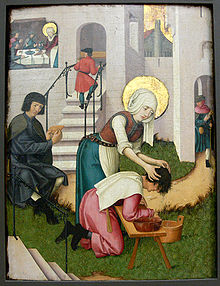
The name was borne by a 3rd-century Egyptian saint who found her way to Switzerland while marching along with the Theban legions. She is considered the patron saint of hairdressers as she was known for converting young native Swiss women to Christianity while washing and styling their hair. There is a shrine dedicated to St. Verena in Zurich, Switzerland.

The name has been popular in Germany and Switzerland and has even experienced some usage in the United States during the 18th and 19th-centuries, no doubt, brought over by German immigrants. It is also an especially common name among Mennonite, Hutterite and Amish families and is a popular name among Egyptian Christians.

It is also the name of a fictional goddess in the popular fantasy/video game series Warhammer. She is the goddess of healing and learning and is based on both Minerva and Athena.

Currently, Verena is the 383rd most popular female name in Germany, (2011).

Other forms of the name include:

  • Virina (Coptic)
  • Vérène (French)
  • Verena Верена (English/German/Italian/Russian/Slovene)
  • Werena (Polish)
  • Frena (Romansch)
  • Varena (Romansch)
  • Vreni (Swiss-German)
  • Vreneli (Swiss-German)


Cillian, Killian

Gender: Masculine
Origin: Gaelic
Meaning: debated
(KILL-yen); (KIL-lee-en)

The name is either derived from the Gaelic, keallach, meaning, “strife,” or the word, ceall meaning, “church; monastery.”

Killian is usually the anglicized version and its one of the few Irish names used outside the English speaking world. It has been in usage in Germany, Poland and France, no doubt, due to the associations with the saint.

It was borne by Saint Killian, the author of the Life of St. Bridget, he was also a missionary to Artois and Franconia and is considered the patron saint of Franconia.

In modern day Bavaria, the name is still quite popular, often rendered as Kilian.

The name is also borne by actor Cillian Murphy.

Kelly is occasionally used as a nickname.

The feast day of St. Killian is July 8.

Currently, Cillian is the 21st most popular male name in Ireland, (2010). His rankings in other countries are as follows:

  • # 43 (Austria, Kilian, 2010)
  • # 62 (Northern Ireland, Cillian, 2010)
  • # 62 (Ireland, Killian, 2010)
  • # 88 (Germany, Kilian, 2011)
  • # 110 (France, Killian, 2009)
  • # 173 (France, Kilian, 2009)
  • # 763 (United States, Killian, 2010)

Other forms include:

  • Quilià (Catalan)
  • Killianus (Dutch/Latin)
  • Killian (English)
  • Kelian (French)
  • Kilien (French)
  • Kilian (German/French/Polish/Romanian)
  • Cillín (Irish-Gaelic)
  • Chiliano (Italian)

Obscure feminine forms include:

  • Kiliane (French)
  • Kiliana (Polish)

Leonie, Léonie, Leona, Leon

Origin: Greek
Meaning: “lion.”
(Eng: lee-OWE-nee; lee-OWE-nuh); Germ (LE-o-nee); Fre (lay-o-NEE)
(Eng: lee-ON; Germ LE-own; Fre (lay-OWn)

Leonie is currently a very popular name in the German-speaking countries, she ranked in at # 1 Austria (2008), she was the 3rd most popular in Germany (2009), the 4th most popular in Liechtenstein (2009) and the 4th most popular female name in all of Switzerland (2008).

In France, she ranked in at # 67 (2006) and at # 251 in the Netherlands (2008) and has yet to hit the U.S. top 1000.

The name Leonie is from the French feminine name, Léonie, which is a French form of the Latinate, Leona, a feminine form of the Greek male name Leon, which comes directly from the Greek word for “lion.”

The name was borne by several saints, which sparked the popularity for both the male and female forms.

In the United States, Leon ranked in as the 501st most popular male name, the highest he peaked in the United States was in 1921, coming in as the 74th most popular male name. In other countries, his rankings are as follows:

  • # 62 (England/Wales, 2008)
  • # 75 (Ireland, 2007)
  • # 184 (the Netherlands, 2008)
  • # 39 (Norway, 2007)
  • # 62 (Scotland, 2008)
  • # 35 (Slovenia, 2005)
  • # 56 (Sweden, 2007)
  • # 2 (Switzerland, 2008)

Lionel is an old French diminutive form that is now exclusively used as an independent given name.

The Latin for of Leo is a cognate, a name which I shall dedicate a separate entry to in another installment.

Other forms of the male form include:

  • Levon (Armenian)
  • Léon (French)
  • Leonius (Late Latin)
  • Leonas (Lithuanian)
  • Leone (Italian)
  • Liun (Romansch)
  • León (Spanish)

Feminine forms include:

  • Leona (English/Italian/Polish/Spanish)
  • Léonie (French)
  • Léonne (French)
  • Leonie (German)
  • Leonia (Late Latin)

Designated name-day for Leonie is January 10 (Germany).