Anna, Anne

Gender: Feminine
Origin: Biblical Hebrew
Meaning: “grace.”
(ANN; AHN). (ANN-uh; AHN-nah). (HANN-uh; HAHN-nah)

Anne is possibly one of the quintessential classic English and French female names. Prior to the 18th-century, it seems that every other girl born in England was either named Anne, Jane or Mary. There were several British and French queens who bore this simplistic moniker, including the ill fated Anne Boleyn, the mother of Elizabeth I. The history of Anne is rather long and complicated.

It was foremost popularized through the cult of St. Anne, a legendary figure who was said to be the mother of the Virgin Mary and the grandmother of Christ.

In Brittany, the name became especially popular because it happened to coincide with the name of an ancient Celtic goddess, her cult being replaced by St. Anne’s. In fact, it was borne by one Breton Princess, Anne of Brittany.

The name was introduced into Britain by the French-Normans after the invasion in 1066. Previously, there had been a minor Saxon king named Anna, but in this case the name is related to the Saxon arn (eagle). Anna and Anne are still occasionally used as male given names in Friesland.

Other than the apocryphal saint, the name Anne can be traced directly back to the Bible. In the New Testament, it is the name of a prophetess who predicts the Crucifixion of Christ.

Anna (Αννα), is the Greek translation of the early Hebrew Channah חַנָּה, usually transliterated as Hannah, meaning “grace.”

Hannah is borne in the Old Testament by the faithful mother of the prophet, Samuel.

Hannah has always been popular among Jewish families, but was virtually unheard of among non-Jews before the Reformation, except in some cases where it may have been used as a diminutive form of Johanna, spelled Hanna.

It was the Byzantines who had introduced the Anna form to the world, making it popular throughout Eastern and Southern Europe. It was a very popular name among the Byzantine royal family and it was borne by the majestic Anna of Byzantium.

Anna may be the more melodic form of the bunch, but Anne’s minimalistic qualities are charming. Short, to the point, no frills. It’s not a bad name, though it does lack some spice, which is why parents are probably more attracted to its more exotic alternatives. In fact, Anne only comes in at # 608 in the top 1000 female names of the United States. It is safe to say, however, that she is very much loved in the middle name spot.

Anna is currently one of the most popular female names in Europe and abroad. Her rankings are as follows:

  • # 1 (Austria, 2010)
  • # 1 (Estonia, 2011)
  • # 2 (Hungary, 2010)
  • # 3 (Ana, Georgia, 2010)
  • # 3 (Iceland, 2010)
  • # 4 (Ana, Croatia, 2010)
  • # 4 (Czech Republic, 2010)
  • # 4 (Germany, 2011)
  • # 4 (Ukraine, 2010)
  • # 5 (Faroe Islands, 2010)
  • # 5 (Ana, Portugal, 2010)
  • # 6 (Armenia, 2010)
  • # 6 (Ane, Greenland, 2002-2003)
  • # 6 (Ana, Romania, 2009)
  • # 6 (Ana, Serbia, 2010)
  • # 7 (Latvia, 2011)
  • # 7 (Russia, 2011)
  • # 8 (German-speaking Switzerland, 2010)
  • # 9 (Denmark, 2011)
  • # 10 (Netherlands, 2010)
  • # 10 (Northern Ireland, 2010)
  • # 10 (Norway, 2010)
  • # 11 (Italy, 2010)
  • # 12 (Ireland, 2010)
  • # 14 (Poland, 2010)
  • # 16 (Catalonia, 2010)
  • # 26 (Canada, B.C., 2010)
  • # 28 (Italian-speaking Switzerland, 2010)
  • # 28 (United States, 2010)
  • # 29 (Scotland, 2010)
  • # 40 (France, 2009)
  • # 46 (French-speaking Switzerland, 2010)
  • # 53 (Belgium, 2009)
  • # 63 (England/Wales, 2010)
  • # 71 (Australia, 2010)
  • # 81 (Sweden, 2010)
  • # 83 (Spain, 2010)
Other forms of the name include:
  • Anneen (Afrikaans/Low German)
  • Anna Анна (Afrikaans/Albanian/Armenian/Breton/Bulgarian/Catalan/Corsican/Czech/Dutch/English/Estonian/Faroese/Finnish/French/Frisian/German/Greek/Hungarian/Icelandic/Italian/Latvian/Limburgish/Maltese/Polish/Russian/Ukrainian/Scandinavian/Slovak)
  • Anne (Basque/Dutch/English/French/Scandinavian)
  • Gánna Га́нна (Belarusian)
  • Annaig (Breton)
  • Annick (Breton)
  • Maina (Breton)
  • Mannaig (Breton)
  • Mannick (Breton)
  • Naig (Breton)
  • Ana Ана ანა (Bulgarian/Croatian/Galician/Georgian/Lombard/Macedonian/Portuguese/Romanian/Samogaitian/Serbian/Slovene/Spanish/Venetian)
  • Jana (Croatian/Ladino)
  • Aneta (Czech/Polish/Samogaitian/Slovak)
  • Aina (Catalan)
  • Anica (Croatian/Serbian/Slovene)
  • Ane (Danish)
  • Anika (Danish)
  • Anneke (Dutch)
  • Anneken (Dutch)
  • Annika (Dutch/Finnish/German/Latvian/Scandinavian)
  • Anka (Dutch/Frisian/German)
  • An(n)ke (Dutch/Frisian)
  • Anouk (Dutch/French)
  • Ans (Dutch)
  • Enneke (Dutch)
  • Enneken (Dutch)
  • Anita (English/German/Polish/Spanish)
  • Annette (English/French/German)
  • Anissa (English)
  • Annelle/Annella (Estonian)
  • Anete (Estonian/Latvian)
  • Anett (Estonian)
  • Anu (Estonian)
  • Anni (Finnish)
  • Annikki (Finnish)
  • Anniina (Finnish)
  • Annukka (Finnish)
  • Niina (Finnish)
  • Anaïs (French/Provençal)
  • Annouche (French)
  • Ninette (French)
  • Ninon (French)
  • Ninouk (French)
  • Anje (Frisian)
  • Ankea (Frisian)
  • Antje (Frisian)
  • Antjen (Frisian)
  • Anute (Fruilian)
  • Anano (Georgian)
  • Annchen (German)
  • Annel (German)
  • Annele (German/Latvian)
  • Anneli(e) (German/Finnish/Swedish)
  • Annet (German)
  • Anina (German)
  • Anja (German/Slovene)
  • Anouschka (German/Italian/Russian)
  • Annaki (Greek)
  • Annoula (Greek)
  • Noula (Greek)
  • Anikó (Hungarian)
  • Annuska (Hungarian)
  • Panni (Hungarian)
  • Áine (Irish)
  • Ánna (Irish)
  • Annarella (Italian)
  • Annella (Italian)
  • Annetta (Italian)
  • Annettina (Italian)
  • Nona (Italian/Romansch)
  • Ance (Latvian)
  • Annija (Latvian)
  • Anninya (Latvian)
  • Ona (Lithuanian)
  • Annamma (Malayalam)
  • Annam (Malayalam)
  • Onnee (Manx)
  • Âone (Norman)
  • Aenna/Aenne (Old High German)
  • Annehe (Old High German)
  • Änna/Änne (Old High German)
  • Neta (Piedmontese)
  • Noto (Piedmontese)
  • Anke (Plattdeutsch)
  • Anneke(n) (Plattdeutsch)
  • Analia (Romansch/Spanish)
  • Annina (Romansch)
  • Annotta (Romansch)
  • Anca (Romanian)
  • Anicuta (Romanian)
  • Anėta (Samogaitian)
  • Anėkė (Samogaitian)
  • Annag (Scottish)
  • Ghianna (Sicilian)
  • Janna (Sicilian)
  • Nanna (Sicilian)
  • Anniken (Swedish)
  • Ann (Welsh)
  • Nan (Welsh)
  • Nanno (Welsh)
  • Nanw (Welsh)
  • Aana (Wolof)
As for the Hannah forms

Hanna without an H is the prefered form on Continental Europe, usually pronounced (HAHN-nah) and in French like Anna. Hanna and Hanne (HAHN-neh) are also used as diminutive forms of Johanna/Johanne in the Netherlands, Sweden, Norway, Denmark and Germany. There is the Hungarian Hajna pronounced (HOY-no). The Czech/Slovak form of Hana nickname Hanka. There are the Yiddish forms of Heyna, Hayna, Hejna (all pronounced like HAY-nah) including the diminutive forms of HenaHende, Hendel and Henye.  The Polish diminutive form of Hania, which might make an interesting alternative to Anya or Hannah. Hannah, Hanna and Henna are all used in the Middle East.

Of course, how could we ever forget the popular diminutive forms of Annie and Nan.
Ava

Gender: Feminine
Origin: German/Persian
Eng (AY-vah); Germ/Per (AH-vah)

This vintagy, two syllable name has risen way up to the US top 10, coming in at # 5 most popular female name in the United States, (2010).

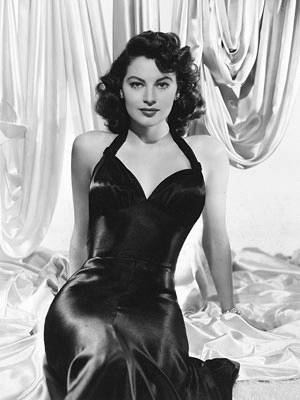
The name was relatively rare before 2000, and came out of nowhere, thanks, no doubt, to such Hollywood trendsetters as Heather Locklear and Reese Witherspoon, both of whom used the name for their daughters in the late 1990s. Both actresses named their daughters in honour of actress, Ava Gardner (1922-1990), whose full name was Ava Lavinia Gardner.

The name has several different origins and meanings, the beloved English counterpart is probably derived from a medieval Frankish name, which was borne in the 9th-century by a saint and the daughter of King Pepin II. In this case, it might be derived from the Germanic element avi meaning “desired.” Other sources have related it to the Frisian awa (water) or from the old Saxon, aval (power).

Another notable bearer is Ava of Melk (1060-1127), a Medieval poetess credited as being the first German language writer. Its recent popularity in German-speaking countries may in part be in tribute to her millennial anniversary and in part to Hollywood.

The name is also a popular Persian female name and is commonly used in Iran and throughout Central Asia. It can either be related to the Persian meaning, “sound, voice” or it may be connected with the Avestan word meaning “first.”

In Ireland and Scotland, it is sometimes used as an anglicized form of Aoife.

Its rankings in other countries are as follows:

  • # 3 (Scotland, 2010)
  • # 6 (Canada, B.C., 2010)
  • # 6 (Ireland, 2010)
  • # 11 (England/Wales, 2010)
  • # 14 (Australia, 2010)
  • # 20 (Northern Ireland, 2010)
  • # 188 (Germany, 2011)
  • # 246 (France, 2009)
  • # 444 (the Netherlands, 2010)

Delphine, Delfina

Gender: Female
Origin: French
Meaning: “dolphin”
(del-FEEN)

This French classic was quite popular in the English-speaking world during the early 19th-century, now seen as a sort of vintage classic, the name may hold appeal to those who are endeared to such names as Josephine, Louise or Marguerite.

The name has its origins in the Greek male name, Delphinos, who, in Greek mythology was a dolphin lord under the god Poseidon.

When his master was wooing the beautiful Naiad Amphitrite, Poseidon demanded Delphinos to seek Amphitrite and to propose to her on his behalf. When Delphinos found the Naiad and brought her before the sea god, Poseidon made Delphinos into a constellation in gratitude for his services.

Alternately, the name could also be taken from the Greek city, Delphi, which ultimately has the same origin as Delphinos, meaning “dolphin.”

In the mortal world, the name first made its appearance in France around the 14th-century. It was borne by a Provençal saint. It was thereafter commonly used among the French aristocracy.

The name was also the subject of a famous French book entitled Delphine by Anne Louise Germaine de Staël, (1802).

The Delphinium plant has the same root and meaning as the name Delphine.

In English, delphine is also used as the adjectival form of dolphin.

Currently, Delfina is the 15th most popular female name in Argentina, (2009).

Other forms of the name include:
  • Delphia (Greek)
  • Delphina (Latin)
  • Delphinia (Latin)
  • Delfina (Italian/Polish/Spanish)
  • Delfino (Provençal)

It also has some male incarnations such as the French Delphin (del-FAHn). Other forms include

  • Delfin (French/Polish)
  • Delphinos (Greek)
  • Delphinus (Latin)
  • Delfino (Italian/Spanish)

Its designated name-day is November 9th.

Daniel, Danielle

Gender: Masculine
Origin: Biblical Hebrew
Meaning: “God is my Judge.”

If you are like me, you probably think Daniel is dull and overused. Then there is the other camp who might think this is a wonderful classic. It has the youthful nickname options of Dan and Danny and its used in just about every European country with such variants as the Italian Daniele and the Czech and Polish diminutive forms of Danek. Another plus is that, while the name has religious connotations, its doesn’t adhere to a specific denomination. It is fair game for both Jewish and Christian parents alike, Catholic and Protestant. It is even used among Muslims.

The name Daniel is found in the Old Testament, (it has its own book), composed of the Hebrew elements dan meaning “judge” and the 1st person possessive singular suffix of i plus El which was a reference to God.

As for the Biblical Daniel himself, according to the Bible, he was a Jewish boy who was captured by the Babylonians and employed as a sort of dream-reader, (sounds like a pretty cool job). Daniel was so good at his job that he eventually became famous, even among his Persian and Babylonian captives. Due to his prestige and influence, Daniel was also able to persuade his captors to release the Jews back to their homeland. There is far more to the Biblical Daniel’s story than I will write here, but he is probably most noted for his steadfast loyalty to his faith and people as well as his miraculous survival after being thrown in a den of lions.

In the United States, Daniel has been steadfast in its popularity. He currently comes in at # 5. Meanwhile, in the United Kingdom, he comes in at # 7. In Scotland at # 3. In Ireland # 4. While in Spain he comes in at a whopping # 2.

This forms is also used in the Czech Republic, Finland, French-speaking countries, German-speaking countries, Poland, Portuguese-speaking countries, Romania,  Scandinavia, Slovakia and Spanish-speaking countries

Other forms include :

  • Dana (Afrikaans)
  • Danieli (Albanian)
  • Danyal دانيال (Arabic)
  • Taniel (Armenian)
  • Danel (Basque)
  • Danilo (Bosnian/Croatian/Serbian)
  • Deniel (Breton)
  • Danail Данаил (Bulgarian)
  • Danelu (Corsican/Sardinian/Sicilian)
  • Daan (Dutch/Limburgish)
  • Daniël (Dutch)
  • Daaniel/Taaniel (Estonian)
  • Tanel/Tani (Estonian)
  • Taano/Tanno (Estonian)
  • Taneli/Tatu (Finnish)
  • Dāniyyêl דָּנִיֵּאל (Hebrew: Modern)
  • Dániel (Hungarian)
  • Daniló (Hungarian)
  • Dános (Hungarian)
  • Daniele (Italian: dahn-YAY-lay)
  • Daniello (Italian: an archaic version which died out in the 17th-century)
  • Danilo/Danilio (Italian: obscure)
  • Danielius (Lithuanian)
  • Daniilu Данїилъ (Old Church Slavonic)
  • Dani داني (Persian)
  • Daniyal دانيال (Persian)
  • Danil/Dănuṭ (Romanian: duh-NOOTS)
  • Daniil Даниил (Russian)
  • Daniele/Danijel (Slovene)
  • Dani/Däne/Dänu/Danü (Swiss-German: Bern dialect)
  • Danyal/Danyel(Turkish)
  • Deiniol (Welsh)

Czech diminutives are: Dan, Daník, Daneček, Danoušek, Danny, Dandýsek, Dady, Danda, Dáda, Danda, Dannys, Danušík and Dandýsek, Italian diminutive forms are: Nilo, Danio, Danino and Nilio.

Danya Даня is a common Russian and Ukrainian diminutive form.

Let us not forget its feminine versions of Daniella, Daniela and Danielle. As of 2010, its Spanish and Slavic diminutive form of Dania reached the top 1000, coming in as the 999th most popular female name in the United States.

The French Danielle, does not have the same staying power as its masculine counterpart. Though always more common as a middle name, Danielle is one of the quintessential names of the 1980s. In 1987, she came close to reaching the top 10 by hitting # 14. In the last popularity census, Danielle still comes in rather high at # 144.  Its Latinate counterpart of Daniela comes in a tad bit higher at # 121, while the Italian Daniella is all the way down at # 303.

Other forms are:

  • Danijela (Bosnian/Croatian/Serbian/Slovene)
  • Danaila (Bulgarian)
  • Daniela (Czech/German/Polish/Portuguese/Romanian/Scandinavian/Slovene/Spanish)
  • Danielle (English)
  • Danièle (French)
  • Danelia (Italian: obscure)
  • Daniella (Italian)
  • Danila/Danilla (Italian: obscure)

Italian feminine diminutives are : Dana, Dania and Nila.

Designated name-days are: July 21 (Germany/Hungary/Slovakia), December 10 (Poland/Lithuanian), December 11 (Denmark, Estonia, Finland, France, Norway, Sweden), December 17 (Greec/Czech Republic)

Regina

Gender: Feminine
Origin: Latin
Meaning: “queen.”
Eng (reh-JEE-nah); Old Eng (reh-JYE-nah); It (ray-JEE-nah); Sp (rey-HEE-nah); Pol/Russ (reh-GHEE-nah).

The name is of late Latin origins and in the Middle Ages, was popularized by a French saint.

Saint Reine/Regina was a virgin martyr whose cult was especially popular in the area of Autun France. Her feast day is September 7th.

In Medieval England, the name was used as a epithet for the Virgin Mary, referencing her as Queen of Heaven. The name fell out of usage after the Reformation and was revived in the 19th-century.

Other famous Reginas include a concubine to Emperor Charlemagne (708); she was the mother of Drogo and Hugh.

Currently, the name is borne by Regina Spektor (b.1980).

Other forms include:

Regina (Croatian/Dutch/English/German/Italian/Lithuanian/Polish/Romansch/Swedish)
Regína (Czech/Hungarian/Slovak)
Regine (Danish/German/Norwegian)
Regiina (Estonian)
Reine (French: archaic)
Régine (French)
Gina (Italian/English)
Reggina (Italian)
Reginella (Italian)
Reginetta (Italian)
Reina/Reyna (Spanish/Estonian)

An obscure Italian male form is Regino.

Source

  1. http://www.behindthename.com/php/find.php?name=regina

Samantha

Gender: Feminine
Origin: Uncertain
Meaning: unknown
Eng (sə-MAN-thə); Fre (SAH-mAWn-TAH)

The name is of unknown derivation or meaning, some sources believe that it may have been an 18th-century feminization of the Biblical male name, Samuel, which means “heard by God”, while others believe it to be a smush of Sam and the Greek female name Antha, meaning “flower.”

The name seems to have first appeared in Colonial America.

Currently, Samantha is the 11th most popular female name in the United States, and the highest she has ranked in U.S. naming history was in 1998, coming in as the third most popular female name. The lowest Samantha has ranked in U.S. history was 1907 when she came as the 945th most popular female name.

The earliest records of U.S. naming trends, which goes far back as 1880, indicates that Samantha was 352nd most popular female name of that year.

Samantha’s popularity may have been due to the hit 1960’s SitCom Bewitched, in which the lead character, named Samantha Stephens, was a witch born in the 16th-century, who decides to settle down in contemporary society.

Whatever Samantha’s origins, its long historical usage in the United States has rendered it a legitimate name, her usage has even gone overseas. Her rankings in other countries are as follows:

  • # 40 (Australia, 2007)
  • # 21 (Canada, B.C., 2008)
  • # 261 (the Netherlands, 2008)
  • # 137 Samanta (Poland, Warsaw, 2009)
  • # 90 (Scotland, 2008)

Samantha is also used ocassionally in French-speaking countries and German-speaking countries, although, Samantha does not currently appear in Germany’s top 500 names (2008).

Samanta has recently become trendy in Central Europe and Italy. An obscure French form is Samanthée.

In English, the most common pet forms are Sam and Sammie.

Italy has given Samantha the name-day of November 1st.

The name is borne by:

“Aunt” Samantha Bumgarner (1878-1960), considered the first recorded female country artist, she was known for her work with the fiddle and banjo in the early 1900s.

Samantha Barning (b.1989) Dutch professional Badminton player

1970s/80s Dutch Radio Presenter, Samantha Dubois, (née Ellen Kraal)/

British model and pop singer, Samantha Fox (b.1966)

Chloe, Chloë, Chloé

Gender: Feminine
Origin: Greek
Meaning: “young green shoot.”
Χλοη
Eng (KLO-wee); Fre (klo-AY)

Currently the 10th most popular female name in the United States, the name is of Greek origin and its meaning refers to a recently budding plant.

In Ancient Greece, the name was used as an epithet for the Greek goddess Demeter.

The name also appears in the New Testament, where it is the name of a woman mentioned by Paul in one of his epistles.

The name also appears in Ancient Greek romance written by Longus, Daphnis & Chloe.

In the English speaking world, the name has been in and out of usage since at least the 18th-century. Between 1944 and 1981, Chloe did not even make it to the U.S. top 1000. For the last decade, Chloe has been one of the most popular female names in the English speaking world.

In other countries, its popularity is as follows:

  • # 2 (Australia, 2008)
  • # 17 (Belgium, 2006)
  • # 2 (Canada, B.C., 2008)
  • # 6 (England/Wales, 2008)
  • # 4 (France, 2009)
  • # 9 (Ireland, 2008)
  • # 6 (Isle of Man, 2008)
  • # 9 (Northern Ireland, 2009)
  • # 6 (Scotland, 2009)
  • # 2 (Switzerland, among French-speakers, 2008)

Chloë and Chloe are both used in the English speaking world, without the diacritic (that is the two dots over the E), she is used in Germany, Poland, the Netherlands, Scandinavia, the Czech Republic and Slovenia.

Other forms include:

  • Chloé (French)
  • Kloé (Hungarian)
  • Cloe (Italian)
  • Cloé (Portuguese)

The name is borne by actress American actress, Chloë Sevigny (b.1974)

Emily, Emil

Gender: Feminine
Origin: Latin
Meaning: “rival.”
(EM-ih-LEE)

The name is an anglicization of the Roman gens name Aemilius which was derived from the Latin aemulus meaning, “rival.”

Contrary to popular belief, Emily is not related to the Germanic, Amalia/Amelia, which is most likely derived from the Germanic element, amal, meaning “to work.”

Emily is just the English feminine form of the Germanic, Emil.

It is believed that Emily was introduced into the English speaking world in the 18th-century, after the German Hanover line had inherited the British throne, but evidence shows that Emily had been in usage in England since at least Norman times and that it may have been introduced through the Normans in 1066.

The name was borne by famous American poet, Emily Dickenson (1830-1886) and by English novelist and poet, Emily Brontë (1818-1848).

In modern history, Emily has been extremely popular in the English speaking world for at least a decade. She is currently the 3rd most popular female name in the United States-2008, and was # 1 in 2007, but was overthrown by the similar sounding Emma.

The lowest that Emily has ranked in U.S. history was in 1962, coming in as the 274th most popular female name.

In other countries, her rankings are as follows:

  • # 5 (Australia, 2008)
  • # 3 (Canada, B.C., 2008)
  • # 72 (Chile, 2006)
  • # 3 (England/Wales, 2008)
  • # 7 (Germany, 2009)
  • # 4  (Ireland, 2008)
  • # 3 (Isle of Man, 2008)
  • # 8 (Luxembourg, 2008)
  • # 137 (the Netherlands, 2008)
  • # 6 (New Zealand, 2009)
  • # 6 (Northern Ireland, 2009)
  • # 4 (Scotland, 2009)

Its more Latinate counterpart of Emilia is as follows:

  • # 6 (Faroe Islands, 2008)
  • # 9 (Finland, among Finnish-speakers, 2007)
  • # 2 (Finland, among Swedish-speakers, 2007)
  • # 3 (Iceland, 2004-2007)
  • # 5 (Liechtenstein, 2008)
  • # 401 (United States, 2008)

Its masculine counterpart has never been widely used in the English speaking world, but has been a long time favorite in Northern Europe.

The last time Emil was seen in the U.S. top 1000 was in 1984, coming in at # 967.

The highest that Emil ever ranked in U.S. naming history was at # 90, back in 1881, the same year that the United States saw a huge influx of Scandinavian immigrants.

Currently, Emil is the 5th most popular male name in Norway (2007) and the 9th most popular in Sweden (2007).

Other forms of Emily are:

  • Emiliya Емилия (Bulgarian)
  • Emílie (Czech: eh-MEEL-yeh)
  • Emilý (Faroese)
  • Émilie (French: ay-mee-LEE. 24th most popular female name in Belgium-2006; 41st most popular in France-2006; 292nd most popular in the Netherlands-2008.)
  • Émilienne (French)
  • Eimíle (Gaelic-Irish)
  • Emelie (German/Swedish: 48th most popular female name in Sweden; EM-eh-LEE)
  • Emilie (German/Danish/Dutch/Norwegian/Swedish: EM-ih-LEE)
  • Emele (Hawaiian)
  • Emilía (Icelandic)
  • Emilia (Italian/Dutch/Estonian/Faroese/Finnish/Polish/Romanian/Scandinavian/Spanish: 16th most popular in Chile-2006; 97th most popular in England/Wales-2008; 18th most popular in Sweden-2007).
  • Emiliana (Italian/Portuguese/Romanian/Spanish)
  • Emilietta/Milietta (Italian: obscure diminutive form that were used as independent given names)
  • Aemilia (Latin: ay-MEE-lyah)
  • Aemiliana (Latin)
  • Emīlija (Latvian)
  • Emilija (Lithuanian/Serbian/Croatian/Slovene)
  • Emília (Portuguese/Hungarian/Slovak: 83rd most popular female name in Hungary-2008)
  • Emilja (Slovene)
  • Emilijana (Slovene)
  • Emila (Spanish: obscure, Emilia is more common)

Masculine forms include:

  • Emilli (Basque)
  • Emilion (Breton)
  • Milig (Breton)
  • Emil Емил (Bulgarian/Serbian)
  • Emili (Catalan)
  • Emiel (Dutch)
  • Eemil (Estoanian/Finnish)
  • Eemeli (Finnish)
  • Émile (French)
  • Émilien (French)
  • Amil (German)
  • Emil (German/Croatian/Czech/Faroese/Hungarian/Icelandic/Norwegian/Polish/Slovene/Swedish)
  • Emilián (Hungarian)
  • Emiliano (Italian/Spanish)
  • Emilietto (Italian: obscure diminutive form that was used as an independent given name)
  • Emilio (Italian/Portuguese/Spanish)
  • Miliano (Italian: obscure contracted form)
  • Aemilianus (Latin)
  • Aemilius (Latin/Dutch)
  • Aimil (Manx/Scottish)
  • Emilian (Romanian)
  • Emilij (Russian)
  • Jemilijan (Russian)
  • Emilijan (Serbo-Croatian/Slovene)
  • Ymil/Yjmil (Silisian: a dialect of Polish)
  • Emilijano (Slovene)
  • Emilij (Slovene)
  • Emilijo (Slovene)

The name-days for Emily/Emilia are:  May 19 (Finland); May 23 (Poland); June 24/30 (Poland); July 19 (Hungary); August 19 (Poland); November 14 (Sweden); November 24 (Poland/Slovakia).

The name-days for Emil are: January 31st (Slovakia); May 22 (Czech Republic/Poland); May 28 (Hungary); July 18 (Bulgaria); August 5/8 (Poland); August 8 (Bulgaria); October 6/11 (Poland).

The masculine and feminine forms are borne by several saints and Emilia is the name of at least three Shakespearean characters.

Common English diminutives are Em, Emmie and Millie. A Spanish diminutive is Emilita. A Slavic diminutive is Emilka; in Polish it is sometimes Milcia.

Ethan

Gender: Masculine
Origin: Hebrew
Meaning: “strong; enduring; solid.”
Eng (EE-then); Heb (ay-TAHN)

Currently the 3rd most popular male name in the United States, Ethan is a Biblical Hebrew name that is mentioned eight times in the Bible.

Not much is known about the Biblical Ethan, other than that it was the name of a possible magi or cymbal player of King David.

The name’s popularity is relatively recent. It was not used much outside the Jewish community until after the Protestant Reformation, even then, the name was still very uncommon.

In 1880, Ethan did not appear in the U.S. top 1000, in 1884, he suddenly appeared coming in at # 613, then fell out of the top 1000 the next year, coming in again at # 846 in 1886.

For the next 80 or so years, Ethan had had a history of disappearing from the top 1000 every few years, and then reappearing, but never ranking very high. It wasn’t until, starting in 1956, that Ethan remained steadily in the top 1000 each year.

For ’56, he was the 948th most popular male name.

Ethan jumped several places towards the end of the 1980s. He came in at # 236 in 1988 and then jumped a couple hundred spots the following year, cracking the top 100, he came in at # 87 for 1989.

In 2002, he hit the top 10, coming in at # 5.

His popularity in other countries are as follows:

  • # 10 (Australia, 2007)
  • # 36 (Belgium, 2006)
  • # 1 (Canada, B.C., 2008)
  • # 15 (England/Wales, 2008)
  • # 24 (France, 2006)
  • # 46 (Ireland, 2007)
  • # 31 (Scotland, 2008)

Other forms of the name include:

  • Etan (German/Polish)
  • Aithan Αιθαν (Greek: Biblical)
  • Eitan/Eytan אֵיתָן (Hebrew: Modern)

The name is also borne American revolutionary Ethan Allen (1738-1789) and by actor, Ethan Hawke (b. 1970).

It is also the name of the protagnostis in Edith Wharton’s novel Ethan Frome (1911)

Michael

Gender: Masculine
Origin: Hebrew
Meaning: “who is like God?”
Eng (MI-kel)

One of the most prevalent male names in the Western World, and to a certain extent, the Middle Eastern world, the name is derived from a rhetorical Hebrew question מִיכָאֵל (Mikha’el) meaning “who is like God?” or “who is like El” the answer being that no one is like God.

This is in reference to the legend of when one of God’s most powerful angels, (Lucifer depending on the theological tradition), became so arrogant and prideful that he built an army of angels in order to overthrow the throne of God, thinking that he himself could be like God, Michael is believed to have smite the fallen angel, asking him the question “who is like God?” after casting him out of the gates of heaven.

According Mormon saint theology, “who is like God?” refers to the idea that Michael was Adam before he was created by God in human form. The meaning of the name explains that all humans are created in God’s image.

Michael is believed to be a powerful angel in Islamic, Christian and Jewish tradition. He appears several times in the Bible, being mentioned in the Book of Daniel, the Book of Jude and the Book of Revelations. He even appears in the apocryphal Book of Enoch.

In Roman Catholicism, Michael is referred to as St. Michael the Archangel and is considered a powerful saint, especially powerful against demonic attacks and is the patron saint of chivalry, the warrior, police officers, paratroopers, firefighters, soldiers and fighter pilots. Among German Catholics, he is the patron saint of Germany, and in Belgium, he considered the patron saint of Brussels.

In the Eastern Christian tradition, is known as Taxiarch Archangel Michael or simply as Archangel Michael.

In Jewish tradition, Michael is the protector and heavenly warrior of Israel and the advocate of the Jews.

In Islam, he is mentioned in the Qu’ran once, in Sura 2:98 and that Michael was a good angel who stood on the left hand of God (Allah’s) throne.

The archangel is also important in the Bahai faith and the New Age religions.

He plays a role in John Milton’s epic poem, Paradise Lost.

There is no reason to explain why Michael is so popular, especially in the U.S. As of 2008, Michael was the 2nd most popular male name. He was moved down from the 1st position down to the 2nd position back in 1999, when he was overthrown by Jacob.

Between the years 1954 and 1999, Michael was the most popular male name. The lowest that Michael ever ranked in U.S. naming history was in 1892 when he came in as the 59th most popular male name in the United States. In other countries, Michael’s rankings are as follows:

  • # 36 (Australia, 2007)
  • # 36 (Canada, B.C. 2008)
  • # 4 (Denmark, 2009)
  • # 52 (England/Wales, 2008)
  • # 10 (Ireland, 2007)
  • # 239 (the Netherlands, 2008)
  • # 33 (Scotland, 2008)

The Michael form is also used in Afrikaans, Danish, Czech, German and Ripoarisch.

Other forms of the name include:

  • Mëhill/Mhill (Albanian)
  • Mighel (Amazigh/Moroccan)
  • Mikhael/Mikail ميخائيل‎, (Arabic/Coptic)
  • Miguel (Aragonese/Galician/Portuguese/Spanish: mee-GEL)
  • Mikael Միքաել (Armenian)
  • Micael (Asturian)
  • Mikayıl (Azeri)
  • Mikel (Basque)
  • Mitxel (Basque)
  • Miquèu (Bearnais/Occitanian/Gascon/Provençal)
  • Mickaël (Breton)
  • Mikael (Breton/Finnish/Icelandic/Norwegian/Swedish: a Finnish diminutive form is Mika)
  • Mihail Михаил (Bulgarian/Russian: Misha is the most common diminutive form)
  • Michjeli (Calabrian: Chjeli is the diminutive mee-KYAY-lee)
  • Miquel (Catalan: mee-KEL. Quelo is a common diminutive form)
  • Myghal (Cornish)
  • Michal (Czech/Slovak: mee-HAHL: 15th most popular male name in the Czech Republic-2007)
  • Mihajlo/Mihovil (Croatian: diminutive form is Miho)
  • Mihail Михаил (Croatian/Serbian)
  • Mikkel (Danish/Norwegian/Swedish: 6oth most popular male name in Norway-2007)
  • Maikel (Dutch: MY-kel)
  • Michaël (Dutch/Frisian: mee-kah-EL)
  • Michiel (Dutch: 307th most popular male name in the Netherlands-2008)
  • Miikael/Mikhel (Estonian)
  • Mikko (Finnish)
  • Michel (French: MEE-shel)
  • Michêl (Fruilian)
  • Mícheál (Gaelic-Irish)
  • Mìcheal (Gaelic-Scotch)
  • Micheil (Gaelic-Scotch)
  • Mikheil მიხეილი (Georgian)
  • Mikhael/Mikhalis Μιχάλης/Μιχαήλ (Greek: Μίκης (Mikis) is the common pet form))
  • Mikala (Hawaiian)
  • Micha’el מִיכָאֵל‎, (Hebrew)
  • Mihály (Hungarian: 60th most popular male name in Hungary-2008. Misi and Miska are the most common pet forms. MEE-hie)
  • Mikhael (Indonesian)
  • Michea (Italian: obscure/archaic mee-KAY-ah)
  • Michele (Italian: mee-KAY-lay)
  • Michelino (Italian: obscure)
  • Miķelis/Mihails (Latvian)
  • Mykolas (Lithuanian)
  • Mikail (Malayalam)
  • Mikiel (Maltese)
  • Mikaere (Maori)
  • Migueltzin (Nahuatl)
  • Michè (Neopolitan)
  • Miché/Michi (Norman)
  • Miqueu (Occitanian)
  • Mikhailu Мїхаилъ (Old Church Slavonic)
  • Michał (Polish/Sorbian: mee-HOW)
  • Mihai/Mihail (Romanian: diminutive form is Mihaita)
  • Micheli/Mikelli/Migali (Sardinian)
  • Mihailo Михаило (Serbian)
  • Miceli (Sicilian: Celi is a diminutive form. mee-KAY-lee)
  • Miha (Slovene: originally a diminutive form of Mihael, now used exclusively as an independent given name, it was the 11th most popular male name in Slovenia-2005)
  • Mihael (Slovene: 86th most popular male name in Slovenia-2005)
  • Mikâil (Turkish)
  • Mikhailo/Mykhailo Михайло (Ukrainian)
  • Michełe (Venetian)
  • Meical (Welsh)

English diminutive forms are: Mick, Micky, Mike and Mikey. German diminutive forms are Maik (pronounced like Mike), Maiki, Michi and Micki. A Swiss-German dialectical diminutive is is Michu (Bern)

There are also forms that mean “Michael Archangel” and are used in reference to the angel. These are:

  • Michelangelo (Italian)
  • Michelarcangelo (Italian)
  • Michelangiolo (Romansch)
  • Mihangel (Welsh)

Michelangela is an Italian feminine form.

An Italian smush is Michelantonio.

The feminine form of Michelle (an English corruption of the French feminine form Michèle), has been used in the English speaking world since the early 20th-century.

It currently ranks in as the 103rd most popular female name, and the highest it peaked was # 2, in the years 1968, ’69 and again in ’71, ’72.

Its Latinate feminine form has recently sparked in popularity as well (see Michaela for more details)

Other feminine forms include:

  • Micaela (Asturian)
  • Mikelle (Basque)
  • Miquèla (Bearnais)
  • Mikaela (Breton)
  • Miquela (Catalan/Occitanian/Gascon/Provençal)
  • Michelle (English/German: a phonetic corruption of the French Michèle)
  • Michèle (French)
  • Michéline (French: mee-shay-LEEN)
  • Michaelina/Michaeline (Irish: an Irish corruption of the French Micheline and the Italian, Michelina, common diminutive form is Micki/Micky. MY-keh-LEEN-ah; MY-keh-LEEN)
  • Michela (Italian: mee-KAY-lah)
  • Michelina (Italian: mee-kay-LEE-nah)
  • Michalina (Polish: mee-ha-LEE-nah: Michalinka and Misia are the diminutive forms)
  • Miguela (Spanish)
  • Miguelina (Spanish)

The designated name-day for Michael is September 29.