Hierotheos

  • Origin: Greek Ἱερόθεος
  • Meaning: “sanctified by God.”
  • Gender: Male
  • Eng (hy-RO-thee-us)

The name is composed of the Greek words, ἱερός (holy to; sacred to) and θεός (God). It first appears as a given name in Christian tradition, being borne by the first bishop of Athens who was said to have been converted and trained by St. Paul himself.

The modern Greek form is ‘Ierotheos and the designated name-day in Greece is September 29th.

The name has also been borne by several Greek patriarchs.

International Variations

  • Hiruthiyus هيروثيوس (Arabic – Egyptian)
  • Hieroteu (Catalan, Portuguese)
  • Hiérothée (French)
  • Hierotheusz (Hungarian)
  • Ieroteo (Italian)
  • Hieroteusz (Polish)
  • Ierotei (Romanian)
  • Ierofej Иерофей (Russian)
  • Jerotej Јеротеј (Serbian)
  • Hierotej (Slovenian)
  • Jeroteo (Spanish)
  • Yerofej Єрофей (Ukrainian)

Sources

Lubomir, Lubomira

  • Origin: Slavic
  • Gender: masculine
  • Meaning: “love & peace.”

Lubomir is composed of the Slavic elements, lubo (love) & mir (peace).

Its Czech form of Lubomír was one of the most popular male names in the Czech Republic between 1935-2006, it peaked at #16 in 1959.

Other forms include:

  • Ljubomir Љубомир Љубомир (Bosnian, Macedonian, Serbo-Croatian, Slovene)
  • Lubomir Любомир (Bulgarian, Polish)
  • Lyubomir Лыѹбомир (Old Church Slavonic, Russian)
  • Lubomierz (Polish)
  • Ľubomír (Slovakian)
  • Lyubomyr (Ukrainian)

Diminutives & Short Forms

  • Ljubiša, Ljubo (Bosnian, Bulgarian, Serbo-Croatian, Slovene)
  • Luboš (Czech)
  • Ljube, Ljupcho, Ljupčo (Macedonian)
  • Ľuboš (Slovakian)

Feminine forms are

  • Ljubomira (Bosnian, Bulgarian, Macedonian, Serbo-Croatian, Slovene)
  • Lubomíra (Czech)
  • Lubomira (Medieval Slavic, Polish)
  • L’ubomíra (Slovak)
  • Lyubomyra (Ukrainian)

Sources

Snezhana

Gender: Feminine
Origin: Croatian/Bulgarian/Serbian/Macedonian/Russian
Meaning: “snow.”
(snyeh-ZHAH-nah)

The name is derived from the Slavonic element sneg, meaning “snow.” Other sources contend that the later part is derived from the word žena meaning woman, however, there seems to be a masculine form that pre-dates the feminine form, Snežan, and in that case, it would be rather unlikely that the suffix is related to žena. Snow White is often transliterated as Snezhana in Bulgarian, Russian and other South Slavic languages. In 2005, it was the 5th most popular female name in Macedonia.

Other forms of the name include:

  • Snezhala (Bulgarian: snyeh-ZHAH-lah)
  • Sniježana/Snježana (Croatian/Slovene: snee-yeh-ZHAH-nah; snyeh-ZHAH-nah)
  • Snježna (Croatian: SNYEHZH-nah)
  • Śnieżka (Polish: very obscure, also a direct translation of Snow White in Polish. SHNYESH-kah)
  • Snezhana Снежана (Russian/Bulgarian/Macedonian/Ukrainian: snyeh-ZHAH-mah)
  • Snežana Снежана (Serbian)
  • Sneža/Snežka/Snežna (Slovene: Sneh-zhah, Snesh-kah, Snezh-nah)
  • Snežanka/Snežica (Slovene: sneh-ZHAHN-kah, sneh-ZHEET-sah)

Southern Slavic masculine forms are: Snežan, Snježko and Snježan.

The designated name-day in Bulgaria is December 14, in other countries, it is August 5.

Svatoslav

Gender: masculine
Origin: Old Slavonic
Meaning: “blessed glory.”

The name is composed of the Old Slavonic elements svyanto meaning “blessed, holy, bright” and slav meaning “glory.” In the Czech Republic, its designated name-day is December 3rd. A common Czech diminutive form is Svatoš.

Other forms of the name are:

  • Světoslav (Czech)
  • Svyatoslav Святослав (Bulgarian/Russian/Ukrainian)
  • Swietosław (Polish)
  • Svätoslav/Svetislav (Slovakian)
  • Svetislav/Svetoslav (Serbo-Croatian)

Maximilian

Durer Maximilian I 1518 BRGender: Masculine
Origin:  Latin
Meaning: “one who is great.”

The name is derived from the Roman cognomen Maximilianus which refers to someone of greatness. The name was borne by a 3rd century martyr. It was borne by several other Christian martyrs, including Maximilian of Lorch, a Christian martyr of Austrian heritage and Maximilian of Antioch. The name was especially popular amongst the Habsburgs, starting with Frederick III who gave it to his son Maximilian I (1459-1519) to honour the two ancient Roman generals Fabius Maximus and Cornelius Scipio Aemilianus, in this case the name was suppose to be a blend of Maximus and Aemilianus. It was also borne by Maximilian II of the Holy Roman Empire, another Habsburg (1527-1576). Maximilian I Duke Bavaria (1573-1651), Maximilian II Emanuel, Elector of Bavaria (1662-1726), Maximilian III Joseph, Elector of Bavaria (1727-1777), Maximilian I of Bavaria (1756-1825), Maximilian II of Bavaria (1811-1864), Prince Maximilian of Baden (1867-1929) and Maximilian I of Mexico (1832-1867). It was also borne by a 20th-century Polish Catholic priest who was killed at Auschwitz known as St. Maximilian Kolbe.

In recent years, in the United States, the name has grown significantly in popularity, it currently comes in at # 300 of the Top 1000 Male Names. It is popular in other countries, especially in Germany and in Sweden. In Sweden, it was the 88th most popular male name in 2007. Its designated name-day is October 12. Other forms of the name include (listed alphabetically by nationality):

  • Maximilián (Czech/Slovak)
  • Maximiliaan (Dutch)
  • Maximilien (French)
  • Miksa (Hungarian)
  • Massimiliano (Italian)
  • Maksymilian (Polish)
  • Maksimiljan/Makso (Serbo-Croatian/Slovenian)
  • Maximiliano (Spanish/Portuguese)
  • Maksimilian/Maks (Russian/Ukrainian)

Feminine forms include:

  • Maximiliana (Czech/Slovak, German, Spanish, Portuguese)
  • Maximilienne (French)
  • Massimiliana (Italian)
  • Maksymiliana (Polish)

A common diminutive is Max

Magdalena, Madeleine, Madeline

Gender: Feminine
Origin: Latin
Meaning: “of Magdala.”

We have the exotic and sophisticated Magdalena, the French classic Madeleine and the English trend setter Madeline.  The origins of these names go all the way back to the Bible, the New Testament to be exact. It is derived from a title given to the famous Catholic saint, Mary Magdalen, also known as Mary of Magdala. Magdala, being the town that the former prostitute turned follower of Christ, hailed from, a town on the sea, near Galilee, its meaning being “tower.”

In the Middle Ages, St. Mary Magdalen was a beloved saint, making the name popular in virtually every European country, evolving into myriad different forms. The cult of St. Mary Magdalen was especially popular in France, where she was known as La Madeleine (lah mah-deh-LEN). In fact, tradition holds that, after the death of Christ, Mary Magdalen travelled to France, where she converted many of the early inhabitants to the new faith. She is considered one of France’s patron saints and it is believed that her bones were buried in France. La Madeleine gave her name to several communes in France as well as a river. It is even the name of a famous French pastry.

While you are out rushing to work, standing in line, getting your daily fix of Starbucks, you may notice that at the front counter there are packages of a soft little sponge-like cookie. These are madeleines or petit madeleines. They are a popular snack in France, made from lemon and butter, and are known for their distinctive shell shape. Legend has it that they acquired their name from the lady who invented them, Madeleine Paulmier. They are a delightful little treat, and I recommend that the next time you are at Starbucks, you should try them yourself.

Likewise, Madeleine has been a very popular choice in Great Britain and currently ranks in as the 80th most popular feminine name in Britain and Wales for 2007, while in its home country of France, it comes in rather low. It was the 454th most popular feminine name in France for 2006.

Let us not forget the fun and sweet version of Madeline (MAD-eh-LINE), Madeline seems to be specifically a North American version of the French form. Originally pronounced (MAD-eh-LIN), its preferred pronunciation has switched over to the former in the last decade, no doubt due to the popular children’s series of books of the same name.

Madeline has been quite popular the last few years, she ranked in at a whopping 61 in the 2007 most popular feminine names in the United States. She has also made her mark in other non-British English speaking countries, such as Canada and Australia. In Canada she came in at 85, while in Australia 93.

There is also the trendified corrupted form of Madelyn, which currently comes in at # 104, however, it is advisable to use the French spelling if you prefer the (Mad-eh-lin) pronunciation, which seems to be the goal of the parents of the Madelyns.

Nicknames include Maddie, Leine and Lynn. The name is borne by Princess Madeleine of Sweden, Madeleine Albright, and author Madeleine L’Engle.

Let us now move on to its Eastern European alternative of Magdalena (MAHG-dah-LAY-nah). This form is used in Spain, the Czech Republic, Slovakia, Bulgaria and Poland. It is especially popular in both Poland and the Czech Republic where it is often shortened to Magda, and occasionally Lenka. There are the Czech spin offs of Alenka and Madlenka, used as an independent name.

Magdalena might be appealing to English speaking parents who love the nickname Maggie but really dislike Margaret. On top of that, it can be shortened to appealing and trendy Laney or even Lena.

Other forms of the trio include:
  • Magdalawit (Amharic/Eritrean)
  • Maialen (Basque: MY-ah-LEN)
  • Madenn (Breton)
  • Miglena (Bulgarian)
  • Alena (Czech-Slovak and occasionally used in Germany. Diminutive form is Alenka)
  • Magdaléna (Czech)
  • Mahulena (Czech: a form created by Czech author, Julius Zeyer, for his his Ráduz and Mahulena-1898)
  • Magdalene (Danish)
  • Magdalone/Malene/Lone (Danish)
  • Malle/Madli (Estonian pronounced MAHL-leh and MAHD-lee) other forms include Mall, Leen (LANE), Leena and Made (MAH-deh)
  • Matleena (Finnish pronounced maht-LAY-nah) diminutive forms now commonly used as independent names include: Leen, Leena and Lenita)
  • Magdeleine (French: archaic form)
  • Leni (German: originally a diminutive form, it has recently become trendy in German speaking countries as an independent name)
  • Madelene (German: mah-deh-LEH-neh: other forms include, Madlene and Madlen)
  • Magdalini (Greek Modern-pronounced mahg-dah-LEE-nee)
  • Magdolna (Hungarian, pronounced mog-DOH-noh) diminutive forms now popularly used as independent name in Hungary are Lenke (LEHN-keh) and Duci (DOOT-see).
  • Madalein (Irish-Gaelic)
  • Mailin (Irish-Gaelic)
  • Maddalena (Italian pronounced mahd-dah-LAY-nah. Other forms include Maida, Madina and Magdala)
  • Madala (Latvian) another form is Magone
  • Talena (Latvian/Scottish)
  • Maguelone (Occitanian)
  • Madalena (Portuguese pronounced mah-dah-LAY-nah)
  • Maclaina (Romansch pronounced mugg-LIE-nah) other Romansch forms include Madina, Madlaina (mudd-LIE-nah) and Madlena (mudd-LEH-nah).
  • Madalina (Romanian pronounced mah-dah-LEE-nah)
  • Magdalina Магдалина (Russian)
  • Manda (Serbo-Croatian/Macedonian/Slovene)
  • Madlena (Sorbian)
  • Malin/Målin (Swedish/Norwegian pronounced MAW-lin, other forms include Malena and Madicken (MAH-dee-KEN)
  • Mädi (Swiss-German: dialectical form from Bern MAD-dee)
  • Magdalyna (Ukrainian)
  • Madałena (Venetian)

Other popular offshoots include the English corrupted form of Madelaine (MAD-eh-LANE): given to the daughter of David Duchovny and Téa Leoni. The dated German forms of Marlene (Eng mar-LEEN; Germ mahr-LEH-neh) & Marla and the Polish Marlena.The designated name day for all of these names is July 22.

French diminutives are Mado and Madelon. Polish diminutive forms are: Madzia, Magda, Magdunia, Magdusia and Magdeczka. Hungarian diminutives are, Duci

There are a few Italian masculine forms and that includes, Maddaleno, Magdalo and Maido.


Bohuslava

  • Gender: Feminine
  • Meaning: God’s glory.”
  • Origin: Czech0-Slovak, Ukrainian
  • (bo-hoo-SLAH-vah)

The name is a feminine form of Bohuslav which is derived from the old Slavonic elements bog meaning “god” and slava meaning “glory.” In the Czech Republic, its designated name day is July 7. The Polish forms are the popular Bogusław and the feminine Bogusława (boh-goo-SWAHF); (bo-goo-SWAH-vah).

Bohuslav was borne by famous Czech Composer Bohuslav Martinů (1890-1959). It was also borne by Polish magnate Bogusław Radziwiłł (1620-1669).

Wanda

Gender: Feminine
Origin: Polish
Pol (VAHN-dah); Eng (WAHN-duh).

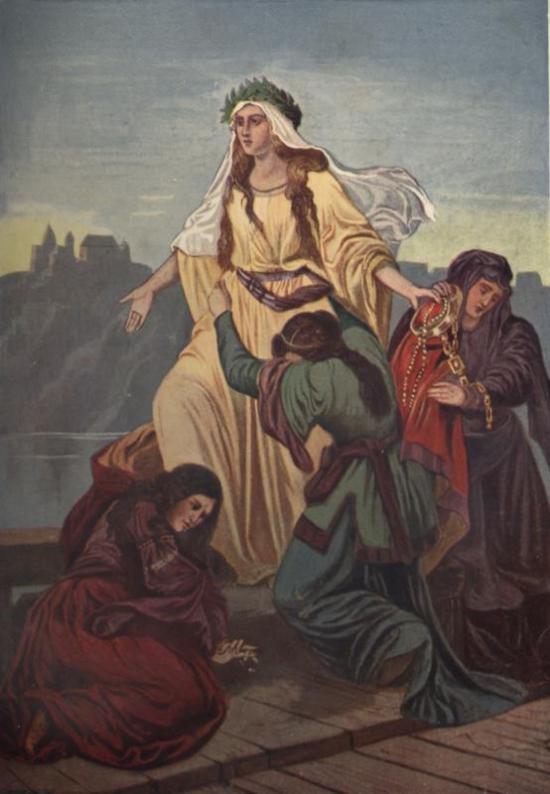
The name first appeared in a legend presented by Polish historian, Wincenty Kadlubek (12-13th century). In his version of the legend, Wanda was the daughter of a Polish king Krak, (founder of the city of Krakow), who inherited her father’s throne. An evil German prince wanted to marry her and take over the Polish lands, but the princess repelled him and drove him to suicide. The prince threw himself into the Vistula. Wanda went on to live a happy and long life, remaining a virgin and vowing to be married only to her country. The most famous account, however, is completely different. In the most beloved form of the tale, rather than have her country taken over by the German invaders, Wanda threw herself into the Vistula. In Poland, she is a symbol of the nation, representing the sacrifice and hardship of the nation of Poland throughout its history. She is a symbol of Polish independence and its victory over German imperialism.

Tradition has it that she is buried in one of the seven mounds of Krakow. Till this day, the Wanda Mound (Kopiec Wanda) rests on the outskirts of Krakow, (in what is now known as the suburb of Nowa Huta).

Wanda is probably one of the very few Polish names that became popular in the English speaking world. It was introduced via author Ouida who used it for heroine in the novel Wanda (1888). The name no longer ranks in the U.S. top 1000, but was once a fairly popular name, coming in at # 47 in 1934, the highest the name ever ranked in U.S. naming history.

Many sources list the name as being a derivative of the Ancient Germanic wend, a name for a group of people who lived near and around the Vistula, however, some Lithuanian sources have argued that it is derived from an ancient Baltic element vanduo meaning “water” while many others speculate that its true origins have been lost and that its true introduction into the world was through Kadlubek.

In Poland, a popular nickname option is Wadzia (VAHD-jah). An alternative is the Czech/Slovak, Italian and Lithuanian, Vanda. There is also the elaborated Swedish name Wendela, though it is speculated if she is truly related to Wanda or if  in fact she is a completely different name of Germanic origins. The name has experienced occasional usage in Germany, Spain, Brazil, Hungary and Russia.

Coincidentally, Vanda is the name of species of orchid indigenous to the Indian subcontinent and Indochina. In this case, Vanda is of Sanskrit origins.

Sophia, Sophie, Sofia

Gender: Female
Origin: Greek
Meaning: “wisdom.”
(so-FEE-yuh); (so-FYE-uh)

A long time Greek classic, the name suddenly appeared in the U.S top 100 circa 2000, and budged itself into the # 6 spot in 2007.

Sophia comes directly from the Greek, and was often used as a personification for Wisdom in philosophical, Christian, Jewish and Gnostic texts.

In Christian lore, Saint Sophia was the mother of three Christian martyrs, Hope (Elpida), Faith (Pisti) and Charity (Agapi). She supposedly died from grief after the death of her daughters, and is now one of the most revered saints of the Eastern Christian churches, making the name a longstanding classic throughout Eastern Europe and modern Greece.

Sophia is the Greek spelling, which seems to be the most worn form in the Western World. However, Sofia is the variation often used in continental Europe.

Sophia was not introduced into the English-speaking world until the 18-century, when it was introduced into the British Family Tree by the German Hanovers, from whose line the names Sophie and Sophia often appear.

In English, the pronunciation of so-FEE-yah, and so-FYE-uh are interchangeable. The former is more of a modern import, and the most popular. The latter is the older English pronunciation of the name, which is seldom heard in the States but is occasionally heard in Britain.

Other forms the name include:
  • Zofiya (Amharic/Ethiopian)
  • Soffi/Soffiya (Armenian)
  • Sachveja/Sofiya (Belorusian: Zosja is a diminutive form)
  • Sofija София (Bulgarian)
  • Sofia (Catalan/Finnish/German/Italian/Norwegian/Occitanian/Portuguese/Romanian/Slovak/Swedish: in 2007, this was the 59th most popular female name in Norway and the 44th most popular in Sweden)
  • Sònia (Catalan)
  • Sofija (Croatian/Serbian)
  • Sofie (Czech: SOFE-yeh)
  • Soňa (Czech/Slovak: a translation of the Russian diminutive form, Sonya)
  • Žofia/Žofie (Czech/Slovak: ZHOFE-yah, and ZHOFE-yeh. Diminutive forms are: Žofka and Žofa.)
  • Såffi (Danish: an old Danish form of Sophia)
  • Sofie (Danish/Dutch/German/Norwegian/Swedish: so-FEE Scand; zo-FEE German. In 2008, she was the 35th most popular female name in the Netherlands, and in 2007, she was the 10th most popular female name in Norway and the 85th most popular in Sweden)
  • Fie (Dutch: originally a diminutive form, now used as an independent given name, FEE-e)
  • Soovi (Estonian)
  • Sohvi (Finnish)
  • Sophie (French/English/German/Dutch. In 2008, this was the 74th most popular female name in the United States, the 12th most popular in Canada, the 7th most popular in England and Wales and the most popular female name in the Netherlands and Scotland. In 2007, it was the 8th most popular female name in Australia)
  • Sonja (German/Estonian/Finnish/Polish/Scandinavian/Serbian/Slovene/Sorbian: a translation of the Russian diminutive form, Sonya).
  • Sonje (German: ZONE-yeh)
  • Sophia Σοφία (Greek Modern/English/Estonian/Italian)
  • Suffi/Suffia (Greenlandic)
  • Szonja (Hungarian)
  • Zsófia (Hungarian: ZHOH-fee-aw. In 2005, this was the 5th most popular female name in Hungary. A common diminutive form is Zsófika)
  • Soffía (Icelandic)
  • Sonia (Italian/Romanian)
  • Sofija/Sofja (Latvian)
  • Sofija/Zofija/Zopija (Lithuanian)
  • Sofija/Sofijana (Macedonian: Sofa is a diminutive form)
  • Sofija (Maltese)
  • Sophi (Persian)
  • Sofi (Plattdeutsch)
  • Zofia (Polish: diminutive forms are: Sonka, Zochna, Zocha, Zofka, Zońka, Zosia, Zośka, Zosieńka, and Zosia (ZOH-shah)
  • Sónia (Portuguese-European)
  • Sônia (Portuguese-Brazilian)
  • Sofiya/Sofya София (Russian/Ukrainian: Russian diminutives include Sonya, which is used as an independent given name in other European countries, but seldom in Russia)
  • Zofija (Slovene)
  • Sofía (Spanish/Galician/Faroese, in 2006, she was the 17th most popular female name in Spain and the 5th most popular in Chile. Spanish diminutives include Chofa, Fifi, SoficitaSofí and Sofita)
  • Sofya (Turkish)
  • Tzofiya (Yiddish)
Masculine forms include Sofko (Bulgarian), Sofus/Sophus (Danish/Norwegian/Swedish) and Sofio (Italian).

The designated name-days are: May 15 (Austria/Germany), May 25 (France), September 17 (Greece), September 30 (Lithuania/Spain),