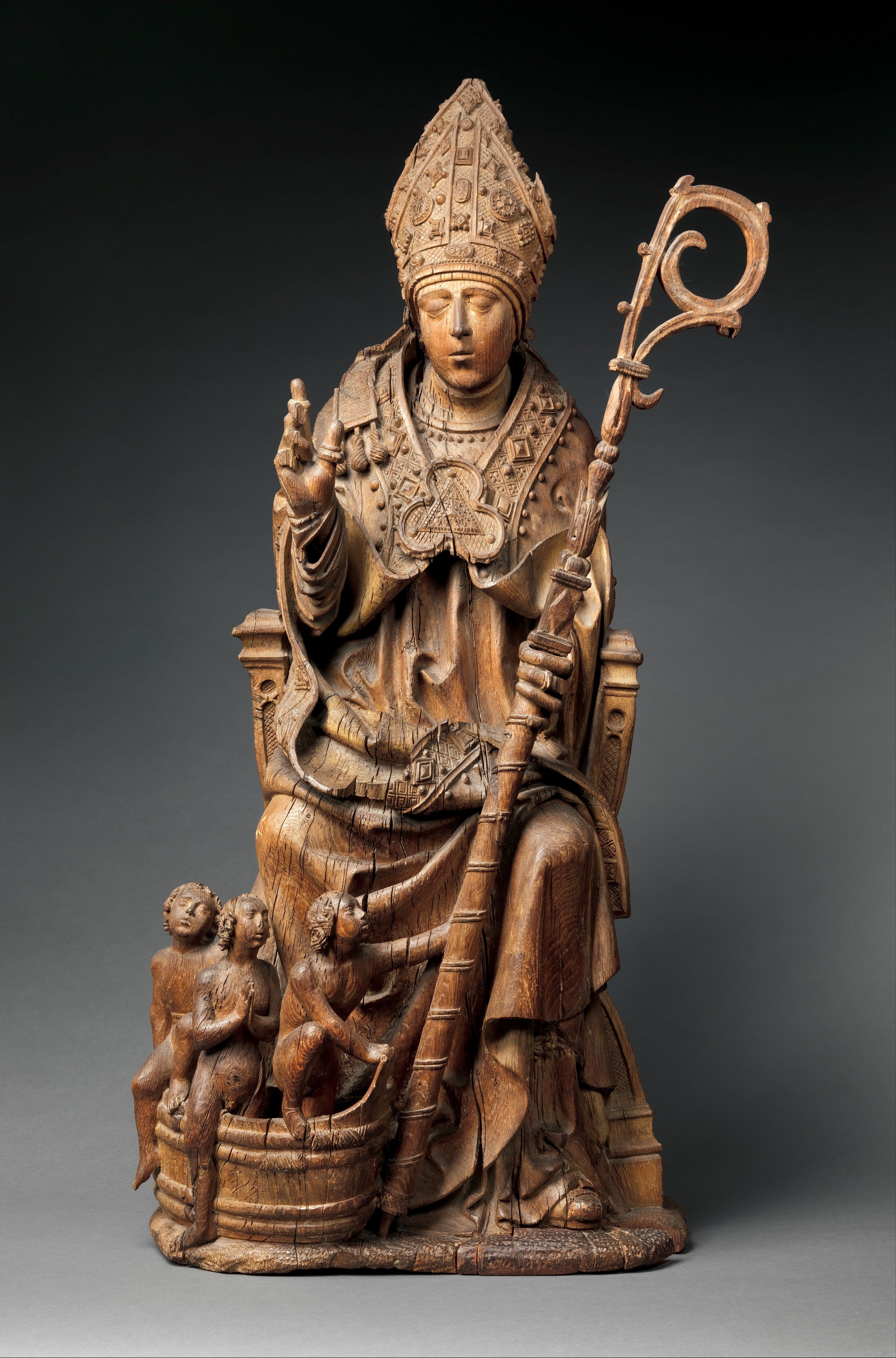
The name comes from the Sanctuary of Arantzazu located in Oñati, Spain. According to legend, the Virgin Mary appeared to Rodrigo de Balanzategui in 1468, to which he exclaimed “Arantzan zu?!” (thou, amongst the thorns?!). It ultimately comes from the Basque meaning, “place of hawthorns.”
Our Lady of Aránzazu is the patron saint of Guipúzcoa.
Aránzazu is it’s Galician and Spanish rendition.
Arantza is a diminutive used as an independent name and may also just be used in reference to the Basque word for a hawthorn.
Arancha is its Spanish form and Aranza is its Galician form.
Arantza’s designated name-day in Spain is September 9th.
The name is composed of the Old Slavonic elements, stracho (fear) and mir (peace). Strachomir is the Polish form, it is first recorded in Poland in 1386 but has since fallen out of use.
It spun off the Medieval Czech and Polish male name, Strachota, which was used as a vernacular form of the Greek name, Methodius which also means “fear.” A hypothetical female form would be Strachomira.
Hypothetical Polish diminutive forms would be, Stracha, Strachot, Strasz, Straszech, Straszek, and Straszko.
The South Slavic forms are Strahimir Страхомир,Strahomir Страхимир, and Strashimir Страшимир.
Strashimirite is a type of mineral which was discovered by Bulgarian minereologist Jordanka Minčeva-Stefanova who named it after Bulgarian minerologist, Strashimir Dimitrov (1892–1960).
Strashimira Страшимирa is a Bulgarian feminine form and it is borne by Bulgarian volleyball player, Strashmira Filipova (b. 1985).
The designated name day in Croatia is September 9.
Sources
A. Cieślikowa (red.), Słownik etymologiczno-motywacyjny staropolskich nazw osobowych, t. 1, Kraków 2000, ISBN 83-87623-23-7
Zenobia is composed of the Greek elements, Zeus (Zeus) and bios (life). It was notably borne by a 1st-century Armenian queen of Georgian descent and later a 3rd-Century Queen of Palmyra who tried to expand into Roman territory but was defeated by Emperor Aurelian.
Zenobia of Palmyra’s name might have been a Hellenized form of her birth name, Bat-Zabbai, which is from the Aramaic meaning “daughter of Zabbai.” Zabbai itself is an Aramaic male name. It seems to be a theophoric name, meaning “gift of–.” The latter part refers to an unknown deity. It may have actually been an Aramaic form of the Hebrew female name, Bathsheba.
Speculation has also linked it with the Arabic female name Zaynab, which can either mean “father’s beauty” or be from the name of a type of flowering tree.
It was borne by the 3rd-century martyrs, Ss. Zenobia and Zenobius, two early Christians who were siblings and beheaded under Emperor Diocletian. Their feast and name-day is October 30.
In the English-speaking world, it is first recorded in Cornwall and Devon, England in the 16th-century. Early English forms of Synibie, Sinobie, Senobie, Cenobie, and Cenoby (Sen-e-bee; SIN-e-bee), would make interesting revivals in the spirit of Sydney and Willoughby. A common English diminutive was Nobby.
Zenobia appeared in the U.S. Top 1000 Most Popular Female names between 1881-1925, peaking at #669 in 1909.
Zenobia is no stranger to English literature, it is the name of a character in Nathaniel Hawthorn’s The Blithedale Romance (1852); Edith Wharton’s Ethan Frome (1911); and is even used by Anne Rice in her the eighth book of her vampire series, Blood and Gold (2001).
Zenobia “Nobby” Hawthorne appears as a character in the P.G. Wodehouse series, Jeeves.
Tina Fey used this as the middle name of daughter, Alice Zenobia.
S.L. Uckelman. “Zenobia”. In S.L. Uckelman, ed. The Dictionary of Medieval Names from European Sources, Edition 2023, no. 1. http://dmnes.org/2023/1/name/Zenobia.
S.L. Uckelman. “Zenobius”. In S.L. Uckelman, ed. The Dictionary of Medieval Names from European Sources, Edition 2023, no. 1. http://dmnes.org/2023/1/name/Zenobius.
The root name is the Frankish Audomar, which is composed of the elements aud (wealth, fortune), and mari (fame).
It was borne by an 8th-century saint and monk, an abbot of St. Gall, Switzerland and a 7th-century Frankish saint, after whom the French commune of St-Omer was named.
The name is Hebrew, either derived from צל (tsel) (shadow) or צלל (tsalal) (to ring like a bell). In Genesis 4:19, it is the name of one of the two wives of Lamech.
Though it never became a widespread Jewish name until recently, it had usage in the Protestant Anglo world since the 16th-century and experienced mild popularity in the mid to late 19th-century. It appeared in the U.S. Top 100 between 1881 and 1886, peaking at #679. It was borne by Zillah Oakes (circ. 1870s), the namesake of the city of Zillah, Washington. It was also borne by New Zealand Politician, Zillah Smith Gill (1859-1937).
In English literature, Lord Byron used it as the name of the wife of Abel in his 1821 play, Cain. It is the name of a servant in Emily Brontë’s Wuthering Heights (1847), and the name of the titular heroin in the 1865 operetta by Australian composer, William Wilkins Russell. In recent years, it is the name of a character in Madeleine L’Engle’s, A Swiftly Tilting Planet (1978).
It may have occasionally been used as a form or short form of Cecilia.
The name is derived from the Latin perpetuus, meaning “continous; perpetual.” It was borne by a 3rd-century Christian matyr and saint, the companion of St. Felicity and it was also the name of the sister of St. Augustine of Hippo.
Perpetua and its various forms have been in sporadic use throughout the Catholic world. In Italy, it became synonymous with a priest’s housekeeper. This is due to the eponymous character in Alessandro Manzoni’s 19th-century novel, “The Betrothed.“
It experienced sporadic use in England in the 1920s after the release of the now lost 1922 film, Perpetua also known as Love’s Boomerang.
It has recently appeared in English literature as the name of minor characters in Bridget Jones’s Diary (Helen Fielding), and in the Harry Potter series (J.K. Rowling).
It was borne by Scottish landscape painter, Perpetua Pope (1916-2013).
It is the name of Cape Perpetua Oregon which was named for St. Perpetua as well as a typeface.
It’s designated name-day is February 1, March 6th and March 7th.
Bogoljub is composed of the South Slavic elements, bog (God) and ljub (love). It was originally a South Slavic vernacular form of Theophilus and Amadeus.
Its designated name-day in Croatia is March 7th and March 30 in Slovenia.
Common diminutive forms include: Bole, Bogo, Bogi, Bojan, Bojica, Bojko, Ljubo and Ljuban.
It is borne by Serbian Statesman, Bogoljub Jevtić (1886–1960), Serbian Businessman, Bogoljub Karić (b. 1954), and Serbian basketball player, Bogoljub Marković (b. 2005).
Its feminine form is Bogoljuba, and affectionate forms include Boba, Bojana, Bojka, Ljubica.
Usage: Arabic-speaking world, most of the Islamic world
Gender: Female
Meaning: “little butterball.”
The name is derived from the Arabic rootز-ب- د (z-b-d), which pertains to “cream, foam, butter,” along with the Arabic feminine diminutive suffix, roughly translating to “little cream” or “little butter,” having the same sense as “cream of the crop.”
This was the sobriquet of Zubaidah bint Ja’far (766–831), the wife of Harun al-Rashid. Borne as Sukhainah or Amat al-‘Aziz, she was known for her construction of wells and reservoirs along the pilgramage routes to Mecca and is featured in The Thousand and One Nights. Her life was later the inspiration behind the character of Zobeide in the German opera Abu Hassan by Carl Maria von Weber.
The Turkish form of the name, Zübeyde, was borne by an Ottoman princess, the daughter of Sultan Ahmed II, who lived from 1728 to 1756. It was also carried by Zübeyde Hanım (1856–1923), the mother of Mustafa Kemal Atatürk. The name appeared in the Top 100 most popular female names in Turkey between 1980 and 1986, peaking at #70 in 1981