Bianca, Blanca, Blanche, Branca

Gender: Feminine
Meaning: “white”
Italian (BYAHN-kah) Eng (bee-AHN-kuh); Sp (BLAHN-kah); Fre (BLOWnSH) Eng (BLANCH).

The etymology of the four above names are virtually the same. The original source is the Spanish, Blanca, which was first recorded in the 12th century, as the name of a Spanish princess, the daughter of King Garcia Ramirez of Navarre.

The name comes directly from the Spanish word for “white.”

It is uncertain how it caught on as a name, however, its meaning might have been synonymous with beauty at the time.

Others believe that it may be a direct translation of the Arabic name Elvira, brought to Spain via the Moors and later latinized as Blanca.

It has also been conjectured that it may have started off as a name given to blonde girls.

The name rapidly spread among Western European royalty due to intermarriages and ancestry. It was introduced to the English speaking world after the Norman Conquest of England.

The name was translated as Blanche in French, Bianca in Italian and Branca in Portuguese.

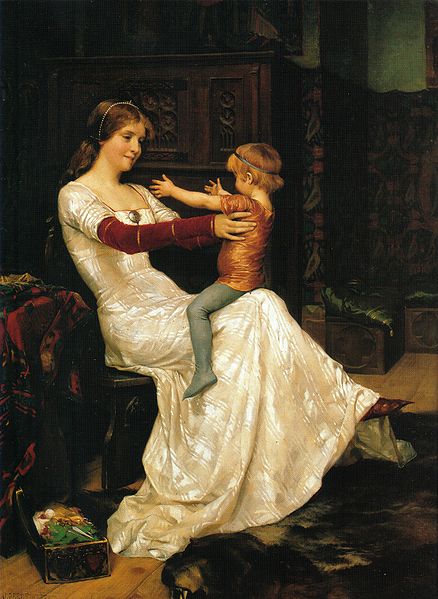
It was borne by Blanche of Champagne (1226-1283); Blanche of Artois (1248-1302); Blanche I of Navarre 1385-1444) and Blanca of Navarre (1420-1464).

Bianca became an exceedingly popular name among the Italian nobility, where it is still very popular till this day.

Blanca and Bianca have spread to Germany and particularly the Czech Republic, Poland, Hungary, Slovakia and Slovenia, where they are often rendered phonetically, as Blanka and Bianka.

Currently, Bianca ranked in as the 204th most popular female name in the United States, in Australia, she was the 76th most popular female (2007), and the 9th most popular female name in Romania, (2008). In 2009, Bianka was the 78th most popular female name in Warsaw Poland.

Blanche has not ranked in the U.S. top 1000 since 1964, when it ranked in as the 911th most popular female names, the highest it has ranked in U.S. naming history was at # 51 in 1886. Perhaps its time for a revival?

As for Blanca, she recently fell out of the U.S. top 1000, she was last seen in 2007, where she came in as the 960th most popular female name. In Spain, in 2006, she was the 45th most popular female name. In 2009, Blanka was the 31st most popular female name in Warsaw, Poland.

Other forms of the names include:

  • Zuria (Basque: a direct translation)
  • Blanca (Catalan)
  • Bijanka (Croatian/Serbian: phonetic spellings)
  • Branca (Galician)
  • Bianchina (Italian: originally a diminutive form, occasionally used as an independent given name)

Common Italian compound forms include: Biancaurora, (literally meaning “white dawn”), Biancaluisa, Biancamaria and Biancarosa, (literally meaning “white rose.”).

Italian masculine forms include: Biancardo, Bianchino and Bianco.

Dalileh

Gender: Feminine
Origin: Persian/Farsi
Meaning: “orchard; green field.”
(DAHL-lee-leh)

Note: the name has no correlation or etymological relation to the Biblical name Delilah. It appears in the Arabian Nights in the story entitled Dalilah the Crafty or Dalilah the Wiley, in which an old crone of Baghdad must figure out how to make ends meet for her and her daughter, Zaynab. Dalilah becomes a swindler, and when caught, is pardoned by the Caliph and becomes a governess, portress and carrier-of-pigeons to the Khan.

Solveig

Gender: Feminine
Origin: Old Norse
Meaning: speculated, but most populary believed to mean “sun way; path to the sun.”
Nor (sol-VIGH;VYE); Swe (sol-VAY).

The name is of Old Norse origins, composed of the elements, sol, meaning,” sun” and veig “way”or “path.” The word veig can also mean “strength,” leading some to believe that the name might actually mean “sun strength.”

Some also believe that the name is composed of the elements solr meaning “yellow coloured” or salr meaning “house, home or hall” and that the second element of the name is either from the word, vig, meaning, “battle” or the word, vigja, meaning,  “to hollow”.

Though the name is technically used throughout Scandinavia, it has been most popular in Norway, no doubt due to the symbolic character of Solveig in Henrik Ibsen’s Peer Gynt.

In the play, Ibsen uses Solveig as a symbol of redemption for the protaganist, Peer Gynt. There is a lot of play on words used throughout the play, and since Solveig represent’s Gynt’s path to redemption and salvation, the meaning of her name as “path to the sun,” is a key factor to the plot of the story.

A popular Norwegian nickname for this is Vivi.

Solveig is currently the 76th most popular female name in Norway (2007).

  • Solvej/Solvey (Danish)
  • Solveigh (German)
  • Solveig (Icelandic)
  • Solveiga (Latvian/Russian)
  • Sølvi (Norwegian)
  • Solvig (Swedish: obscure form)
  • Sylvi (Swedish/Norwegian/Finnish)

Other forms include: The name also appears in Icelandic as Sólveig, Sólveigu and Sólveigar.

Zlatko

Gender: Masculine
Origin: Bulgarian/Croatian/Czech/Macedonian/Serbian/Slovak/Slovene
Meaning: “golden; honey coloured.”
Златко
(ZLAHT-ko)

The name is derived from the Slavic word, zlata, meaning, “gold.” This form of the name referes to the honey brown golden colour. The designated name-day in the Czech Republic and Slovakia is June 12th; in Bulgaria, its October 18. Feminine versions include: Zlata and Zlatka. Another masculine form is Zlatan.

The name was borne by famous Croatian violinist, Zlatko Balakovic (1895-1965)

Hazel

Gender: Feminine
Origin: English
(HAY-zul)

The name comes directly from the English word for the plant or shrub which is classified in the birch family and produces the flavorful nut known as hazelnut.

The word itself is derived from the Anglo-saxon Haesel. Like many popular floral names, Hazel first came into usage in the 19th-century. The word hazel is also used to describe a type of eye colour that is a mixture of green and brown.

The highest she has ranked in the U.S. top 1000 is in 1897 when she came in at # 18. Hazel completely fell out of the top 1000 in 1975 and reappeared in 1998 coming in at # 940. She currently rests at # 343 and seems to be rising. In Ireland she is quite popular, coming in at # 87 in 2007.

It was the name of a popular sitcom of the 1960s.

Chiara, Clara, Clare, Claire

Gender: Feminine
Origin: Latin
Meaning: “clear; see through”

    Chiara (kee-AH-rah), (KYAH-rah), has been in usage in Italy since the early Middle Ages. Chiara is also the Italian feminine adjective for the word, chiaro meaning, “clear” or “bright.”

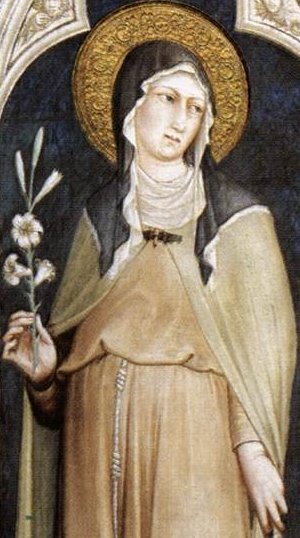
    It was borne by Saint Chiara d’Assisi. (1194-1253). She was a companion of St. Francis of Assisi, both of whom believed in self-mortification and helping the poor. Chiara decided to start an order, known as the Poor Clares, while Francis went off to start his own order known as the Franciscans.

    Chiara is still a very popular first name in Italy. In 2006, she was the 5th most popular female name.

    The French form of Claire, also came into usage during the early Middle Ages. No doubt due to the cult of the male St. Clair of Dauphine, the patron saint of tailors.

    The name came to England via the Normans in the form of Clare, and the male Latin form of Clarus was borne by a British saint of Rochester, a Benedictine monk. Both forms of Clare and Clara were very popular prior to the Reformation in England and both names were revived during the 19th century.

    In recent years, for whatever reason, the French spelling of Claire has often times been the preferred choice among American parents. In 2008, Claire came in at # 62 in the U.S  Top 1,00o Female Names, while its elder English counterpart of Clare came in at # 679. In fact, even the Latinate version of Clara is far more prevalent than Clare, coming in at # 206.

    Clara/Klara is a popular choice throughout Northern and Central Europe.

    Other forms of the name include:

    • Clarice (English/French/Italian)
    • Clarissa (English)
    • Klára (Hungarian/Czech)
    • Claritia (Latin)
    • Claritta (Romansch)
    • Bistra/Jasna (Serbo-Croatian/Slovene: both literally mean “light; clear” and are used as indigenous cognates)
    • Clarisa (Spanish)
    • Clarita (Spanish: initially a diminutive form, commonly used as an independent given name)

    Diminutive forms are the French, Clairette, the Italian, Chiaretta, Chiarina and Claretta.

    There is the masculine Latin form of Clarus and the French masculine form of Clair.

    Blerina

    Gender: Feminine
    Origin: Albanian
    Meaning: “greenery; verdure.”
    (bleh-REE-nah)

    Derived from the Albanian word blerim describing a shade of green, roughly translating as “spring-green,” the adjective is used to describe the greenery of plants, grass and leaves.

    The masculine form is Blerim (bleh-REEM).