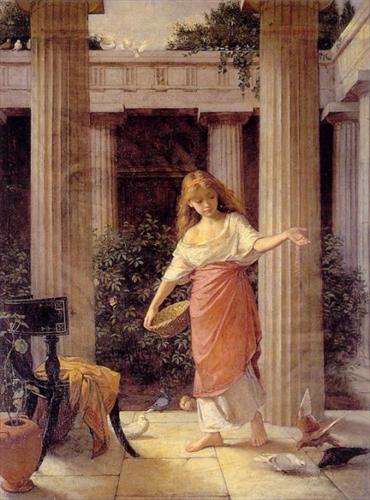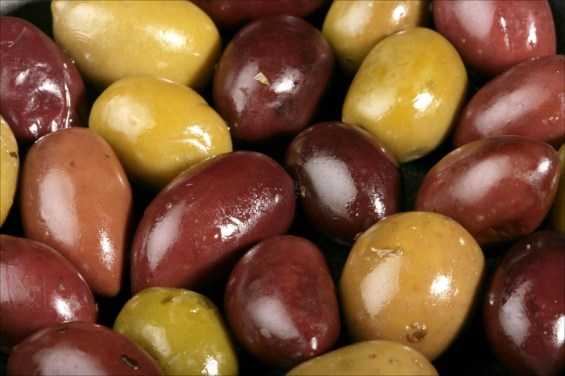
Olivia

Gender: Feminine
Origin: Latin
Meaning “olive”
(o-LIV-ee-ah)

The name is often believed to have been an invention of William Shakspeare for his play Twelfth Night, however, the name was borne by a 9th century Sicilian saint. She is considered one of the patron saints of Palermo, and legend has it that she was kidnapped by Muslim invaders and taken into slavery to Tunisia. Her captors were so impressed with her sincerity, virtue and beauty that they permitted her to remain a Christian and to live as a hermitess in a cave.

She was known for performing miracles among the local Tunisians, and many had converted to Christianity as a result. She was imprisoned and tortured and then burnt at the stake. Legend pertains that when they lit the fires at the stake, the flames would not touch her and she was decapitated instead. For whatever reason, she is also considered the patron saint of music.

The name was then possibly introduced into the English speaking world through William Shakespeare in 1599 for one of his characters in the play Twelfth Night. Since then, the name has been in usage in the English speaking world. In the States, the name has been in the top 1,000 since 1880. The name has gradually climbed its way up to the top 10 the last 20 years. In 1989, Olivia came in at # 179 the following year of 1990 saw it jump all the way up to # 72, by 2001 it reached position # 1o and as of last year, 2008, it has made itself a niche at # 6. In Poland, it is at # 5 as the most popular female name, spellt Oliwia. The name is in the top in Canada and the United Kingdom.

The name is used in virtually every European country.

Other forms include:

  • Olivija (Croatian/Serbian/Slovene)
  • Olivie (Czech: ah-LEEV-yeh)
  • Oliva (English/Italian)
  • Olive (English)
  • Olivie/Olivia (French)
  • Olivette (French: obscure)
  • Olívia (Hungarian/Portuguese/Slovak)
  • Olivana/Oliviana (Italian: obscure)
  • Oliveira/Oliviera (Italian)
  • Olivetta (Italian: obscure)
  • Oliwia (Polish: o-LEEV-yah)

Nicknames include: Ollie, Liv, and Livy. A German nickname is Livchen.

A very rare Polish masculine form is Oliwjusz.
Capucine

Gender: Feminine
Origin: French
Meaning: “hood; cape” or “nasturtium.”
(kah-poo-SEEN)

The name is derived from the Italian cappucio which was a translation of the old French word, chaperon, meaning “hood” or “cape.”

The chaperon was a type of hood that could be worn in various different styles, by both men and women, that was popular throughout Western Europe during the Middle Ages.

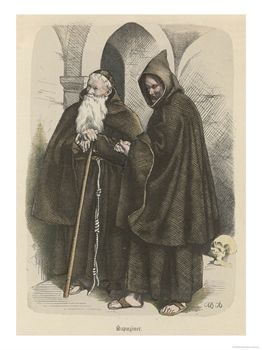
The name was given to the Capuchin Friars, an off shoot of the Franciscan order, to denote the long woolen brown hooded robes that they were especially known for.

nastThough of the same etymology as the above two words, in modern French, capucine is the word for the nasturtium plant.
The name first took off after the 1960s, due to famed actress, Capucine, star of the Pink Panther (1933-1990).

Currently, the name is very fashionable in France.

In 2006 it came in at # 96 in the Top Female name of France.

The designated name-day in France is October 5.

The nasturtium is able to survive in the fall months.

Belcolore

Gender: Feminine
Origin: Italian
Meaning “beautiful colour.”
(Bel-koh-LORE-ay)

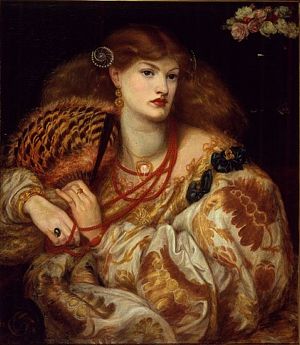
The name seems to have been in usage in Medieval Italy. The name appears once in the Florence registar of 1427, as that of the name of a woman. It is also the name of a female character in Boccaccio’s second story of the eighth day in the Decameron. Dante Gabriel Rossetti did a portrait of a Medieval Italian lady entitled Belcolore (left). The name is made up of two elements bel meaning beautiful and colore meaning colour. Nicknames could include Belle

Bleuenn

Gender: Female
Origin: Breton
Meaning “white flower.”
(blew-ENN)

    The name is the Breton counterpart to the Welsh Blodwen.

    The name has currently gained some popularity in France. In 2005, it appeared in the Top Female names of France coming it at # 735.

    Possible nickname options include “Blue”

    Variations include Bleunwenn (blewn-VEN), Bleuzenn (blew-ZEN), Bleunienn (blew-NYEN), Bleunig (blew-NEEK).

    Direct French translation would be Blanchefleur, which was a name common in the Middle Ages and appears as the name of a character in the King Arthur legends.

    Galatea

    Gender: Feminine
    Origin: Greek
    Meaning: “milky white.”
    Pronunciation (gah-lah-TAY-ah)

    The name is found in Greek mythology. It borne by a wood nymph who lived on the Isle of Sicily; she was pursued by the giant, Polyphemos, but rejected his advances and fell in love with a local mortal by the name of Acis. In his jealousy, Polyphemos bashed Acis’ skull with a rock. Grief-stricken, Galatea transformed Acis into a stream.

    Another Galatea was the object of Pygmalion’s affection. He carved a beautiful statue and fell in love with it, after praying to Aphrodite, the statue came to life and was named Galatea, due to the milky white texture of her skin.

    Possible nickname options include Gala & Tea.

    The name is used in Spanish and Italian.

    Other forms include:

    • Galateja (Bosnian/Croatian/Serbian)
    • Galateia (Czech/Portuguese/Slovak)
    • Galatée (French)
    • Galatėja (Lithuanian)

    Xanthe

    Gender: Feminine
    Origin: Greek
    Meaning: “blonde; yellow; yellow-brown.”
    Pronunciation: (ZAN-thee)
    Ξανθη

    This was the name of one of the daughters of the minor Greek god, Oceanus. She was a nephalai nymph who was responsible for yellow tinged clouds. It was also the name of an Amazon and it was borne by the wife of Aesclepius.

    In Classical Greece, the name was most likely bestowed upon fair haired girls or used as a sort of nickname for blondes, the equivalent of the English nickname, Blondie, and of the Latin Flavia.

    Blonde hair was considered an exotic trait, and was therefore a rarity, yet pertained much admiration. The Greeks considered it as a sign of divinity, in fact, the Greeks liked to believe that the Gods all had blonde hair, especially Aphrodite.

    If the idea of an X name is too much to fathom on a child, then you might prefer the slightly more tamed and Italianate Flavia or Flaviana. Xan would make an incredibly spunky nickname option.

    Another form is Xanthia and the masculine form is Xanthos (Ξανθος)