 Gender: Feminine
Origin: Latin
Meaning: “clear; see through”
Chiara (kee-AH-rah), (KYAH-rah), has been in usage in Italy since the early Middle Ages. Chiara is also the Italian feminine adjective for the word, chiaro meaning, “clear” or “bright.”
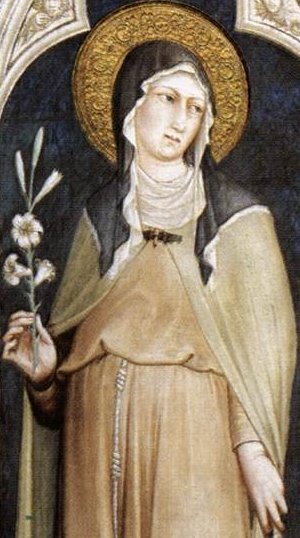
It was borne by Saint Chiara d’Assisi. (1194-1253). She was a companion of St. Francis of Assisi, both of whom believed in self-mortification and helping the poor. Chiara decided to start an order, known as the Poor Clares, while Francis went off to start his own order known as the Franciscans.
Chiara is still a very popular first name in Italy. In 2006, she was the 5th most popular female name.
The French form of Claire, also came into usage during the early Middle Ages. No doubt due to the cult of the male St. Clair of Dauphine, the patron saint of tailors.
The name came to England via the Normans in the form of Clare, and the male Latin form of Clarus was borne by a British saint of Rochester, a Benedictine monk. Both forms of Clare and Clara were very popular prior to the Reformation in England and both names were revived during the 19th century.
In recent years, for whatever reason, the French spelling of Claire has often times been the preferred choice among American parents. In 2008, Claire came in at # 62 in the U.S Top 1,00o Female Names, while its elder English counterpart of Clare came in at # 679. In fact, even the Latinate version of Clara is far more prevalent than Clare, coming in at # 206.
Clara/Klara is a popular choice throughout Northern and Central Europe.
Other forms of the name include:
- Clarice (English/French/Italian)
- Clarissa (English)
- Klára (Hungarian/Czech)
- Claritia (Latin)
- Claritta (Romansch)
- Bistra/Jasna (Serbo-Croatian/Slovene: both literally mean “light; clear” and are used as indigenous cognates)
- Clarisa (Spanish)
- Clarita (Spanish: initially a diminutive form, commonly used as an independent given name)
Diminutive forms are the French, Clairette, the Italian, Chiaretta, Chiarina and Claretta.
There is the masculine Latin form of Clarus and the French masculine form of Clair.
