- Origin: Occitanian
- Meaning: uncertain
- Gender: Female
- Eng pron: (KLAIR-e-mund)
A Medieval Occitanian name first recorded in 12th-century French chivalric literature, Clarimond (also found as Clarimonde, Claramonde, or Claramunda) is either a diathemic compound of the Latin clārus (“bright, light, clear”) and the Old High German mund (“protection”), or derived from an Occitanian phrase meaning “bright world; clear world”
In the 12th-century chanson de geste, Huon de Bordeaux, the name appears in its earlier form as Esclarmonde borne by a Saracen princess who converts to Christianity and marries the hero Huon. Similar formations (Florimond, Rosamond, Alemond) were fashionable among the knightly and aristocratic classes of the High Middle Ages. The 1889 opera by Jules Massenet, Esclarmonde, is loosely based on the character from Huon de Bordeaux.
Historically, Esclarmonde and its variants were borne by at least four noblewomen of the House of Foix, the most famous being Esclarmonde de Foix (d. 1215), sister of Count Raymond-Roger de Foix, who was noted for her learning and association with the Cathar movement in southern France.
Though rare, Clarimond saw occasional use in 17th-century England, likely revived through renewed interest in medieval romance literature. Clarimonde was also occasionally found in 18th-19th-century Acadia, and was used by the closely related Cajuns in Louisiana.
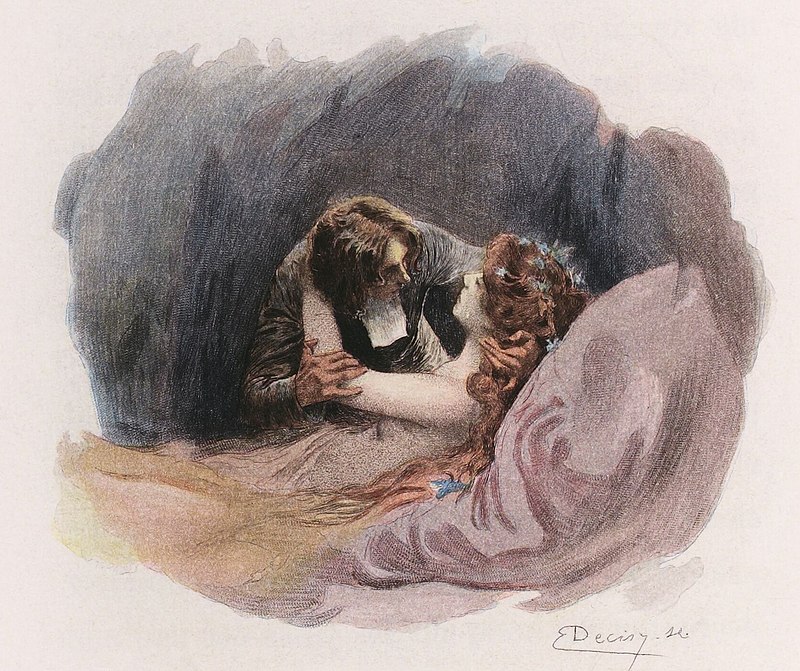
In 1836, French writer Théophile Gautier reintroduced the name in his celebrated vampire novella La Morte Amoureuse (Clarimonde in French; The Beautiful Vampire in English). Gautier’s heroine—a sensual courtesan who blurs the line between life and death—cemented Clarimonde’s association with Gothic beauty, nocturnal allure, and eternal fascination, making it an especially fitting name for Halloween
Other forms include:
- Esclarmonda (Catalan, Occitanian)
- Clarimond (English)
- Clarimonde (French)
- Clarimunda (Late Latin, Spanish)
- Esclarmonde (Old French)
- Clarmonda (Occitanian)
- Clarmontina (Occitanian)
- Mondina (Occitanian)
- Esclaramunda (Spanish)
Sources
- Withycombe, E. G. The Oxford Dictionary of English Christian Names. Oxford: Clarendon Press, 1950.
- https://en.wikipedia.org/wiki/Huon_of_Bordeaux
- https://fr.wikipedia.org/wiki/Esclarmonde_(homonymie)
- https://en.wikipedia.org/wiki/La_Morte_Amoureuse

 Here is my second list of Polish and French nature names. Please keep in mind that many of these are hypothetical. I would be honored if someone actually found inspirations and used these on their children. What do you think? Hypothetical names will have an asterisk. Names with no asterisk actually have a history of use. Also be advised that names whose meanings are obvious will not have their meaning in parenthesis.
 Gender: Feminine
 Gender: Feminine
 Origin: Hebrew גַבְרִיאֵל Γαβριηλ
 Gender: Feminine
 Gender: Masculine
 Gender: Masculine