The name is the modern English form of the Anglo-Saxon female name, Eahlswiþ, which is composed of the Anglo-Saxon elements, eahl (temple) and swiþ (strong).
The most famous historical bearer is Ealhswith (Elswith), Queen of Wessex and wife of King Alfred the Great (d. 902). She was the mother of Edward the Elder and Æthelflæd, Lady of the Mercians, and is remembered for her wisdom, learning, and piety.
Her name appears in multiple forms across medieval chronicles: Ealhswith, Ealswitha, Aelswith, Aelswitha, Alswith, Elswith, Elswitha, and Elswyth.
The name gained renewed attention through the popular Netflix/BBC historical drama The Last Kingdom (2015–2022) and its sequel film Seven Kings Must Die (2023), based on Bernard Cornwell’s The Saxon Stories series.
Since 2022, at least 11 girls have been bestowed the name Elswyth in England & Wales.
While Ealhswith fell out of use after the Norman Conquest, Elswith or Elswyth has occasionally been revived in historical fiction and modern England as a rare, archaic revival, akin to Edith and Ethel. It fits within the current trend toward names that blend mythic, Old English, and Celtic sounds, offering an even more unique alternative to trending names such as Eloise,Elowen and Ella.
Prosdocimus is a Late Latin form of the Greek Προσδόκιμος (Prosdokimos), derived from prosdokein, meaning “the awaited; the expected,” allegedly used for a long awaited child.
The name is best known from Saint Prosdocimus, a 1st-century Christian bishop and missionary of Greek origin, who evangelized the region around Patavium (Padua) in northern Italy. He is venerated as the first bishop and patron saint of Padua, and a major church, the Basilica di San Prosdocimo, adjoining the Abbey of Santa Giustina, bears his name. His cult was established early in the Christian era and remained locally important throughout the Middle Ages.
Because of the saint’s regional veneration, the given name Prosdocimo remained rare and was used mainly in the Veneto, occasionally appearing in baptismal records in Padua and neighboring areas. Outside northern Italy it has always been exceptional, preserved chiefly in ecclesiastical or hagiographic contexts.
Poetic, bold and well, grim, it is an obsolete Medievel gem which is composed of the Germanic elements, ebur (boar) and grim (bold; fierce; grim).
Source
S.L. Uckelman. “Evergrim”. In S.L. Uckelman, ed. The Dictionary of Medieval Names from European Sources, Edition 2023, no. 1. http://dmnes.org/2023/1/name/Evergrim.
Mannix is the Anglicized form of the early Irish given name Mainchín, a diminutive of Old Irish manach, meaning “monk.” The root manach comes from Latin monachus, “monk,” introduced to Ireland through early Christian monasticism.
Mainchín was a popular given name among early Irish saints, particularly during Ireland’s monastic age (6th–8th centuries). Notable bearers include: Saint Mainchín of Limerick, a 6th-century bishop and the patron saint of the city; and Saint Mainchín of Corann, a lesser-known saint of County Sligo.
As Irish names were adapted into English, Mainchín became Mannix (also occasionally Manix or Mannex). Over time, this Anglicized given name also evolved into a family surname, carried by descendants of those named Mainchín.
The name gained brief international attention through Archbishop Daniel Mannix (1864–1963) of Melbourne, a prominent Irish-Australian religious leader, and through the late-1960s detective series Mannix, which reintroduced the name to modern audiences.
Today, Mannix is a rare but genuine revival of an ancient Irish Christian name — never invented, never fabricated from a surname, but descended directly from one of Ireland’s earliest monastic names. It combines the humility of its meaning (“little monk”) with the strong, contemporary rhythm of names ending in -x (Felix, Lennox, Maddox).
Craft is a Latinate form of the German, Kraft (power; strength). It was in use as a male given-name in Medieval Germanic countries but is today obsolete. A variant Latinate form is Crafto.
This may make the perfect name for a Halloween baby.
Sources
S.L. Uckelman. “Craft”. In S.L. Uckelman, ed. The Dictionary of Medieval Names from European Sources, Edition 2023, no. 1. http://dmnes.org/2023/1/name/Craft.
Socin, Adolf. Mittelhochdeutsches Namenbuch: Nach oberrheinischen Quellen des 12. und 13. Jahrhunderts. Basel: Helbing & Lichtenhahn, 1903. Digitized by the Bavarian State Library. Accessed October 29, 2025. https://www.digitale-sammlungen.de/en/view/bsb10931113
A 19th-century gem and late 20th-century vampiric monikor, the name is of uncertain meaning but has its origins in Medieval Spain. It is likely of Visigothic origins, possibly derived from Gailawera or Geloyra, which stem from gails (happy) or (spear); and wers (friendly, agreeable, true).
It should be noted that Elvira (Latin: Iliberri or Iliberis) was an ancient Iberian and later Roman city located near present-day Granada, in Andalusia, southern Spain. However, in this case, it is likely derived from an Iberian source, meaning “new town.”
It was a popular female name among the royal family of Castille & León, producing two queens who bore this name, Elvira of Castile, Queen of León (965–1017) and Elvira of Castile, Queen of Sicily (c. 1100–1135).
It was later used in Mozart’s 1787 opera Don Giovanni (libretto by Lorenzo Da Ponte), in which Donna Elvira is one of Don Giovanni’s former lovers. This likely popularized the name outside of the Iberian peninsula.
By the turn of the 20th-century, Elvira was not unknown in the United States, though never overly popular, it peaked at #254 in 1914, but fell out the Top 1000 by 1981, the same year Elvira, Mistress of the Dark came on the scene.
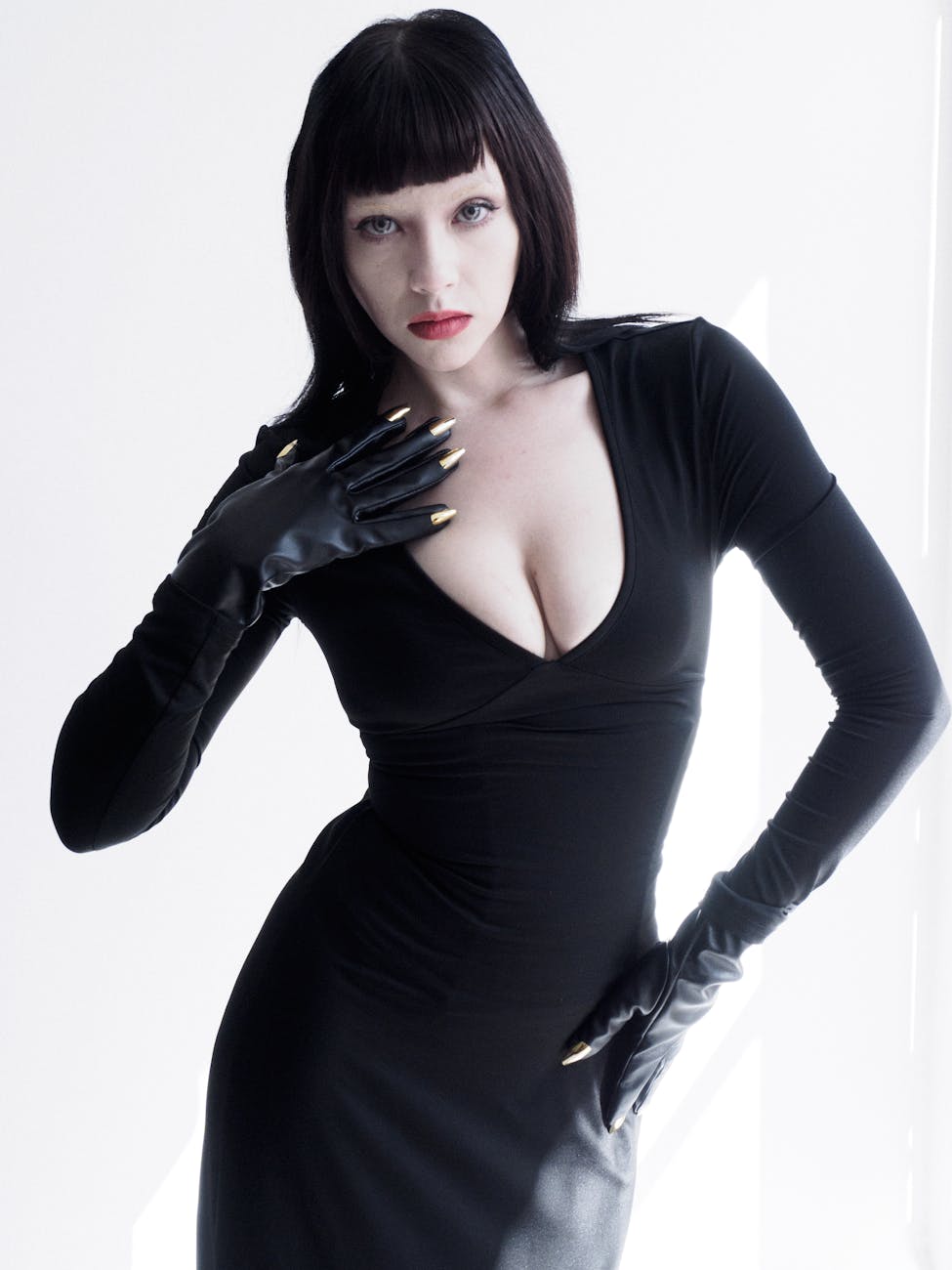
The real Halloween link began in 1981, when actress Cassandra Peterson created the camp-horror TV hostess Elvira, Mistress of the Dark for a Los Angeles late-night show (Movie Macabre).
Dressed in a plunging black gown with a beehive of jet hair, Elvira presented old horror movies with sardonic humor — blending Gothic sex appeal, irony, and B-movie kitsch.
The character became a pop-culture icon: Halloween TV specials, films, pinball machines, comic books, and even perfume lines immortalized her as the Queen of Halloween.
Outside the United States, this name does not have such associations. In Sweden, it has been among the top 100 girls’ since 1998 and peaked at #25 in 2014. As of 2024, it came in at #40.
It’s a popular name in the Balkans, even spinning off a male form of Elvir (Bosnian and Albanian).
Other forms include:
Elbire (Basque)
Elvíra (Czech/Slovakian)
Elviira (Estonian, Finnish)
Elvire (French)
Elwira (Polish, also an alternate Swedish spelling, Sorbian)
Elvīra (Latvian)
Elvyra (Lithuanian)
Obscure Lithuanian male forms are the Lithuanian, Elvyras; the Polish, Elwir(o), and the Italian Elviro.
Name days: August 25 (Austria), July 16 (Croatia), February 10 (Hungary), January 25 (Spain), March 1 (Sweden), November 21 (Slovakia), August 13 (Latvia).
Sources
Withycombe, E. G. The Oxford Dictionary of English Christian Names. Oxford: Clarendon Press, 1950.
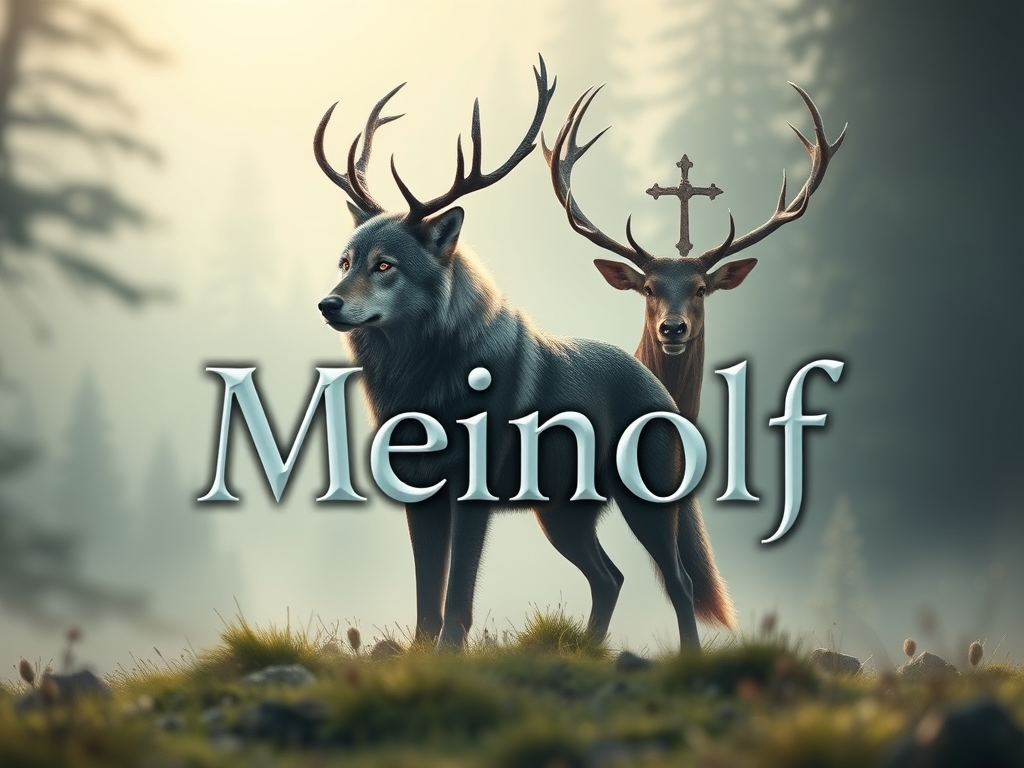
The name is from the Old German, magin, magen (powerful) and wulf (wolf).
The name was borne by a 9th-century saint, a godson of Charlemagne, who according to legend found his monastery on the spot where he saw a stag appear with a cross between its antlers.
It is also a German surname, in which case, it is a patronymic derived from the given-name.
The designated name-day is October 5th.
Usage
The name is used in Dutch-speaking countries, German-speaking countries and Nordic countries, though nowadays, it is rather old fashioned.
German Diminutives
Meino
International Variations
Melf (Frisian)
Meinolph (German, alternate spelling)
Meinolphus (Latin)
Maganulf, Maginulf, Meginulf (Old German)
Magnulf (Old Norse)
Sources
S.L. Uckelman. “Meinulf”. In S.L. Uckelman, ed. The Dictionary of Medieval Names from European Sources, Edition 2023, no. 1. http://dmnes.org/2023/1/name/Meinulf.
Both names are rooted in the Old Irish adjective odhar, meaning “dun, pale, sallow, greenish-grey.” The word originally described earthy or muted colors — the shade of an animal’s coat, or a green-brown hue in nature.
Odhrán (modern spelling in Irish, often Anglicized as Oran or Orin) is a diminutive form: odhar + -án, meaning “little pale one” or “little sallow/greenish one.”
Odharnait is the feminine form, built from odhar + –ainait, a feminine diminutive ending.
Odhrán is well-attested in medieval Ireland. A 6th-century saint named Odhrán of Iona (also called Odran) was a companion of St. Columba and is remembered as one of the first Irish Christian martyrs. His feast day is celebrated on October 27.
The early 20th century brought Janet back from the dead, and the 1980s revived Tiffany and Allison—two names that had once flourished in medieval England before fading into obscurity. Many other forgotten names share a similar story. Countless early English forms were gradually displaced by their Latinized versions, leaving behind a treasure trove of names that feel surprisingly fresh today. With their short, crisp sounds and understated elegance, many of these medieval forms fit seamlessly into modern naming trends.