Zīle and Zīlīte are speculated to be ancient Latvian females names that survived Christianization.
Zīle is from the Latvian word for acorn or the name of a type of passerine bird known as the titmouse in English. It is first recorded in Riga as early as 1544 (1).
Zīlīte is also a Latvian word, derived from Zīle, with a diminutive suffix attached, also mean “titmouse” or “pupil.” Its usage is recorded as early as 1499 in Riga (2).
The name is from the Arabic word مَوَدَّة (mawaddah), meaning, “affection; love; friendship.” It has the same sense as the Greek word and name, Agape. It is ultimately derived from the Arabic root و-د-د (w-d-d), meaning, “love; affection; compassion.”
The name comes directly from the Farsi word نیلوفر (niloufar), meaning, “morning glory; water lily; nenuphar.”
It ultimately derives from Middle Persian nīlōpār, from Sanskrit nīlotpala (नीलोत्पल) meaning blue lotus (nīla “blue” + utpala “lotus”). Through Persian, it spread widely into other languages of the Islamic and Silk Road world. The Greek-Latin loan nénuphar comes from this same root, appearing in medieval botanical and poetic texts to denote the water lily (Nymphaea).
Niloufar has been used as a feminine given name in Iran, Afghanistan, Tajikistan, Azerbaijan, and Turkey (where it appears as Nilüfer).
Notable bearers include:
Niloufar Bayani, Iranian conservationist and scholar.
Nilüfer Yumlu (known simply as Nilüfer), celebrated Turkish pop singer.
Princess Niloufer of Hyderabad (1916–1989), Ottoman princess renowned for her beauty and philanthropy.
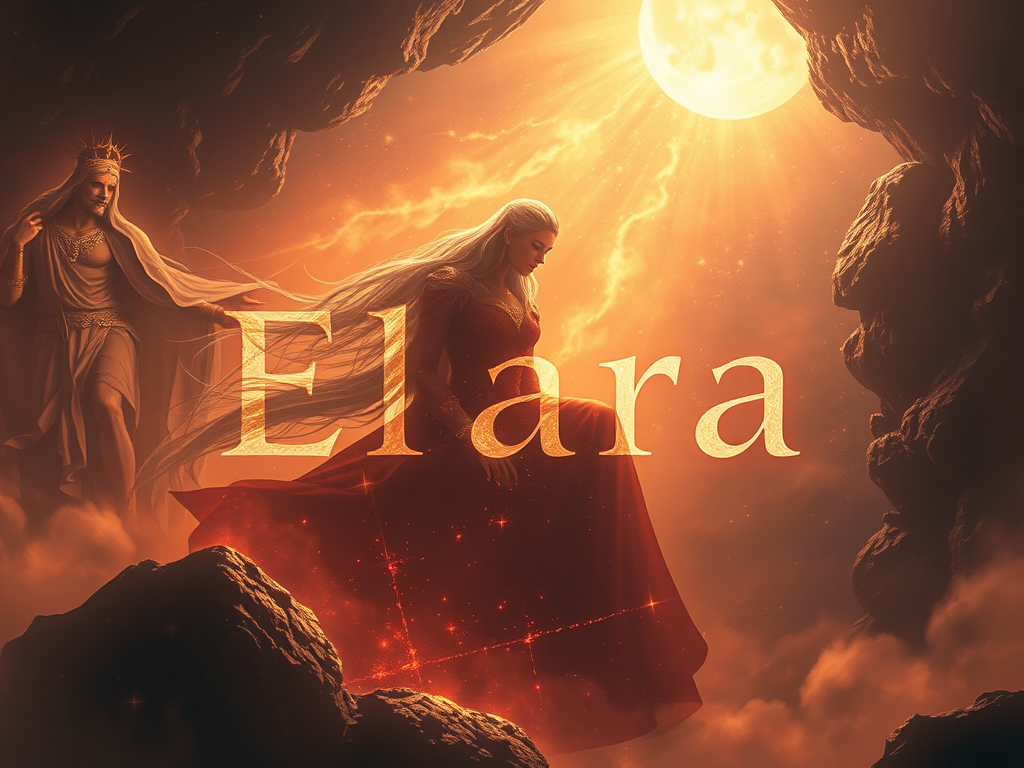
The name is of uncertain etymology. It has sometimes been linked to the ancient Greek word ἄλαρα (álara), said to mean “hazelnut” or “spear-shaft.”
In Greek mythology, Elara was a mortal princess of Orchomenus loved by Zeus. When she became pregnant, Zeus hid her deep beneath the earth to protect her from Hera’s jealousy. There she gave birth to their gigantic son Tityos (Τιτυός). Because of this myth, Elara is sometimes associated with the earth or the underworld. One of Jupiter’s moons, discovered in 1905 by Charles Dillon Perrine, was later named in her honor.
As a given-name in the English-speaking world, it does appear in records in the 19th-century, mainly in the U.S. Recently, it has appeared in England & Wales Top 900 girls’ name, coming at #467 (2024).
With its celestial link and mythological depth, Elara feels like a luminous and romantic alternative to other El- names such as Elena, Eleanor, and Elodie. Its lunar connection gives it a quietly modern yet timeless appeal.
The name Hephzibah (Hebrew חֶפְצִי־בָהּ, Ḥefzī-bāh) means “my delight is in her.” In the Hebrew Bible, it appears as the name of the wife of King Hezekiah and the mother of King Manasseh (2 Kings 21:1; 2 Chronicles 33:1).
In Isaiah 62:4, Hephzibah is also used symbolically as a poetic name for restored Zion, representing the renewed favor of God toward His people
The name was occasionally used among medieval Jewish communities, where it appears in apocryphal and mystical writings such as the Apocalypse of Zerubbabel and the Zohar. In these texts, a legendary warrior woman named Hephzibah fights the enemies of Israel in the messianic age, slaying wicked kings and defending Jerusalem.
Hephzibah enjoyed modest popularity among Protestant families in the 18th and 19th centuries, especially in colonial America and Puritan New England, where Old Testament names were widely favored. Common diminutives included Eppie, Hepsie, and Hepsy.
By the early 20th century, the name’s use had largely waned, surviving mainly as a literary or historical curiosity.
It was often utilized in 19th-century literature, being the name of a character in George Eliot’s Silas Marner (1861); and Nathaniel Hawthorne’s The House of the Seven Gables (c. 1851), which features Hepzibah Pyncheon, a proud but impoverished New England gentlewoman. Recently, it appears as the name of a witch in the Harry Potter series by J.K. Rowling.
An early notable bearer was American Bostonian Socialite, Hepzibah Swan (d. 1825, unknown birth date). A more recent notable bearer is American-Australian pianist, Hephzibah Menuhin (1920-1981).
It is also the name of several places in the United States.
With its mix of Biblical grace, Gothic Americana, and warrior-woman legend, Hephzibah carries both majesty and mystery. Its vintage nicknames—Eppie, Hepsie, Hepsy—soften its grandeur, making it unexpectedly wearable today.
Hephzibah, long slumbering in scripture and story, may be ready for revival.
Sources
Withycombe, E. G. The Oxford Dictionary of English Christian Names. Oxford: Clarendon Press, 1950.
A poetic rarity, it is from the ancient Greek λαλαγέω (lalageo) meaning “to babble; to prattle.”
The most famous bearer of the name appears in Horace’s Odes (Book I, 22), in which it is the name of the poet’s idealized beloved.
Edgar Allan Poe later used Lalage as a tragic heroine in his 1835 play Politian, reinforcing its Romantic aura.
The name experienced some usage in the 19th-century throughout the English-speaking world. A notable bearer is British educator and feminist, Lalage Brown (b. 1927).
The name is from the Tagalog word, may-ari, meaning, “owner, master.”
In Filipino mythology, Mayari is the goddess of the moon, war, revolution, strength, weaponry, and beauty — and is celebrated as one of the most radiant and formidable deities in the Tagalog pantheon. She is the daughter of Bathala, the supreme god and creator of the world and was mothered by a mortal woman.
When Bathala died without naming an heir to rule his earthly domain, Mayari and her brother Apolaki, the god of the sun, fought for succession, using bamboo sticks as weapons. During their fierce duel, Apolaki struck out one of Mayari’s eyes. Realizing the cost of their conflict, the siblings reconciled and agreed to share rule over the world — Apolaki reigning over the day, and Mayari over the night.
Because of her single remaining eye, the moon’s light is dimmer than the sun’s. In some regional traditions, Mayari is also linked to Tala, the goddess of the stars — as her sister, or in alternate legends, as her mother.
A 19th-century gem and late 20th-century vampiric monikor, the name is of uncertain meaning but has its origins in Medieval Spain. It is likely of Visigothic origins, possibly derived from Gailawera or Geloyra, which stem from gails (happy) or (spear); and wers (friendly, agreeable, true).
It should be noted that Elvira (Latin: Iliberri or Iliberis) was an ancient Iberian and later Roman city located near present-day Granada, in Andalusia, southern Spain. However, in this case, it is likely derived from an Iberian source, meaning “new town.”
It was a popular female name among the royal family of Castille & León, producing two queens who bore this name, Elvira of Castile, Queen of León (965–1017) and Elvira of Castile, Queen of Sicily (c. 1100–1135).
It was later used in Mozart’s 1787 opera Don Giovanni (libretto by Lorenzo Da Ponte), in which Donna Elvira is one of Don Giovanni’s former lovers. This likely popularized the name outside of the Iberian peninsula.
By the turn of the 20th-century, Elvira was not unknown in the United States, though never overly popular, it peaked at #254 in 1914, but fell out the Top 1000 by 1981, the same year Elvira, Mistress of the Dark came on the scene.
The real Halloween link began in 1981, when actress Cassandra Peterson created the camp-horror TV hostess Elvira, Mistress of the Dark for a Los Angeles late-night show (Movie Macabre).
Dressed in a plunging black gown with a beehive of jet hair, Elvira presented old horror movies with sardonic humor — blending Gothic sex appeal, irony, and B-movie kitsch.
The character became a pop-culture icon: Halloween TV specials, films, pinball machines, comic books, and even perfume lines immortalized her as the Queen of Halloween.
Outside the United States, this name does not have such associations. In Sweden, it has been among the top 100 girls’ since 1998 and peaked at #25 in 2014. As of 2024, it came in at #40.
It’s a popular name in the Balkans, even spinning off a male form of Elvir (Bosnian and Albanian).
Other forms include:
Elbire (Basque)
Elvíra (Czech/Slovakian)
Elviira (Estonian, Finnish)
Elvire (French)
Elwira (Polish, also an alternate Swedish spelling, Sorbian)
Elvīra (Latvian)
Elvyra (Lithuanian)
Obscure Lithuanian male forms are the Lithuanian, Elvyras; the Polish, Elwir(o), and the Italian Elviro.
Name days: August 25 (Austria), July 16 (Croatia), February 10 (Hungary), January 25 (Spain), March 1 (Sweden), November 21 (Slovakia), August 13 (Latvia).
Sources
Withycombe, E. G. The Oxford Dictionary of English Christian Names. Oxford: Clarendon Press, 1950.
Lollius (pronounced LOH-lee-us) was an old Roman nomen gentilicium — that is, a family name identifying the gens Lollia, a plebeian family attested since the late Republic. The feminine form, Lollia (LOH-lee-ah), denoted women of that lineage.
The etymology is not entirely certain, scholars have proposed that it could derive from a Latin word, lolium, meaning (“darnel grass”), while others suggest a Sabine or Oscan origin of unknown meaning.
Notable bearers from antiquity include:
Marcus Lollius (M. Lollius) – Roman consul in 21 BC, a confidant of Augustus, later disgraced after a military defeat in Germany.
Lollia Paulina (15 BC – 49 AD) – renowned for her beauty and extravagance, she was briefly the wife of Emperor Caligula and later courted by Claudius before being exiled and forced to commit suicide by Agrippina the Younger for witchcraft.
Lollius Urbicus (2nd century AD) – a distinguished Roman governor of Britain under Antoninus Pius, remembered in inscriptions on the Antonine Wall in Scotland.
Other historical forms include:
Lòl·lia (Catalan)
Lollie (French)
Lolia (Portuguese, Spanish)
While Lollius remains primarily of scholarly or historical interest, Lollia has quiet potential as a revival name. It resembles fashionable names like Lola, Luna, and Lilia, yet carries an authentic Roman pedigree.
Pronounced LOH-lee-ah or LOH-lyah, it has a lilting, floral sound that feels simultaneously ancient and elegant.
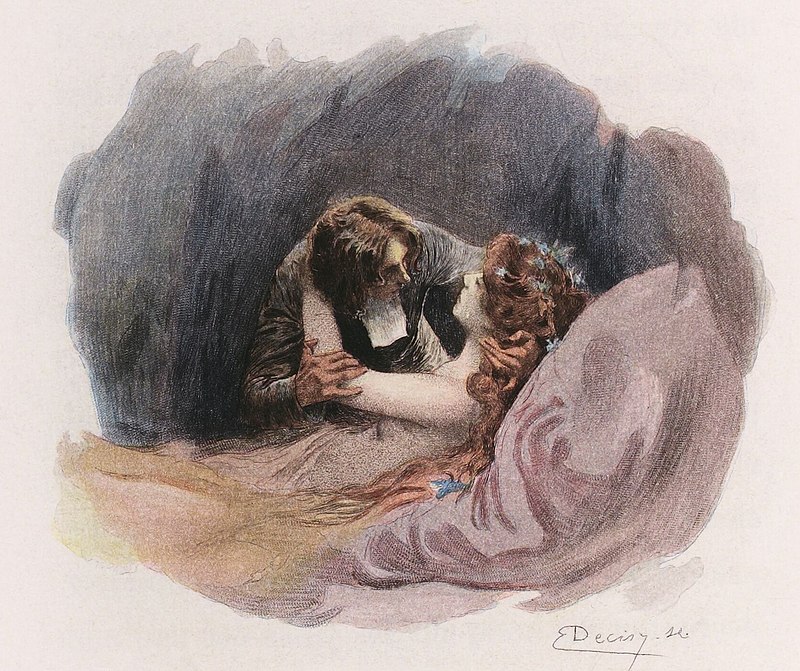
“Her head fell back, but she still wrapped her arms around me as if to hold me back.” Etching by Eugène Decisy [fr] after a watercolor by Paul Albert Laurens, 1904.
Origin: Occitanian
Meaning: uncertain
Gender: Female
Eng pron: (KLAIR-e-mund)
A Medieval Occitanian name first recorded in 12th-century French chivalric literature, Clarimond (also found as Clarimonde, Claramonde, or Claramunda) is either a diathemic compound of the Latin clārus (“bright, light, clear”) and the Old High German mund (“protection”), or derived from an Occitanian phrase meaning “bright world; clear world”
In the 12th-century chanson de geste, Huon de Bordeaux, the name appears in its earlier form as Esclarmonde borne by a Saracen princess who converts to Christianity and marries the hero Huon. Similar formations (Florimond, Rosamond, Alemond) were fashionable among the knightly and aristocratic classes of the High Middle Ages. The 1889 opera by Jules Massenet, Esclarmonde, is loosely based on the character from Huon de Bordeaux.
Historically, Esclarmonde and its variants were borne by at least four noblewomen of the House of Foix, the most famous being Esclarmonde de Foix (d. 1215), sister of Count Raymond-Roger de Foix, who was noted for her learning and association with the Cathar movement in southern France.
Though rare, Clarimond saw occasional use in 17th-century England, likely revived through renewed interest in medieval romance literature. Clarimonde was also occasionally found in 18th-19th-century Acadia, and was used by the closely related Cajuns in Louisiana.
In 1836, French writer Théophile Gautier reintroduced the name in his celebrated vampire novella La Morte Amoureuse (Clarimonde in French; The Beautiful Vampire in English). Gautier’s heroine—a sensual courtesan who blurs the line between life and death—cemented Clarimonde’s association with Gothic beauty, nocturnal allure, and eternal fascination, making it an especially fitting name for Halloween
Other forms include:
Esclarmonda (Catalan, Occitanian)
Clarimond (English)
Clarimonde (French)
Clarimunda (Late Latin, Spanish)
Esclarmonde (Old French)
Clarmonda (Occitanian)
Clarmontina (Occitanian)
Mondina (Occitanian)
Esclaramunda (Spanish)
Sources
Withycombe, E. G. The Oxford Dictionary of English Christian Names. Oxford: Clarendon Press, 1950.