Alma

The name has several different origins and meanings. Its usage as a name in Britain skyrocketed around 1854, after the victorious Battle of Alma, which took place near the Alma River in the Crimea.

In this case, the name is derived from the Tatar word for, “apple.” It is interesting to note that Alma, till this day, is a traditional and common female name across Central Asia, especially among Russian-Tatars, Kazakhs and Uzbeks. In Uzbek, it appears in the form of Olma. Alma is also the word for apple in Hungarian, where it is also occasionally used as a female given name.

The name also appears in Edmund Spenser’s The Faerie Queen as the name of a minor character, the head of the House of Temperance in Book 2. In this case, the name is most likely taken from the Portuguese and Spanish word for “soul.”

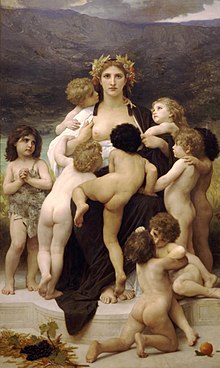
Alma appears sparingly as a female given name in Renaissance Italy, in this case, it is most likely derived from the Latin, almus, meaning, “nourishing”; hence the term, alma mater (fostering mother). This usage of the name also appears as an epithet for a few Roman goddess, particularly Venus and Ceres.

It is the name of a book in The Book of Mormon, but in this case, it is masculine, being the name of two prophets, a father and son; Alma the Younger being the Chief Judge among the Nephites.

Other etymologies which have been suggested, include:

  • It is from the Greek, αλμη (salt water)
  • It is from an Arabic source, al-ma, meaning, (the water).
  • It is a contracted form of Amalia and Amalberga.

The name is used in virtually every European country, including Scandinavia, where it is currently very trendy.

As of 2010, Alma was the 8th most popular female in the Faroe Islands. Her rankings in other countries are as follows:

  • # 23 (Sweden, 2010)
  • # 24 (Denmark, 2010)
  • # 48 (Norway, 2010)
  • # 49 (Bosnia & Herzegovina, 2010)
  • # 80 (Spain, 2010)
  • # 849 (United States, 2010)


Rebecca

Gender: Feminine
Origin: debated
Meaning: debated
Eng (re-BEK-ka)

Rebecca is the English form of the Biblical Hebrew רִבְקָה (Rivqah), which possibly means “snare” or “noose” possibly referring to captivation or beauty, but may also be of an unknown Aramaic source.

The name is borne in the Bible by the Aramean wife of Isaac and the mother of Jacob and Esau. She is considered a Jewish matriarch.

In the English speaking world, the name was seldom used until the Protestant Reformation, where it became an exceedingly popular name. Pocahantas even took this as her Christian name upon her baptism.

Currently, Rebekka is the 3rd most popular female name in Faroe Islands, (2010). Her rankings in other countries are as follows:

  • # 20 (Rebecca, Italy, 2010)
  • # 24 (Rebeka, Hungary, 2010)
  • # 37 (Rebecca, Northern Ireland, 2010)
  • # 38 (Rebecca, Scotland, 2010)
  • # 48 (Rebecca, Ireland, 2010)
  • # 75 (Rebeka, Slovenia, 2010)
  • # 75 (Rebecca, Sweden, 2010)
  • # 82 (Rebecca, England/Wales, 2010)
  • # 137 (Rebecca, United States, 2010)
  • # 290 (Rebecca, Netherlands, 2010)
  • # 304 (Rebecca, France, 2009)
  • # 404 (Rebekah, United States, 2010)

Other forms of the name include:

  • Rafqa ﻪﻔﻴﻓﺍﺭ (Arabic/Syriac)
  • Rebeka Ребека (Bosnian/Bulgarian/Czech/Hungarian/Lithuanian/Polish/Slovak/Slovene)
  • Rebeca (Catalan/Ladino/Portuguese/Romanian/Spanish)
  • Rebekka (Dutch/Ethiopian/Finnish/German/Scandinavian)
  • Rebecca (English/Italian/Scandinavian)
  • Becca (English)
  • Reba (English)
  • Rebekah (English)
  • Rébecca (French)
  • Rebèque (French)
  • Rebekah (Greek: Biblical)
  • Revekka Ρεβέκκα (Greek: Modern)
  • Rifqa (Hebrew: Biblical)
  • Riva/Rivka רִבְקָה, רבקה אמנו (Hebrew: Modern)
  • Réba (Hungarian)
  • Ribka (Indonesian)
  • Ryfka (Polish-Yiddish)
  • Rebecke (Plattdeutsch)
  • Revekka Реве́кка (Russian)
  • Reveka (Serbian)
  • Rebecka (Swedish)
  • Rifka/Riwka (Yiddish)

The name was the subject of the 1938 British novel of the same name, written by Daphne du Maurier. It is also borne by a 19th-century Lebanese Christian saint. The designated name-day is March 23 (France).

Common English diminutive forms include: Becca, Beck, Becky, Bex, Reba and Rebi.

Sources

  1. Genesis 22:20-23
  2. http://www.ou.org/torah/ti/5764/toldot64.htm
  3. http://www.behindthename.com/name/rebecca
  4. http://www.askoxford.com/firstnames/rebecca?view=uk

Leah

Gender: Feminine
Origin: Hebrew
Meaning: debated
Eng (LEE-uh); Heb (LAY-ah)

The name is found in the Old Testament as the name of the sister of Rachel and the first wife of Jacob.

In Jewish tradition, Leah is considered a matriarch and among Christians, she is believed to be the direct ancestor of Jesus.

Its exact meaning and origins are debated. Many scholars believe that it is from the Hebrew לְאָה (le’ah), meaning, “weary.” Other sources have suggested that it is from an Akkadian source meaning, “lady; mistress.”

In the English speaking world and on the continent, it was not common outside the Jewish community until after the Protestant Reformation.

Currently, Leah ranks in as the 24th most popular female name, (2010) and this is the highest the name has ranked in U.S. naming history. She is quite popular in other countries, her rankings in other countries are as follows:

  • # 1 (Lea, Faroe Islands, 2010)
  • # 1 (Léa, Monaco, 2009)
  • # 1 (Lea, Romansch-speaking, Switzerland, 2010)
  • # 2 (Léa, French-speaking, Switzerland, 2010)
  • # 2 (Lea, Liechtenstein, 2010)
  • # 3 (Léa, France, 2009)
  • # 3 (Lea, Luxembourg, 2009)
  • # 5 (Lea, Austria, 2010)
  • # 5 (Lea, German-speaking, Switzerland, 2010)
  • # 5 (Léa, Belgium, 2010)
  • # 5 (Lea/Leah, Germany, 2011)
  • # 9 (Lea, Malta, 2010)
  • # 14 (Leah, Norway, 2010)
  • # 15 (Leah, Ireland, 2010)
  • # 17 (Lea, Croatia, 2009)
  • # 20 (Leah, Northern Ireland, 2010)
  • # 25 (Leah, Scotland, 2010)
  • # 39 (Lea, Slovenia, 2010)
  • # 46 (Lea, Denmark, 2010)
  • # 49 (Lea, Sweden, 2010)
  • # 50 (Leah, England/Wales, 2010)
  • # 55 (Leia, Sweden, 2010)
  • # 56 (Leah, Canada, BC, 2010)
  • # 59 (Lia, Slovenia, 2010)
  • # 63 (Leah, New Zealand, 2010)
  • # 89 (Lea, Norway, 2010)
  • # 95 (Lia, Hungary, 2010)
  • # 96 (Leah, Australia, NSW, 2010)
  • # 299 (Lia, France, 2009)
  • # 320 (Leia, France, 2009)
  • # 356 (Lia, Netherlands, 2010)
  • # 386 (Leah, Netherlands, 2010)
  • # 418 (Lea, Netherlands, 2010)
  • # 566 (Lea, United States, 2010)
  • # 830 (Leia, United States, 2010)

Other forms of the name include:

  • Lia (Catalan/Czech/Hungarian/Italian/Portuguese/Biblical Latin/Slovene)
  • Lea (Czech/Dutch/Estonian/Finnish/German/Hungarian/Icelandic/Norwegian/Polish/Romansch/Scandinavian/Slovak/Slovene/Spanish/Turkish)
  • Leah (English/Ethiopian/German/Scandinavian)
  • Leea (Finnish)
  • Leija (Finnish)
  • Leja (Finnish)
  • Lessu (Finnish)
  • Léa (French)
  • Leaette/Liette (French: originally a diminutive form, used as an independent given name, especially among French Huguenots).
  • Lía (Galician/Spanish)
  • Leia Λεια (Greek: Biblical)
  • Léá (Irish-Gaelic)
  • Lija/Liya Лия (Russian)
  • Lejá (Sami)

Common Czech diminutives include:

  • Leana
  • Leí
  • Leonka
  • Leoša
  • Leuška
  • Leúšik
  • Lienka
  • Liuška

The designated name-days are: January 5 (Estonia/Finland), March 22 (France), April 29 (Slovak), June 26 (Sweden).

Eva, Eve

Gender: Feminine
Origin: Hebrew
Meaning: “life.”
Eng (EEV); (EE-vuh); Germ/Sp/Pol (EV-ah)

The name is borne in the Bible and in the Quran by the first woman created by God. She and her husband were expelled from the Garden of Eden after eating from the Tree of Knowledge.

The name is believed to be derived from the Hebrew roots חַוָּה, Ḥavvāh, from the Hebrew root ḥāyâ meaning “life” and the Semitic element, ḥyw “to live.” Both the Hebrew word chavah meaning “to live” and chayah meaning “to breath” share the same root.

Despite Eve’s fall from Grace in the Bible, the name was always in usage among Jewish, Christian and Muslim communities. In England, its usage can be traced back to the 12th-century. Its Latinate form of Eva, has always been a classic in continental Europe, especially in Germany, Poland, Slovakia and the Czech Republic.

As of 2010, Eva was the most popular female name in the Faroe Islanda and in Slovenia. Eve, Eva and all her various forms’ rankings in other countries are as follows:

  • # 3 (Iceland, 2010)
  • # 4 (French-speaking, Switzerland, 2010)
  • # 5 (Netherlands, 2010)
  • # 7 (Ieva, Lithuania, 2010)
  • # 10 (Armenia, 2010)
  • # 10 (Evie, England/Wales, 2010)
  • # 14 (Northern Ireland, 2010)
  • # 15 (France, 2009)
  • # 17 (Scotland, 2010)
  • # 20 (Belgium, 2009)
  • # 24 (New Zealand, 2010)
  • # 26 (Australia, NSW, 2010)
  • # 29 (Croatia, 2010)
  • # 31 (Evie, Scotland, 2010)
  • # 33 (Evie, Australia, NSW, 2010)
  • # 37 (England/Wales, 2010)
  • # 44 (Eevi, Finland among Finnish-speakers, 2010)
  • # 44 (Ireland, 2010)
  • # 46 (Austria, 2010)
  • # 47 (Canada, BC, 2010)
  • # 48 (Spain, 2010)
  • # 55 (Catalonia, 2010)
  • # 55 (Éabha, Ireland, 2010)
  • # 56 (Eve, Northern Ireland, 2010)
  • # 59 (Eve, Ireland, 2010)
  • # 86 (Norway, 2010)
  • # 91 (United States, 2010)
  • # 92 (Eve, England/Wales, 2010)
  • # 99 (Eve, Australia, NSW, 2010)
  • # 201 (Eve, France, 2009)
  • # 589 (Eve, United States, 2010)
  • # 705 (Evie, United States, 2010)

Other forms of the name include:

  • Eva Ева ევა
    (Afrikaans/Albanian/Armenian/Basque/Belarusian/Bosnian/Catalan/Croatian/Czech/Dutch/Faroese/French/Frisian/Galician/Georgian/German/Icelandic/Italian/Portuguese/Romansch/Spanish/Scandinavian)
  • Evis (Albanian)
  • Mahalet/Mahlet (Amharic)
  • Hawa حواء Хауа (Arabic)
  • Yeva (Armenian)
  • Həvva (Azeri)
  • Yeva Ева Эва (Belarusian/Russian/Ukrainian)
  • Yevga Евга (Belarusian)
  • Hava (Bosnian)
  • Evy (Danish/Norwegian/Swedish: initially a diminutive form, occasionally used as an independent given name)
  • Eveke (Dutch: initially a diminutive form, used as an independent given name, EV-eh-ke)
  • Eve (English/Estonian/Walon)
  • Evie (English)
  • Hawat/Hewa (Egyptian/Coptic)
  • Eeva (Estonian/Finnish)
  • Eevi (Estonian/Finnish)
  • Evi (Estonian)
  • Ivi/Iivi (Estonian)
  • Iivika (Estonian)
  • Ève (French)
  • Eefje, Eefke (Frisian)
  • Hawwa ሕይዋን (Ge-ez)
  • Eua Ευα (Greek)
  • Chava חַוָה (Hebrew: Modern: KHAH-vah, gutteral CH sound)
  • Éva (Hungarian: AY-vaw, diminutive form is Évike)
  • Hawa (Indonesian/Malayalam)
  • Éabha (Irish-Gaelic)
  • Ieva (Latvian/Lithuanian: YEH-vah)
  • Evuzus (Malaysian)
  • Aaue (Manx)
  • Èva (Occitanian)
  • Ewa (Polish: EH-vah, diminutive forms are Ewka, Ewunia and Ewusia)
  • Evá (Sami)
  • Evelia (Spanish)
  • Evita (Spanish)
  • Eba (Tagalog)
  • Havva (Turkish)
  • Efa (Welsh)

Italian masculine form is Evo.

Traditionally, in most European countries, the name-day for Adam and Eve is December 24.

Leila, Layla

Gender: Feminine
Origin: Arabic לילה‎ ليلى
Meaning: “night.”
(LAY-la)

The name is derived from the Arabic and has a variety of different meanings depending on its spelling, the most popular etymology is that it is from a Semitic root, l-y-l, meaning, “night” and shares the same etymology as the name Lilith.

The name has always been popular in the Middle East and is found in the 7th-century romantic poem, Qays & Layla also known as Layla & Majnun (written by Persian poet, Nizami Ganjavi). The legend trickled down to throughout the Middle East, Near East, Central Asia and South Eastern Europe, making the name a long time classic in all those regions.

It was introduced into the English-speaking world via Lord Byron in which the name appears in two of his works, The Gaiour (1813) and Don Juan (1819). It was further popularized in the 1970s when the name was the subject of two songs, one being the famous Eric Clapton song and the other being “Layla” by Derek and the Dominos.

Her Bosnian form of Lejla is the 7th most popular female name in Bosnia & Herzegovina, (2010). Her rankings in other countries are as follows:

  • # 3 (Leyla, Azerbaijan, 2010)
  • # 36 (Layla, Australia, 2010)
  • # 37 (Layla, United States, 2010)
  • # 44 (Layla, England/Wales, 2010)
  • # 50 (Layla, Ireland, 2010)
  • # 50 (Layla, Scotland, 2010)
  • # 71 (Leila, Hungary, 2010)
  • # 76 (Layla, Canada, BC, 2010)
  • # 95 (Laila, England/Wales, 2010)
  • # 138 (Laila, United States, 2010)
  • # 143 (Leila, France, 2009)
  • # 204 (Leila, United States, 2010)
  • # 304 (Layla, Netherlands, 2010)
  • # 478 (Laila, Netherlands, 2010)
  • # 747 (Leyla, United States, 2010)

The name is also common in Iran, Israel, the Balkans and in the Turkic world.

In the Middle East, the name was popularized by a 7th-century poet by the name of Qays, whose lady love was named Layla. His story became a popular Medieval Arabic romance.

Other forms of the name include:

  • Lejla Лейла (Albanian/Bosnian/Dagestani/Kazakh/Maltese/Tatar)
  • Laïla (Algerian/Moroccan/Tunisian)
  • Leïla (Algerian/Moroccan/Tunisian)
  • Leyli Լեյլի (Armenian)
  • Leyla (Azeri/English/Kurdish/Turkish)
  • Lajla Лайла (Chechen)
  • Leila ლეილა (Circassian/English/Ethiopian/French/Georgian/Hungarian)
  • Laila (Dutch/English/Estonian/Finnish/Hindi/German/Latvian/Scandinavian/Urdu)
  • Layla (English/Italian/Uzbek)
  • Lejli Лейли (Kazakh)
  • Ljajlim Ляйлим (Kazakh)
Laila can also be a Sami form of Helga.

Luna

Gender: Female
Origin: Latin
Meaning; “moon”
(LOO-nah).

The name comes directly from the Latin word for moon, and it was the name of a Roman goddess, the counterpart to the Greek goddess, Selene.

Luna had a temple dedicated to her on the Aventine Hill in Rome in the 6th-century BCE. Including another temple dedicated to her on the Palatine Hill, Luna Noctiluca, (luna that shines by night).

Luna, as a word, has transferred over into other languages, it is the Spanish, Romanian, Italian, Bulgarian and Russian word for moon.

The name has become increasingly popular across Europe, in recent years. In 2009, she was the 43rd most popular female name in France, add the trendier phonetic French spelling of Louna, and she would probably rank even higher. Her rankings in other countries are as follows:

  • # 12 (Belgium, 2006)
  • # 31 (Netherlands, 2010)
  • # 45 (Denmark, 2010)
  • # 65 (Croatia, 2010)
  • # 86 (Slovenia, 2010)
  • # 86 (Spain, 2010)
  • # 343 (United States, 2010)

She is rising occasionally used in Bosnia, Germany, Poland and in Italy.

There is also the French, Lune (literally, the French word for moon), which is also becoming more prevalent in France, and the Dutch corruption is Loena, (a phonetic Dutch spelling to reflect the true Latin pronunciation).

In France, its designated name-day is August 4th.

Anna, Anne

Gender: Feminine
Origin: Biblical Hebrew
Meaning: “grace.”
(ANN; AHN). (ANN-uh; AHN-nah). (HANN-uh; HAHN-nah)

Anne is possibly one of the quintessential classic English and French female names. Prior to the 18th-century, it seems that every other girl born in England was either named Anne, Jane or Mary. There were several British and French queens who bore this simplistic moniker, including the ill fated Anne Boleyn, the mother of Elizabeth I. The history of Anne is rather long and complicated.

It was foremost popularized through the cult of St. Anne, a legendary figure who was said to be the mother of the Virgin Mary and the grandmother of Christ.

In Brittany, the name became especially popular because it happened to coincide with the name of an ancient Celtic goddess, her cult being replaced by St. Anne’s. In fact, it was borne by one Breton Princess, Anne of Brittany.

The name was introduced into Britain by the French-Normans after the invasion in 1066. Previously, there had been a minor Saxon king named Anna, but in this case the name is related to the Saxon arn (eagle). Anna and Anne are still occasionally used as male given names in Friesland.

Other than the apocryphal saint, the name Anne can be traced directly back to the Bible. In the New Testament, it is the name of a prophetess who predicts the Crucifixion of Christ.

Anna (Αννα), is the Greek translation of the early Hebrew Channah חַנָּה, usually transliterated as Hannah, meaning “grace.”

Hannah is borne in the Old Testament by the faithful mother of the prophet, Samuel.

Hannah has always been popular among Jewish families, but was virtually unheard of among non-Jews before the Reformation, except in some cases where it may have been used as a diminutive form of Johanna, spelled Hanna.

It was the Byzantines who had introduced the Anna form to the world, making it popular throughout Eastern and Southern Europe. It was a very popular name among the Byzantine royal family and it was borne by the majestic Anna of Byzantium.

Anna may be the more melodic form of the bunch, but Anne’s minimalistic qualities are charming. Short, to the point, no frills. It’s not a bad name, though it does lack some spice, which is why parents are probably more attracted to its more exotic alternatives. In fact, Anne only comes in at # 608 in the top 1000 female names of the United States. It is safe to say, however, that she is very much loved in the middle name spot.

Anna is currently one of the most popular female names in Europe and abroad. Her rankings are as follows:

  • # 1 (Austria, 2010)
  • # 1 (Estonia, 2011)
  • # 2 (Hungary, 2010)
  • # 3 (Ana, Georgia, 2010)
  • # 3 (Iceland, 2010)
  • # 4 (Ana, Croatia, 2010)
  • # 4 (Czech Republic, 2010)
  • # 4 (Germany, 2011)
  • # 4 (Ukraine, 2010)
  • # 5 (Faroe Islands, 2010)
  • # 5 (Ana, Portugal, 2010)
  • # 6 (Armenia, 2010)
  • # 6 (Ane, Greenland, 2002-2003)
  • # 6 (Ana, Romania, 2009)
  • # 6 (Ana, Serbia, 2010)
  • # 7 (Latvia, 2011)
  • # 7 (Russia, 2011)
  • # 8 (German-speaking Switzerland, 2010)
  • # 9 (Denmark, 2011)
  • # 10 (Netherlands, 2010)
  • # 10 (Northern Ireland, 2010)
  • # 10 (Norway, 2010)
  • # 11 (Italy, 2010)
  • # 12 (Ireland, 2010)
  • # 14 (Poland, 2010)
  • # 16 (Catalonia, 2010)
  • # 26 (Canada, B.C., 2010)
  • # 28 (Italian-speaking Switzerland, 2010)
  • # 28 (United States, 2010)
  • # 29 (Scotland, 2010)
  • # 40 (France, 2009)
  • # 46 (French-speaking Switzerland, 2010)
  • # 53 (Belgium, 2009)
  • # 63 (England/Wales, 2010)
  • # 71 (Australia, 2010)
  • # 81 (Sweden, 2010)
  • # 83 (Spain, 2010)
Other forms of the name include:
  • Anneen (Afrikaans/Low German)
  • Anna Анна (Afrikaans/Albanian/Armenian/Breton/Bulgarian/Catalan/Corsican/Czech/Dutch/English/Estonian/Faroese/Finnish/French/Frisian/German/Greek/Hungarian/Icelandic/Italian/Latvian/Limburgish/Maltese/Polish/Russian/Ukrainian/Scandinavian/Slovak)
  • Anne (Basque/Dutch/English/French/Scandinavian)
  • Gánna Га́нна (Belarusian)
  • Annaig (Breton)
  • Annick (Breton)
  • Maina (Breton)
  • Mannaig (Breton)
  • Mannick (Breton)
  • Naig (Breton)
  • Ana Ана ანა (Bulgarian/Croatian/Galician/Georgian/Lombard/Macedonian/Portuguese/Romanian/Samogaitian/Serbian/Slovene/Spanish/Venetian)
  • Jana (Croatian/Ladino)
  • Aneta (Czech/Polish/Samogaitian/Slovak)
  • Aina (Catalan)
  • Anica (Croatian/Serbian/Slovene)
  • Ane (Danish)
  • Anika (Danish)
  • Anneke (Dutch)
  • Anneken (Dutch)
  • Annika (Dutch/Finnish/German/Latvian/Scandinavian)
  • Anka (Dutch/Frisian/German)
  • An(n)ke (Dutch/Frisian)
  • Anouk (Dutch/French)
  • Ans (Dutch)
  • Enneke (Dutch)
  • Enneken (Dutch)
  • Anita (English/German/Polish/Spanish)
  • Annette (English/French/German)
  • Anissa (English)
  • Annelle/Annella (Estonian)
  • Anete (Estonian/Latvian)
  • Anett (Estonian)
  • Anu (Estonian)
  • Anni (Finnish)
  • Annikki (Finnish)
  • Anniina (Finnish)
  • Annukka (Finnish)
  • Niina (Finnish)
  • Anaïs (French/Provençal)
  • Annouche (French)
  • Ninette (French)
  • Ninon (French)
  • Ninouk (French)
  • Anje (Frisian)
  • Ankea (Frisian)
  • Antje (Frisian)
  • Antjen (Frisian)
  • Anute (Fruilian)
  • Anano (Georgian)
  • Annchen (German)
  • Annel (German)
  • Annele (German/Latvian)
  • Anneli(e) (German/Finnish/Swedish)
  • Annet (German)
  • Anina (German)
  • Anja (German/Slovene)
  • Anouschka (German/Italian/Russian)
  • Annaki (Greek)
  • Annoula (Greek)
  • Noula (Greek)
  • Anikó (Hungarian)
  • Annuska (Hungarian)
  • Panni (Hungarian)
  • Áine (Irish)
  • Ánna (Irish)
  • Annarella (Italian)
  • Annella (Italian)
  • Annetta (Italian)
  • Annettina (Italian)
  • Nona (Italian/Romansch)
  • Ance (Latvian)
  • Annija (Latvian)
  • Anninya (Latvian)
  • Ona (Lithuanian)
  • Annamma (Malayalam)
  • Annam (Malayalam)
  • Onnee (Manx)
  • Âone (Norman)
  • Aenna/Aenne (Old High German)
  • Annehe (Old High German)
  • Änna/Änne (Old High German)
  • Neta (Piedmontese)
  • Noto (Piedmontese)
  • Anke (Plattdeutsch)
  • Anneke(n) (Plattdeutsch)
  • Analia (Romansch/Spanish)
  • Annina (Romansch)
  • Annotta (Romansch)
  • Anca (Romanian)
  • Anicuta (Romanian)
  • Anėta (Samogaitian)
  • Anėkė (Samogaitian)
  • Annag (Scottish)
  • Ghianna (Sicilian)
  • Janna (Sicilian)
  • Nanna (Sicilian)
  • Anniken (Swedish)
  • Ann (Welsh)
  • Nan (Welsh)
  • Nanno (Welsh)
  • Nanw (Welsh)
  • Aana (Wolof)
As for the Hannah forms

Hanna without an H is the prefered form on Continental Europe, usually pronounced (HAHN-nah) and in French like Anna. Hanna and Hanne (HAHN-neh) are also used as diminutive forms of Johanna/Johanne in the Netherlands, Sweden, Norway, Denmark and Germany. There is the Hungarian Hajna pronounced (HOY-no). The Czech/Slovak form of Hana nickname Hanka. There are the Yiddish forms of Heyna, Hayna, Hejna (all pronounced like HAY-nah) including the diminutive forms of HenaHende, Hendel and Henye.  The Polish diminutive form of Hania, which might make an interesting alternative to Anya or Hannah. Hannah, Hanna and Henna are all used in the Middle East.

Of course, how could we ever forget the popular diminutive forms of Annie and Nan.
Joel

Gender: Masculine
Origin: Biblical Hebrew יוֹאֵל 
Meaning: “Yahweh is God.”
Eng (JOLE); Fre (zhoh-EL); Germ (YOH-el)

The name is derived from the Hebrew male name, Yo’el  (יוֹאֵל), meaning, “Yahweh is God.” The name is borne in the Old Testament by a minor prophet.

Currently, Joel is the 14th most popular male name in German-speaking, Switzerland, (2010). And his rankings in other countries are as follows:

  • # 20 (Catalonia, 2010)
  • # 33 (Finland, 2010)
  • # 39 (Gioele, Italian-speaking, Switzerland, 2010)
  • # 46 (Germany, 2011)
  • # 50 (Northern Ireland, 2010)
  • # 58 (Spain, 2010)
  • # 59 (Sweden, 2010)
  • # 79 (New Zealand, 2010)
  • # 81 (England/Wales, 2010)
  • # 99 (Australia, 2010)
  • # 132 (United States, 2010)
  • # 152 (Netherlands, 2010)
  • # 161 (Scotland, 2010)

Other forms of the name include:

  • Joel (Catalan/English/Finnish/Polish/Portuguese/Romansch/Scandinavian/Spanish)
  • Joël (Dutch/German/French)
  • Yo’el יוֹאֵל (Hebrew)
  • Gioele (Italian)
A French feminine form is Joëlle.

Allegra

Gender: Feminine
Origin: Italian
Meaning: “cheerful; happy.”
Eng (uh-LAY-grah); (uh-LEG-rah); It (ahl-LAY-grah)

Allegra first appeared in Medieval Italy and was used as an auspicious name. It was especially common among Italian-Jewish families and more common in Central and Northern Italy.

It was introduced into the English-speaking world through Clara Allegra Byron (1817-1822), the short lived daughter of Lord Byron and Claire Clairmont. It was also borne by Anne Allegra Longfellow (1855-1934), the daughter of Henry Wadsworth Longfellow who is mentioned in the 1860 poem The Children’s Hour.

It is currently borne by Allegra Versace (b.1986), heiress to the Versace fashion house.

Allegra is also the Romansch word for hello and is used by Romansch-speakers as a given name.

Another Italian form is Allegrina. A Spanish and Ladino cognate is Alegría.

Allegra is the 413th most popular female name in Germany, (2011).


Jimena, Ximena

Gender: Feminine
Origin: Spanish
Meaning: debated
Ximena Sp/Cat (shee-MEH-nah); South Am. Sp (hee-MEH-nah)
Jimena (hee-MEH-nah)

There are two general theories as to the origins of this name, one is that it is a feminine form of Simon another is that it is derived from the Basque word seme meaning “son.” In either case, it seems to have been a very popular female name in Medieval Spain.

It was borne by Ximena Díaz (1054-1115) the wife of El Cid and who also eventually became his successor to the Valencian throne. It was also borne by an even earlier Spanish noblewoman, Jimena of Asturias (b.900).

Currently Jimena and Ximena both appear in the Mexican top 100. Its Catalan form of Ximena is the 2nd most popular female name in Mexico while its Spanish derivative of Jimena ranked in at # 13.

Her rankings in other countries are as follows:

  • # 42 (Spain, 2010 Jimena)
  • # 272 (United States, 2010 Ximena)
  • # 400 (United States, 2010 Jimena)

Other forms of the name include:

  • Ximena (Catalan/Ladino/Portuguese)
  • Chimène (French. shee-MEN)
  • Ximene (French. zee-MEN)
  • Jimena (Galician/Spanish)
  • Gimena (Medieval Spanish)
Obscure masculine forms are Jimeno and Ximeno.
Sources