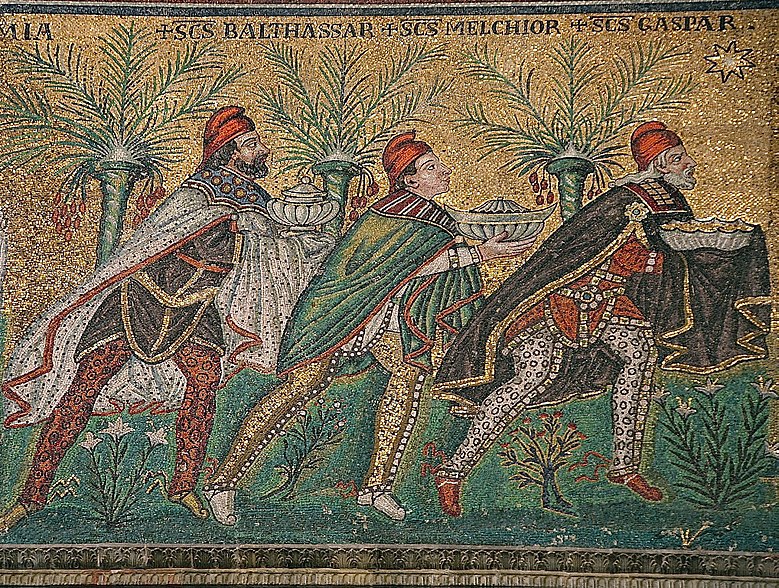
Casper/Jasper

Gender: Masculine
Origin: Persian
Meaning: “treasurer; treasure bringer.”

Caspar, Casper and Jasper are Greek corruptions of an ancient Chaldean or Persian word, gizbar, which means “treasurer.” In modern Hebrew, gizbar is still the word for “treasurer.”

Traditionally, the name is attributed to one of the three Magi, or the Three Wise Men, who are noted for bearing the Christ child gifts. Gaspar is supposedly the one who brought frankincense.

The names of the Magi first appeared in Latin texts which date from the 9th-century C.E. Since then, the name has been in usage in Europe since the Middle Ages, and Gaspar/Caspar is attributed as a saint.

Currently, Jasper ranked in as the # 451st most popular male name in the United States. In Belgium, it is the 51st (2006) and in the Netherlands, the 35th (2008).

Casper did not make it into the U.S. top 1000, the name has not been in the top 1000 since 1933, when it came in as the 978th most popular male name for that year. Its disfavor may have been due to the popular children’s cartoon series, Casper the Friendly Ghost.

His rankings in other countries are as follows:

  • # 77 (the Netherlands, 2008)
  • # 86 (Norway, 2007)
  • # 46 (Sweden, 2007)

Other forms of the name include:

  • Karsudan (Amharic/Ethiopian)
  • Kagpha (Armenian)
  • Gasparu (Corsican)
  • Kašpar (Czech)
  • Jesper (Danish/Dutch/Norwegian/Swedish: YES-per. The 97th most popular male name in the Netherlands-2008, 56th most popular in Norway-2007 and the 74th most popular in Sweden-2007)
  • Kasper/Kaspar (Danish/Dutch/German/Maltese/Norwegian/Swedish)
  • Casper/Caspar (Dutch/English)
  • Jasper (Dutch/English/German: pronounced YAHS-per in Dutch and German)
  • Gaspard (French/Portuguese)
  • Jaspert (Frisian)
  • Gaspare (Italian: gahs-PAH-re)
  • Gasparo/Gaspero (Italian)
  • Gasparino/Gasperino (Italian)
  • Caspar/Gasparus (Latin)
  • Gaspars (Latvian)
  • Kasparas (Lithuanian)
  • Ġaspar (Maltese)
  • Kacper (Polish: most common form)
  • Kasper/Gaspar (Polish)
  • Gašpar (Prekmurian)
  • Chasper/Chispar (Romansch: diminutive is Chasprot)
  • Hasper (Romansch)
  • Papper (Romansch)
  • Tgasper (Romansch)
  • Aspano/Asparinu (Sicilian)
  • Gašpar (Slovene/Croatian)
  • Gaspar (Spanish/Basque/French/Occitanian)
  • Gushnasaph (Syrian)

Feminine forms are the Dutch Jasperine, the French Gasparine and the Italian Gasparina.

The designated name-day is January 6th.

August

It’s the beginning of August and summer is almost over. Hence is why I have decided to write about the August names.

The root of these names is the Latin verb augere meaning “to increase.” Augustus was a title given to Octavian, the first Emperor of the Roman Empire.

Augustus as a title implied a person with great reverence and awe, usually suggesting “venerated” or “exhalted.” The name eventually spun off as a first name, and even left an impact on our month names. In the Roman Empire, the month of Sexitilis’ name was changed to August in honour of the Emperor Octavian. Its feminine version is the austere and rather severe, version of Augusta. Both Augustus and Augusta have a lot of potential. Augustus fits right in with the other “old man” dramatic chic names that seem to be rising up the charts. Think Jasper, Atticus and Leo. There is a certain nobility and sophistication to the name. Its feminine version has the same vibe, fitting right in with other current trends, such as Sophia, Matilda and Eleanor.

We also have the much shorter version of August, which has been used across central Europe for centuries. August seems to be climbing up the American charts, he currently comes in at # 482, while the more formal version of Augustus has ways to go, coming in at # 795. If August still feels too wordy to you, then you might like August with an e, Auguste is the French form.

Of course, how could we ever forget the saintly and scholarly Augustine. The name Augustine is a derivative of the Latin, Augustinus. It has the same meaning as Augustus.

The name was borne by the renowned Catholic Theologian and Doctor of the Church, Augustine of Hippo. Either pronounced (uh-GUS-tin) or (AW-guh-STEEN) the name does not even appear in the top 1000. Parents may find the –stine ending too feminine. It would make a great middle name, or a great alternative to the more common Austin.

Other forms of the name include:

Augustus Forms

  • Augustu (Asturian/Sicilian)
  • Avqust (Azeri)
  • Aogust (Breton)
  • August (Catalan)
  • August (Croatian/English/German/Letzeburgish/Occitanian/Polish/Romanian)
  • Augustus(Czech/Danish/Dutch/English/Finnish/Frisian/Estonian/German/Latin/Norwegian/Swedish)
  • Guus (Dutch: originally a diminutive form, now used as an independent given name)
  • Aukusti/Aku/Aki (Finnish)
  • Auguste (French)
  • Ágost (Hungarian)
  • Ágústus (Icelandic)
  • Augustale (Italian: obscure)
  • Ágastas (Irish/Gaelic)
  • Augusts (Latvian)
  • Ësti (Letzebergish: initially a diminutive form)
  • Gust/Gusti (Letzebergish: initially diminutive forms)
  • Augustas (Lithuanian)
  • Ágošt (Prekmurian)
  • Aujußß (Ripoarisch)
  • Aokuso (Samoan)
  • Augosts (Samogaitian)
  • Austu (Sardinian)
  • Avgust (Slovene)
  • Augusto (Spanish/Italian/Portuguese/Aragonese/Basque)
  • Awgust (Sorbian/Turkmen)
  • Ågusse (Walon)

German diminutives are Gustel, Gustl, Gusti and Augi. Slovenian diminutives are: Gustek, Gustel, Gustelj and Gusti

Feminine forms include:

  • Augusta (Czech/Danish/Dutch/English/German/Italian/Portuguese/Spanish)
  • Gusta/Guusje/Guuske (Dutch: initially diminutive forms, used as independent given names)
  • Auguste (German: final E is pronounced)
  • Auguszta/Ágosta (Hungarian)
  • Ágústa (Icelandic)
  • Avgusta (Slovene)

Augustine Forms

  • Augustini (Albanian)
  • Agostín (Aragonese)
  • Avqustin (Azeri)
  • Aogustin (Breton)
  • Agustí (Catalan)
  • Augustín (Czech/Slovak)
  • Augustijn (Dutch)
  • Augustine (English)
  • Austin (English: a medieval contracted form of Austin, in the United States, this is the most prevalent form of the August names, in 2008, he was the 55th most popular male name, between 1997-1998, he was the 9th most popular male name)
  • Gus (English: sometimes used as an independent given name)
  • Augustin (French/Basque/Croatian/Danish/Norwegian/Romanian)
  • Agostiño (Galician)
  • Ágoston (Hungarian)
  • Ágústínus (Icelandic)
  • Agaistín (Irish/Gaelic)
  • Agostino (Italian)
  • Augustinus (Latin/Dutch/Frisian/Estonian/Finnish/German/Swedish)
  • Augustīns (Latvian)
  • Augustinas (Lithuanian)
  • Wistin (Maltese)
  • Agustin (Piedmontese)
  • Augustyn (Polish)
  • Agostinho (Portuguese)
  • Aujustin (Ripoarisch)
  • Augostėns (Samogaitian)
  • Austinu (Sardinian)
  • Avguštin (Slovene)
  • Agustín (Spanish/Asturian)
  • Awstin (Welsh)

Feminine forms include

  • Austine (English)
  • Augustine (French/German)
  • Agostina (Italian)
  • Augustina (Latin)
  • Augustyna (Polish)
  • Austina (Sardinian)
  • Agustina (Spanish)

Jasperine

Gender: Feminine
Origin: Dutch
Pronunciation: Dutch (yahs-peh-REE-neh); English (JAS-peh-REEN).

The feminine form of the male name Jasper, which is the Dutch form of Caspar, which is Persian and means “treasure.”
The Jasper stone is a pattered chalcedony rock and was held sacred by certain Native American tribes. Several towns in the United States have been named for the stone.