From the Arabic verb تَمايَدَ (tamayada), meaning “to sway gracefully, to move with a gentle or elegant motion.” It comes from the triliteral root م ي د (m-y-d), which carries connotations of swaying, oscillating, or walking with poise and pride.
It is mainly used in the Levant, Gulf Countries and Sudan.
Two notable bearers are Syrian singer singer, Mayada El-Hennawy (b. 1959) and Palestinian-German runner, Mayada Al-Sayad (b. 1992).
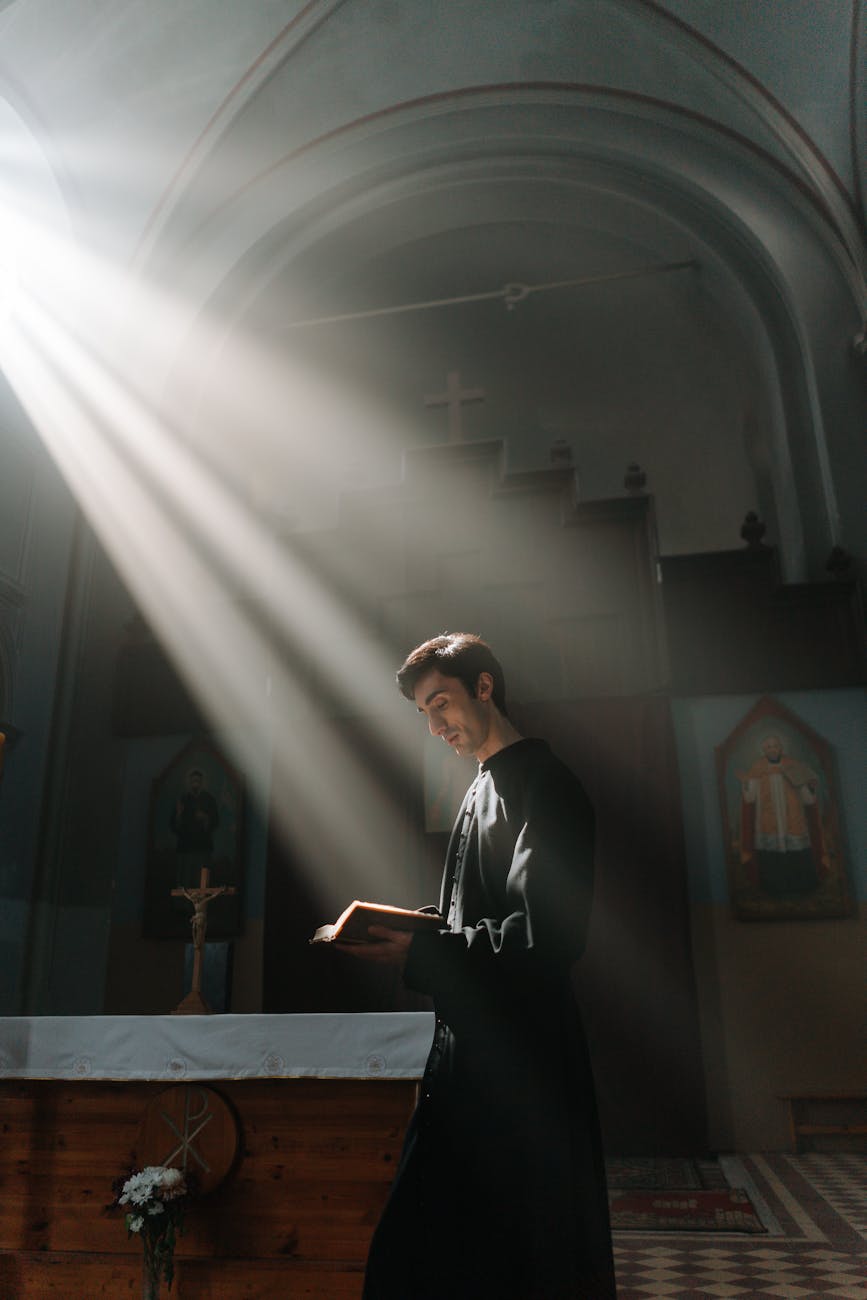
Mannix is the Anglicized form of the early Irish given name Mainchín, a diminutive of Old Irish manach, meaning “monk.” The root manach comes from Latin monachus, “monk,” introduced to Ireland through early Christian monasticism.
Mainchín was a popular given name among early Irish saints, particularly during Ireland’s monastic age (6th–8th centuries). Notable bearers include: Saint Mainchín of Limerick, a 6th-century bishop and the patron saint of the city; and Saint Mainchín of Corann, a lesser-known saint of County Sligo.
As Irish names were adapted into English, Mainchín became Mannix (also occasionally Manix or Mannex). Over time, this Anglicized given name also evolved into a family surname, carried by descendants of those named Mainchín.
The name gained brief international attention through Archbishop Daniel Mannix (1864–1963) of Melbourne, a prominent Irish-Australian religious leader, and through the late-1960s detective series Mannix, which reintroduced the name to modern audiences.
Today, Mannix is a rare but genuine revival of an ancient Irish Christian name — never invented, never fabricated from a surname, but descended directly from one of Ireland’s earliest monastic names. It combines the humility of its meaning (“little monk”) with the strong, contemporary rhythm of names ending in -x (Felix, Lennox, Maddox).
Poetic, bold and well, grim, it is an obsolete Medievel gem which is composed of the Germanic elements, ebur (boar) and grim (bold; fierce; grim).
Source
S.L. Uckelman. “Evergrim”. In S.L. Uckelman, ed. The Dictionary of Medieval Names from European Sources, Edition 2023, no. 1. http://dmnes.org/2023/1/name/Evergrim.
A poetic rarity, it is from the ancient Greek λαλαγέω (lalageo) meaning “to babble; to prattle.”
The most famous bearer of the name appears in Horace’s Odes (Book I, 22), in which it is the name of the poet’s idealized beloved.
Edgar Allan Poe later used Lalage as a tragic heroine in his 1835 play Politian, reinforcing its Romantic aura.
The name experienced some usage in the 19th-century throughout the English-speaking world. A notable bearer is British educator and feminist, Lalage Brown (b. 1927).
The name is formed from the Latin nox (“night”) and lucere (“to shine”). It is an obscure Roman epithet but may make the right choice for parents looking for a gothic, romantic and celestial appellation.
Noctiluca served as an epithet of Venus in ancient Rome. According to Ovid (Fasti 4.373–376), the Romans celebrated a festival to Venus Noctiluca (“Venus the Night-Shining”) on the Aventine Hill, where fires were lit in her honor.
The word was later borrowed into natural history as the name of a bioluminescent sea creature—Noctiluca scintillans—whose glowing waters inspired comparisons to stars reflected in the ocean.
Noctiluna is another variation that may be appealing to those who love Luna but want something more unique.
The nicknames Nockti, Nocktie, Nockty or Luca are options.
A name forever haunted by legend and scripture, Ichabod carries an aura of solemnity and old-world eeriness. Though seldom used today, its deep Biblical roots and literary afterlife make it a quintessential Halloween name with legitimate historical pedigree.
The name appears in the Old Testament (Hebrew: אִי־כָבוֹד, ’I-Kavod), meaning “no glory” or “the glory has departed.” It is first recorded in 1 Samuel 4:21, where Phinehas’s wife, upon hearing of the Ark of the Covenant’s capture and her husband’s death, names her newborn son Ichabod to mark Israel’s loss of divine favor.
In the English-speaking world, the name came into use in the 17th-century, mainly among Puritan families.
In colonial America, one of the best-known bearers was Reverend Ichabod Wiswall (1637–1700) of Massachusetts.
The name’s haunting reputation was sealed by Washington Irving’s 1820 short story “The Legend of Sleepy Hollow.” Its lanky, superstitious schoolmaster, Ichabod Crane, pursued by the Headless Horseman, transformed the Biblical lament into a symbol of American Gothic folklore.
Irving is believed to have drawn the name from a real historical figure, Colonel Ichabod Bennett Crane (1787–1857), an officer in the U.S. Marine Corps whom the author reportedly met while stationed at Fort Pike, New York. The coincidence of name and temperament lent the fictional character an extra layer of realism — and ensured that Ichabod would forever echo through ghostly New England legend.
It is borne by several other famous early American personages,
Traditional short forms in the 18th-19th centuries were Cabe, Bud, and Buddy.
A 19th-century gem and late 20th-century vampiric monikor, the name is of uncertain meaning but has its origins in Medieval Spain. It is likely of Visigothic origins, possibly derived from Gailawera or Geloyra, which stem from gails (happy) or (spear); and wers (friendly, agreeable, true).
It should be noted that Elvira (Latin: Iliberri or Iliberis) was an ancient Iberian and later Roman city located near present-day Granada, in Andalusia, southern Spain. However, in this case, it is likely derived from an Iberian source, meaning “new town.”
It was a popular female name among the royal family of Castille & León, producing two queens who bore this name, Elvira of Castile, Queen of León (965–1017) and Elvira of Castile, Queen of Sicily (c. 1100–1135).
It was later used in Mozart’s 1787 opera Don Giovanni (libretto by Lorenzo Da Ponte), in which Donna Elvira is one of Don Giovanni’s former lovers. This likely popularized the name outside of the Iberian peninsula.
By the turn of the 20th-century, Elvira was not unknown in the United States, though never overly popular, it peaked at #254 in 1914, but fell out the Top 1000 by 1981, the same year Elvira, Mistress of the Dark came on the scene.
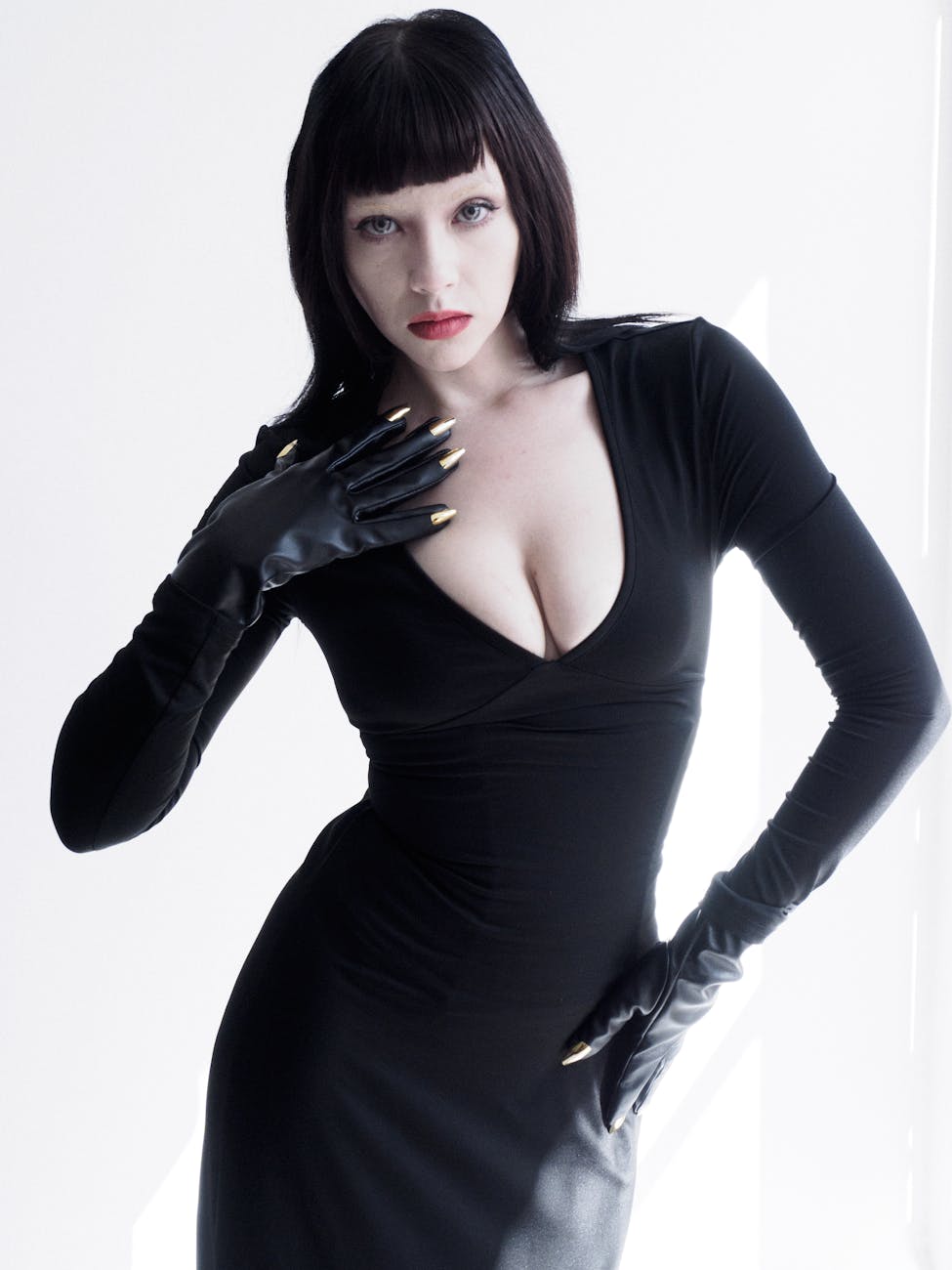
The real Halloween link began in 1981, when actress Cassandra Peterson created the camp-horror TV hostess Elvira, Mistress of the Dark for a Los Angeles late-night show (Movie Macabre).
Dressed in a plunging black gown with a beehive of jet hair, Elvira presented old horror movies with sardonic humor — blending Gothic sex appeal, irony, and B-movie kitsch.
The character became a pop-culture icon: Halloween TV specials, films, pinball machines, comic books, and even perfume lines immortalized her as the Queen of Halloween.
Outside the United States, this name does not have such associations. In Sweden, it has been among the top 100 girls’ since 1998 and peaked at #25 in 2014. As of 2024, it came in at #40.
It’s a popular name in the Balkans, even spinning off a male form of Elvir (Bosnian and Albanian).
Other forms include:
Elbire (Basque)
Elvíra (Czech/Slovakian)
Elviira (Estonian, Finnish)
Elvire (French)
Elwira (Polish, also an alternate Swedish spelling, Sorbian)
Elvīra (Latvian)
Elvyra (Lithuanian)
Obscure Lithuanian male forms are the Lithuanian, Elvyras; the Polish, Elwir(o), and the Italian Elviro.
Name days: August 25 (Austria), July 16 (Croatia), February 10 (Hungary), January 25 (Spain), March 1 (Sweden), November 21 (Slovakia), August 13 (Latvia).
Sources
Withycombe, E. G. The Oxford Dictionary of English Christian Names. Oxford: Clarendon Press, 1950.
Craft is a Latinate form of the German, Kraft (power; strength). It was in use as a male given-name in Medieval Germanic countries but is today obsolete. A variant Latinate form is Crafto.
This may make the perfect name for a Halloween baby.
Sources
S.L. Uckelman. “Craft”. In S.L. Uckelman, ed. The Dictionary of Medieval Names from European Sources, Edition 2023, no. 1. http://dmnes.org/2023/1/name/Craft.
Socin, Adolf. Mittelhochdeutsches Namenbuch: Nach oberrheinischen Quellen des 12. und 13. Jahrhunderts. Basel: Helbing & Lichtenhahn, 1903. Digitized by the Bavarian State Library. Accessed October 29, 2025. https://www.digitale-sammlungen.de/en/view/bsb10931113
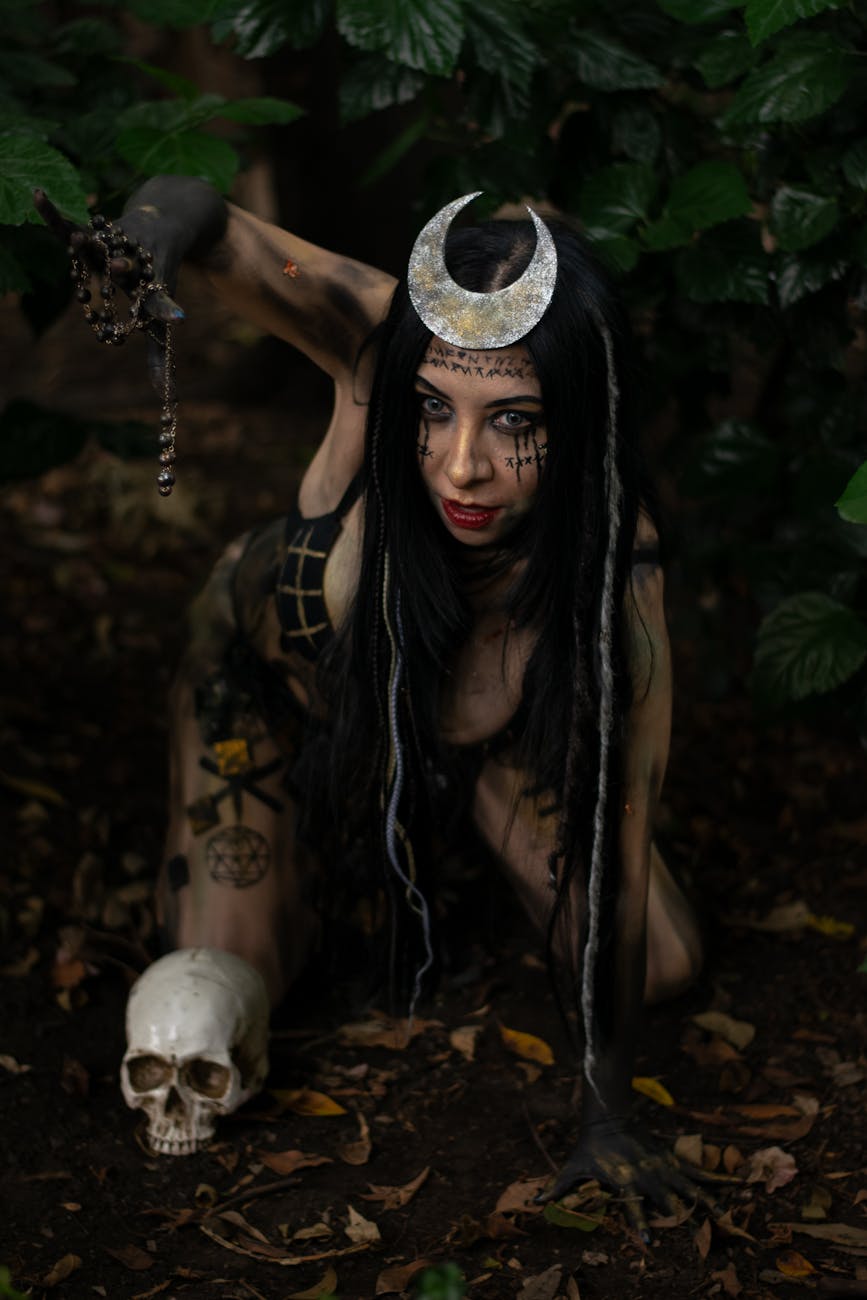
The name is from the Tagalog word, may-ari, meaning, “owner, master.”
In Filipino mythology, Mayari is the goddess of the moon, war, revolution, strength, weaponry, and beauty — and is celebrated as one of the most radiant and formidable deities in the Tagalog pantheon. She is the daughter of Bathala, the supreme god and creator of the world and was mothered by a mortal woman.
When Bathala died without naming an heir to rule his earthly domain, Mayari and her brother Apolaki, the god of the sun, fought for succession, using bamboo sticks as weapons. During their fierce duel, Apolaki struck out one of Mayari’s eyes. Realizing the cost of their conflict, the siblings reconciled and agreed to share rule over the world — Apolaki reigning over the day, and Mayari over the night.
Because of her single remaining eye, the moon’s light is dimmer than the sun’s. In some regional traditions, Mayari is also linked to Tala, the goddess of the stars — as her sister, or in alternate legends, as her mother.