The name comes directly from the Arabic لمِيس (lamīs), meaning “soft; tender; soft to the touch.”
An Urdu and Bengali form is Lamisa.
Alternately, it appears in Greek mythology, in the epic Dionysiaca by Nonnus of Panopolis as the name of one of the leaders of the satyrs who joined the army of Dionysus in his campaign against India. In that context, the meaning of the name is not clarified and the mythological reference is very obscure.
The name comes directly from the Igbo word for blessing. It incidentally is also the name of several places in Africa, most notably a city in Burundi, however, they do not share the same etymology.
The name is from the Arabic word مَوَدَّة (mawaddah), meaning, “affection; love; friendship.” It has the same sense as the Greek word and name, Agape. It is ultimately derived from the Arabic root و-د-د (w-d-d), meaning, “love; affection; compassion.”
The name comes directly from the Farsi word نیلوفر (niloufar), meaning, “morning glory; water lily; nenuphar.”
It ultimately derives from Middle Persian nīlōpār, from Sanskrit nīlotpala (नीलोत्पल) meaning blue lotus (nīla “blue” + utpala “lotus”). Through Persian, it spread widely into other languages of the Islamic and Silk Road world. The Greek-Latin loan nénuphar comes from this same root, appearing in medieval botanical and poetic texts to denote the water lily (Nymphaea).
Niloufar has been used as a feminine given name in Iran, Afghanistan, Tajikistan, Azerbaijan, and Turkey (where it appears as Nilüfer).
Notable bearers include:
Niloufar Bayani, Iranian conservationist and scholar.
Nilüfer Yumlu (known simply as Nilüfer), celebrated Turkish pop singer.
Princess Niloufer of Hyderabad (1916–1989), Ottoman princess renowned for her beauty and philanthropy.
The name comes directly from the Tswana word for “light.”
Lesedi La Rona (our light), is the fifth largest diamond in the world.
Currently, Lesedi was the 6th most popular female name in South Africa in 2023 and was among the top 10 most popular male names in South Africa until 2022.
A notable female bearer is Namibian tennis player, Lesedi Sheya Jacobs (b. 1997) and a notable male bearer is South African soccer player, Lesedi Kapinga (b. 1995).
With its radiant meaning and musical sound, Lesedi carries a sense of warmth, dignity, and brilliance. It’s a name that feels both grounded in African linguistic heritage and luminous enough to travel globally—an embodiment of “light” in every sense.
The name is of uncertain etymology. It has sometimes been linked to the ancient Greek word ἄλαρα (álara), said to mean “hazelnut” or “spear-shaft.”
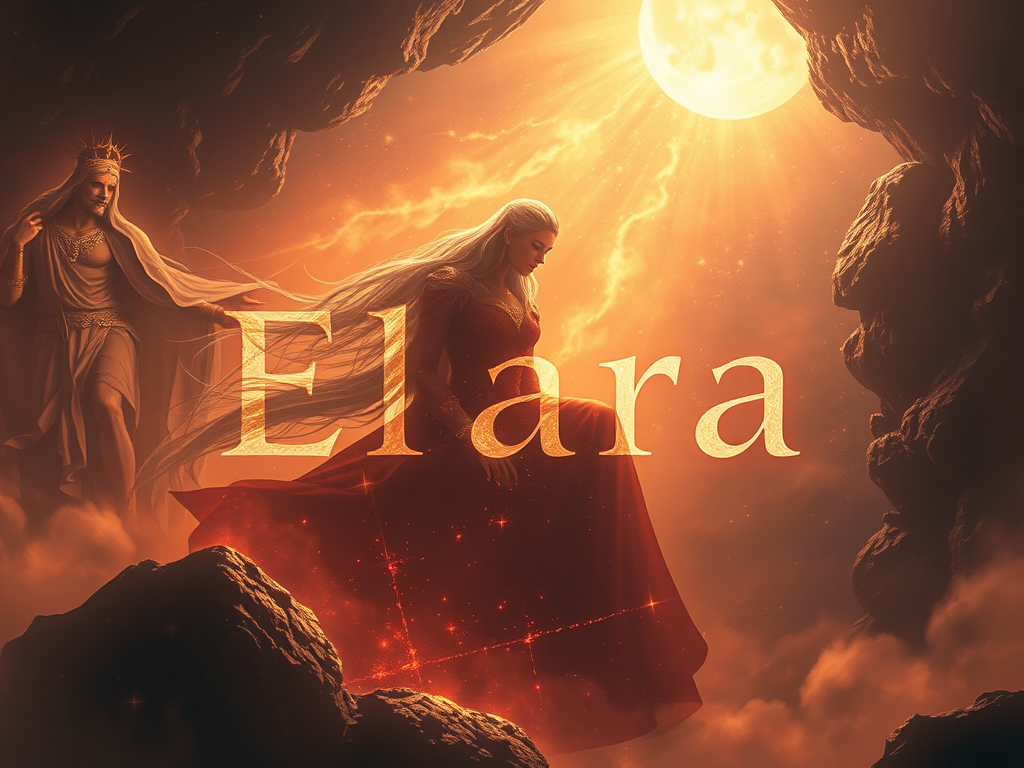
In Greek mythology, Elara was a mortal princess of Orchomenus loved by Zeus. When she became pregnant, Zeus hid her deep beneath the earth to protect her from Hera’s jealousy. There she gave birth to their gigantic son Tityos (Τιτυός). Because of this myth, Elara is sometimes associated with the earth or the underworld. One of Jupiter’s moons, discovered in 1905 by Charles Dillon Perrine, was later named in her honor.
As a given-name in the English-speaking world, it does appear in records in the 19th-century, mainly in the U.S. Recently, it has appeared in England & Wales Top 900 girls’ name, coming at #467 (2024).
With its celestial link and mythological depth, Elara feels like a luminous and romantic alternative to other El- names such as Elena, Eleanor, and Elodie. Its lunar connection gives it a quietly modern yet timeless appeal.
From the Biblical Hebrew קוּםqum (to rise) and אֵל ‘el (God).
It is borne by at least three Biblical figures, including the nephew of Abraham in Genesis 22:21, a leader of the tribe of Ephraim in Numbers 34:24; and the ruler of the tribe of Levi in Book of Chronicles 27:17.
It was in use in 19th-century America among Protestant families with the short form of Kem.
The name comes directly from the Persian کیوان, which is the Persian word for the planet Saturn. It is ultimately derived from the Sumerian designation of the planet, Kaimanu.
In Zoroastrianism, the planet Saturn was viewed as the planet of strength, endurance, loyalty and patience. The Mandaic version of the name is Kiwan ࡊࡉࡅࡀࡍ.
Despite its pre-Islamic associations, the name is still popularly used in Iran and is still used among Zoroastrian families.
The Syriac version of Kewan ܟܝ݂ܘܢ is used among Assyrian Christians.
The name Hephzibah (Hebrew חֶפְצִי־בָהּ, Ḥefzī-bāh) means “my delight is in her.” In the Hebrew Bible, it appears as the name of the wife of King Hezekiah and the mother of King Manasseh (2 Kings 21:1; 2 Chronicles 33:1).
In Isaiah 62:4, Hephzibah is also used symbolically as a poetic name for restored Zion, representing the renewed favor of God toward His people
The name was occasionally used among medieval Jewish communities, where it appears in apocryphal and mystical writings such as the Apocalypse of Zerubbabel and the Zohar. In these texts, a legendary warrior woman named Hephzibah fights the enemies of Israel in the messianic age, slaying wicked kings and defending Jerusalem.
Hephzibah enjoyed modest popularity among Protestant families in the 18th and 19th centuries, especially in colonial America and Puritan New England, where Old Testament names were widely favored. Common diminutives included Eppie, Hepsie, and Hepsy.
By the early 20th century, the name’s use had largely waned, surviving mainly as a literary or historical curiosity.
It was often utilized in 19th-century literature, being the name of a character in George Eliot’s Silas Marner (1861); and Nathaniel Hawthorne’s The House of the Seven Gables (c. 1851), which features Hepzibah Pyncheon, a proud but impoverished New England gentlewoman. Recently, it appears as the name of a witch in the Harry Potter series by J.K. Rowling.
An early notable bearer was American Bostonian Socialite, Hepzibah Swan (d. 1825, unknown birth date). A more recent notable bearer is American-Australian pianist, Hephzibah Menuhin (1920-1981).
It is also the name of several places in the United States.
With its mix of Biblical grace, Gothic Americana, and warrior-woman legend, Hephzibah carries both majesty and mystery. Its vintage nicknames—Eppie, Hepsie, Hepsy—soften its grandeur, making it unexpectedly wearable today.
Hephzibah, long slumbering in scripture and story, may be ready for revival.
Sources
Withycombe, E. G. The Oxford Dictionary of English Christian Names. Oxford: Clarendon Press, 1950.