A poetic rarity, it is from the ancient Greek λαλαγέω (lalageo) meaning “to babble; to prattle.”
The most famous bearer of the name appears in Horace’s Odes (Book I, 22), in which it is the name of the poet’s idealized beloved.
Edgar Allan Poe later used Lalage as a tragic heroine in his 1835 play Politian, reinforcing its Romantic aura.
The name experienced some usage in the 19th-century throughout the English-speaking world. A notable bearer is British educator and feminist, Lalage Brown (b. 1927).
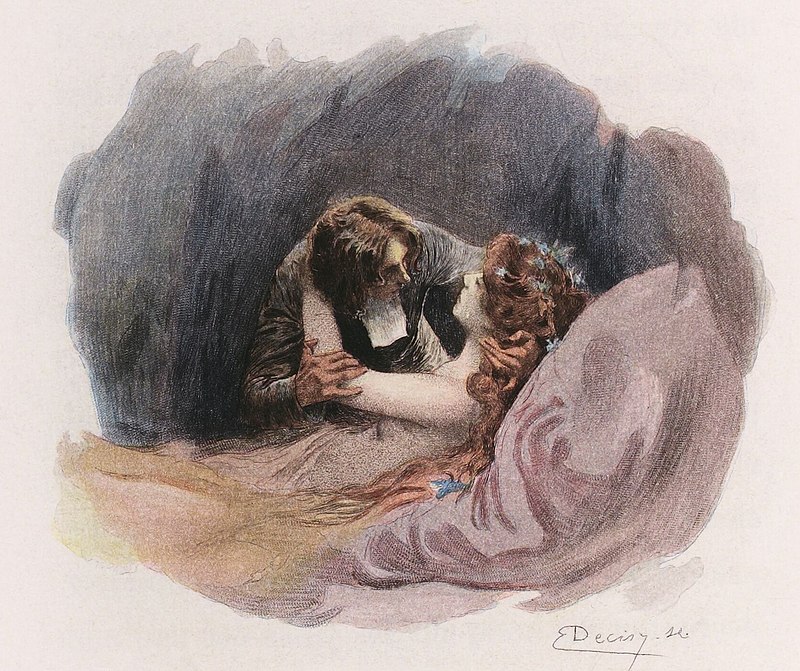
“Her head fell back, but she still wrapped her arms around me as if to hold me back.” Etching by Eugène Decisy [fr] after a watercolor by Paul Albert Laurens, 1904.
Origin: Occitanian
Meaning: uncertain
Gender: Female
Eng pron: (KLAIR-e-mund)
A Medieval Occitanian name first recorded in 12th-century French chivalric literature, Clarimond (also found as Clarimonde, Claramonde, or Claramunda) is either a diathemic compound of the Latin clārus (“bright, light, clear”) and the Old High German mund (“protection”), or derived from an Occitanian phrase meaning “bright world; clear world”
In the 12th-century chanson de geste, Huon de Bordeaux, the name appears in its earlier form as Esclarmonde borne by a Saracen princess who converts to Christianity and marries the hero Huon. Similar formations (Florimond, Rosamond, Alemond) were fashionable among the knightly and aristocratic classes of the High Middle Ages. The 1889 opera by Jules Massenet, Esclarmonde, is loosely based on the character from Huon de Bordeaux.
Historically, Esclarmonde and its variants were borne by at least four noblewomen of the House of Foix, the most famous being Esclarmonde de Foix (d. 1215), sister of Count Raymond-Roger de Foix, who was noted for her learning and association with the Cathar movement in southern France.
Though rare, Clarimond saw occasional use in 17th-century England, likely revived through renewed interest in medieval romance literature. Clarimonde was also occasionally found in 18th-19th-century Acadia, and was used by the closely related Cajuns in Louisiana.
In 1836, French writer Théophile Gautier reintroduced the name in his celebrated vampire novella La Morte Amoureuse (Clarimonde in French; The Beautiful Vampire in English). Gautier’s heroine—a sensual courtesan who blurs the line between life and death—cemented Clarimonde’s association with Gothic beauty, nocturnal allure, and eternal fascination, making it an especially fitting name for Halloween
Other forms include:
Esclarmonda (Catalan, Occitanian)
Clarimond (English)
Clarimonde (French)
Clarimunda (Late Latin, Spanish)
Esclarmonde (Old French)
Clarmonda (Occitanian)
Clarmontina (Occitanian)
Mondina (Occitanian)
Esclaramunda (Spanish)
Sources
Withycombe, E. G. The Oxford Dictionary of English Christian Names. Oxford: Clarendon Press, 1950.
The name comes directly from the Arabic word نُعْمان (nu’man), which is a poetic term describing “blood” as in a type of blood that brings vitality and beauty. It is also the word for the colour crimson and the anemone flower. It is ultimately from the root n–ʿ–m (ن ع م), which shares the same root with Naim نعم (comfort, tranquility, luxury, ease).
Numan ibn al-Munḏir (d. 602 CE) was one of the last Lakhmid kings of al-Ḥīrah, a pre-Islamic Arab Christian kingdom in southern Iraq. He is remembered in Arabic literature for his eloquence and patronage of poets.
In early Islamic history, Numan ibn Bashir al-Ansari (d. 684 CE) was a Companion of the Prophet Muḥammad and a prominent figure in the first Islamic century.
Giselher is an early Old High German masculine name formed from two classic Germanic elements, gisel (pledge) and hari (army).
The best-known figure is King Giselher of Burgundy, a 5th-century ruler who appears in both history and legend. He is immortalized as a character in the Nibelungenlied, the great Middle High German epic, alongside his brothers Gunther and Gernot.
It was also the name of an 11th-century Bishop of Madgeburg who succeeded St. Adalbert.
It is found in records as the name of Teutonic Knights in Estonia, Latvia and Poland. It experienced a minor revival in the early 20th-century but is quite rare in contemporary German-speaking countries.
Its Anglo-Saxon version of Gislhere was borne by an 8th-century Bishop of Selsey.
A more recent bearer was German composer, Giselher Klebe (1925-2009).
Its designated name-day in Austria is September 28th.
S.L. Uckelman. “Giselhar”. In S.L. Uckelman, ed. The Dictionary of Medieval Names from European Sources, Edition 2023, no. 1. http://dmnes.org/2023/1/name/Giselhar.
Sohrab (Persian: سهراب) is a classic Persian male name. It is most famous from the Shahnameh. In the epic, Sohrab is the heroic son of Rostam and Tahmineh. He is celebrated for his beauty and courage. He is known for his tragic duel with his father Rostam. It is one of the most famous episodes in Persian literature. His story has inspired countless Persian miniatures, operas, and poems. There are also even Western adaptations. One example is Matthew Arnold’s 19th-century poem Sohrab and Rustum.
Scholars derive it from Middle Persian, Suhrāv / Sōhrāv. It is composed of suhr / sohr (سهر) – “red, ruddy, rosy, dawn-colored.” The term āb آب means “water,” but in old compound names, it figuratively represents “essence, fluid, brightness, radiance.” The latter may also be related to آو / او (âv / ô / ow), which is an older or poetic variant meaning, “sound” or “voice.” In some historical compounds, it functions like âb to indicate “substance” or “radiance.”
The name appears not only in Iran, but is found across the Persianate world, including Tajikistan, Afghanistan, and Azerbaijan. It also exists among Central Asian and South-Asian communities influenced by Persian literature, and Zurab ზურაბ is its Georgian form.
The name appears in Norse Mythology as the name of the first woman, who has a husband named Ask. They are attested to in the Poetic Edda and the Prose Edda.
The name Embla itself may derive from the Proto-Norse *elm-la (elm tree), the Proto-Norse *Ambilō (vine) or the Proto-Norse eim + la (firemaker) and it has even been connected with the Germanic root word, amal (work).
It is first attested to in Sweden in 1882, in Norway in 1900, and in Iceland after 1950, however, it may have been in use in Medieval times as well.
Between 2010 and 2016, this was among the most popular female names in Iceland. In Iceland, it peaked at #8 in 2016 . It is currently the 96th Most Popular Female Name in Norway (2023).
Pron: (HERSH; HER-shuh; HERSH-e-NEE, some dialects HERSH-nee); HERSH-ee-kuh; HERSH-ee-tuh; HERSH-VERD-the-nuh)
From the Sanskrit root हर्ष (harsa) meaning “joy; delight; excitement.” It can also refer to sexual excitement or an erection. In Hinduism, Harsha is one of the twenty-four emanations of the celestial couple, Lakshmi and Narayana. It is also the name of one of the three sons of Dharmadeva and the husband of Nandi (also meaning “joy).
Harsha itself is unisex but is more common on males. It was born by a 7th-century Emperor of Kannauj of the Pushyabhuti dynasty in Northern India, also known as Harshvardhana or Harsh-Vardhana, and several other medieval Indian Kings as well as a 12th-century C.E. Sanskrit epic poet. A strictly masculine form is Harsh (HERSH).
Harshvardhana or sometimes spelled Harsh Vardhana is a masculine double name which means “increasingly happy,” being composed of the Sanskrit words, हर्ष (harsa) and वर्धन vardhana (increase; growth).
The feminine offshoot of Harshika derives from the same root but also refers to a type of musical metre.
Another feminine form is Harshini, which derives from the Sanskrit adjective हर्षिन् (harSin) meaning “delightful; joyful.” Harshini is also the name of a type of plant. This beautiful name is not pronounced har-SHEE-nee, but more like HERSH-e-nee or HERSH-nee, like Hershey Chocolate Kisses. There is also just Harshi, pronounced like Hershey.
And another female form is Harshita, which is of the same root being from the Sanskrit हर्षित (harsita) meaning, “pleased; gladdened; joy; happy; delight; charmed” or “made to stand erect.”
The name is of uncertain meaning, it is possibly a feminine form of the Welsh male name, Lleu (bright, light), or composed of the Welsh element, lleu (bright; light) and cu (dear), or derived from the Welsh lleuad (moon).
It is the name of a heroine in the 14th-century Welsh poem by Llywelyn Goch ap Meurig Hen, Marwnad Lleucu Llwyd, it is said to have been written for his deceased lover of the same name.
From the Medieval Italian term, villano, meaning a farmhand, countryman, peasant, ultimately from the Latin villanus, of the same above meaning.
Both its masculine form of Villano and its feminine form of Villana were in common use in Medieval Italy. Its masculine form was born by two 12th-century Italian bishops, and its feminine form was born by Bl. Villana de Botti (1332-1360), an Italian nun and penitent who is currently up for canonization by the Catholic Church.
Both names fell out of use in Italy due to the term later taking on the meaning of a rude or crass person. Villano is however, also an Italian surname. Its gallicized forms of Villain and Villaine appear in sporadic use in France between the 11th-17th centuries.
Villanella is a type of Italian music, which later spun off the Villanelle (derived from pluralized of the former word), which is the name of a type of pastoral poem that became popular in 19th-century England.
Villanelle was used as the name of a character in the 1987 Jeannette Winterson novel, The Passion. It was then used as the name of a character in the Luke Jennings’ thriller novel, Codename Villanelle, which later spun off the BBC series, Killing Eve (2018-2022). Since 2018, the name has appeared in sporadic use in the U.K. being given to 5 baby girls a year.
Theoretically, Villanella could have been a Medieval diminutive form of Villana, and it would then be possible to gallicize the name to Villanelle, but I cannot find any records for either name being used prior to the 21st-century, and Villana’s French form was Villaine, which would more likely to have lend itself to the diminutive form of Villainette.