Alanta

Flowing streamGender: Feminine
Origin: Lithuanian
Meaning: “to run; to stream merrily.”
(ah-LAHN-tah).

From the name of a river in Lithuania, which is a tributary of the Virinta, the name is derived from an ancient Lithuanian verb alėti meaning “to run (used in reference to moving water); or to stream merrily.” It is also the name of a town in the Molėtai district municipality, which was named for the river. It has a name-day, which indicates it is considered a legitimate name in its home country, as well as a masculine form, Alantas. The designated name-day is October 3.

Another feminine form is Alantė.

Note: The town name has a Polish equivalent: Owanta (oh-VAHN-tah), but it is not used as a feminine give name in Poland; it also has a Yiddish version, Avonte אַוואָנטע.

The name has no equivalents in other languages but Alanta can work in most Germanic languages, including English as well as most Latin Languages with the exception of French. In French, recommended orthography would perhaps be Alante (which can work for both the feminine and masculine form) or Alantée which would be a specific feminine form.

sources

post updated on 03/22/2023

Núria, Nuria

Gender: Feminine
Origin: Catalan
Meaning: Unknown
(NOO-ree-ah)

Another Spanish place name turned first name, like Meritxell, she is a popular given name due to her associations with a miraculous statue of the Virgin Mary. The sound is pretty, the statue of the Virgin Mary is exquisite and the landscape of Vall de Núria is breath taking. Unfortunately, I could not find the etymology of the name. The name is currrently very popular in Spain, ranking in as the twenty-sixthe most popular female name of 2006. Its designated name day is September 8th. To hear how its pronounced, go here: http://www.forvo.com/word/núria/ Namesakes include: Nuria Bermudez (b. 1980) a Spanish actress and football agent and Nuria Llagostera Vives (b.1980) a Spanish tennis player.

Meritxell

Gender: Feminine
Origin: Catalan
Meaning: “midday.”
(meh-ree-CHEL)

She rhymes a bit with Michelle, but looks unpronounceable to an English speaker. The name is currently popular in Spain, particularly in Barcelona, where the langauge of Catalan is spoken. It is also very prevalent in the country of Andorra, where Catalan is the official language. Meritxell started off as the name of a place, but due to its associations with the Virgin Mary, it became a favorite among Catalan speakers. As for the origins of the name itself, Catalan Philologist, Joan Caromines, claims the name is derived from a diminiutive merig which is ultimately from the Latin meridiem meaning “midday.” Merig is a name used by shephards to denote a pasture with a lot of sun. The legend of Our Lady of Meritxell concerns a statue of the Blessed Virgin Mary. In the 12th-century, mass goers in the village of Canillo in Andorra, discovered a statue of the Virgin Mary. It was placed among blooming roses, something which was thought of as miraculous, since it was the dead of winter. You can find more about the story here http://en.wikipedia.org/wiki/Our_Lady_of_Meritxell. A church was built for the statue, and Our Lady of Meritxell is considered the patron saint of the principality of Andorra. In the 1970s, the church and statue were destroyed in a fire, the church was rebuilt and a replica of the statue reproduced. The name day in Spain is September 8, when the statue was destroyed by fire in the 1970s. The name is currently borne by Andorran Minister of Foreign Affairs, Meritxell Mateu i Pi (b. 1966). This site had an audio of the name being spoken by a Catalan speake http://www.forvo.com/search/Meritxell/. In 2003, the name was the 49th most popular female in Spain. In 2006, it did not rank in the top 100 female names of Spain.

Višnja

Gender: Feminine
Origin: Serbo-Croat
Meaning: “cherry.”
(VEESH-nyah)

As summer comes to a close, I almost forgot to post about this lovely gem. Find Cherry too tacky as a given name? Then why not this Balkan beauty. The name comes directly from the South Slavic word for the cherry, and it a fairly common name in the former Yugoslav Republic. In Slovenia, its the name of a mountain Gora Visnja, known as Weichselburg in German.

Neringa

Gender: Feminine
Origin: Lithuanian
Meaning: “to dive like a swimmer”
(ne-RIN-gah)

Beautiful Neringa is a city that lies in the Curonian Spit, a jewel on the Baltic coast. A famous resort which boasts the highest sand dunes in all of Europe, it was once the seat of the Teutonic Knights, in fact, it belonged to Germany for 700 years before being handed over to Lithuania in 1923. Though the regions inhabitants were not Germans themselves, they were a melange of various Baltic tribes comprised mostly of Latvian, Prussian and Lithuanian fishing villages. Today Neringa is renowned for its beauty and summer getaways for Lithuanian, Russian, Latvian and German tourists.

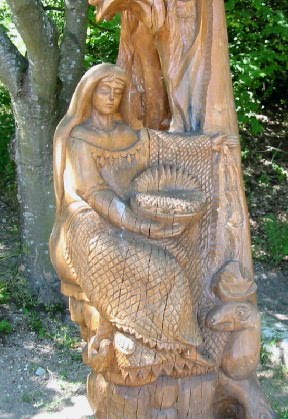
Legend has it that the city got its name from a virginal giantess. There are a few different legends of the maiden floating around, most of the legends tell of a gentle giant who built a mound of sand to keep the stormy waves of the Baltic sea at bay, but the most amusing, (made famous by a Lithuanian children’s book, written and illustrated by Domicela Tarabildienės in 1949, Naglis ir Neringa), is s quirky tale about unrequited love, which includes the love sick dragon by the name of Naglis, (also the name of a famous dune on the sands of the Curonian Spit).

Neringa lived on the Baltic coast, like the city named for her, she was renowned for her beauty, she caught the attention of a local dragon or a sea serpent by the name of Naglis, who quickly fell in love with her. When Neringa did not return his love, he started to eat the local fishermen in grief. In order to completely cut of all ties with Naglis the dragon, Neringa had to create a strip of sand between the bay and the Baltic sea, which would seperate her and her subjects from the dragon forever. This is supposedly how the spit was created.
As for the etymology of Neringa itself, many sources claim that it is derived from an ancient Latvian or Prussian word neria which means “to dive like a swimmer.” The name has been in usage as a feminine given name for awhile, it most likely caught on after 1923 when the spit was incorporated into Lithuania and the legend of the giantess revived. Its name day in Lithuania August 20.

Altmann

Gender: Masculine
Origin: German/Yiddish
Meaning: “old man.”
Germ (AHLT-mahn); Eng (ALT-men)

This old and obscure German name is often associated with a surname. Its bearers mostly being of Askkenzi Jewish descent or of German ancestry. The name did start off as a first name. In fact, it was borne by a medieval German saint and bishop. Altmann of Passau, (1015-1091), is most noted for his clerical reforms as well as for his founding of several monasteries throughout Wesphalia. His feast day and  name-day is commerated on August 8. The name’s Jewish associations are probably just as strong as its Christian. Altmann, as a given name, became very popular among German Jews starting in the Middle Ages. There was an old folk belief, specific among the Ashkenazim that giving a child a name with undesirable traits would have a sort of repellent effect against the associations the name represented. Therefore, it was often believed that naming your child a name like “old man” would make him live a long and vibrant life. In German speaking countries, the name has long been out of favor, since it still carries a literal meaning in German.  However, in the United States, due to the popularity of surname names, the name might be quite appealing to the American ear. There is Hunter, Taylor and I’ve even seen Cutter, so why not Altmann. Another possible attraction to this name is that it incorporates both Jewish and Christian heritage, perhaps a suitable name for a child of mixed faiths. The name is also the name of a German brand of car, as well as a the summit of the Appenzell Alps in Switzerland. Another cool association!

Emőd

Gender: Masculine
Origin: Hungarian
Meaning: “suckling: little baby”
(eh-MEWD)

This ancient Hungarian male name may be derived from an ancient Magyar element meaning “suckling” a reference to a very small baby. It is also the name of a town in Northern Hungary, though the town got its name from the personal name. For a better idea of its pronunciation, consult this link http://www.forvo.com/search/Emőd/. Its designated name day is August 9.

Salme, Salmi

Gender: Feminine
Origin: Estonian/Finnish
Meaning: debated
(SAHLL-meh); (SAHLL-mee)

The names are possibly derived from the Estonian word salmike meaning “rhyme”. They are also possibly taken from an Estonian place and Finnish name. Salme is the name of a Parish in Estonia, while Salmi is the name of a place in the Republic of Karelia . Its designated name day is August 5.

Lydia

Gender: Feminine
Origin: Latin/Greek
(LID-dee-uh)

Lydia has a sweet feminine vibe. Its classic without sounding too stuffy. Lydia could work just as well on a five month old as it would on a 55 five year old. It has the same feel as the popular Olivia and it wouldn’t be surprising if Lydia soon took Olivia’s place. Lydia currently stands as the 120th most popular female name in the United States.

As for Lydia’s history, it first appears as a given name in the New Testament. It was the name of a woman who had converted to Christianity after befriending St. Paul. Some scholars believe that Lydia was not her actual name, rather, it was a nickname to denote her place of origins, (Lydia in Asia Minor).

Lydia is a Greek word for an ancient country, known in Assyrian as Luddu, this particular’s country’s culture and language has been lost to history and speculation. The Greeks talked quite a bit about it, and in the Bible it is often refered to as Lud.

Lydia has multiple forms, including:

  • Lidiya Лидия (Bulgarian/Russian: Lidochka is a Bulgarian diminutive form)
  • Lídia (Catalan/Hungarian/Portuguese/Spanish)
  • Lýdie (Czech: LEED-yeh)
  • Lydia Λυδια (English/Estonian/Greek)
  • Lii/Ly (Estonian)
  • Liidia/Liidi (Estonian)
  • Lyydia/Lyyti (Finnish)
  • Lydie (French: LEE-DEE)
  • Lida (Hungarian)
  • Licia (Italian: lee-CHEE-ah).
  • Lidia (Polish/Italian/Romansch: a Polish diminutive form is Lidka.)
  • Livli (Sami)
  • Lýdia (Slovakian)
  • Lidija (Slovene/Croatian: diminutive forms are, Lidonka, Lidunka and Liduška)

In other Continental European countries, the name is usually rendered the same as it is in English. In German speaking countries its pronounced (LUY-dee-ah). Its designated name day is August 3rd.