Kayal

The name is a feminine Indian name that sounds identical to the male English surname & given-name, Kyle.

It can either be derived from the Hindi “कायल (convinced) or the Tamil கயல் which is the name of a species of fish endemic to the Indian subcontinent, known under the scientific term of cyprinus fimbriatus or the Fringed-lipped peninsula carp.

Sources

Meri

Gender: Feminine
Origin: Finnish/Estonian
Meaning: “the sea.”
(MEH-ree). Pronunciation can be heard here: http://www.forvo.com/word/meri/

The name comes directly from the Finnish and Estonian word for the sea, but it is also speculated that it may have originally been used as an alternative for Maria. As of 2008, approximately 5521 women in Finland bore the name Meri. There is also a popular compound form, which is Meri-Tuuli, literally meaning “sea wind.” The designated name-day in Finland is December 3, while in Estonia, it is April 22nd.

Kaija

Gender: Feminine
Origin: Latvian
Meaning: “gull; seagull.”
Lat (KYE-yah).

The name comes directly from the Latvian word for sea-gull, coincidentally, it is also used in Finland as a form of Katherine. As of 2008, there were 97 registered Kaijas in Latvia. Its designated name-day in Latvia is November 12.

Selga

Gender: Feminine
Origin: Latvian
Meaning: “deep sea.”
(SEL-gah)

The name is derived from the Latvian word used to refer to the deep sea. In Latvia, at least 230 women bore this name as of 2008.

It is also the name of a type of biscuit produced by Latvian chocolatier compant, Laima.

Its designated name-day in Latvia is September 12th.

Another form is Silga.

Aira

Gender: Feminine
Origin: Latvian
Meaning: “oar; scull.”
(I-rah).

I have seen this name listed across the internet before, with the dubious meaning “of the wind” and its origins listed as “American.” While the windy meaning seems nice and “airy,” (no pun intended), I am almost certain this is just another name that has been given an embellished meaning, much like Vanessa being listed as Slavic for “butterfly” and Ashley meaning “pretty ash tree of God.” Apparently, Aira is a traditional Latvian female name. A google search brought me the personal web pages of Latvian women of varying ages. I cannot confirm how popular Aira is in its home country as I couldn’t find a stastical data past Latvia’s top 10. Aira is listed on the Latvian national calender, deeming the name an accepted female given name in the Latvian lexicon. I had a hard time finding a meaning for this one. There are not very many sites listing Latvian names with meanings. There are plenty of baby name websites in Latvian that tend not to list the meanings. Mostly because the meanings of many Latvian given names are obvious to native speakers. Though there are plenty of Greek, Latin, German and Russian names that have been borrowed over the centuries, the Latvians have, as do other Baltic countries, their own set of unique names derived from vocabulary in their language. Nature names and word names are apart of the norm. Upon further research, I found that at least in Latvian etymology, Aira is a feminine form of Airis, Airis in turn comes directly from the Latvian word for oar. Not surprising to find such a name among a sea-fearing people. I also found that Aira is scientific name for hair grass. In Latvia, Aira’s name day is August 31st.

Neringa

Gender: Feminine
Origin: Lithuanian
Meaning: “to dive like a swimmer”
(ne-RIN-gah)

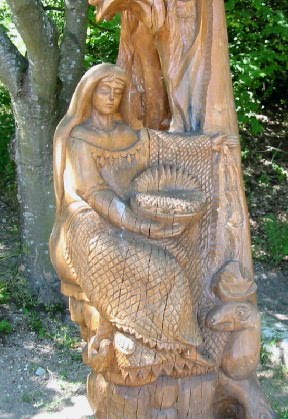
Beautiful Neringa is a city that lies in the Curonian Spit, a jewel on the Baltic coast. A famous resort which boasts the highest sand dunes in all of Europe, it was once the seat of the Teutonic Knights, in fact, it belonged to Germany for 700 years before being handed over to Lithuania in 1923. Though the regions inhabitants were not Germans themselves, they were a melange of various Baltic tribes comprised mostly of Latvian, Prussian and Lithuanian fishing villages. Today Neringa is renowned for its beauty and summer getaways for Lithuanian, Russian, Latvian and German tourists.

Legend has it that the city got its name from a virginal giantess. There are a few different legends of the maiden floating around, most of the legends tell of a gentle giant who built a mound of sand to keep the stormy waves of the Baltic sea at bay, but the most amusing, (made famous by a Lithuanian children’s book, written and illustrated by Domicela Tarabildienės in 1949, Naglis ir Neringa), is s quirky tale about unrequited love, which includes the love sick dragon by the name of Naglis, (also the name of a famous dune on the sands of the Curonian Spit).

Neringa lived on the Baltic coast, like the city named for her, she was renowned for her beauty, she caught the attention of a local dragon or a sea serpent by the name of Naglis, who quickly fell in love with her. When Neringa did not return his love, he started to eat the local fishermen in grief. In order to completely cut of all ties with Naglis the dragon, Neringa had to create a strip of sand between the bay and the Baltic sea, which would seperate her and her subjects from the dragon forever. This is supposedly how the spit was created.
As for the etymology of Neringa itself, many sources claim that it is derived from an ancient Latvian or Prussian word neria which means “to dive like a swimmer.” The name has been in usage as a feminine given name for awhile, it most likely caught on after 1923 when the spit was incorporated into Lithuania and the legend of the giantess revived. Its name day in Lithuania August 20.
Laine

Gender: Feminine
Origin: Estonian
Meaning: “wave.”
(LAHEE-neh)

No, this is not a new trendy spelling for the masculine surname name Lane. It is, however, a traditional Estonian female name that somewhat rhymes with the last part of Carolina.

It comes directly from the Estonian word for wave.

Its designated name day is August 6.

Variations include Lainela, Laina and Laini.

Sources

  1. http://www.behindthename.com/namedays/lists/8.php
  2. http://www.behindthename.com/php/find.php?name=laine

Bylgja

Gender: Feminine
Origin: Old Norse/Icelandic
Meaning: “wave; billow.”
(BILG-yah)

    The name is borne in Norse Mythology by one of the nine daughters of Rán and Aegir.

    Bylgja represented the waves of the sea and she is the mother of Heimdall by the god Odin.

    In Icelandic, it coincides with the modern word for wave.

    As a first name, it is currently borne by 116 women, and as a middle name, it is borne by 19 women (July 2007).

    For an English speaker considering this name, a possible nickname option is Billie.