Antonia

Gender: Feminine
Origin: Latin
Eng (an-TOH-nee-ah; AN-tuh-NEE-ah)

The name is a feminine form of Antonius. In Roman times, this name was used for the female offspring of the Antonii clan.

It was borne by several famous Roman matrons, including the daughter of Marc Antony (50 BCE-?).

Currently, Antonia is the 58th most popular female name in Germany, (2011) and the 72nd most popular in Croatia, (2010).

Other forms of the name include:

  • Antonia (Catalan/Corsican/Croatian/Dutch/English/German/Greek/Italian/Polish/Romanian/Romansch/Scandinavian/Spanish)
  • Antonija Антония (Croatian/Macedonian/Russian/Serbian/Slovene)
  • Antonie (Czech/French)
  • Antónia (Hungarian/Portuguese/Slovak)
  • Antonía (Icelandic)
  • Antía (Galician)


Mara

The name could be of several different origins and meanings depending on the bearer of the name. Generally, the name is mostly used in reference to its Biblical origins, when Naomi takes the name of Mara(h) (Ruth 1:20), (which in Hebrew means “bitter”) as a way to express her grief over losing her husband and sons. The same name also appears in the Exodus as the name of one of the locations which the Torah identifies as having been travelled through by the Israelites.

It could also be from Latvian mythology, spelled Māra, being the name of the supreme goddess who was associated with all feminine aspects of life. She is sometimes believed to be one and the same as Laima.

The name also appears in Slavic mythology as another name of the goddess Marzanna, the goddess of death and winter. Interestingly, it is also the name of the goddess of death in Hinduism. The two deities may have a distant connection.

In German the name is ultimately derived from a proto-Indo European source meaning “to harm” or “to rub away.” In folklore, mara were wraiths who pressed on the chests of sleeping victims, this is where the word nightmare is believed to have derived.

It is interesting to note that the name appears in the top 100 most popular female names in Germany, where it is currently the 55th most popular female name, (2011). It is doubtful, however, that the name is used in reference to its Germanic folklore origins, but is more likely used in reference to its Biblical connections.

The name could also be from the Syriac and modern Maltese meaning, “woman.”

In Hungarian and Croatian, it is used as a form of Marija.

Her rankings in other countries are as follows:

  • #79 (Croatia, 2010)
  • # 93 (Spain, 2010)
  • # 128 (Netherlands, 2010)
  • # 869 (United States, 2010)


Alina

The name could be of several different origins and meaning depending on the bearer of the name.

In Romanian, it is derived from the verb meaning “to sooth”. It even boasts its own masculine version: Alin.

It could also be a German and Dutch contraction of Adelina.

Other sources have popularly attributed it to be a form of the Arabic, Alia (lofty; sublime). In this case, the name appears in One Thousand and One Nights as the name of a beautiful princess.

In Belarusian, it is a name of pre-Christian origins, being derived from the old Slavic word алы (aly) meaning “scarlet.” In Russian, it has been linked with the names Albina, Aleksandra and Akulina, considered contracted forms. While in Bulgarian, it is considered a contracted form of Angelina.

In Italy, it is viewed as a contracted form of Rosalina or Pasqualina, the name can be typically found in Northern and Central Italy.

In Polish and Lithuanian, it has been suggested that the name may be derived from Alna, the Lithuanian name of a river which runs through northern Poland and Kaliningrad, (known in Polish as Łyna). Alna is from a medieval Baltic word meaning, “doe; female deer”, (compare modern Lithuanian elnias). Famed Polish playwright, Juliusz Słowacki seems to have popularized the name via his 1839 play, Balladyna.  Alina is murdered by her jealous sister Balladyna as they are picking raspberries.

It has also been suggested to be related to Halina, a Polish form of Galina.

Currently, Alina is the 4th most popular female name in German-speaking Switzerland, (2010). Her rankings in other countries are as follows:

  • # 4 (Liechtenstein, 2010)
  • # 17 (Russia, 2011)
  • # 28 (Germany, 2011)
  • # 30 (Austria, 2010)
  • # 38 (Slovenia, 2010)
  • # 39 (Romania, 2009)
  • # 78 (Bosnia & Herzegovina, 2010)
  • # 264 (United States, 2010)
  • # 323 (Netherlands, 2010)

Other forms of the name include:

  • Alina Аліна الينا (Arabic/Belarusian/Bosnian/Bulgarian/Czech/Dutch/Finnish/German/Hungarian/Italian/Latvian/Lithuanian/Polish/Romanian/Russian/Scandinavian/Serbian/Slovak/Slovene/Ukrainian)
  • Aliina (Finnish)
  • Aline (French)

Theresa

Gender: Feminine
Origin: Uncertain
Eng (teh-REE-sah; teh-REESE); Spanish (teh-REY-sah); German/Polish (teh-REH-zah); French (teh-HREZ).

The name was first recorded in the 4th century as Therasia. It was borne by the wife of the ex-Roman senator turned Christian Bishop, St. Paulinus of Nola. Therasia had hailed from the Northern Region of Spain, and the name took off as Teresa in both Spain and Portugal.

Its origins are most popularly attributed to the Greek, therizo, meaning, “to harvest” or “to reap.” However, some sources believe that it might be from the Greek word theros meaning “summer” or that it is derived from the name of one of the Santorini islands. It could also very well be an old Iberian name of uncertain etymology. What is certain is that the name’s usage was confined to the Iberian Peninsula up until the 16th-century when it was made famous throughout Europe by St. Teresa of Avila, a Roman Catholic nun and mystic. She is revered as a Doctor of the Church.

In the German-speaking world, it was popularized by Habsburg, Maria Theresa (1717-1780), Empress of the Austro-Hungarian Empire.

It is also borne by a 19th-century French nun, St. Thérèse de Lisieux. She is also revered as a great theologian and Doctor of the Church.

Currently, Teresa/Theresa is the 31st most popular female name in Austria, (2010), the 65th most popular in Germany (2011) and the 100th most popular in Spain, (2010). While in the United States, she comes in at a lowly # 936 (2010).

Popular English nicknames include:  Trace, Tracy, Terry, Tess, Tessa, Tressie (also used as a nickname in Malta), Tress & Reese.
Other forms of the name:
  • Teresa تيريزا (Albanian/Arabic/Catalan/Finnish/German/Italian/Latvian/Polish/Portuguese/Spanish)
  • Terese (Basque/Norwegian/Swedish)
  • Terezija (Croatian/Slovenian)
  • Rezika (Croatian/Slovenian)
  • Resa (Bavarian)
  • Reserl (Bavarian)
  • Resi (Bavarian)
  • Tessa (Bavarian/English/German/Italian)
  • Tereza (Bulgarian/Czech/Maltese/Portuguese-Brazilian/Romanian/Slovak)
  • Teresia (Corsican/Swedish)
  • Terezie (Czech)
  • Thera (Dutch)
  • Theresa (Dutch/German/English)
  • Theresia (Dutch/German/Swedish: common Dutch nicknames are Thera and Trees)
  • Tereesa/Tereese (Estonian)
  • Thérèse (French)
  • Tereixa (Galician)
  • Terisa (German)
  • Therese (German/Scandinavian)
  • Theres (German/Scandinavian)
  • Terézia (Hungarian/Czech/Slovak. Hungarian diminutive form is Teca)
  • Teréz (Hungarian)
  • Teresía (Icelandic)
  • Toiréasa (Irish)
  • Treasa (Irish)
  • Teresiana (Italian)
  • Teresina (Italian)
  • Terina (Italian)
  • Teresija (Latvian)
  • Terēze (Latvian)
  • Tèrìz (Lebanese)
  • Teresė (Lithuanian:Teresijus)
  • Threissya (Malayalam)
  • Trezza (Maltese)
  • Teresita (Spanish)
  • Tessan (Swedish: traditionally a diminutive form, occasionally bestowed as an independent given name)
The designated name-day is often October 15.

Maurice

Gender: Masculine
Origin: Latin
Meaning: “dark; black”
Fr. (moh-REESE) Eng (MOR-ris).

He may seem a bit dated to some, but parents looking to vintage names like Leo and Brice/Bryce might see the appeal in this. Traditionally nicknamed Maury, parents who opt for the French pronunciation have the advantage of using Reese. Look past Maury Povich and the cartoon character in Madgascar, and you will find that the name has a long and rich history.

He is a derivative of the Roman name Mauritius, which is derived from the Latin Maurus meaning, “dark-skinned; dark complexion.”

The name was borne by Emperor Maurice of Byzantium (539-602). Known in Greek as Maurikios and in his native Armenian as Morik, he was one of the most influential and decisive rulers of the Byzantine Empire, so much so that he is a national hero in his native Armenia till this day.

StMaurice2 (1)The name is also borne by a very popular 3rd century saint. St. Maurice was an Egyptian by birth and a Roman citizen. He served in the Roman army and was apart of the Theban legions, which had been stationed in Switzerland at the time of the saint’s martyrdom. According to legend, Emperor Maximian ordered Maurice and his legions to destroy a local Christian community, when Maurice and his followers refused to harass fellow Christians, the emperor ordered them to be executed. The area of martyrdom is now known as Saint Maurice-en-Valais and the Abbey of Saint Maurice-en-Valais supposedly houses the saint’s relics.

800px-St._Moritz_by_nightThe saint also gave his name to another town in Switzerland: St. Moritz, (Top of the World), is a beautiful little resort town that sits in the Valley of Engadine and the canton of Graubünden. Their coat of arms actually features the legendary saint. St. Maurice is also venerated among Coptic Christians. In fact, the names Maurice and Maurikios are fairly common among Egyptian Christians.

The German form of Moritz is found in the popular German children’s series Max and Moritz written by Wilhelm Busch in 1865. The humorous duo is still a common pop icon in German speaking countries. Other notable appearances include a novel by E.M. Forster, (Maurice) written in 1913, a tale of same sex love in early 20th-century England.

The Island of Mauritius or L’île Maurice in French, is a former French colony off the coast of Africa. It was named in honor of Prince Maurice of Nassau, the Stadtholder of the Netherlands.

The designated name-day is September 22

Currently, Maurice is the 150th most popular male name in Germany, (2011), and he still lurks within the U.S top 1000 coming in as the 445th most popular male name, (2010).

Other forms of the name include:

  • Morik Մորիկ (Armenian)
  • Moïc (Breton)
  • Maurici (Catalan)
  • Maurikios (Coptic/Greek)
  • Maric Мариц (Croatian/Serbian)
  • Maurits (Dutch/Scandinavian)
  • Mauri (Finnish)
  • Maur (French)
  • Maurice (French/English)
  • Moriz (German: archaic)
  • Moritz (German/Scandinavian)
  • Móric (Hungarian/Slovakian)
  • Mór (Hungarian)
  • Muiris (Irish)
  • Maurizio (Italian)
  • Mauro (Italian/Portuguese/Romansch)
  • Mauritius (Late Latin)
  • Maurus (Latin/Romansch)
  • Morics (Latvian)
  • Maurycy (Polish)
  • Maurício (Portuguese)
  • Maurin (Romansch)
  • Murezi (Romansch)
  • Murezzan (Romansch)
  • Mauricio (Spanish)
  • Meuric/Meurig (Welsh)

Its feminine counterparts are Maura, Mauricia and Maurizia.

Common English short forms are  Maury, Moe and Morry.

Torben

Gender: Masculine
Origin: Danish/German
Meaning: “Thor’s bear.”

The name is derived from the Old Norse, Þórbjörn, which is composed of the elements, Þór (Thor) and björn (bear).

Currently, Torben is the 177th most popular male name in Germany, (2011).

Other forms of the name include:

  • Tarben (Danish)
  • Thorben (Danish/German)
  • Torbjørn (Danish/Norwegian)
  • Þórbjörn (Faroese/Icelandic/Old Norse)
  • Thorbjøn (Norwegian)
  • T(h)orbjörn (Swedish)


Elli

Gender: Feminine
Origin: Old Norse
Meaning: “old age.”
(EL-lee)

I love this, while it is not a name I’d ever use myself, it is one of those names that you would never suspect had such a long and symbolic history.

The name is often listed as a Germanic diminutive form of Elisabeth, which may be in part, true, but its usage as a given name actually pre-dates Elisabeth’s introduction to the Germanic world.

In Old Norse, elli is the word for old age, and she is personified in the Prose Edda. Her story is recounted in the Book of Gylfaginning, in which she defeats Thor in a wrestling match.

In pre-Christian Norse culture, old age often symbolized wisdom.

Elli has been a popular name throughout Scandinavia and Germany. It experienced a vogue in the 19th-century and seems to be experiencing a revival. It is currently the 172nd most popular female name in Germany, (2011). Another German spelling is Elly.

Elli is also used in Estonia and Finland.

Mona

The name could be of several different etymologies depending on the source of the bearer. In Nothern Europe, it is a contracted form of Monika or any name that contains the element -mona. 
In the case of the Mona Lisa, mona is an archaic Italian title, being a contraction of madonna.

It has been suggested that the name could be from the Greek monos (one) and it can also be used as an anglicized form of the Gaelic, Muadhnait (little noble one).

The name is used throughout the Middle East, in this case it is derived from the Arabic منى (muna) meaning, “wishes; desires.”

Currently, Mona is the 160th most popular female name in Germany, (2011).


Titus

Titus (Roman Emperor)Gender: Masculine
Origin: Latin
Meaning: “title of honour.”
Eng (TY-tus)

The name comes from the Roman praenomen which is derived from the Latin, titulus, meaning “title of honour.”

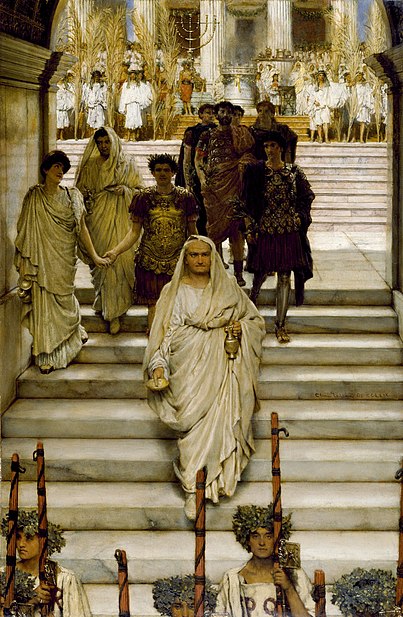
In Ancient History, the name is borne by Titus Flavius Vespasianus, the tenth Roman emperor in the Roman Empire and the second of the Flavian Dynasty.

In the New Testament, the name is borne by a companion of St. Paul who later became the first bishop of Crete and was a recipient of one of Paul’s epistles.

The name was also used by Shakespeare for his tragedy Titus Andronicus (1593).

Currently, Titus is the 253rd most popular male name in Germany, (2011) and the 397th most popular in the United States, (2010).

Other forms of the name include:

  • Tito (Aragonese/Basque/Galician/Italian/Portuguese/Spanish)
  • Titus (Czech/Danish/Dutch/English/French/German/Latin/Norwegian/Swedish)
  • Tiitus (Finnish)
  • Tite (French)
  • Titos Τιτος (Greek Biblical)
  • Titou τιτου (Greek Modern)
  • Titusz (Hungarian)
  • Títus (Icelandic/Slovak)
  • Titas (Lithuanian)
  • Titu Тітъ (Old Church Slavonic)
  • Tytus (Polish)
  • Tit Тит (Romanian/Russian/Croatian/Slovene)

An Italian, Portuguese and Spanish feminine form is Tita.

The designated name-day is January 4th.

Leif

Gender: Masculine
Origin: Old Norse
Meaning: “descendant; heir.”
Eng (LEEF); Eng/Swe/Ice (LAFE); Nor (LIFE)

The name is derived from the Old Norse, Leifr meaning (heir, descendant). It is most famously borne by Norse Explorer, Leif Eriksson (970-1020), who is regarded as the first European to set foot on North America and is credited for discovering Greenland.

The name has always been prevalent throughout Scandinavia. However, its usage in Germany is relatively recent where it’s currently the 263rd most popular male name, (2011). The name has also had prevalent usage in North America, particularly within the Midwest where a large Scandinavian-American population resides, one notable American bearer being former teen pop idol, Leif Garrett (b.1961).

Other forms of the name include:

  • Leif (Danish/English/Faroese/Finnish/German/Icelandic/Norwegian/Swedish)
  • Leif(f) (Danish: obscure)
  • Lejf (Danish: obscure)
  • Leifur (Icelandic: more common form)
  • Leiv (Norwegian)
  • Leifr (Old Norse)