
- Origin: Italian
- Meaning: “elm tree.”
- Gender: Male
- OLE-moh
The name comes directly from the Italian word for the elm tree.
Source
The name comes directly from the Italian word for the elm tree.
Source
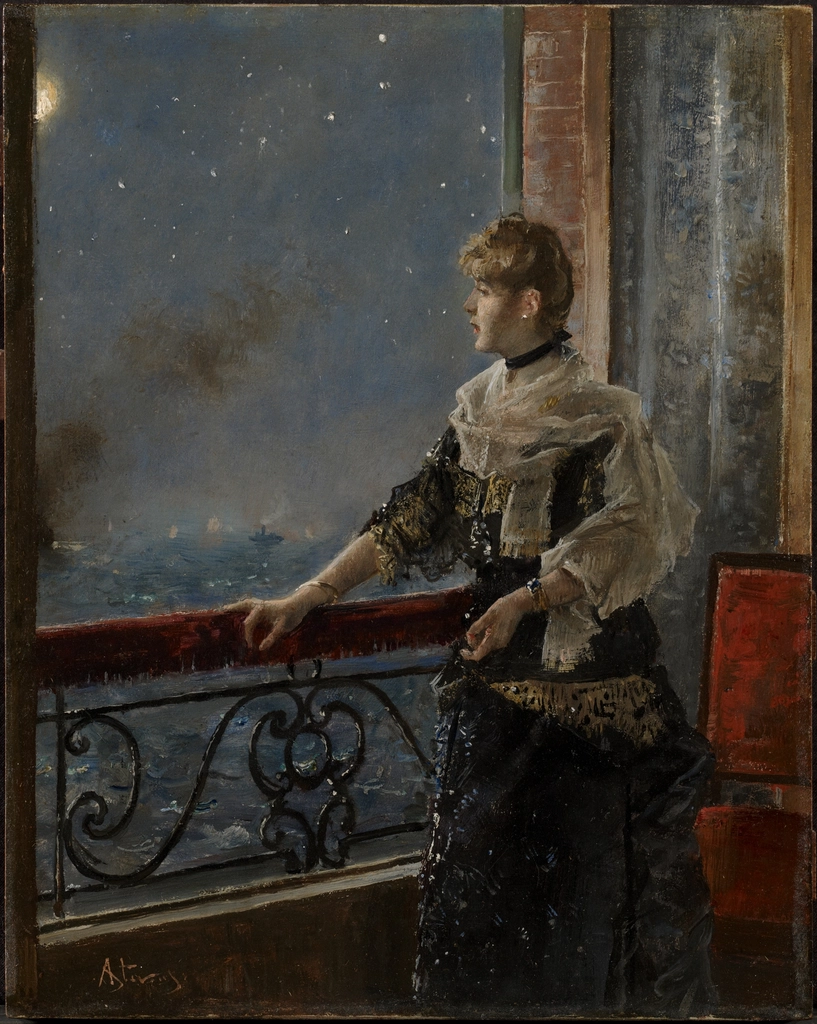
Elide is an Italian feminine given name of uncertain origin that has been in use since medieval times, particularly in northern and central Italy. Although many modern name dictionaries list it as meaning “gift from the sun,” said to derive from Greek, this explanation appears to be a highly exaggerated etymology rather than a historically documented derivation, however, it is possible it derives from the Greek, Helios (sun).
According to several Italian onomastic sources, Elide may in fact derive from a toponymic origin — the ancient Greek place name Ilida (Ἦλις, Latin Elis), a region of the Peloponnese that was home to Olympia, site of the ancient Olympic Games.
Elidia is another Italian variation, which also appears in use in 18th-19th-century British and American records, while Elídia is the Spanish and Portuguese form.
There is Elidi, which has recently had rare use in the U.K., being given to 3 babies in 2024. It may be inspired by the similarly sounding and trending Elodie. Whereas, Elide has been given to 80 girls in Italy in 2024.
Elidia has the same rhythm and style as Olivia and it may appear to be a more elaborate form of Lydia at first glance, which may appeal to modern parents.
Other Italian forms include: Elida, Ellide, and Ellida, while the masculine forms are Elido and Elidio (the latter when spelled Elídio is Spanish and Portuguese).
Sources
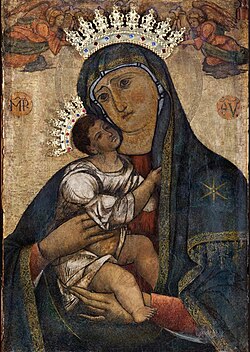
A rare vintage name from Southern Italy, Sterpeta is associated with the Virgin Mary, deriving from Madonna della Sterpeto – the name of a Marian shrine located near Barletta, in the province of Apulia (Puglia). The title Sterpeto itself comes from the Italian sterpeto, meaning “thicket,” “bramble,” or “brushwood,” referring to the rural area where the miraculous image was discovered.
According to local tradition, during a devastating plague in 16th-century Barletta, a perfectly preserved medieval icon of the Virgin Mary was found hidden in the cellar of an abandoned monastery. The townspeople carried the image in procession, and as soon as it was revealed, the plague ceased and the people were healed. In gratitude, the sanctuary of Madonna dello Sterpeto was built on the site, and devotion to the image spread throughout the region. Her feast-day is May 8th.
The personal name Sterpeta emerged as a devotional given name in honor of la Madonna dello Sterpeto, but its usage remained largely confined to Barletta, Foggia, and Bari in Puglia. The name gradually fell out of use in the 20th century and was last recorded in Italy in 2006.
With its strong regional flavor and deep Marian symbolism, Sterpeta is a distinctive relic of Southern Italian faith and folklore. It is a name that bridges miracle, memory, and devotion, and its meaning also links it to fall or autumnal themes.
Sources

A 19th-century gem and late 20th-century vampiric monikor, the name is of uncertain meaning but has its origins in Medieval Spain. It is likely of Visigothic origins, possibly derived from Gailawera or Geloyra, which stem from gails (happy) or (spear); and wers (friendly, agreeable, true).
It should be noted that Elvira (Latin: Iliberri or Iliberis) was an ancient Iberian and later Roman city located near present-day Granada, in Andalusia, southern Spain. However, in this case, it is likely derived from an Iberian source, meaning “new town.”
It was a popular female name among the royal family of Castille & León, producing two queens who bore this name, Elvira of Castile, Queen of León (965–1017) and Elvira of Castile, Queen of Sicily (c. 1100–1135).
It was later used in Mozart’s 1787 opera Don Giovanni (libretto by Lorenzo Da Ponte), in which Donna Elvira is one of Don Giovanni’s former lovers. This likely popularized the name outside of the Iberian peninsula.
By the turn of the 20th-century, Elvira was not unknown in the United States, though never overly popular, it peaked at #254 in 1914, but fell out the Top 1000 by 1981, the same year Elvira, Mistress of the Dark came on the scene.
The real Halloween link began in 1981, when actress Cassandra Peterson created the camp-horror TV hostess Elvira, Mistress of the Dark for a Los Angeles late-night show (Movie Macabre).
Dressed in a plunging black gown with a beehive of jet hair, Elvira presented old horror movies with sardonic humor — blending Gothic sex appeal, irony, and B-movie kitsch.
The character became a pop-culture icon: Halloween TV specials, films, pinball machines, comic books, and even perfume lines immortalized her as the Queen of Halloween.
Outside the United States, this name does not have such associations. In Sweden, it has been among the top 100 girls’ since 1998 and peaked at #25 in 2014. As of 2024, it came in at #40.
It’s a popular name in the Balkans, even spinning off a male form of Elvir (Bosnian and Albanian).
Other forms include:
Obscure Lithuanian male forms are the Lithuanian, Elvyras; the Polish, Elwir(o), and the Italian Elviro.
Name days: August 25 (Austria), July 16 (Croatia), February 10 (Hungary), January 25 (Spain), March 1 (Sweden), November 21 (Slovakia), August 13 (Latvia).
Sources

Lollius (pronounced LOH-lee-us) was an old Roman nomen gentilicium — that is, a family name identifying the gens Lollia, a plebeian family attested since the late Republic.
The feminine form, Lollia (LOH-lee-ah), denoted women of that lineage.
The etymology is not entirely certain, scholars have proposed that it could derive from a Latin word, lolium, meaning (“darnel grass”), while others suggest a Sabine or Oscan origin of unknown meaning.
Notable bearers from antiquity include:
Other historical forms include:
While Lollius remains primarily of scholarly or historical interest, Lollia has quiet potential as a revival name. It resembles fashionable names like Lola, Luna, and Lilia, yet carries an authentic Roman pedigree.
Pronounced LOH-lee-ah or LOH-lyah, it has a lilting, floral sound that feels simultaneously ancient and elegant.
Sources

The name is composed of the Greek words, ἱερός (holy to; sacred to) and θεός (God). It first appears as a given name in Christian tradition, being borne by the first bishop of Athens who was said to have been converted and trained by St. Paul himself.
The modern Greek form is ‘Ierotheos and the designated name-day in Greece is September 29th.
The name has also been borne by several Greek patriarchs.
International Variations
Sources

Derived from the ancient Greek male name Πτολεμαῖος (Ptolemaios), which in turn comes from πτόλεμος (ptólemos), meaning “war” or “battle.”
The word ptólemos is an older Aeolic dialectal form of πόλεμος (pólemos), the standard Classical Greek word for “war,” sharing the same root with the English word, “polemic.”
Ptolemy I Soter (367–283 BCE) was a general of Alexander the Great and later became Pharaoh of Egypt, founding the Ptolemaic Dynasty (323–30 BCE). This dynasty ruled Egypt for nearly three centuries and ended with Cleopatra VII, the most famous bearer of the family’s legacy.
Claudius Ptolemaeus (Ptolemy) (2nd century CE) was the famed Greek astronomer, mathematician, and geographer of Alexandria, whose Almagest shaped Western astronomy for over a millennium.
According to the Book of 1 Maccabees (135/4 BC), Ptolemy of Jericho betrayed his father-in-law, Simon the High Priest, by murdering him and his two sons while they slept as guests under his roof. This act of treachery is used in Dante Alighieri’s The Inferno, in which the ninth circle of Hell is called Ptolomea after him, a frozen realm reserved for those who betray their guests.
Ptolomy is also the name of an early Christian saint.
In the English-speaking world, Ptolomy has been used on and off since the 18th-century. It appeared in the U.K’s top 500 boys’ names in 2004, ranking in at #906.
A modern bearer is American author, Ptolemy Tompkins. Celebrity couple Gretchen Mol and Tod Williams bestowed this on their son in 2007.
Common English short forms include: Tollie, Tolly, and Tal.
International Variations
Female forms include the sensual Ptolemaïs (Πτολεμαΐς) and the Italian, Tolomea.
Sources

The name Prosper comes from the Latin Prosperus, meaning “fortunate,” “successful,” or “prosperous.” It is derived from the Latin verb prōspere, “to cause to thrive, to be favorable,” ultimately from pro- (“forward”) and spēs (“hope”).
Saint Prosper of Aquitaine (c. 390–455) was a Christian writer and theologian who defended the doctrines of Saint Augustine. His influence made Prosper a well-established saint’s name in medieval France, especially in Aquitaine and Provence.
In France, the name was relatively common at the turn of the 20th-century, ranking in at #96 in 1902. In the USA, it never ranked as high but did make it to the Top 1000, peaking at # 886 in 1881.
Several other early Christian saints and bishops also bore the name.
The most famous literary bearer is Prospero, the magician-duke in William Shakespeare’s The Tempest (1611).
The Puritans occasionally used Prosper as well.
The designated name-days include: June 25th (Denmark & France), September 2nd (Croatia), June 23rd (Poland).
International Variations
Female Forms
Diminutives
Sources
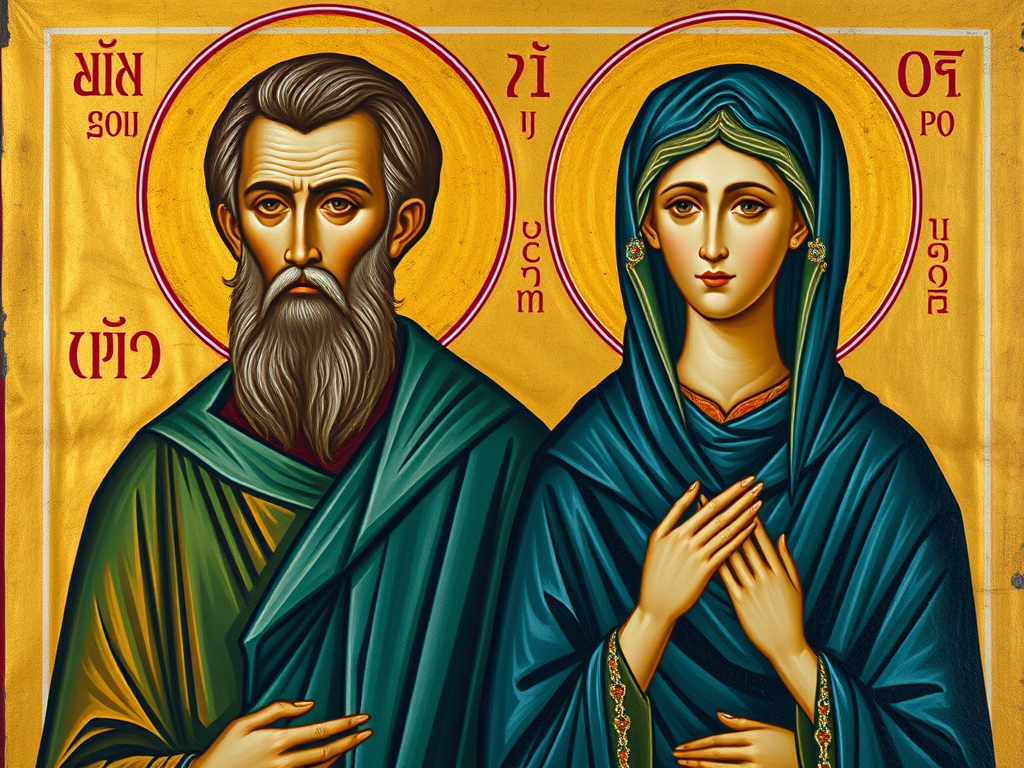
Chariton is an ancient Greek masculine name derived from χάρις (charis), meaning “grace, kindness, favor.”
The name was borne by Saint Chariton the Confessor (4th century), a revered Christian monk and founder of several monasteries in the Judaean Desert. His feast day is observed in the Eastern Orthodox Church on September 28.
Chariton also appears in classical Greek literature as a personal name. It was the name of a 1st-century Greek writer.
International Variations
Charitine, Charitina
The feminine form of Charitine (Χαριτίνη) is the feminine counterpart, and it was latinized as Charitina. An English pronuncitation would be KARE-e-TEE-nee (Grk), and KARE-e-TEE-nah or KARE-e-TIE-nuh).
Saint Charitine of Rome (also known as Charitina, 4th century) is a virgin martyr honored in the Eastern Orthodox Church and Catholic Churches. The feast day and designated name-day is October 8th.
Charitina was later borne by a Medieval Russian Orthodox saint of Lithuania. Very little is known of her hagiography other than her being an indigenous Lithuanian woman who was born pagan but later converted to Christianity.
Female International Variations
Sources

Giselher is an early Old High German masculine name formed from two classic Germanic elements, gisel (pledge) and hari (army).
The best-known figure is King Giselher of Burgundy, a 5th-century ruler who appears in both history and legend. He is immortalized as a character in the Nibelungenlied, the great Middle High German epic, alongside his brothers Gunther and Gernot.
It was also the name of an 11th-century Bishop of Madgeburg who succeeded St. Adalbert.
It is found in records as the name of Teutonic Knights in Estonia, Latvia and Poland. It experienced a minor revival in the early 20th-century but is quite rare in contemporary German-speaking countries.
Its Anglo-Saxon version of Gislhere was borne by an 8th-century Bishop of Selsey.
A more recent bearer was German composer, Giselher Klebe (1925-2009).
Its designated name-day in Austria is September 28th.
Variation & International Variations
Sources