Cuthbert

  • Origin: Anglo-Saxon
  • Meaning: “bright famous.”
  • Gender: masculine
  • KUTH-bert

The name is composed of the Anglo-Saxon words cuþ “famous” and beohrt “bright.” It is notably borne by St. Cuthbert of Lindisfarne, a 7th-century English saint who is revered as the patron saint of Northumbria. Even after the Protestant Reformation, he remained a popular figure in Northern England, the Cathedral of Durham is where he lies entered.

It is the progenitor of the eponymous English surname.

Common short forms are Cuddy & Cuth.

Other forms include:

  • Cuthbehrt (Anglo-Saxon)
  • Cuthbertus (Dutch, Late Latin)
  • Cuthbert (English, French, German)
  • Cudbert (French)
  • Cutberto (Italian, Spanish)
  • Kutbert (Polish)
  • Cuteberto (Portuguese)
  • Cuithbeart (Scottish-Gaelic)
  • Katbert Катберт (Ukrainian)
  • Cwthbert (Welsh)

Sources

Cassiel

  • Origin: Hebrew פצִיאֵל
  • Meaning: “God is my cover; cover of God; speed of God.”
  • Gender: masculine
  • Pronunciation: Eng KAS-see-el

The name is derived from the Hebrew פצִיאֵל (Qaftzi’el), which is likely to mean “cover of God” or “God is my cover.” Other sources claim this name means “speed of God.” According to Judeo-Christian apocrypha, Cassiel is one of the 7 archangels. In the Hekhalot Rabbati, he is the one of the guardians of the doors of the 7th Heaven. In the Sefer Raziel, he is described as the Prince of Saturn, while in the Zohar, he is credited as being one of the aides of the Archangel Gabriel. He is also mentioned in the rabbinic literature of the Kabbalah. In Christian literature, he is mentioned in the grimoire known as The Sworn Book of Honorius as well as in Peter Abano’s Heptameron. He is mentioned in a Byzantine text regarding exorcism. He also appears as an archangel in mystic Islamic literature under the name كسفيائيل‎, Kasfiyāʼil.

Cassiel was traditionally believed to not have much input on the things that occur in the world of man, he was also considered the angel who presided over the death of kings as well as the angel of tears and the angel of temperance. His days are sometimes Thursday or Friday.

As a given-name, it has only come into occasional use the last century. It may have become even more widespread after its use in the Wim Wender 1987 film, Wings of Desire.

I could not find any strong evidence that this name has ever been used as a given-name among Jews or Muslims, though I don’t believe it is considered a forbidden name in either religion, more likely, the obscurity of the angel in the general populace of both religions has left the name obsolete.

Other forms include: Cafziel, Kafziel, Caphziel,Captiel, Cassael, Castiel, Qaspiel, Qephetzial, & Quaphsiel.

Forms in other languages include:

  • Kasfiyāʼil كسفيائيل‎, (Arabic)
  • Cassiël (Dutch)
  • Cassiel (English, French, German, Portuguese, Spanish)
  • Qaftzi’el קפציאל‎ (Hebrew)

Feminine forms include: Kasiela, Casiel(l)a, Qaftiziela (modern Hebrew); Cassielle (English, French), Cassiëlle (Dutch), Casiele (Brazilian-Portuguese).

Sources

Faolán, Phelan, Fillin

  • Origin: Gaelic
  • Meaning: “little wolf.”
  • Gender: masculine
  • Gaelic (FWAY-lahn); Eng (FAY-len; FIL-lin)

The name is derived from the Gaelic, faol, meaning “wolf” and the diminutive suffix –án. It is borne by 3 Medieval Saints from Ireland, 2 who settled in Scotland and another that did missionary work in Frankish Brabant.

There is a Cathedral dedicated to St. Foillan of Brabant in Aachen, Germany.

It is the ancestor of several Irish and Scottish surnames, such as Fylan, Hyland, MacClellan, MacClelland, Mac Giolla Fhaoláin, McClellan, McClelland, Ó Faoláin, Phelan, Whalen & Whelan.

Fillan is also the name of a place in Norway, but the name is probably of a separate etymology.

Other forms include:

  • Foillan (Dutch, French, German)
  • Phillan (English)
  • Feuillien (French)
  • Folien (French)
  • Foilan (French)
  • Pholien (French)
  • Foillano (Italian)
  • Fillano (Italian)
  • Foilanus/Foillanus (Late Latin)
  • Fáelán (Old Irish)
  • Felano (Spanish)

Sources

Fuad

  • Origin: Arabic فُؤاد
  • Meaning: “heart.”
  • Gender: masculine
  • Pronunciation: foo-AD

The name comes directly from the Arabic word for heart. It is used equally among Arab- Muslims & Christians. Among Christians, particularly Palestinians, Chaldeans and Lebanese Christians who profess Roman Catholicism, it is used in reference to the Sacred Heart of Jesus or the Immaculate Heart of Mary, in the same way the Spanish name Corazón is used in the Spanish-speaking world, though in the Arabic case, the name is strictly masculine.

Among Muslims, the term fu’ad is used at least 5 times in the Quran. The name is used throughout the Islamic world.

It is even used among Non-Arab groups in the Middle East, such as Mizrachi Jews.

The name was borne by two Egyptian kings.

Other forms include:

  • Fuad (Amharic, Azeri, Bosnian, Indonesian)
  • Fouad (Maghrebi)
  • Fuat (Turkish)
  • Fawad (Urdu)

A feminine form is Fuada(h).

Sources

Menas, Minas, Mina

  • Arabic مينا;
  • Armenian Մինաս
  • Coptic ⲙⲏⲛⲁ
  • Ge’ez ሜናስ
  • Greek Μηνᾶς

Menas is a popular male name among Eastern Christians, it is of uncertain meaning, it may derive from the Greek μήνη (mene) meaning, “moon,” or the ancient Egyptian Menes, which is the name of a 3rd-century BCE Egyptian pharaoh, in which case, the name derives from the ancient Egyptian, mnj (he who endures). It may also be related to the ancient Egyptian divinity name, Min, which is of uncertain meaning. However, according to Coptic tradition, the name means “amen.”

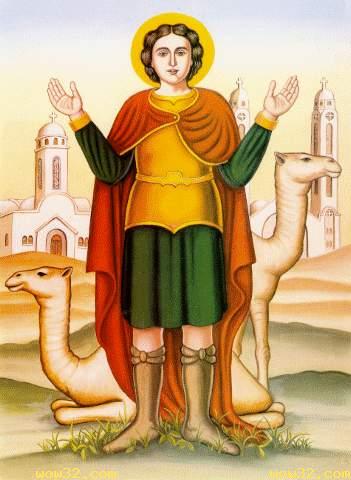
It is the name of a popular 2nd-century Coptic saint and martyr, known as Ⲁⲃⲃⲁ Ⲙⲏⲛⲁ (Abba Mina). According to legend, St. Menas’ parents were devout Christians who were having a hard time having children. His mother prayed to the Virgin Mary for a child, and she heard a response saying “amen,” this is where the name Menas supposedly derives from. It is speculated by some that the Western St. Christopher and the Eastern St. Menas are one and the same person. It is also borne by an Ethiopian saint of the 6th-century (CE) and a 16th-century CE Ethiopian emperor.

It was the name of 1st-century CE Roman admiral who features in Shakespeares, Antony & Cleopatra.

Other forms of the name include:

  • Minasə ሚናስ (Amharic)
  • Mina مينا; Мина ⲙⲏⲛⲁ Ми́на Міна (Arabic, Bulgarian, Coptic, Romanian, Russian, Ukrainian)
  • Minas Մինաս Μηνάς (Armenian, Greek)
  • Menna (Catalan)
  • Ménas (French)
  • Menas (German, Latin, Polish, Portuguese, Spanish)
  • Ménász, Mennasz, Mínász (Hungarian)
  • Mena (Italian)

Sources

Blessing

  • Origin: English
  • Gender: Female

The name comes directly from the word and first came into use as a female given-name in 16th-century English, it was later adopted by the Puritans and has had sporadic use as a given-name by various Christian groups since. The name has recent been very popular among Nigerian Christians.

The word itself derives from the Anglo-Saxon, blǣdsian, which originally meant “to mark with blood,” which was often done during pre-Christian Anglo-Saxon religious rights.

Blessing first entered the U.S. Top 1000 Female Names in 2019, ranking in at #916.

A notable bearer is Nigerian Track & Field Athlete, Blessing Ogakbere (b.1988).

Sources

Joah

JoahOrigin: Biblical Hebrew
Meaning: “Yahweh is brother; brother of Yahweh”
Gender: Masculine
(JOH-ah)

The name is composed of the Hebrew elements,יַהְוֶה‬(Yahweh) and אָח (ach) meaning “brother.”

Joah is borne by 4 minor characters in the Old Testament.

In the English-speaking world, Joah has been in sporadic use since the 17th-century. A notable bearer was English musician, Joah Bates (1741–1799).

Another form is Joach.

Sources

Winifred, Winnie, Gwenffrewi

Hollywell.jpgOrigin: Welsh
Meaning: uncertain
Gender: Feminine
(WIN-e-fred; WIN-nee; gwen-VROO-wee)

Winifred is an anglicized from of the Welsh female name, Gwenfrewi, the first element, gwen meaning “white; holy,” while the second element is uncertain but is suggested to mean “reconciliation” or “peace.” Many sources have confused this with the Anglo-Saxon male name, Winfred which actually means “friend of peace” or “peaceful friend,” but the names are actually unrelated.

In Medieval England, the name was popularized by the cult of a 7th-century Welsh saint. According to legend, Winifred wanted to be a nun, which enraged a jealous suitor by the name of Caradog who decapitated her. Her uncle, St. Beuno, was able to place her head back on her shoulders and she was miraculously restored back to life. St. Winifred was able to live the rest of her life in holiness and died at a ripe old age, while her brother killed Caradog in revenge for her decapitation. A spring miraculously rose up from the site of her decapitation and for centuries, this was a site of pilgrimage for healing. While her story of being decapitated and brought back to life cannot be verified, historians do believe St. Winifred was a real person and that something definitely happened to her neck at some point in her life, as old Latin records always refer to a strange scar. Who knows….

To this day, Winifred’s Well in Holywell in Shrewsbury, England remains a popular site of pilgrimage, despite Henry VIII’s destruction of the shrine in the 16th-century, it seems to have been rebuilt.

St. Winifred has been referenced in English literature throughout the centuries. Her well is mentioned in the Medieval poem, Sir Gawain and the Green Knight. Her life story was dramatized as a play by William Rowley in A Shoemaker a Gentleman (1637), which was based on an earlier work by Thomas Deloney, The Gentle Craft (1584). In the 19th-century, St Winifred’s Well was written by Gerard Manley Hopkins.

Winifred was in the U.S. Top 1000 Female names between 1900 and 1965. The name was never too popular however, the highest Winifred ever ranked was at #141 in 1917.

Its diminutive offshoot of Winnie established itself as an independent given name by the 16th-century. There are a few records of “just Winnies” going as far back as the 1500s. Other interesting variations that appear in old English records include Wenefrett, Wenneffred, Winefrute, and Winnifruite.

Winnie appeared in the U.S. Top 1000 between 1900 and 1957 and peaked at #190 between 1900 and 1901.

Its original Welsh form doesn’t seem to have ever been in popular use outside of Wales, and while other Welsh names have established themselves in regular use across the anglosphere, Gwenffrewi was never one of them.

Other forms of the name include:

  • Gwenfrewi (Breton, Welsh)
  • Winefride (French)
  • Vinfreda (Italian/Latin)
  • Wenefryda (Polish)
  • Wenfryda (Polish)
  • Winifreda (Polish)
  • Wenifreda (Polish)
  • Winfryda (Polish)
  • Gwenffrwd (Welsh)

Sources

Temperance

Temperance

The name comes directly from the English virtue word pertaining to the idea of self-control and self-constraint.

The name is often associated as a Puritan name, and it did become popular in 16th-century England around the time of the Protestant Reformation, as well as in France, perhaps among Huguenot families, in the form of Tempérance.

In recent years, the name has come back into the spotlight due to the TV series Bones, which is based on the books written by Kathy Reichs.

Common short forms are Tempe, Tempie, Pency.

A Latin form, which was often referenced by St. Augustine in his works is Temperantia.

Sources

Zabdiel

zabdielOrigin: Biblical Hebrew
Meaning: bestowed by God; gift of God
Gender: Masculine
(ZAB-dee-el)

The name is composed of the Hebrew elements, zeved זבד (gift, bestowal) and el אל (elohim; God).

The name is borne in the Old Testament by 2 very minor characters.

  • In (1 Chronicles 27:2) Zabdiel is mentioned as the father of Jeshobeam and one of the 12 commanders of the subdivisions in Israel.
  • In (Nehemiah 11:14), Zabdiel is the son of Heggedolim.

In the English-speaking world, the name came into sporadic use in the 16th-century, around the time of the Protestant Reformation. Notable bearers include early American physician Zabdiel Boylston 1679-1766 (who is noted as the first person to perform a surgical operation in the U.S.), and Massachusetts representative, Zabdiel Sampson (1781-1828).

Sources