 Gender: Feminine
Origin: Greek
Meaning: “messenger.”
Eng (AN-je-luh)
The name is a feminine form of the Greek male name, Ángelos (αγγελος), meaning, “messenger.”
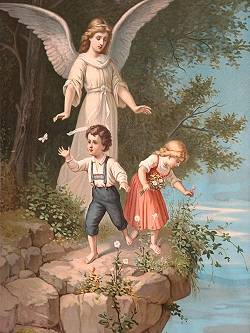
In Greek mythology, Ángelos was an epithet for the god, Hermes. In later Judeo-Christian culture, the name became associated with angels since it shares the same etymology with the word angel.
The name has been borne by several saints.
In the United States, she currently ranks in at # 133. The highest she peaked in U.S. naming history was between 1974-1976 where she was the 5th most popular female name in the United States.
Her rankings in other countries are as follows:
- # 91 (Canada, B.C. 2008)
- # 56 (Chile, 2006)
- # 481 (the Netherlands, 2006)
- # 25 (Spain, 2006)
Angela is used in Danish, Dutch, English, German, Icelandic, Italian, Norwegian, Romanian, Romansch, Slovak , Slovene and Swedish.
Its Latinate diminutive form, Angelina, has recently sparked in popularity, due to the fame of American actress, Angelina Jolie.
In the United States, she currently ranks in as the 69th most popular female name (2008). Her rankings in other countries are as follows:
- # 54 (Australia, 2007)
- # 91 (Canada, B.C. 2008)
- # 72 (France, 2006)
- # 184 (the Netherlands, 2008)
- # 96 (Sweden, 2007).
Other feminine forms Angela include:
- Anxhela (Albanian)
- Anela/Aneliya (Bulgarian)
- Àngela (Catalan)
- Angiola (Corsican/Romansch/Sardinian)
- Angioletta (Corsican/Romansch/Sardinian)
- Anđela (Croatian)
- Anděla (Czech)
- Angèle (French: an obscure diminutive form is Angelette)
- Anela/Ankela (Hawaiian)
- Angéla (Hungarian)
- Aingeal (Irish Gaelic)
- Angeletta (Italian: obscure diminutive form which was occasionally used as an independent given name)
- Anġla (Maltese)
- Ainle (Manx)
- Aniela (Polish: diminutive form is Anielka)
- Ângela (Portuguese)
- Anzhela ангела (Russian)
- Andjela Анђела (Serbian)
- Ángela (Spanish)
- Angelia (Spanish)
- Angelita (Spanish: a diminutive form occasionally used as an independent given name)
An English diminutive is Angie, German diminutives are Angie and Geli.
Some Italian smush names include Giovannangela, Giuliangela, Mariangela, Michelangela, and Rosangela.
Masculine forms are:
- Angeru (Basque)
- Angel Ангел (Bulgarian)
- Àngel (Catalan)
- Anđelko (Croatian)
- Anděl (Czech)
- Anxo (Galician)
- Angelos Αγγελος (Greek Modern)
- Angelo (Italian/Spanish: currently the 284th most popular male name in the United States-2008; and the 98th in Chile-2006)
- Angelus (Latin)
- Anġlu (Maltese)
- Ángel (Spanish)
Other forms of Angelina include:
- Angiolina (Corsican/Romansch/Sardinian)
- Angelien (Dutch)
- Angéline (French)
- Anzhelina Анжелина (Russian)
Angelina is also used in English, French, German, Italian, Polish, Romanian and Spanish.
Angela’s designated name-day is sometimes January 4th.

