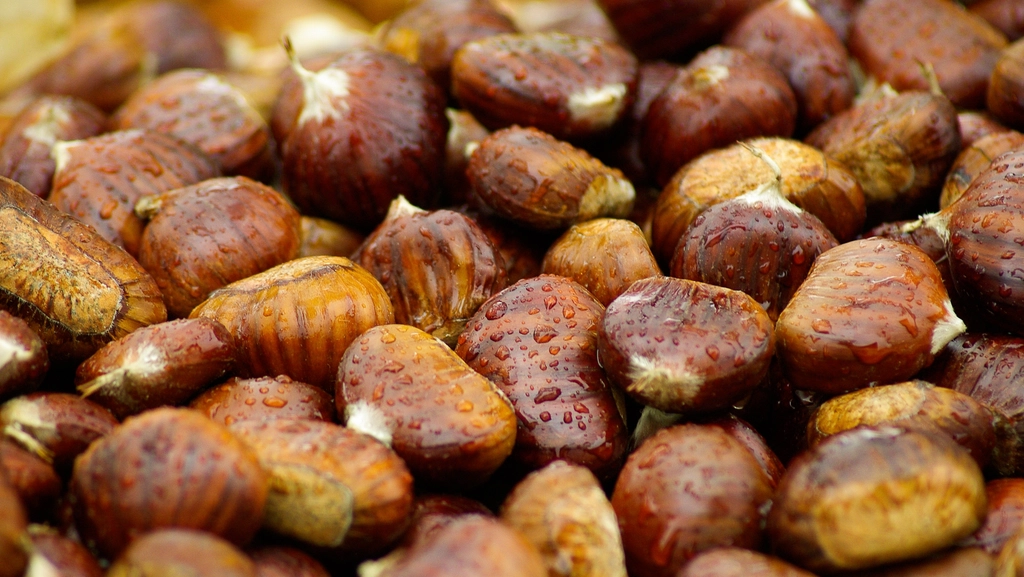
- Origin: Lithuanian
- Meaning: “chestnut.”
- Gender: Male
- KAHSH-to-nahs
It comes directly from the Lithuanian noun kaštonas, which refers both to the chestnut tree (Aesculus hippocastanum) and its rich, glossy brown nuts.
Source
It comes directly from the Lithuanian noun kaštonas, which refers both to the chestnut tree (Aesculus hippocastanum) and its rich, glossy brown nuts.
Source

Milvydas is an ancient Baltic male name constructed from the elements, mīlas or mielas, meaning, “dear; kind; beloved,” and vydėti, “to see, to perceive,” or vydas “vision; sight.” Another form is Milvidas.
Male diminutive forms are: Milas, Milius, Vidas, Vidis, and Vydas.
The feminine counterparts are Milvida, Milvyda and Milvydė.
The designated name-day for Milvydė is November 11th.
Female diminutive forms are: Mila, Milė, Milva, Vyda, and Vydė.
Source

Svirbutas is an ancient Lithuanian male name, attested in historical sources from the 13th–15th centuries. It belongs to the older layer of Baltic personal names that predate Christianization, often formed from archaic roots with meanings now obscure or lost.
It likely derives from the Lithuanian elements svir (to swing, to sway; to be of importance) and but (to be; to exist).
The designated name-day is November 8th.
A potential Lithuanian female form is Svirbutė.
Sources
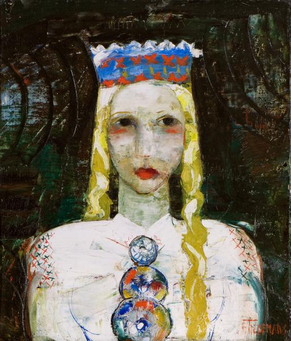
Jānis Tīdemanis (1930)Derived from the Latvian poetic word daile, meaning, “beauty, grace, or artistic refinement.”
The noun daile itself was standardized by linguist and writer Atis Kronvalds in 1868, who likely modeled it on Lithuanian dailė (“art, artistic creation”). Both words share the Baltic root dail-, conveying ideas of beauty, craftsmanship, and aesthetic harmony.
As a personal name, Daila and its variant Daile first appeared in Latvian name calendars in the late 19th century, but did not come into regular use until the 1920s, during the national revival when many symbolic native words were adopted as given names.
Regional and Linguistic Variants
The designated name-day for Daila is February 4th (Latvia); and December 3 for Daile (Latvia).
Sources

Derived from the ancient Greek male name Πτολεμαῖος (Ptolemaios), which in turn comes from πτόλεμος (ptólemos), meaning “war” or “battle.”
The word ptólemos is an older Aeolic dialectal form of πόλεμος (pólemos), the standard Classical Greek word for “war,” sharing the same root with the English word, “polemic.”
Ptolemy I Soter (367–283 BCE) was a general of Alexander the Great and later became Pharaoh of Egypt, founding the Ptolemaic Dynasty (323–30 BCE). This dynasty ruled Egypt for nearly three centuries and ended with Cleopatra VII, the most famous bearer of the family’s legacy.
Claudius Ptolemaeus (Ptolemy) (2nd century CE) was the famed Greek astronomer, mathematician, and geographer of Alexandria, whose Almagest shaped Western astronomy for over a millennium.
According to the Book of 1 Maccabees (135/4 BC), Ptolemy of Jericho betrayed his father-in-law, Simon the High Priest, by murdering him and his two sons while they slept as guests under his roof. This act of treachery is used in Dante Alighieri’s The Inferno, in which the ninth circle of Hell is called Ptolomea after him, a frozen realm reserved for those who betray their guests.
Ptolomy is also the name of an early Christian saint.
In the English-speaking world, Ptolomy has been used on and off since the 18th-century. It appeared in the U.K’s top 500 boys’ names in 2004, ranking in at #906.
A modern bearer is American author, Ptolemy Tompkins. Celebrity couple Gretchen Mol and Tod Williams bestowed this on their son in 2007.
Common English short forms include: Tollie, Tolly, and Tal.
International Variations
Female forms include the sensual Ptolemaïs (Πτολεμαΐς) and the Italian, Tolomea.
Sources

The name is derived from the Latin perpetuus, meaning “continous; perpetual.” It was borne by a 3rd-century Christian matyr and saint, the companion of St. Felicity and it was also the name of the sister of St. Augustine of Hippo.
Perpetua and its various forms have been in sporadic use throughout the Catholic world. In Italy, it became synonymous with a priest’s housekeeper. This is due to the eponymous character in Alessandro Manzoni’s 19th-century novel, “The Betrothed.“
It experienced sporadic use in England in the 1920s after the release of the now lost 1922 film, Perpetua also known as Love’s Boomerang.
It has recently appeared in English literature as the name of minor characters in Bridget Jones’s Diary (Helen Fielding), and in the Harry Potter series (J.K. Rowling).
It was borne by Scottish landscape painter, Perpetua Pope (1916-2013).
It is the name of Cape Perpetua Oregon which was named for St. Perpetua as well as a typeface.
It’s designated name-day is February 1, March 6th and March 7th.
Forms & Usages
English short forms include: Perp, Perpie, Perpy, and Petty.
Masculine forms include
Sources

Both come from the Greek, θεός (theos) meaning “god” and δόσις (dosis) meaning “giving.” Both the male and female form were borne by several Christian saints and Medieval rulers. In the English-speaking world, a notable bearer was Theodosia Alston Burr (1783-1813), the daughter of Aaron Burr and an American socialite who mysteriously disappeared in a ship-wreck. Her fate has been a source of speculation for two centuries, but she most likely died in the wreck. She is also the subject of the Broadway opera song from Hamilton, My Theodosia.
It’s female version has experienced usage in the English-speaking world since the 15th-century. It has spun off several diminutive off-shoots, which later became independent names, such as Docie/Dosey, Doshie, Dosha, Docia and Theda.
Theodosia appeared in the U.S. Top 1000 Most Popular Female Names between 1880-1895, it peaked at number #547 in 1880. It’s offshoot of Doshie appeared in the U.S. Top 1000 between 1880-1905 and peaked at #640 in 1884 whereas Doshia peaked at #582 in 1881 and Docia at #317 in 1880.
Theda (THEE-dah) was the name of silent film actress, Theda Bara (born Theodosia Burr Goodman, 1885-1955). Theda appeared in the U.S. Top 1000 between 1880-1948 and peaked at #350 in 1916. Theda Bara may have helped sustain the usage of the name in the United States, but it seems to have been common enough long before she graced the silver screen.
In the 1988 movie For Keeps, starring Molly Ringwald, a teen couple are faced with an unexpected pregnancy, in which they name their daughter Theodosia, short form Thea, it is a last minute decision decided by the father who gets the name from his deceased grandmother of the same name.
It is the name of the main character of the R. L. LaFevers 2007 children’s novel, Theodosia and the Serpents of Chaos, which spun off a tv series.
Its pronunciation in the English-speaking world fluctuates depending on the region and personal preference, from THEE-oh-DOH-see-uh, to THEE-oh-DOH-shuh and THEE-oh-DOH-zhuh, the sky’s the limits.
Its masculine form has always been prevalent in eastern Christian countries but did not pick up the same momentum in the English-speaking world as its feminine counterpart did.
Female forms
Male Forms
Sources

Kintvilas (KINT-vih-las) is a Lithuanian male name which is composed of the Lithuanian words, kentėti (to suffer) & viltis (hope). It’s feminine form is Kintvilė (KINT-vil-lay).
The designated name-day is December 14th.
Source

The name comes directly from the Lithuanian word migla, meaning “fog; mist.” This is also the word for the plant, “bluegrass.”
It has been in the Top Most Popular Female Names in Lithuania since 1999, and peaked at #10 in 2010. As of 2019, it ranks in as the 21st most popular female name in Lithuania.
A notable bearer is Lithuanian Track Cyclist, Miglė Marozaitė (b. 1996).
The designated nameday in Lithuania is May 11th.
Other forms include: Migla, Miglena, Migleta, Miglija, Miglutė, Migle & Miglita.
Sources
 Gender: Masculine
Origin: German/Polish/Italian/French
Meaning: “from Caieta.”
It (guy-TAH-no); Fre (GAH-eh-TAWn); Pol/Germ (KYE-eh-TAHN)
The name is derived from the Latin place name, Caietanus, meaning, “from Caieta”. Caieta is now known as Gaeta.
In ancient Greece, this was a town where prisoners were taken to be executed. The town probably got its name from the wet nurse of Zeus in Greek myth.
It was borne by a 16th-century Italian saint, which spurred the popularity of the name throughout Europe. It has been in usage in German speaking countries as well as in Poland in the form of Kajetan and Cajetan, the name Kaj was later spun off from this name, now being more popular than its formal form in Sweden and Denmark.
As of 2010, its French form of Gaétan was the 122nd most popular male name in France.
Other forms of the name include:
Feminine forms are:
Its designated name day is August 7.