Pran is a male Indian given-name derived from the Sanskrit प्राण (prana), meaning, “breath; breath of life,” “life force” or, “vital energy.”
In Indian philosophy and yoga, prāṇa represents the universal life energy that animates all living beings.
The Thai feminine form Prani (ปราณี) combines this same Sanskrit root with the suffix -i, creating a meaning closer to “kind,” “merciful,” or “gracious.” In Thai and Pali contexts, Prani can also mean “a living being” or “one endowed with breath.” It is sometimes transcribed as Pranee.
The name comes from Sanskrit मैथिली (Maithilī), meaning “from Mithila.” Mithila was the name of an ancient kingdom located in present-day Bihar (India) and parts of Nepal.
The most famous bearer of this name is Sita, heroine of the Ramayana. As the daughter of King Janaka of Mithila, she was called Mythili (“princess of Mithila”).
The name Padma (पद्म) is derived from Sanskrit, meaning “lotus.” In South Asian tradition, the lotus is one of the most sacred flowers, symbolizing purity, beauty, spiritual awakening, and transcendence — a blossom that rises pristine from muddy waters.
Religious & Mythological Significance
Lakshmi: In Hindu texts, Padma is used as a by-name of the goddess Lakshmi, goddess of wealth, fortune, and prosperity. She is often depicted standing or seated upon a lotus, holding lotus flowers in her hands.
Vishnu: The lotus is also associated with Vishnu, Lakshmi’s consort, and the cosmic lotus from which the universe springs.
Attributes: The padma is one of the four attributes (ayudhas) often shown in iconography of deities — symbolizing purity, enlightenment, and divine perfection.
Buddhism & Jainism: The lotus also holds deep meaning in Buddhist and Jain traditions, where it represents spiritual liberation and the blossoming of wisdom.
The name is technically unisex but more commonly bestowed on females. A notable bearer is American author, Padma Lakshmi (b. 1970).
It is also the name of a major river in Bangladesh and in the Harry Potter series, Padma Patil is the twin of Parvati Patil.
International Variations
Padmé (f) – a pop-culture invention from the Star Wars franchise, which is based on the Sanskrit name.
Rudraksha रुद्राक्ष is a male Sanskrit name. It is the name of a genus of Eleocarpus plant. The seeds are considered sacred to Lord Shiva. They are harvested and dried to be used to create prayer beads in both Hinduism and Buddhism. The etymology is composed of the SanskritRudra and अक्ष (akṣa), meaning “eyes.”
The name is from the Sanskrit हरिण (harina), which can refer to a doe as well as to a yellowish-greenish colour, such as tawny or green. It is used to refer to yellow jasmine as well as to an idol made of gold. Harini (doe) is also used to describe one of four classes of a type of woman, feminine and sweet like a doe. It is also an epithet for the goddess Lakshmi.
All names are derived from the Sanskrit जीवा (life).
In Hinduism and Jainism, the term jiva is used to describe the soul.
Jiva can be unisex and was borne by the 4th-century (CE) Buddhist nun and sister of King Kucha as well as a 16th-century male Hindu philosopher and saint, Jiva Goswami.
Jiva ultimately derives from the Indo-European *gʷih₃wotós, which also produced the Latin vita (life), Lithuanian gyvatà (life) and Proto-Slavic *živòtъ (life). See Živa of the same etymology.
The name comes directly from the Sanskrit word for daughter, which ultimately derives from the Sanskrit word नन्दि (nandi) meaning, “joy; delight; rejoice.”
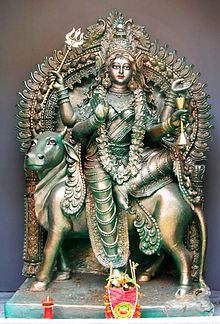
In Hinduism, it is one of the many epithets for the goddess Durga.
Dhyana & Dhyani are unisex (pronounced TAH-nah & TAH-nee), ultimately derived from the Sanskrit ध्यान and meaning “meditation; attention.” Both concepts are applied in Buddhism and Hinduism.
The name comes directly from the Sanskrit word meaning “fair; light-skinned; white; brilliant.” In Hinduism, this is an epithet for the goddess Parvati in her Mahagauri form.
The Kannada and Tamil form is Gowri கௌரி (Tamil) & ಗೌರಿ (Kannada).
Gauri can also be a Finnish male form of the name Gabriel.
The name can have a few origins and meanings. It is primarily an Indian name that comes from the Sanskrit हंस (hamsa), which originally referred to an aquatic bird of passage. The hamsa is described as a mythical bird with knowledge in the Rig Veda and also as the main means of transport for the gods Brahma, Gayatri, Saraswati, and Vishvakarma in Hinduism. In the Ramayana, the hamsa was the bird that carried love letters between Damayanti and Nala. According to Indian legend, arayanna (heavenly hamsa swans) are said to live in the Himalayas where they eat pearls and are able to separate milk from water.
The hamsa bird is also associated with the concept of soham (that I am), as when it is said fast, hamsa starts to resemble soham. The latter is linked with the Brahman, and thus the bird is often associated with the cycle of samsara.
The hamsa bird has also been a popular motif in Indian art for centuries.
Over the centuries, it has interchangeably been translated as a swan, flamingo, goose or duck. It is ultimately from the Proto-Indo-European root word *ǵʰh₂éns, which is also the progenitor of the English word goose, German gans (goose), and the Latin anser (goose).
In India, as a given-name, it is used among all languages groups. The name is primarily used on females but has occasionally been given to males.
The name is also German and Scandinavian female name, being a contracted form of Johanna. Other forms are Hansina and Hansine.