The name is from the Greek Rallou, which is a diminutive form of Herakleia, meaning “glory of Hera. The name was introduced into Romania by Rallou Karatza (1778-1870), a Wallachian princess and actress of Greek descent.
Sahir is a masculine name which is derived from the Arabic root: س-ه-ر (s-h-r), related to staying awake at night. In some contexts it can also carry the poetic meaning “bright, wakeful like the night sky.” Its feminine form is Sahira ساهرة, also sometimes transliterated as Sahera and Sahirah.
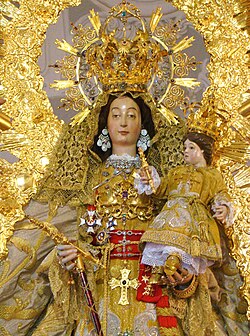
Remedios is a Spanish given name—technically unisex but used almost exclusively for girls—meaning “remedies” or “cures.” It derives from a Marian title, Nuestra Señora de los Remedios (“Our Lady of Remedies”).
The devotion to Our Lady of Remedies originated with the Trinitarian Order in the late 12th century, and it spread widely in Spain after the Reconquista. By the time of the Spanish explorations of the Americas, the Virgin under this title had become a favored patron of soldiers and conquistadores.
It is the name of a character in Gabriel Garcia Marquez’s 1967 novel, One Hundred Years of Solitude.
It is borne by Spanish Flamenco singer, Remedios Amaya (b. 1962) and Spanish painter, Remedios Varo (1908-1963).
Its also the name of several places in Latin America.
Its Catalan form is Remei and Remédios its Portuguese form.
Remedy is a potential English form but has only been in use as a given name since the 20th-century.
Common Spanish diminutives include: Remi, Remita, Medi, Medis, Mecha, Chío, and Chita.
The name is derived from the Arabic word اَشْھَل (ashal) meaning, “bluish black eyes.” The name is also used in Iran, Afghanistan and among South-Asian Muslims.
The name is derived from the Roman gens name, Mamilius. Its meaning is uncertain. It may relate to the Latin mamilla meaning, “breast; nip; tit” or to mar, meaning “the shining one, splendid one.” It has also been linked with the Celtic mam (strength) and hil (seed).
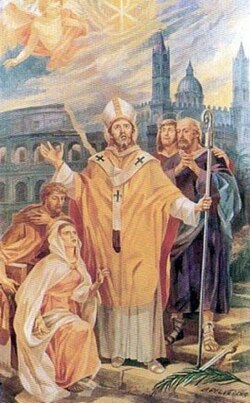
The most notable bearer is Saint Mamilian of Palermo (San Mamiliano), a 5th-century bishop and martyr venerated in Sicily. The designated name-day is September 15, which on the island of Giglio, there is a yearly festival held in the saint’s honor.
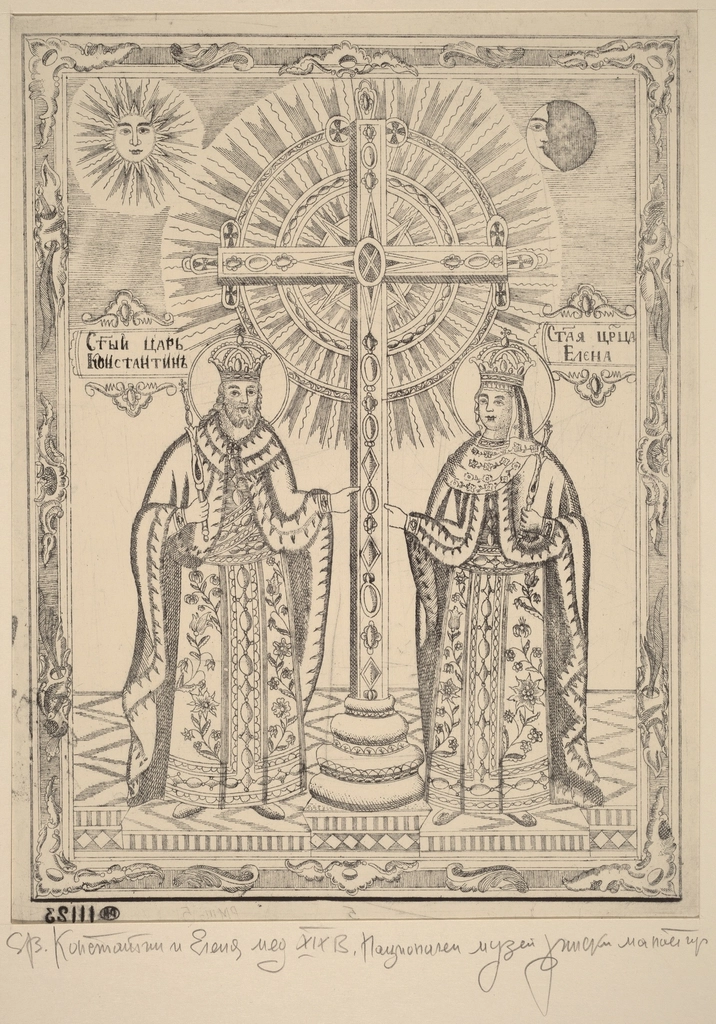
Krastyo кръст is derived from the Bulgarian krast (cross), and is a vernacular form of the Greek, Stavros.
It was borne by Krastyo Krastev (1866-1919), a Bulgarian writer, philosopher and translator known as Bulgaria’s first literary critic. It was also borne by Krastyo Hadzhiivanov, a Bulgarian poet and resistance fighter (1929-1952).
Other forms include: Krastyu, Krastan, Krustan and Krustyo.
Croatian and Serbian forms are Krst and Krstan.
Feminine forms include: Krastana, Krastina, Krustana, and Krustina.
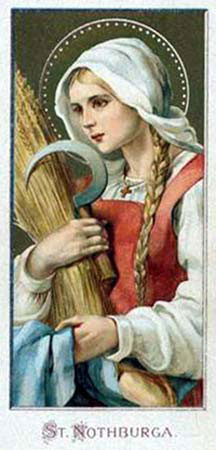
The name is composed of the Germanic elements naudiz (need, necessity) and burg (fortress, protection).
It was borne by a medieval Austrian saint. She was known for her devotion to the poor and performance of miracles. Legend has it that her master demanded she stay and scythe the wheat instead of attending mass. She threw the scythe in the air, and it remained suspended. This is the reason why she is depicted with a scythe.
The name is mainly used in Austria and Southern German but is now unusual.
Another spelling is Nothburga. An obscure French form is Notburge.
German diminutives include: Burgi, Burgel, Nota and Notti.
The designated name-days are January 26th and September 13th.
The name is from the classical Greek, related toApollo. It was borne by several early Christian saints. The most notable being St. Apollinaris of Ravenna, a Syrian Christian missionary to Ravenna who was martyred there and thereafter became the city’s patron saint.
The French form Apollinaire is linked to the Franco-Polish poet, Guillaume Apollinaire. He lived from 1880 to 1918. He was born Wilhelm Albert Włodzimierz Apolinary Kostrowicki.
Apolinary was common in Poland during the late 19th-century and early 20th-centuries, it is now obsolete. Diminutives include: Apolinek, Apollinek, Apolin, Apollin, Polin, Polinary, Polinarek, Polinaruś, Poli, and Polik.
In Italy, Apollinare was mainly used in the Romagna region due to it being the name of their patrion saint, but it has since fallen out of use.
Apollinaire sporadically appeared in the French Top 1000 between 1900 and 1926 and peaked at #403 in 1923. In 2024, 5 babies were given this name.
Neither its masculine form nor its feminine form had much usage in the English-speaking world. It was mostly used in families of Greek or Eastern European background during the late 19th-century.
Designated name-days include July 20th, July 23rd, and September 12th
A traditional feminine diminutive form in Russian is Polina. Polish diminutives include: Apollinka, Apollina, Apolinka, Apolla, Apola, Pola, Polka, Polcia, Polina, and Polinka. Modern Greek diminutives include: Nαρία (Naría), Πόλλα (Pólla), or Λίνα (Lina). Potential English short forms would include: Apple, Pollie, Polly, and Narey, or Narie.