- Origin: Lithuanian
- Meaning: “chestnut.”
- Gender: Male
- KAHSH-to-nahs
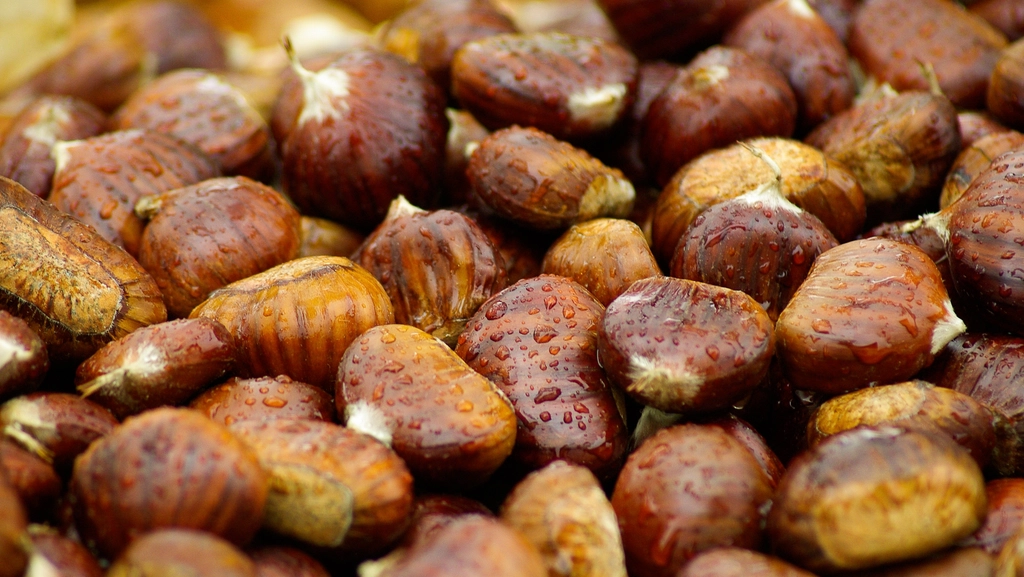
It comes directly from the Lithuanian noun kaštonas, which refers both to the chestnut tree (Aesculus hippocastanum) and its rich, glossy brown nuts.
Source
It comes directly from the Lithuanian noun kaštonas, which refers both to the chestnut tree (Aesculus hippocastanum) and its rich, glossy brown nuts.
Source
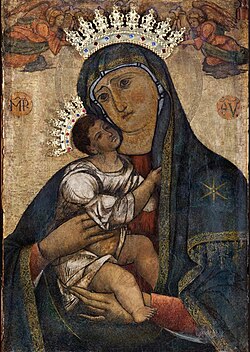
A rare vintage name from Southern Italy, Sterpeta is associated with the Virgin Mary, deriving from Madonna della Sterpeto – the name of a Marian shrine located near Barletta, in the province of Apulia (Puglia). The title Sterpeto itself comes from the Italian sterpeto, meaning “thicket,” “bramble,” or “brushwood,” referring to the rural area where the miraculous image was discovered.
According to local tradition, during a devastating plague in 16th-century Barletta, a perfectly preserved medieval icon of the Virgin Mary was found hidden in the cellar of an abandoned monastery. The townspeople carried the image in procession, and as soon as it was revealed, the plague ceased and the people were healed. In gratitude, the sanctuary of Madonna dello Sterpeto was built on the site, and devotion to the image spread throughout the region. Her feast-day is May 8th.
The personal name Sterpeta emerged as a devotional given name in honor of la Madonna dello Sterpeto, but its usage remained largely confined to Barletta, Foggia, and Bari in Puglia. The name gradually fell out of use in the 20th century and was last recorded in Italy in 2006.
With its strong regional flavor and deep Marian symbolism, Sterpeta is a distinctive relic of Southern Italian faith and folklore. It is a name that bridges miracle, memory, and devotion, and its meaning also links it to fall or autumnal themes.
Sources

Zīle and Zīlīte are speculated to be ancient Latvian females names that survived Christianization.
Zīle is from the Latvian word for acorn or the name of a type of passerine bird known as the titmouse in English. It is first recorded in Riga as early as 1544 (1).
Zīlīte is also a Latvian word, derived from Zīle, with a diminutive suffix attached, also mean “titmouse” or “pupil.” Its usage is recorded as early as 1499 in Riga (2).
Sources

Sariyah سارية is from an Arabic word that means “clouds at night.”
It is derived from the Arabic root S-R-A, and can be associated with “night rain” or “night travel.”
Saria and Sarya is the Urdu transliteration and is popular in Pakistan and India among Muslims.
Other forms include:
Sources
The name is composed of the Albanian elements, si (like) and hëna (moon).
The name is borne by Albanian supermodel, Sihana Shalaj.
Sources

The name is derived from the Arabic رحيم meaning “light rain; drizzle. A popular Urdu transliteration is Rihaam. Other Arabic transliterations are Roham & Reeham.
Sources
Gender: Feminine
Origin: Icelandic
Meaning: “pine tree.”
(FEU-rah) the u is somewhat akin to the French eu sound.
The name comes from the Icelandic word for pine tree, according to the Icelandic Registry, only 3 women bore the name as of 2007.
Gender: Feminine
Origin: Icelandic/Faroese
Meaning: “oak”
Ice (AKE)
The name is an Icelandic and Faroese female name and comes from the Old Norse word for “oak”. It remains the word for oak in Dutch, Norwegian, Icelandic and Faroese. However, its usage as a female given name is exclusive to both Iceland and the Faroe Islands. The Danish word for oak (eg), the Swedish word for oak (ek) and the German word for oak (eiche) share the same etymological root.
According to the Icelandic Registry, 18 women bore Eik as a first name and 110 bore it as a middle name.