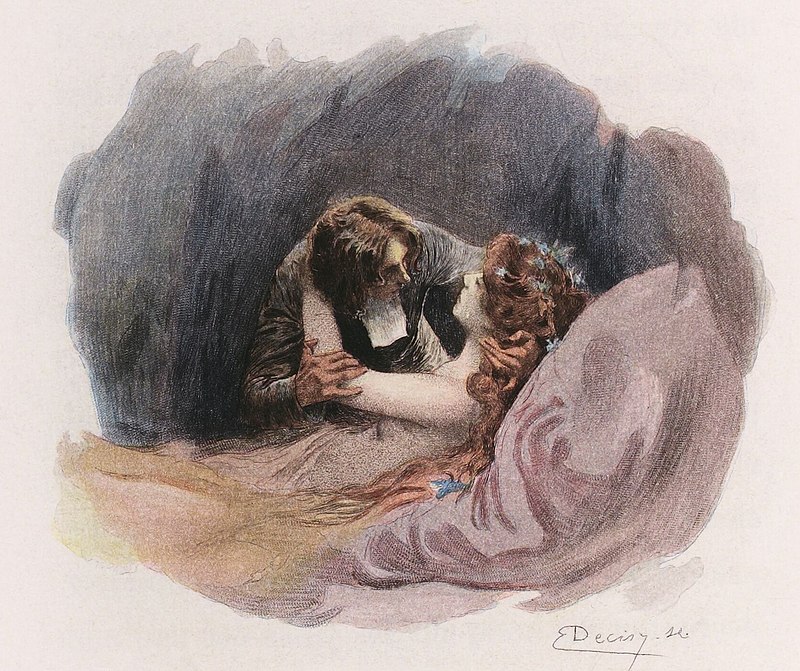
Clarimond(e)

  • Origin: Occitanian
  • Meaning: uncertain
  • Gender: Female
  • Eng pron: (KLAIR-e-mund)

A Medieval Occitanian name first recorded in 12th-century French chivalric literature, Clarimond (also found as Clarimonde, Claramonde, or Claramunda) is either a diathemic compound of the Latin clārus (“bright, light, clear”) and the Old High German mund (“protection”), or derived from an Occitanian phrase meaning “bright world; clear world”

In the 12th-century chanson de geste, Huon de Bordeaux, the name appears in its earlier form as Esclarmonde borne by a Saracen princess who converts to Christianity and marries the hero Huon. Similar formations (Florimond, Rosamond, Alemond) were fashionable among the knightly and aristocratic classes of the High Middle Ages. The 1889 opera by Jules Massenet, Esclarmonde, is loosely based on the character from Huon de Bordeaux.

Historically, Esclarmonde and its variants were borne by at least four noblewomen of the House of Foix, the most famous being Esclarmonde de Foix (d. 1215), sister of Count Raymond-Roger de Foix, who was noted for her learning and association with the Cathar movement in southern France.

Though rare, Clarimond saw occasional use in 17th-century England, likely revived through renewed interest in medieval romance literature. Clarimonde was also occasionally found in 18th-19th-century Acadia, and was used by the closely related Cajuns in Louisiana.

In 1836, French writer Théophile Gautier reintroduced the name in his celebrated vampire novella La Morte Amoureuse (Clarimonde in French; The Beautiful Vampire in English). Gautier’s heroine—a sensual courtesan who blurs the line between life and death—cemented Clarimonde’s association with Gothic beauty, nocturnal allure, and eternal fascination, making it an especially fitting name for Halloween

Other forms include:

  • Esclarmonda (Catalan, Occitanian)
  • Clarimond (English)
  • Clarimonde (French)
  • Clarimunda (Late Latin, Spanish)
  • Esclarmonde (Old French)
  • Clarmonda (Occitanian)
  • Clarmontina (Occitanian)
  • Mondina (Occitanian)
  • Esclaramunda (Spanish)

Sources

Oliver, Olivier

Gender: Masculine
Origin: debated
Meaning: debated
Eng (AHL-ih-VER); Fre (oh-LEE-vyay)

This name has a very interesting past. Its origins and meaning are debated, despite its obvious similarity with the word “olive”, many sources believe that is is either derived from one or two Old Norse names, Alfihar or OleifrAlfihar meaning “elf army” or Oleifr meaning “ancestral relic,” while other sources argue that it is indeed related to the Latin word oliverus meaning “olive tree.”

The name first appears in the French epic poem, Le Chanson de Roland. Olivier is the one of the better retainers of Roland. The name was introduced into England by the Normans and was consequently anglicized as Oliver.

The name has been in and out of usage in the English-speaking world since the Middle Ages. There was a time in England when the name went out of favor due to the bloody exploits of Oliver Cromwell. It was revived in the 19th-century due to Dicken’s lovable orphaned character of Oliver Twist.

In recent years, the name has seemed to go through a revival in both the United States and the United Kingdom. In 1979, Oliver ranked in at # 396 for the most popular male names in the United States, in 2010, however, he cracked into the top 100, making it all the way up to # 88. No doubt thanks to the popularity of its seemingly feminine form of Olivia.

As of 2010, he was the most popular male name in England/Wales. His rankings in other countries are as follows:

  • # 3 (Australia, NSW, 2010)
  • # 3 (New Zealand, 2010)
  • # 6 (Norway, 2010)
  • # 7 (Sweden, 2010)
  • # 8 (Scotland, 2010)
  • # 9 (Denmark, 2010)
  • # 10 (Finland, 2011)
  • # 12 (Ólafur, Iceland, 2010)
  • # 16 (Northern Ireland, 2010)
  • # 23 (Canada, BC, 2010)
  • # 25 (Oliwier, Poland, 2009)
  • # 38 (Olivér, Hungary, 2010)
  • # 48 (Óliver, Iceland, 2010)
  • # 51 (Austria, 2010)
  • # 52 (Ireland, 2010)
  • # 55 (Olivier, Netherlands, 2010)
  • # 86 (Spain, 2010)
  • # 269 (Netherlands, 2010)
  • # 305 (Olivier, France, 2009)

The name is used throughout continental Europe. Its French form of Olivier is still fairly common in France and it is occassionally found in the Bayous of Louisiana among Cajun families, along with its lovely accented drawled out pronunciation of (oh-LIV-ee-AY).

In Poland it is rendered as Oliwer pronounced the same way as in English though the final R is rolled. In Iceland the popular male name of Olafur may be related. Pronounced (OH-lahf-ER), it has a feminine form of Olafia (OH-lah-FEE-ah).

Popular English nicknames are Ollie and the less common Noll.

Its designated name day is July 12.

Other forms include:

  • Olivier (Afrikaans/Dutch/French/Frisian)
  • Oliver Оливер (Croatian/Czech/Dutch/English/Estonian/Finnish/German/Hungarian/Macedonian/Portuguese/Russian/Serbian/Slovak/Spanish)
  • Fier (Dutch: originally a diminutive form, used as an independent given name)
  • Oluvier (Dutch)
  • Olivur (Faroese)
  • Ólivar (Faroese)
  • Olivér (Hungarian)
  • Ólafur (Icelandic)
  • Óliver (Icelandic)
  • Ólíver (Icelandic)
  • Oilibhéar (Irish)
  • Oliviero (Italian)
  • Olivarius/Oliverus (Latin)
  • Alfher (Old High German)
  • Áleifr (Old Norse)
  • Oliwer/Oliwier (Polish)
  • Oliwir/Olwer/Olwir (Polish: obscure)
  • Oliveiros (Portuguese)
  • Olaghair (Scottish)
  • Oilbhreis (Scottish)

Renata, Renatus, René, Renée

Origin: Latin
Meaning: “rebirth.”

The origins of René and Renée can be traced back to the Late Latin male name Renatus, meaning “rebirth; born again.” The name is borne by several saints in both its Latin masculine form and feminine Latin form. The French forms have experienced usage in the Netherlands, Slovenia, Slovakia, the Czech Republic as well as Anglo-phone countries.

Renée enjoyed a short spout of popularity in the United States during the late 60s and early 70s, the highest it peaked was in 1967 coming in at # 62. As of 2008, she came in at # 734. Surprisingly, its masculine version ranked in higher in the top 1000, coming in as the 561st most popular male name in 2008. René is still somewhat prevalent among the Cajun and Creole communities of Louisiana.

In 2005, he was the 57th most popular male name in Slovenia.

Renata has experienced usage from South America to Eastern Europe, she is a common choice in Poland, Germany, Italy and Brazil. In 2006, she was the 34th most popular female name in Chile and the 68th most popular female name in Hungary.

Other forms of the name include:

  • Renata (Czech, Croatian, German, Italian, Lithuanian, Polish, Portuguese, Spanish. Polish diminutive forms are: Rena, Renatka and Renia. Spanish diminutive form is Renita, often used as an independent given name)
  • Renate (Dutch/German)
  • Renáta (Hungarian/Czech/Slovak)

Masculine forms include:

  • René (French, Czech, Dutch, German, Hungarian, Slovakian, Slovenian)
  • Renát (Hungarian/Slovakian)
  • Röné (Hungarian)
  • Renato (Italian/Spanish)
  • Renatus (Late Latin)
  • Renáto (Slovakian)
  • Renátus (Slovakian)

The designated name-day is November 6 in Slovakia, October 19 in France, November 12 in Poland and Lithuania, November 28 in the Czech Republic (Renata is October 13); October 6 in Hungary and January 23 in Estonia.

The name is borne by French mathematician and philosopher René Descartes and French painter René Magritte and American actress Renée Zellweger.