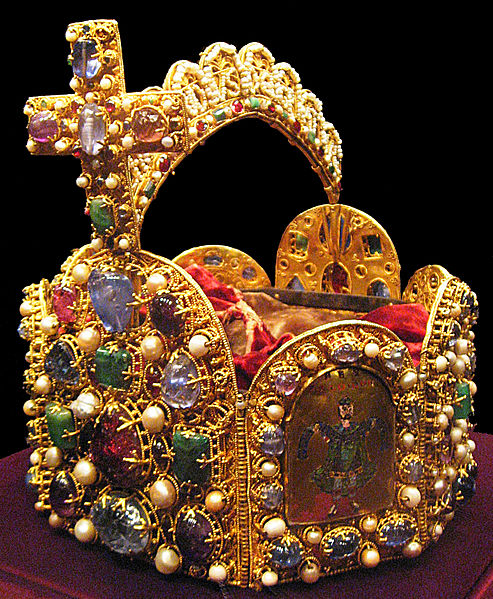
Otto

Gender: Masculine
Origin: German
Meaning: “wealth; riches.”
(OT-to)

The name is derived from the early Germanic Audo. It seems like the quintessential German name, but has been out of favor in German speaking countries until recently, where it seems to be experiencing a revival. The name was borne by four Germanic kings. The first being Otto I, (also known as Otto the Great), the first Holy Roman Emperor. It was also borne by German Chancellor Otto von Bismarck (1815-1898).

To American ears, it might sound a bit quirky, but to hipsters, he might just make the perfect brother to little Gunnar or Atticus. Otto exhibits a certain quality of strength. It wouldn’t be bad to give him a chance, at least as a middle name. Otto has not ranked in the US top 1000 since 1974, when he came in at a measly #969. The highest he has seemed to rank in American history was in 1909, when he came in at a decently high #144. No doubt due to a large influx of German and Swedish immigrants at the time.

In Germany, he hasn’t made it to the top 500 as of yet, but I am happily able to report that, recently, while browing through some German birth announcement from Berlin, I was happy to see a few newborn Ottos, either as their first name or middle name.

Update: As of 2011, Otto was the 30th most popular male name in Finland and in 2010, he was the 92nd most popular male name in Sweden.

In Germany and Austria, his designated name day is September 7th. Similar variations include Otmar which means “possesing of fame” and Ottokar meaning “wealthy and vigilant.” If Otto feels too short for you, then you might want to consider Otmar or Ottokar as a formal version.

Other forms of the name include:

  • Ot (Catalan)
  • Ota (Czech)
  • Oto (Czech/Slovak)
  • Otto (Dutch/Estonian/Faroese/Finnish/Frisian/German/Polish/Romansch/Sami/Scandinavian)
  • Ode (English)
  • Eudes (French)
  • Odilon (French/Portuguese)
  • Odon (French/German)
  • Odo (German)
  • Udo (German)
  • Ortu (Greenlandic)
  • Ottó (Hungarian/Icelandic)
  • Oddo (Italian)
  • Ottone (Italian)
  • Ottorino (Italian)
  • Rino (Italian)
  • Audo (Old High German)
  • Odo (Old High German)
  • Otton (Polish)
  • Otte (Scandinavian)
  • Oton (Slovene/Spanish)

A common Czech diminutive form is Otik.

Feminine forms are so numerous that I shall save those for a separate entry, stay tuned 🙂

August

It’s the beginning of August and summer is almost over. Hence is why I have decided to write about the August names.

The root of these names is the Latin verb augere meaning “to increase.” Augustus was a title given to Octavian, the first Emperor of the Roman Empire.

Augustus as a title implied a person with great reverence and awe, usually suggesting “venerated” or “exhalted.” The name eventually spun off as a first name, and even left an impact on our month names. In the Roman Empire, the month of Sexitilis’ name was changed to August in honour of the Emperor Octavian. Its feminine version is the austere and rather severe, version of Augusta. Both Augustus and Augusta have a lot of potential. Augustus fits right in with the other “old man” dramatic chic names that seem to be rising up the charts. Think Jasper, Atticus and Leo. There is a certain nobility and sophistication to the name. Its feminine version has the same vibe, fitting right in with other current trends, such as Sophia, Matilda and Eleanor.

We also have the much shorter version of August, which has been used across central Europe for centuries. August seems to be climbing up the American charts, he currently comes in at # 482, while the more formal version of Augustus has ways to go, coming in at # 795. If August still feels too wordy to you, then you might like August with an e, Auguste is the French form.

Of course, how could we ever forget the saintly and scholarly Augustine. The name Augustine is a derivative of the Latin, Augustinus. It has the same meaning as Augustus.

The name was borne by the renowned Catholic Theologian and Doctor of the Church, Augustine of Hippo. Either pronounced (uh-GUS-tin) or (AW-guh-STEEN) the name does not even appear in the top 1000. Parents may find the –stine ending too feminine. It would make a great middle name, or a great alternative to the more common Austin.

Other forms of the name include:

Augustus Forms

  • Augustu (Asturian/Sicilian)
  • Avqust (Azeri)
  • Aogust (Breton)
  • August (Catalan)
  • August (Croatian/English/German/Letzeburgish/Occitanian/Polish/Romanian)
  • Augustus(Czech/Danish/Dutch/English/Finnish/Frisian/Estonian/German/Latin/Norwegian/Swedish)
  • Guus (Dutch: originally a diminutive form, now used as an independent given name)
  • Aukusti/Aku/Aki (Finnish)
  • Auguste (French)
  • Ágost (Hungarian)
  • Ágústus (Icelandic)
  • Augustale (Italian: obscure)
  • Ágastas (Irish/Gaelic)
  • Augusts (Latvian)
  • Ësti (Letzebergish: initially a diminutive form)
  • Gust/Gusti (Letzebergish: initially diminutive forms)
  • Augustas (Lithuanian)
  • Ágošt (Prekmurian)
  • Aujußß (Ripoarisch)
  • Aokuso (Samoan)
  • Augosts (Samogaitian)
  • Austu (Sardinian)
  • Avgust (Slovene)
  • Augusto (Spanish/Italian/Portuguese/Aragonese/Basque)
  • Awgust (Sorbian/Turkmen)
  • Ågusse (Walon)

German diminutives are Gustel, Gustl, Gusti and Augi. Slovenian diminutives are: Gustek, Gustel, Gustelj and Gusti

Feminine forms include:

  • Augusta (Czech/Danish/Dutch/English/German/Italian/Portuguese/Spanish)
  • Gusta/Guusje/Guuske (Dutch: initially diminutive forms, used as independent given names)
  • Auguste (German: final E is pronounced)
  • Auguszta/Ágosta (Hungarian)
  • Ágústa (Icelandic)
  • Avgusta (Slovene)

Augustine Forms

  • Augustini (Albanian)
  • Agostín (Aragonese)
  • Avqustin (Azeri)
  • Aogustin (Breton)
  • Agustí (Catalan)
  • Augustín (Czech/Slovak)
  • Augustijn (Dutch)
  • Augustine (English)
  • Austin (English: a medieval contracted form of Austin, in the United States, this is the most prevalent form of the August names, in 2008, he was the 55th most popular male name, between 1997-1998, he was the 9th most popular male name)
  • Gus (English: sometimes used as an independent given name)
  • Augustin (French/Basque/Croatian/Danish/Norwegian/Romanian)
  • Agostiño (Galician)
  • Ágoston (Hungarian)
  • Ágústínus (Icelandic)
  • Agaistín (Irish/Gaelic)
  • Agostino (Italian)
  • Augustinus (Latin/Dutch/Frisian/Estonian/Finnish/German/Swedish)
  • Augustīns (Latvian)
  • Augustinas (Lithuanian)
  • Wistin (Maltese)
  • Agustin (Piedmontese)
  • Augustyn (Polish)
  • Agostinho (Portuguese)
  • Aujustin (Ripoarisch)
  • Augostėns (Samogaitian)
  • Austinu (Sardinian)
  • Avguštin (Slovene)
  • Agustín (Spanish/Asturian)
  • Awstin (Welsh)

Feminine forms include

  • Austine (English)
  • Augustine (French/German)
  • Agostina (Italian)
  • Augustina (Latin)
  • Augustyna (Polish)
  • Austina (Sardinian)
  • Agustina (Spanish)

Atticus

Gender: Male
Origin: Greek
Meaning: “from Athens.”
(AT-tik-kus)

    The name has its origins in an ancient Roman cognamen, in addition to it being a popular Greek name, used in reference to someone who hailed from the Greek region of Attica, where Athens is situated.

    It was borne by Titus Pomponius Atticus, (35 BC). Saint Atticus of Constantinople (a.d. 425); Herodes Atticus, a Greek rhetorician (101-177) B.C.; Atticus the Philosopher, a companion to Plato (175 B.C.)

    In modern popular culture, it was the name of Atticus Finch, in (To Kill a Mockingbird), and the main title character of the novel by Ron Hansen, Atticus.

    The feminine form is Attica which was a common female name in Ancient Rome.

    During the last five years, the name has become increasingly more common in the United States, it currently ranks in # 689 and seems to be rising.

    Atticus is also a brand of clothing, founded in 2001, by Blink-182 band members Tom DeLonge and Mark Hoppus.

    Another form is the Serbo-Croatian, Atik.