Ariadne, Ariadni, Ariadna

waterhouse_ariadneGender: Feminine
Origin: Greek
Meaning: “most holy; most chaste.”

The name is composed of the Cretan elements ari meaning “most” and adnos meaning “holy.” Other sources argue that it is composed of the ancient Greek elements ari meaning “most” and hagne meaning “chaste.”

In Greek mythology the name is borne by the daughter of King Minos and his wife Pasiphaë of Crete. Ariadne is most known for helping the hero Theseus overcome the minotaur and find his way back through the labyrinth by giving him a ball of red yarn. Ariadne was in love with Theseus and ran off with him after he had killed the minotaur, but Theseus had abandoned her while she was sleeping, on the isle of Naxos. This part of the myth has been popularly rendered in paintings. It is said that Ariadne later married the god Dionysus. Many scholars suggest that Ariadne was originally a pre-Olympian Cretan goddess.

The name was also borne by an early Christian martyr, a Christian slave who refused to participate in the regulatory libations to the local gods, legend says that she was hunted down by the authorities until she ran into a chasm that miraculously swallowed her up. Her feast is held on September 17 and she is a popular saint in the Greek Orthodox Church. In modern Greece, where the it is rendered in the conventional form of Ariadni, the name is still relatively common. It is growing in popularity in Spain and Poland as Ariadna. The Latin and Italian rendition of the name is Arianna, also a common name in Greece.

The name is borne by Greek-American author and syndicated columnist Arianna Huffington (b. 1950).

In recent years, its Italian form of Arianna has become quite prevalent in the U.S. coming in at # 66 among the top 1000 female names of 2008. The French form is Ariane and the more obscure Arienne. Another more modern version is Ariana, which comes in as the 81st most popular female name in the United States ( 2008). There is also an ancient Etruscan form Areatha.

Other forms include:

  • Arijadna (Croatian)
  • Ariadné (Hungarian)
  • Ariadnė (Lithuanian)

Aurelia, Aurelius

thumbnailOrigin: Latin
Meaning: “golden”

Originally a Roman gens name, Aurelius is from the Latin meaning, “golden; gilded.”

The name is borne by several famous personages throughout history, the earliest being the Roman Emperor Marcus Aurelius and its feminine form, by his daughter Annia Aurelia Galeria Lucilla. Aurelia is also the name of the mother of Julius Caesar, (Aurelia Cotta), Tacitus proclaimed her the ideal Roman Matron. The Via Aurelia was named for an ancestor of her’s, Aurelius Cotta. The Via Aurelia is an ancient road that runs through Rome. Other famous Aurelias include Portuguese painter Aurélia de Souza (1867-1922), famous Romanian gymnast Aurelia Dobre (b.1972) and the mother of famed poetess, Sylvia Plath.

The Latinate form is popular in all the Latin based countries: Italy, Portugal and Spain including South America, as is its masculine counterpart, Aurelio.  Aurelia is also quite prevalent in Poland. In addition, Aurelia shares her name with a genus of jellyfish, an asteroid and it is also used as a synonym for a chrysalis.

Other feminine forms of the names and cognates are:

  • Aorell (Breton)
  • Aurelija (Croatian/Lithuanian)
  • Aurélie (Czech: ow-REL-yeh)
  • Zlata. Zlatka, Zlatica (Czech/Slovakian: these names are often used as cognates for the Latin Aurelia, but literally mean “gold” in Czech and Slovakian)
  • Aurélie (French: the name came in as the 74th most popular female name in Belgium in 2006 and the 89th most popular female in France in 2003. oh-hray-LEE)
  • Aureliane/Auriane (French: obscure)
  • Aranka (Hungarian: this is another one that literally means “gold” in Hungarian but is used as a form of Aurelia)
  • Aurélia (Hungarian/Portuguese/Slovakian)
  • Rella/Relli (Hungarian: originally diminutive forms, now used as independent given names, they even have their own name day, which is October 15).
  • Auksė (Lithuanian: literally means “gold” in Lithuanian but is often used as a cognate)
  • Aura/Aurelia/Aurica (Romanian)

Hungarian diminutive forms are: AuraAurácska and Aurika.

Its masculine forms include:

  • Aurelian (English/Romanian)
  • Aurèle (French)
  • Aurélien (French: in France, he came in as the 88th most popular male name in 2006).
  • Aurel (German, Romanian and Czech)
  • Aurél (Hungarian/Romansch/ Bavarian)
  • Aurelianus (Latin)
  • Auksys (Lithuanian)
  • Aureliusz (Polish)
  • Oral (Romansch)
  • Aureliano (Spanish)

Its designated name-day in some countries is September 25, and the name is borne by several saints.

Linas

flax_flowers_good_bigGender: Masculine
Origin: Lithuanian
Meaning: “flax”
(LIN-ahs)

The name is fairly popular in Lithuania, the name comes directly from the Lithuanian word for flax, linum usitatissimum, and it could also be a form of the Greek name Linos meaning “comfort song.” In the Lithuanian case, it is most likely that the name has its origins in indigenous Baltic roots. Its feminine forms is Linė (LIN-ay) and Lina (LIN-ah). The name is borne by Lithuanian basketball player Linas Kleiza (b.1985). Its designated name-day is September 23. There is a Spanish form: Lino.

Núria, Nuria

Gender: Feminine
Origin: Catalan
Meaning: Unknown
(NOO-ree-ah)

Another Spanish place name turned first name, like Meritxell, she is a popular given name due to her associations with a miraculous statue of the Virgin Mary. The sound is pretty, the statue of the Virgin Mary is exquisite and the landscape of Vall de Núria is breath taking. Unfortunately, I could not find the etymology of the name. The name is currrently very popular in Spain, ranking in as the twenty-sixthe most popular female name of 2006. Its designated name day is September 8th. To hear how its pronounced, go here: http://www.forvo.com/word/núria/ Namesakes include: Nuria Bermudez (b. 1980) a Spanish actress and football agent and Nuria Llagostera Vives (b.1980) a Spanish tennis player.

Meritxell

Gender: Feminine
Origin: Catalan
Meaning: “midday.”
(meh-ree-CHEL)

She rhymes a bit with Michelle, but looks unpronounceable to an English speaker. The name is currently popular in Spain, particularly in Barcelona, where the langauge of Catalan is spoken. It is also very prevalent in the country of Andorra, where Catalan is the official language. Meritxell started off as the name of a place, but due to its associations with the Virgin Mary, it became a favorite among Catalan speakers. As for the origins of the name itself, Catalan Philologist, Joan Caromines, claims the name is derived from a diminiutive merig which is ultimately from the Latin meridiem meaning “midday.” Merig is a name used by shephards to denote a pasture with a lot of sun. The legend of Our Lady of Meritxell concerns a statue of the Blessed Virgin Mary. In the 12th-century, mass goers in the village of Canillo in Andorra, discovered a statue of the Virgin Mary. It was placed among blooming roses, something which was thought of as miraculous, since it was the dead of winter. You can find more about the story here http://en.wikipedia.org/wiki/Our_Lady_of_Meritxell. A church was built for the statue, and Our Lady of Meritxell is considered the patron saint of the principality of Andorra. In the 1970s, the church and statue were destroyed in a fire, the church was rebuilt and a replica of the statue reproduced. The name day in Spain is September 8, when the statue was destroyed by fire in the 1970s. The name is currently borne by Andorran Minister of Foreign Affairs, Meritxell Mateu i Pi (b. 1966). This site had an audio of the name being spoken by a Catalan speake http://www.forvo.com/search/Meritxell/. In 2003, the name was the 49th most popular female in Spain. In 2006, it did not rank in the top 100 female names of Spain.

Athene, Athena, Athina

Gender: Feminine
Origin: Greek
Meaning: debated
Αθηνα
Eng (uh-THEE-nah; uh-THEE-nee); Mod Grek (ah-THAY-nah; ah-THEE-nah).

The name is of debated origin, but is speculated to be composed of the elements ather meaning “sharp” and aine meaning “praise.” Others suggest that it is composed of pre-Greek elements, possibly constructed from the Lydian word ati meaning “mother” and combined with the name of a Hurrian goddess: Hannahanna or Ana. Plato himself claimed the name was derived from Atheonoa, a compound of the Greek theos meaning “the gods” and nous meaning “mind.”

In Greek mythology, the name is borne by the goddess of wisdom, reason, warfare and peace. She was also the patron goddess of the region of Attica and the city of Athens, which was named for her. I don’t believe I can do justice to the role Athena played for the ancient Greeks. But to be to the point, the Greeks so admired Athena that she appears as a recurrent figure in many Greek tragedies and epics. Athena was also the goddess of weaving and handicrafts. It is interesting to note, that unlike the other Greek goddesses, Athena remained a virgin, and was celebrated for her chastity. Though Greece no longer worships the ancient pantheon of Mt. Olympus, the names Athena and Athina still prevail in the small mediterranean country.

The name is borne by the grand-daughter of Greek shipping magnate, Aristotle Onassis, Athina Onassis Rousel (b. 1985).

In Greece, its designated name day is September 1st. Other interesting forms include: the Ancient Attic Athenaia and the Doric Athana.

Other modern forms include:

  • Atenea (Asturian/Spanish)
  • Afina (Azeri/Russian)
  • Atena (Catalan/Italian/Polish/Portuguese/Romanian/Serbo-Croatian/Slovene)
  • Athéna (Czech)
  • Athene (Danish/French/German)
  • Athéna/Athéné (French)
  • AÞena (Icelandic)
  • Atēna (Latvian)
  • Atėnė (Lithuanian)
  • Atene/Athene (Norwegian)
  • Aténa (Slovakian)


Hermione, Ermioni

Gender: Feminine
Origin: Greek
Ερμιόνη
Eng (/hərˈmaɪ.ɵniː/ hər-MYE-o-nee); mod Grk (air-MYOH-nee)

She probably reminds you of Hermione Granger, the character from J.K. Rowling’s Harry Potter series. The name is of ancient Greek origin and it is derived from the masculine name Hermes.

In Greek mythology, Hermione was the only daughter of Helen and Menelaus. The name is also found in the calender of Saints, Hermione of Ephesus was an early martyr, and as an interesting side note, the Hermione of Harry Potter is named for the saint and not for the maiden of Greek Legend.

Hermione of Sicily is a character featured in Shakespeare’s Play, A Winter’s Tale (1610).

The name, though quirky and a bit extravagent, seems to have been a common moniker in Britain prior to Harry Potter fame. It is borne by several British actresses, Hermione Baddeley (1906-1986), Hermione Cockburn (b.1973) Hermione Gulliford, Hermione Hannen (1913-1983) and Hermione Norris (b.1968). It is also borne by British painter, Hermione Hammond (1910-2005).

It is also the name of an Opera, based on the Hermione of Greek Mythology.

In modern Greece, the name is often transliterated as Ermioni and Ermione where its designated name day is September 4th. It is also the name of a town in the Peloponnese.

In Italy, Ermione is the prefered form.

Despite the charming associations with Harry Potter, the name has not ranked in the US top 1000. In Britain, it does not appear in their top 100, but I have seen many instances of babies with the middle name or even the first name of Hermione in the British birth announcements. Other forms Herminie and Hermia. To hear the way the name is pronounced in Italian, you can listen to it here: http://www.forvo.com/search/Ermione/

Other forms include:

  • Hermiona (Croatian/Czech/Serbian)
  • Hermioné (Czech/Hungarian)
  • Hermelien (Dutch: could also be a feminine form of Herman)
  • Hermine (German/Norwegian)
  • Hermione (French)
  • Ermione (Italian: air-MYOH-nay)
  • Hermiona (Lithuanian/Polish)
  • Ermion (Piedmontese)
  • Hermiuona (Saimogaitian)
  • Hermíone (Spanish/Portuguese)

Antigone, Antigoni

Gender: Feminine
Origin: Greek
Meaning: debated
Greek Pronunciation: http://www.forvo.com/search/Antigoni/
English: http://www.forvo.com/search/Antigone/

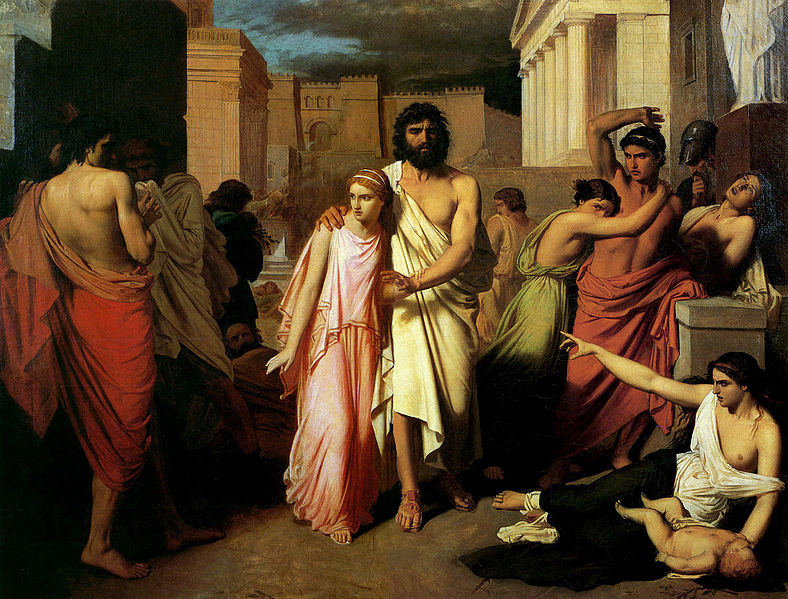
The name is a feature in Greek tragedy, and the story of Antigone’s origins are not too pretty.

Despite it’s rather unsavory connotations, the name is still a regular in Greece and Albania. The Greeks tend to favor the more modern form of Antigoni, while the Albanians like the elaborated version of Antigona.

The meaning of the name is debated. Some say it is composed of the elements anti meaning “against” or “opposed to” and gon meaning “corner, bend, angle.” Others argue that the second part is actually derived from gonē which refers to semen and signifies motherhood. So in either case, the name may mean “against the bend” or “against motherhood.”

Back to its associations:

Antigone is the daughter of Oedipidus and Jocasta, she is the product of an incestuous relationship, Oedipidus accidentally married his biological mother.

Antigone is known for trying to secure a proper burial for her brother Polynieces even though he was a traitor to the small Greek city state, Thebes. She is the subject of many ancient classical Greek plays, the most widely known being the one written by Sophocles in 442 B.C.E.

It is also the name of a few other women in Greek Mythology.

Other forms of the name include: (Note: many of these forms are very rare in their home countries)

  • Antígona (Catalan/Galician/Portuguese/Spanish)
  • Antigoné (Hungarian)
  • Antygona (Polish)
  • Antigona (Romanian/Serbo-Croatian/Slovakian)


Adelind

Gender: Feminine
Origin: German
Meaning: “noble and tender”

I have seen Adalyn quite a few times in the birth announcements. I don’t know if this is suppose to be a tryndification of Adeline or if its just a smush of Ada and Lynn, but whatever its origins, it may be the next Madelyn. That said, Adelind, a very obscure German female given name, is composed of the ancient Germanic elements adal meaning noble and lind meaning “tender.” Variations include the Italian and Spanish Adelinda. Possible nickname options are of course Addie, Ada, Del and Lindy.

Assunta, Asuncion, Jasone

Gender: Feminine
Origin: Italian/Romansch/Spanish/Basque
Meaning: “assumption.”
It (ahs-SOON-tah); Sp (ah-soon-THYONE); Lat Am (ah-soon-SYONE); Basque (zhah-SOH-neh).

Assunta comes directly from the Italian word for assumption and is usually given in honor of the Virgin Mary. It is far more common in the southern regions of Italy than in the northern regions. It is also used in the Romansch speaking cantons of Switzerland.

August 15 is the Feast of the Assumption, where, according to Catholic tradition, Mary was assumed into heaven body and soul.

Today, the name is considered rather old fashioned in Italy. It’s Spanish cognate is Asuncion and its Basque form is Jasone.

Assunta is borne by Filipina actress, Assunta de Rossi.