Elvira

  • Origin: Visigothic
  • Meaning: Uncertain
  • Usage: Albanian, Bashkir, Bosnian, Catalan, Croatian, Dutch, Estonian, Finnish, Galician, German, Hungarian, Italian, Latvian, Portuguese, Provençal, Romanian, Romansch, Russian, Scandinavian, Slovene, Tatar
  • Transcription: Эльвира (Russian)
  • Gender: Female
  • Eng (el-VY-rah); Sp (el-VEE-rah; el-BEE-rah)

A 19th-century gem and late 20th-century vampiric monikor, the name is of uncertain meaning but has its origins in Medieval Spain. It is likely of Visigothic origins, possibly derived from Gailawera or Geloyra, which stem from gails (happy) or (spear); and wers (friendly, agreeable, true).

It should be noted that Elvira (Latin: Iliberri or Iliberis) was an ancient Iberian and later Roman city located near present-day Granada, in Andalusia, southern Spain. However, in this case, it is likely derived from an Iberian source, meaning “new town.”

It was a popular female name among the royal family of Castille & León, producing two queens who bore this name, Elvira of Castile, Queen of León (965–1017) and Elvira of Castile, Queen of Sicily (c. 1100–1135).

It was later used in Mozart’s 1787 opera Don Giovanni (libretto by Lorenzo Da Ponte), in which Donna Elvira is one of Don Giovanni’s former lovers. This likely popularized the name outside of the Iberian peninsula.

By the turn of the 20th-century, Elvira was not unknown in the United States, though never overly popular, it peaked at #254 in 1914, but fell out the Top 1000 by 1981, the same year Elvira, Mistress of the Dark came on the scene.

The real Halloween link began in 1981, when actress Cassandra Peterson created the camp-horror TV hostess Elvira, Mistress of the Dark for a Los Angeles late-night show (Movie Macabre).

Dressed in a plunging black gown with a beehive of jet hair, Elvira presented old horror movies with sardonic humor — blending Gothic sex appeal, irony, and B-movie kitsch.

The character became a pop-culture icon: Halloween TV specials, films, pinball machines, comic books, and even perfume lines immortalized her as the Queen of Halloween.

Outside the United States, this name does not have such associations. In Sweden, it has been among the top 100 girls’ since 1998 and peaked at #25 in 2014. As of 2024, it came in at #40.

It’s a popular name in the Balkans, even spinning off a male form of Elvir (Bosnian and Albanian).

Other forms include:

  • Elbire (Basque)
  • Elvíra (Czech/Slovakian)
  • Elviira (Estonian, Finnish)
  • Elvire (French)
  • Elwira (Polish, also an alternate Swedish spelling, Sorbian)
  • Elvīra (Latvian)
  • Elvyra (Lithuanian)

Obscure Lithuanian male forms are the Lithuanian, Elvyras; the Polish, Elwir(o), and the Italian Elviro.

Name days: August 25 (Austria), July 16 (Croatia), February 10 (Hungary), January 25 (Spain), March 1 (Sweden), November 21 (Slovakia), August 13 (Latvia).

Sources

Urraca

Photo by Ronald on Pexels.com
  • Origin: Spanish
  • Meaning: “magpie.”
  • Gender: Female
  • oo-RAH-kah

The name comes directly from the Spanish word for “magpie,” ultimately derived from the Latin furax (thievish).

The name was popular in the early Middle Ages among the Christian kingdoms of the Iberian Peninsula.

Several medieval queens and princesses bore the name, including Queen Urraca of León and Castile (1079–1126), the powerful daughter of Alfonso VI, who ruled as queen regnant and Infanta Urraca of Portugal (11th century), daughter of King Afonso I.

It’s French form is Urraque. Early records also yield, Hurraca, Hurraqua, Urraka (Basque), Urraqua and Urraquoa.

Its softer Galician form is Orraca.

This beautiful Medieval gem deserves a comeback, especially with the nickname, Rocky.

Sources

Tarquin

Tarquin the Elder consulting Attus Nevius the Augur by Sebastiano Ricci
  • Origin: Etruscan
  • Meaning: Unknown
  • Gender: Male

Tarquin is the English form of Tarquinius, the Latin family name of a powerful Etruscan dynasty that ruled early Rome. The name’s exact Etruscan root is uncertain, but it may derive from the ancient city of Tarquinii (modern Tarquinia) in central Italy, itself probably from an older Etruscan personal or place name.


Two Roman kings bore this name: Lucius Tarquinius Priscus, the fifth king of Rome, and Lucius Tarquinius Superbus, the seventh and last king, whose overthrow in 509 BCE led to the founding of the Roman Republic.


While rare, Tarquin appears in English records from the Renaissance onward, often chosen for its aristocratic and classical resonance. Italian retains Tarquino as a given name. The name has also been used in literature and drama —Shakespeare famously tells the story of “The Rape of Lucrece” by Tarquin. It was recently used as the name of Tarquin Blackwood in Anne Rice’s The Vampire Chronicles.

Modern bearers include British journalist Tarquin Hall (b. 1969), the middle name of American actor, Timothy Tarquin Hutton (b. 1960).


Today Tarquin feels distinctive and slightly theatrical, blending ancient Roman history with a sleek, modern sound. If you are looking for a fuller name for Quinn, this may be the perfect choice for you.

International variations include:

  • Tarkinio (Basque)
  • Tarquini, Tarquí (Catalan)
  • Tarkvinije Тарквиније (Croatian, Serbian)
  • Tarquinius (Dutch, Latin)
  • Tarquin (English, French)
  • Tarquinio, Tarquino (Italian, Spanish)
  • Tarkvinijus (Lithuanian)
  • Tarkwiniusz (Polish)
  • Tarquínio, Tarquino, Tarquim (Portuguese)
  • Tarkvinij (Slovene)

Female Forms

Its Italian feminine form of Tarquinia was borne by Italian Renaissance singer, Tarquinia Molza (1542-1617). This would also make a fabulous fuller version for the nickname Quinn. Another Italian female form is Tarquina.

Sources

Leontius, Léonce

  • Origin: Greek
  • Meaning: “lion-like.”
  • Gender: Male
  • Eng Pron (lee-ON-shus)

The name is derived from the Greek genitive λέοντος (leontos), meaning, “belonging to a lion; lion-like.”

It was borne by an 8th-century Byzantine emperor and several saints.

The designated name-day is January 13th.

An early English form is perhaps, Leontes, which appears in Shakespeare’s play, The Winter’s Tale (1610).

Léonce is its unisex French form. It appeared in the French Top 1000 Male Names between 1900-1969, and peaked at #95 in 1909. It simultaneously appeared in the French Top 1000 Female Names between 1900-1940 and peaked at #187 in 1915.

Léonce also appeared in the U.S. Top 1000 Male Names between 1887-1895, peaking at #819 in 1887.

Other masculine forms

  • Liyonṭiyos ܠܝܘܢܛܝܘܣ (Assyrian)
  • Leoncio (Asturian, Spanish)
  • Leontzio (Basque)
  • Leonti, Leontiy, Leonty Леонтий (Bulgarian, Russian, Ukrainian)
  • Lleonci (Catalan)
  • Leontios Ⲗⲉⲟⲛⲧⲓⲟⲥ, Λεοντιος (Coptic, Greek)
  • Leontius (Dutch, English, German, Latin)
  • Leontes (English)
  • Léonce (French)
  • Leonte ლეონტე (Georgian)
  • Leonzio (Italian)
  • Leoncjusz (Polish)
  • Leôncio (Portuguese)
  • Leontie (Romanian)
  • Leontije (Serbo-Croatian)
  • Leonziu (Sicilian)

Feminine forms include

  • Léonce (French)
  • Léoncette (French)
  • Léoncie (French)
  • Léoncine (French)
  • Léonte (French)
  • Leontia (Greek, Latin, Romanian)
  • Leonzia (Italian)
  • Leoncja (Polish)
  • Leôncia (Portuguese)

Another possible female off-shoot is Léontine – popular in France from the late 19th to early 20th centuries, it is pronounced [le.ɔ̃.tin]. It is debated whether it is a direct feminine form of Leontius or related to a Latin source meaning, “from Lentini.” A future entry will be written completely dedicated to Léontine.

Sources

Bonaventure

  • Origin: Italian
  • Meaning: “good luck.”
  • Gender: Male

Bonaventure is the French and English form of the Medieval Italian male name, Bonaventura. It is ultimately made up of the Latin words, bonus “good” and venturas “the things that will come, the future.” A 13th-century Catholic Saint bore this name. He is considered a Doctor of the Church and known for authoring the biography of St. Francis of Assisi.

The name experienced widespread use throughout Catholic Europe until it fell out of use by the early 20th-century. It was the middle name of actor, Spencer Tracy (1900-1967).

The designated name-day is July 15th and September 11 in Croatia.

In recent years, it was the name of one of the ill-fated Lisbon sisters. This character appeared in Jeffrey Eugenides’ novel, The Virgin Suicides (1993). She is referred to as “Bonnie,” for short.

Other forms include

  • Bonabendur (Basque)
  • Bonaventura (Catalan, Croatian, Czech, Dutch, German, Hungarian, Italian, Scandinavian, Slovene)
  • Boaventura (Galician, Portuguese)
  • Buonaventura (Italian)
    • Bonaventūra, Bonaventūras (Lithuanian)
  • Bonawentura (Polish)
  • Buenaventura (Spanish)

Italian short forms are Ventura, Venturo, and Venturino, also used as independent names.

Sources

Arantzazu, Arantza, Arancha

  • Origin: Basque
  • Gender: Female

The name comes from the Sanctuary of Arantzazu located in Oñati, Spain. According to legend, the Virgin Mary appeared to Rodrigo de Balanzategui in 1468, to which he exclaimed “Arantzan zu?!” (thou, amongst the thorns?!). It ultimately comes from the Basque meaning, “place of hawthorns.”

Our Lady of Aránzazu is the patron saint of Guipúzcoa.

Aránzazu is it’s Galician and Spanish rendition.

Arantza is a diminutive used as an independent name and may also just be used in reference to the Basque word for a hawthorn.

Arancha is its Spanish form and Aranza is its Galician form.

Arantza’s designated name-day in Spain is September 9th.

Sources

Zenobia

Zenobia is composed of the Greek elements, Zeus (Zeus) and bios (life). It was notably borne by a 1st-century Armenian queen of Georgian descent and later a 3rd-Century Queen of Palmyra who tried to expand into Roman territory but was defeated by Emperor Aurelian.

Zenobia of Palmyra’s name might have been a Hellenized form of her birth name, Bat-Zabbai, which is from the Aramaic meaning “daughter of Zabbai.” Zabbai itself is an Aramaic male name. It seems to be a theophoric name, meaning “gift of–.” The latter part refers to an unknown deity. It may have actually been an Aramaic form of the Hebrew female name, Bathsheba.

Speculation has also linked it with the Arabic female name Zaynab, which can either mean “father’s beauty” or be from the name of a type of flowering tree.

It was borne by the 3rd-century martyrs, Ss. Zenobia and Zenobius, two early Christians who were siblings and beheaded under Emperor Diocletian. Their feast and name-day is October 30.

In the English-speaking world, it is first recorded in Cornwall and Devon, England in the 16th-century. Early English forms of Synibie, Sinobie, Senobie, Cenobie, and Cenoby (Sen-e-bee; SIN-e-bee), would make interesting revivals in the spirit of Sydney and Willoughby. A common English diminutive was Nobby.

Zenobia appeared in the U.S. Top 1000 Most Popular Female names between 1881-1925, peaking at #669 in 1909.

Zenobia is no stranger to English literature, it is the name of a character in Nathaniel Hawthorn’s The Blithedale Romance (1852); Edith Wharton’s Ethan Frome (1911); and is even used by Anne Rice in her the eighth book of her vampire series, Blood and Gold (2001).

Zenobia “Nobby” Hawthorne appears as a character in the P.G. Wodehouse series, Jeeves.

Tina Fey used this as the middle name of daughter, Alice Zenobia.

Other forms include

  • Zenobia Զենոբիա ზენობია ܙܢܘܒܝܐ Armenian, Assyrian, Coptic, Czech, Danish, Galician, Georgian, German, Greek, Italian, Polish, Portuguese, Provencal, Romanian, Swedish, Spanish)
  • Zanubya ܙܢܘܒܝܐ (Assyrian)
  • Zinovia Зіновія Зиновия Ζηνοβία Зіновія (Belarusian, Modern Greek, Romanian, Russian, Ukrainian)
  • Zinovija Зиновия (Bulgarian, Serbian)
  • Cenobia (Catalan, English, Spanish, Swedish)
  • Anobia Ⲁⲛⲟⲃⲓⲁ (Coptic); Zanubiyah زنوبيا (Modern Arabic/Coptic)
  • Zenobie (English, archaic)
  • Senobia, Senobie, Sinobia (English)
  • Synibie, Sinobie, Cenobie, Cenoby (English)
  • Senopia (Finnish)
  • Zénobie, Zénobine (French)
  • Zenovia Ζηνοβία(Greek, modern, Romanian)
  • Zenóbia (Hungarian)
  • Zanobia (Italian, archaic)

Diminutives

  • Zinooba, Nubya (Assyrian)
  • Nobby, Zeena, Zina (English)
  • Pia, Piiu, Piu, Seno, Senu (Finnish)
  • Zena, Zenna (Hungarian)
  • Zenka, Zenobijka, Zenia, Zeba, Zebia, Zebka, Zeniulka, Zenusia, Zeniusia, Zeneczka (Polish)
  • Zina Зина (Russian)

Masculine forms include

  • Zenob Զենոբ (Armenian)
  • Zinovi Զինովի (Armenian)
  • Zenobio ܙܢܘܒܝܐ (Assyrian, Italian, Spanish)
  • Kenoba (Basque)
  • Zinovij Зиновий (Bulgarian, Serbian)
  • Cenobio, Zenobi (Catalan)
  • Zenóbe (French)
  • Zenobios Ζηνόβιος (Greek, classical)
  • Zinovios Ζηνόβιος (Greek, modern)
  • Zenóbiosz (Hungarian)
  • Zanobi (Italian, archaic)
  • Zenobiusz, Zenobi (Polish)
  • Zenovie (Romanian)
  • Zinoviy Зиновий Зіновій (Russian, Ukrainian)

Sources

Perpetua

  • Origin: Late Latin
  • Gender: Female
  • Meaning: “perpetual.”
  • Eng pron (per-PET-choo-ah)

The name is derived from the Latin perpetuus, meaning “continous; perpetual.” It was borne by a 3rd-century Christian matyr and saint, the companion of St. Felicity and it was also the name of the sister of St. Augustine of Hippo.

Perpetua and its various forms have been in sporadic use throughout the Catholic world. In Italy, it became synonymous with a priest’s housekeeper. This is due to the eponymous character in Alessandro Manzoni’s 19th-century novel, “The Betrothed.

It experienced sporadic use in England in the 1920s after the release of the now lost 1922 film, Perpetua also known as Love’s Boomerang.

It has recently appeared in English literature as the name of minor characters in Bridget Jones’s Diary (Helen Fielding), and in the Harry Potter series (J.K. Rowling).

It was borne by Scottish landscape painter, Perpetua Pope (1916-2013).

It is the name of Cape Perpetua Oregon which was named for St. Perpetua as well as a typeface.

It’s designated name-day is February 1, March 6th and March 7th.

Forms & Usages

  • Perpetua (Basque, Croatian, Dutch, Galician, German, Italian, Latvian, Lithuanian, Polish, Provençal, Romanian, Spanish)
  • Perpètua (Catalan)
  • Perpétue, Perpétué, Perpetue (French)
  • Perpétua (Hungarian, Portuguese)
  • Perpetuya Перпетуя (Russian)

English short forms include: Perp, Perpie, Perpy, and Petty.

Masculine forms include

  • Perpeta (Basque)
  • Perpetu (Catalan)
  • Perpet (French, Polish)
  • Perpetuo (Italian, Spanish)
  • Perpète (French)
  • Perpetuus (Late Latin)
  • Perpetuüs (German)

Sources

Indalecio

Indalo Symbol of Almeria, Spain
  • Origin: unknown
  • Meaning: unknown
  • Gender: masculine

The name is of debated origin and meaning. It is argued to be derived from an unknown Iberic phrase indal eccius meaning, “messenger of the Gods,” though this etymology seems dubious. It has also been linked with the Basque element, inda meaning “strength.” It has been associated with the neolithic Indalo symbol found in Almería, Spain, now used as a good luck symbol and a popular motif found throughout the town. It was born by St. Indalacio of Almería of the 1st-century C.E. who was said to have evangelized the town of Almería and thus became its first bishop. He was later martyred by the pre-Christian Iberians.

The name is rare but does continue to experience usage in Almería and to a lesser extent, the rest of the Spanish-speaking world, a notable bearer was the Spanish politician, Indalacio Prieto (1833-1962).

In Spain, the designated name day is May 15th.

A common short form is Idalo.

Other forms include:

  • Indalecio (Aragonese, Galician, Italian, Spanish)
  • Indaleki (Basque)
  • Indaleci (Catalan)
  • Indalezio (Italian)
  • Indalizio (Italian)
  • Indaletius (Late Latin)
  • Indalécio (Portuguese)

A feminine form is Indalecia.

Sources

Barnabas, Barnaby, Barney

180px-San_Barnaba


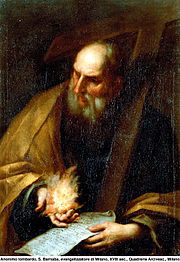
The name is borne by St. Barnabas, a companion of St. Paul who was instrumental in converting gentiles to the new Christian faith. St. Barnabas was believed to be a Cypriot Jew whose true name was Joseph but he is referred to as Barnabas in Acts 4:36, which describes the name to mean “son of consolation,” possibly being linked with the Aramaic בר נחמה, bar neḥmā of the same meaning. Many linguists contradict this meaning and claim that the latter part of the name might actually be derived from the Hebrew nabī נביא meaning “prophet.”

St. Barnabas is considered an early apostle and the founder of the Christian Church in Cyprus who was eventually stoned to death by an angry mob in Syria. He is considered the patron saint of Cyprus and his feast day is June 11th.

As a given-name, Barnaby has been the preferred form in England since medieval times. Its usage spread to the rest of the English-speaking world through colonialism. It spawned the diminutive off-shoot of Barney, which has been used as an independent given-name in its own right.

To millennials, Barney is often associated with the beloved purple dinosaur of their childhood. However, he appeared in the U.S. Top 1000 between 1880-1976. Never a huge hit, the highest he ever ranked in the U.S. Charts was #201 in 1887. He hasn’t been seen in the charts since 1976, but in England & Wales he currently ranks in as the #492nd Most Popular Males Name (2018).

Barnaby is currently the 251st Most Popular Male Name in England & Wales (2018). Whereas Barnabás is currently the 32nd Most Popular Male Name in Hungary (2018).


Other forms include:

  • Barnabana برنابا (Arabic, Persian)
  • Barnabas Բառնաբաս ബർണബാസ് (Armenian, Coptic, Dutch, English, Finnish, Frisian, German, Greek, Icelandic, Latvian, Lithuanian, Malayalam, Scandinavian, Syriac, Welsh)
  • Bernaba (Basque)
  • Varnáva Варна́ва (Bulgarian)
  • Bernabé (Catalan, Portuguese, Spanish)
  • Barnaba ბარნაბა (Croatian, Georgian, Italian, Polish, Romanian, Slovenian)
  • Barnabáš (Czech/Slovak)
  • Barnaby (English, Plattdeutsch)
  • Barnabé (French)
  • Balló (Hungarian)
  • Barna (Hungarian)
  • Barnabás (Hungarian)
  • Barnabà (Lombard)
  • Varnava Варнава (Macedonian, Serbian, Russian, Ukrainian)

An obscure Spanish feminine form is Bernabea.

Sources