Mishael, Misael

Simeone Solomone, Shadrach, Meshach, Abednego
  • Origin: Biblical Hebrew מישאל
  • Meaning: debated
  • Gender: Masculine
  • Transcriptions: ሚሳኤል (Amharic), Ⲙⲓⲥⲁⲏⲗ (Coptic), Μισαήλ (Greek)
  • ENG: mih-SHILE, mih-SHALE; Heb: (MEE-SHAH-yel); Sp: (mee-SAH-yel)

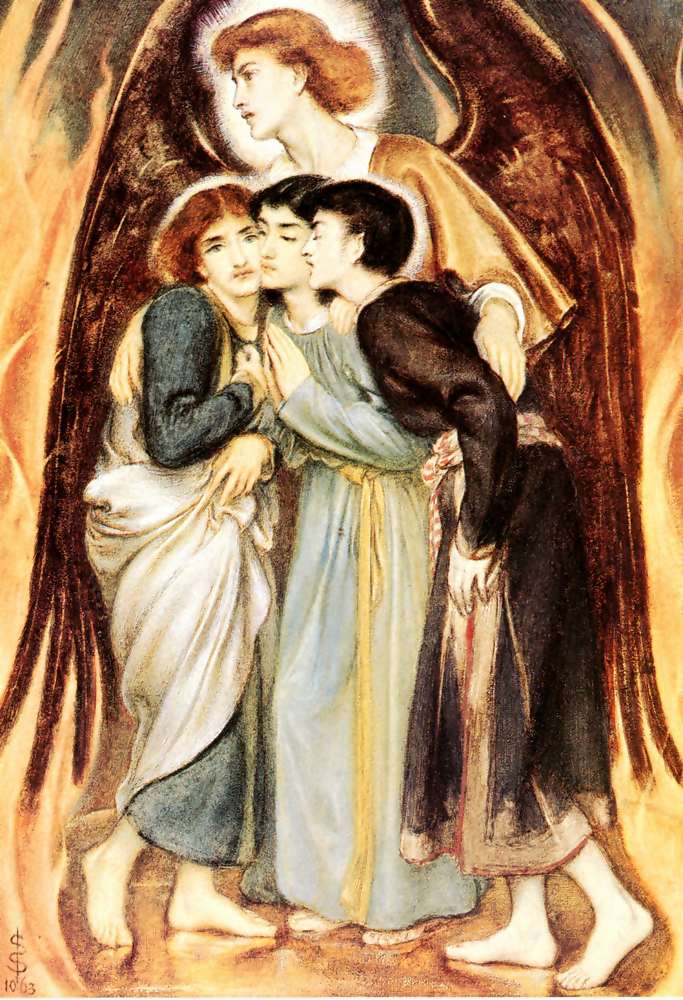
The name comes from the Hebrew meaning, “who is like God?; who is equal to God?,” “who is asked for?” and according to Hitchcock Bible names, “lent.” The name is borne by three male characters in the Bible, one mentioned in (Exodus 6:22) as one of the sons of Uzziel, the uncle of Moses and Aaron and most notably, it is the Hebrew name of Meshach (Dan. 1:11, 19) one of the three youths who refused to worship idols and were thrown in a furnace but miraculously survived.

Misael currently ranks in as the 192nd most popular male name in Mexico (2021) and the 790th most popular male name in the United States (2022).

In the Coptic Church, it is borne by St. Misael the Anchorite (7th-century CE).

Its feminine version of Mishaela is a pop song by Israeli pop singer, Achinoam Nini and has experienced sporadic usage in Israel and the English-speaking world. It is also the name of a character in Shining Force Gaiden: Final Conflict.

Other forms/Usage

Male

  • Misael (Amharic, Coptic, Greek, Portuguese, Spanish)
  • Misiel ܡܝܣܝܝܠ (Assyrian – Neo Aramaic)
  • Misayyl ميصائيل (Egyptian-Arabic, used by Copts)
  • Misaël (French)
  • Mischaël (German)
  • Misaele (Italian)
  • Miszael (Polish)
  • Misail Мисаи́л, Mizael Мизаел (Ukrainian, Russian)

An Italian short form is Misa.

Sources

Rasha

Photo by Marian Florinel Condruz on Pexels.com
  • Origin: Arabic رشا
  • Meaning: “young gazelle.”
  • Gender: feminine
  • Pronunciation: reh-SHA

The name comes directly from the Arabic word رشا meaning “young gazelle.”

The stress is on the second syllable.

Another transliteration is Reshaa.

Sources

Theodosia, Theodosius

Photo by Juliano Astc on Pexels.com
  • Origin: Greek
  • Meaning: “giving to God.”

Both come from the Greek, θεός (theos) meaning “god” and δόσις (dosis) meaning “giving.” Both the male and female form were borne by several Christian saints and Medieval rulers. In the English-speaking world, a notable bearer was Theodosia Alston Burr (1783-1813), the daughter of Aaron Burr and an American socialite who mysteriously disappeared in a ship-wreck. Her fate has been a source of speculation for two centuries, but she most likely died in the wreck. She is also the subject of the Broadway opera song from Hamilton, My Theodosia.

It’s female version has experienced usage in the English-speaking world since the 15th-century. It has spun off several diminutive off-shoots, which later became independent names, such as Docie/Dosey, Doshie, Dosha, Docia and Theda.

Theodosia appeared in the U.S. Top 1000 Most Popular Female Names between 1880-1895, it peaked at number #547 in 1880. It’s offshoot of Doshie appeared in the U.S. Top 1000 between 1880-1905 and peaked at #640 in 1884 whereas Doshia peaked at #582 in 1881 and Docia at #317 in 1880.

Theda (THEE-dah) was the name of silent film actress, Theda Bara (born Theodosia Burr Goodman, 1885-1955). Theda appeared in the U.S. Top 1000 between 1880-1948 and peaked at #350 in 1916. Theda Bara may have helped sustain the usage of the name in the United States, but it seems to have been common enough long before she graced the silver screen.

In the 1988 movie For Keeps, starring Molly Ringwald, a teen couple are faced with an unexpected pregnancy, in which they name their daughter Theodosia, short form Thea, it is a last minute decision decided by the father who gets the name from his deceased grandmother of the same name.

It is the name of the main character of the R. L. LaFevers 2007 children’s novel, Theodosia and the Serpents of Chaos, which spun off a tv series.

Its pronunciation in the English-speaking world fluctuates depending on the region and personal preference, from THEE-oh-DOH-see-uh, to THEE-oh-DOH-shuh and THEE-oh-DOH-zhuh, the sky’s the limits.

Its masculine form has always been prevalent in eastern Christian countries but did not pick up the same momentum in the English-speaking world as its feminine counterpart did.

Female forms

  • Tayodosiya ታዮዶሲዮስ (Amharic)
  • Thudusya ثيودوسيا (Arabic, used by Arab Christians)
  • T’eodosia Թեոդոսիա (Armenian)
  • Teodosija ТеодосиЯ (Bulgarian, Latvian, Lithuanian)
  • Teodosia თეოდოსია (Catalan, Corsican, Georgian, Italian, Portuguese, Romanian, Sardinian, Sicilian, Spanish)
  • Theodosia Θεοδοσια ⲑⲉⲟⲇⲟⲥⲓⲁ.(Coptic, English, German, Greek, Latin, Nordic, Romansch)
  • Teodozija Теодосија (Croatian, Macedonian, Serbian, Slovene)
  • Docia, Dosha, Doshia (English)
  • Docie, Docey (English)
  • Dosia (English, Polish)
  • Theda (English)
  • Théodosie (French)
  • Teodózia (Hungarian)
  • Teodosja (Maltese)
  • Teodozja (Polish)
  • Teodósia (Portuguese)
  • Feodosija Феодосия (Russian, Ukrainian)
  • Teudosia (Sicilian)

Male Forms

  • Teodosi (Albanian, Catalan)
  • Tayodosiyos ታዮዶሲዮስ (Amharic)
  • Thudusyus ثيودوسيوس (Arabic, used by Arab Christians)
  • T’eodosios Թեոդոսիոս (Armenian)
  • Teodosij Теодосий (Bulgarian)
  • Theodosios Θεοδόσιος ⲑⲉⲟⲇⲟⲥⲓⲟⲥ (Coptic, Greek)
  • Teodosiu (Corsican, Romanian, Sardinian)
  • Teodozije Теодосије (Croatian, Macedonian, Serbian, Slovene)
  • Theodosius (English, German, Latin, Nordic)
  • Théodose (French)
  • Theodósziosz (Hungarian)
  • Teodosio (Italian, Spanish)
  • Teodosijs (Latvian)
  • Teodosijus (Lithuanian)
  • Teodosju (Maltese)
  • Teodozy, Teodozjusz (Polish)
  • Teodósio (Portuguese)
  • Theodosi (Romansch)
  • Teodosie (Romanian)
  • Feodosij Феодосий (Russian, Ukrainian)
  • Teudosiu (Sicilian)
  • Teodóz (Slovak)

Sources

Potamiana, Butamina

Photo by Ismael Abdal Naby studio on Pexels.com
  • Origin: Egyptian/Coptic ⲡⲟⲧⲁⲙⲓⲁⲛⲁ
  • Gender: feminine
  • Meaning: “from the lake; from the sea.”

Potamiana is a latinized form of the Demotic Tꜣ-pꜣ-ym, ultimately derived from the Coptic Tapiam ⲧⲁⲡⲓⲁⲙ meaning “of the sea; of the lake.” It later evolved into the Greek Taphomis Ταπιωμις, and further hellenized as Potamiana.

Butamina and Butamiyana بُوطَامِيانَا‎ are it’s Arabized forms.

The name was borne by a 3rd-century AD Egyptian saint who was martyred for her Christianity.

Her feast day is June 28th.

Other forms of the name include:

  • Butamina بوتاميانا, Butamiyana بوتاميانا (Arabic)
  • Pwtmyana ܦܘܛܡܝܢܐ (Aramaic)
  • Potamiana Ποταμιανή Потамиана (Croatian, Czech, English, German, Greek, Polish, Portuguese, Romanian, Russian, Spanish)
  • Potamienne, Potamène, Potamine (French)
  • Potamiaina, Potamiöna (German)
  • Potamaena, Potamiaena (Late Latin)
  • Potamiena (Italian, Spanish)
  • Potamina (Italian)
  • Potamijana Потамијана (Serbian)
  • Potamiyana Потаміана (Ukrainian)

Sources

Awwal, Oula

Photo by Pixabay on Pexels.com
  • Origin: Arabic
  • Meaning: “first; foremost.”
  • masc (AHW-wahl); fem (OO-lah)

Awwal أوّل is an Arabic male name which comes directly from the Arabic word القائمة (first, foremost). It’s feminine form is Oula أولى. A unisex form is Awwalan أَوَّلاَن which is derived from the plural form of awwal.

In Islam, al-Awwal is one of the many names of God.

Sources

Ayman, Yamina, Yumna

Photo by Skylar Kang on Pexels.com
  • Origin: Arabic
  • Meaning: “right.”
  • masc. (I-mun); fem (yah-MEE-nah); YOOM-na

Ayman is derived from the Arabic word يمين (yamin) meaning “right,” referring to the right hand. The word is ultimately derived from a Semitic root ي م ن (right). The Arabic root word is y-m-n (ي-م-ن), which can mean “right hand,” “right side,” “favor,” “blessing,” “prosperity,” “ease,” or “success.” It shares the same root as the Hebrew מִין (yamin) meaning, “right hand; south,” which forms a basis of the name Benjamin. The country of Yemen also gets its name from the same root word.

The name was borne by a companion of the Prophet Mohammed, known as Ayman Ibn Abayd.

Ayman is a traditional male name in the Arabic-speaking world, but has been commonly used on females in Pakistan, possibly in reference to the kunya of Umm Ayman (meaning “mother of Ayman”, the mother of Ayman Ibn Abayd, or perhaps due to it sounding more feminine in the Urdu language.

Its traditional Arabic feminine form is Yamina يمينة which is a popular female name in Maghrebi countries but is used in other predominate Islamic countries. Another feminine form is Yumna يُمْنَى, which is currently the 983rd most popular female name in the United States (2021).

A more unusual feminine form is Yumnaat يُمْنَات.

Ayamin أَيامِن which is a plural form يمين (yamin) is occasionally used as a unisex name.

Ayman currently ranks as the 96th most popular male name in Catalonia, Spain (2021).

Its current rankings in other countries are as follows:

  • #407 (England & Wales, 2021).
  • #477 (France)

Its Turkish form of Eymen is the 5th most popular male name in Turkey (2021). In the Netherlands it ranks in at #344 (2022) and in France at #440 (2021).

Another transliteration of Ayman is Aiman.

Other forms include:

  • Ejmen (Albanian)
  • Yaman, Yamin يمين (Arabic)
  • Yumn يُمْن (Arabic)
  • Ayman (Arabic, Azeri, Urdu)
  • Aiman আইমান Әймән (Bengali, Kazakh, Tatar)
  • Ajman (Bosnian)
  • Aymon Аймон (Tajik)
  • Eymen (Turkish)

Feminine forms include:

  • Jamina (Albanian, Bosnian)

Sources

Azraq, Zaraq, Zarqaa

Photo by cottonbro studio on Pexels.com
  • Origin: Arabic زرقاء
  • Meaning: “blue”
  • (uz-ROCK); (zuh-ROCK); (zar-KA)
  • Usage: Arabic-Speaking countries, India and Pakistani among Muslim communities

Azraq أَزْرَق is from the masculine Arabic noun from the word for blue. The name has occasional use in Arabic-speaking North Africa and the Levant.

It’s feminine form of Zarqaa زرقاء is the Arabic feminine version of the word for blue زرقاء. It is transliterated as Zerqa or Zerka in Maghrebi Arab countries. Zerka can also be the Bosnian or Albanian form. This name has occasional use across the Islamic world.

Zaraq زرق is an Arabic unisex name derived from the neuter Arabic noun meaning “greenish-blue,” roughly translating to the color of turquoise (not the gemstone which in Arabic is Fairuz فيروز). Zaraq is mainly used as a masculine name in Southeast Asian countries such as Pakistan and India, but is considered unisex in the Arabic-Speaking world.

All three names derive from the Arabic root word z-r-q (ز-ر-ق), which means “blue.”

Other transliterations of the feminine form are Zurqa and Zurqa.’

Sources

Hatan, Hattan

Photo by Jill Burrow on Pexels.com
  • Origin: Arabic هتان
  • Meaning: “downpour, rain.”
  • Gender: masculine

The name comes directly from the Arabic weather term هتان (hattan) meaning “downpour; rain.” It is commonly used in Arab Gulf countries.

Sources

Sadime, Sadeem

  • Origin: Arabic سديم
  • Meaning: “nebula; fog; mist.”
  • Gender: female

The name comes directly from the Arabic word سديم meaning “nebula, fog; mist.” The word itself is from the Arabic root s-d-m, which means “darkness” “obscurity.”

The word use is found in Arabic poetry to describe a mist or haze that obscures the view.

sources

Faaria, Faria, Farya

  • Origin: Arabic فارعة
  • Meaning: “lofty; tall; towering; slender; slim; beautiful; handsome; pretty.”
  • Gender: feminine
  • Pronunciation: Arabic: fah-REE…AH; Urdu: FAR-yah

The name is derived from the Arabic word فَارِع (fari) which can mean “tall; lofty” and also “slim; slender” as well as “beautiful; handsome; pretty.” It is derived from the Arabic verbal root ف ر ع (f-r-‘) meaning, “to ascend.” The same root shares is also related فَرْع‎ (farʿ), meaning “tree branch; hair; mountain top; upper part,” which is why some websites list it as meaning, “beautiful hair.”

Sources