Heka, Hik

  • Origin: Ancient Egyptian
  • Meaning: “magic.”
  • Coptic: ϩⲓⲕ
  • Gender: Male

The Ancient Egyptian word and name Heka (transliterated ḥkꜣ, later Hkȝ) literally means “magic,” “sorcery,” or “divine power.” It derives from the root ḥk — “to work magic” — and the ending ꜣ (the Egyptian aleph) which functions as a nominal element.

In Egyptian cosmology, heka was not mere illusion or trickery, but a primordial creative force — the divine energy that allowed both gods and humans to act, heal, and give life. The term is thus best understood as “creative power made manifest,” and shares a root with the Ancient Egyptian ka, roughly translating to “soul.”

Heka was also deified as a god embodying magic itself. He appears as a male deity in Old Kingdom Pyramid Texts (c. 2500 BCE) and remained important through the Greco-Roman period.

In theology, Heka was said to have existed before all other gods — the power through which even the creator gods shaped the universe. The Coffin Texts describe him as:

“I am Heka, the magic, the child of Atum… before the gods came into being, I was.”

In later periods, he was depicted as a man holding two entwined serpents, sometimes accompanying deities such as Khnum and Neith, and invoked by priests and physicians in medical papyri. His power was integral to Egyptian medicine and ritual; magic (heka) was considered a sacred technology given by the gods for healing and protection.

The Coptic form is Hik, it is not used as a name among contemporary Copts but may make an interesting revival.

It is speculated that Hecate’s name and cult may have its roots in the Ancient Egyptian god.

Sources

Ptolomy

  • Origin: Greek Πτολεμαῖος
  • Meaning: “aggressive, warlike.”
  • Gender: Male
  • Eng (PTAHL-e-mee, TAHL-e-mee)

Derived from the ancient Greek male name Πτολεμαῖος (Ptolemaios), which in turn comes from πτόλεμος (ptólemos), meaning “war” or “battle.”

The word ptólemos is an older Aeolic dialectal form of πόλεμος (pólemos), the standard Classical Greek word for “war,” sharing the same root with the English word, “polemic.”

Ptolemy I Soter (367–283 BCE) was a general of Alexander the Great and later became Pharaoh of Egypt, founding the Ptolemaic Dynasty (323–30 BCE). This dynasty ruled Egypt for nearly three centuries and ended with Cleopatra VII, the most famous bearer of the family’s legacy.

Claudius Ptolemaeus (Ptolemy) (2nd century CE) was the famed Greek astronomer, mathematician, and geographer of Alexandria, whose Almagest shaped Western astronomy for over a millennium.

According to the Book of 1 Maccabees (135/4 BC), Ptolemy of Jericho betrayed his father-in-law, Simon the High Priest, by murdering him and his two sons while they slept as guests under his roof. This act of treachery is used in Dante Alighieri’s The Inferno, in which the ninth circle of Hell is called Ptolomea after him, a frozen realm reserved for those who betray their guests.

Ptolomy is also the name of an early Christian saint.

In the English-speaking world, Ptolomy has been used on and off since the 18th-century. It appeared in the U.K’s top 500 boys’ names in 2004, ranking in at #906.

A modern bearer is American author, Ptolemy Tompkins. Celebrity couple Gretchen Mol and Tod Williams bestowed this on their son in 2007.

Common English short forms include: Tollie, Tolly, and Tal.

International Variations

  • Butlimus بطليموس (Arabic)
  • Ptghomeos Պտղոմեոս (Armenian)
  • Ptaljemej Пталемей (Belarusian)
  • Ptolemej Птолемей (Bulgarian, Croatian, Serbian, Ukrainian)
  • Ptolemeu, Tolomeu (Catalan)
  • Ptolomeos ⲡⲧⲟⲗⲉⲙⲉⲟⲥ (Coptic)
  • Ptolemy (Another English form)
  • Ptolémée (French)
  • Tolomaes (Gaelic)
  • Ptolomeu (Galician, Occitanian, Romanian)
  • Ptolemäus (German)
  • Ptolemaiosz (Hungarian)
  • Ptólmæos (Icelandic)
  • Tolomeo (Italian, Spanish)
  • Tolommeo (Italian)
  • Ptolomaeus (Latin)
  • Ptolemajs (Latvian)
  • Ptolemėjus (Lithuanian)
  • Ptolomey, Ptolomej Птолемей (Macedonian, Russian)
  • Tolomé (Piedmontese)
  • Ptolomeusz (Polish)
  • Ptolomeu (Portuguese)
  • Ptolemæus (Scandinavian)
  • Ptolomaidh (Scottish-Gaelic)
  • Tulumeu (Sicilian)
  • Ptolomaj (Slovenian)
  • Ptolemeo, Ptolomeo (Spanish)
  • Batlamyus (Turkish)

Female forms include the sensual Ptolemaïs (Πτολεμαΐς) and the Italian, Tolomea.

Sources

Nefertari

  • Origin: Ancient Egyptian
  • Meaning: “the most beautiful one; the beautiful one has come.”
  • Gender: Female
  • Eng pron: (NEF-er-TAH-ree)

The name comes from the Ancient Egyptian elements, nfrt-jrj. The first element nfrt means “beautiful,” the second element jry means, “the one who is near.”

Nefertari was most famously borne by Queen Nefertari Meritmut, the beloved Great Royal Wife of Pharaoh Ramses II (19th Dynasty, 13th century BCE). Her elaborate tomb in the Valley of the Queens is among the best-preserved monuments of the New Kingdom.

After the Ptolemaic and Roman periods, Egyptian high culture became heavily Hellenized. Names like Cleopatra, Arsinoe, and Berenike (Greek) dominated the elite. With the rise of Christianity and later Islam, names shifted almost entirely to Biblical (Greek, Hebrew, Latin) Arabic. As a result, “Nefertari” remained locked in the Pharaonic past, only rediscovered in the 19th century by archaeologists.

In the 1980s, the name started to be used sporadically by African Americans. In 2024, at least 3 baby girls in the U.K were bestowed this ancient gem as a given-name.

In Coptic, this name would be rendered as ⲛⲉⲫⲣⲧⲁⲣⲓ (Nephrtari). In modern Egyptian Arabic, it is نفرتاري (Nifirtārī).

This may be due for a comeback, especially if you are of Egyptian descent.

Sources

Osiris

Photo by Fatiha Hassan on Pexels.com
  • Origin: Ancient Egyptian
  • Meaning: unknown
  • Gender: masculine
  • Ὄσιρις (Greek) ⲟⲩⲥⲓⲣⲓ (Coptic – Bohiric)

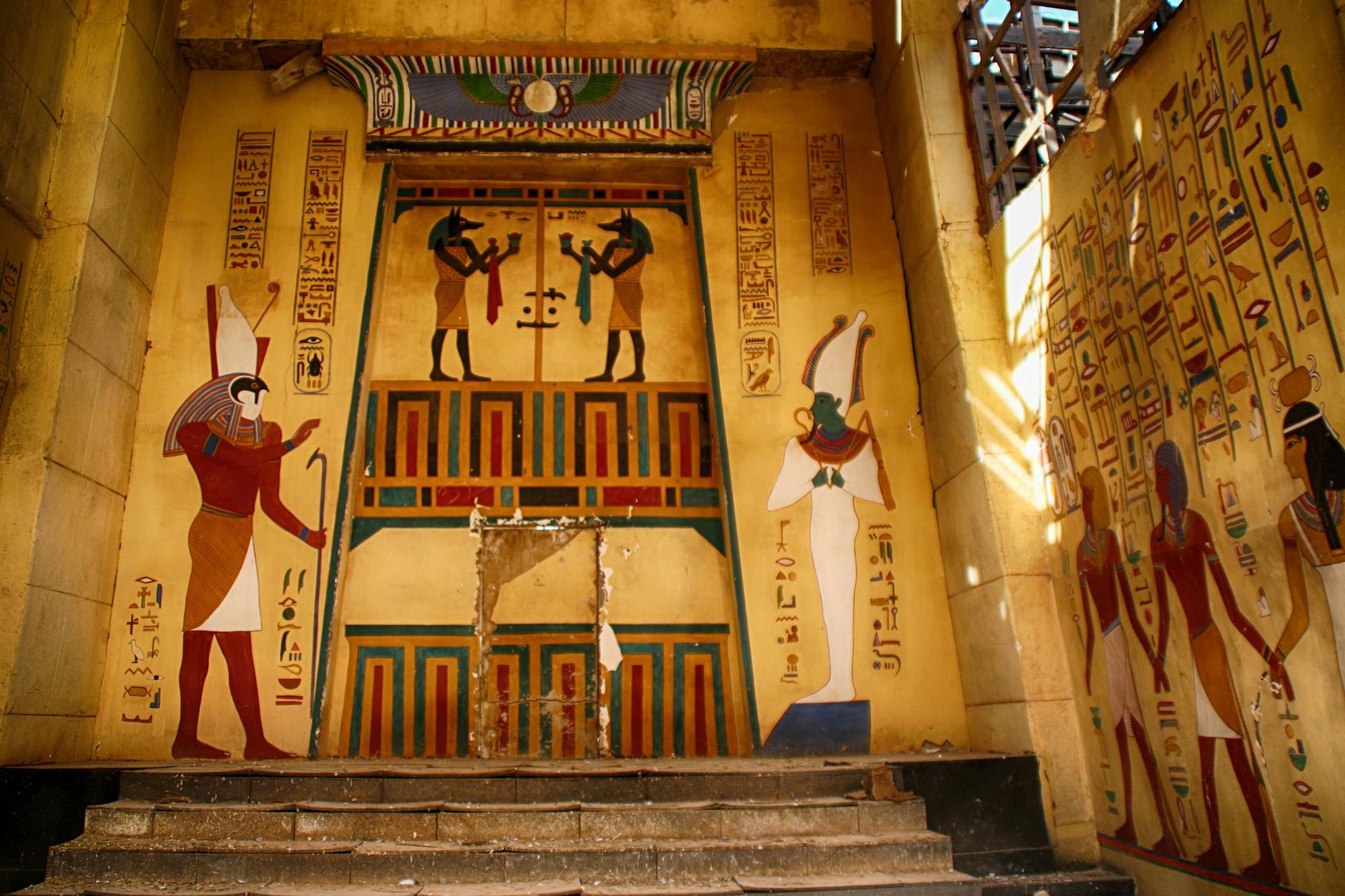
From the name of the Ancient Egyptian God of the dead, the afterlife and resurrection, its exact etymology is unknown and debated amongst Egyptologists. The most popular theories is that it either derives from the wsr (the mighty one) or jrt (eye). It is often vocalized as Asar, Ausar, Ausir, Wesir, modern Coptic forms are Usir and Usire. Among Copts, it is sometimes Arabized as Uzair, which has a similar sound, but different etymology. However, it has been suggested by linguists that the two names are actually related.

In the United States, it recently entered the U.S. Top 1000 Male Names, it is currently the 976th most popular male names.

Other forms include:

  • Osir ⲟⲥⲓⲣ (Coptic)
  • Osiride, Osiri (Italian)

Sources

Potamiana, Butamina

Photo by Ismael Abdal Naby studio on Pexels.com
  • Origin: Egyptian/Coptic ⲡⲟⲧⲁⲙⲓⲁⲛⲁ
  • Gender: feminine
  • Meaning: “from the lake; from the sea.”

Potamiana is a latinized form of the Demotic Tꜣ-pꜣ-ym, ultimately derived from the Coptic Tapiam ⲧⲁⲡⲓⲁⲙ meaning “of the sea; of the lake.” It later evolved into the Greek Taphomis Ταπιωμις, and further hellenized as Potamiana.

Butamina and Butamiyana بُوطَامِيانَا‎ are it’s Arabized forms.

The name was borne by a 3rd-century AD Egyptian saint who was martyred for her Christianity.

Her feast day is June 28th.

Other forms of the name include:

  • Butamina بوتاميانا, Butamiyana بوتاميانا (Arabic)
  • Pwtmyana ܦܘܛܡܝܢܐ (Aramaic)
  • Potamiana Ποταμιανή Потамиана (Croatian, Czech, English, German, Greek, Polish, Portuguese, Romanian, Russian, Spanish)
  • Potamienne, Potamène, Potamine (French)
  • Potamiaina, Potamiöna (German)
  • Potamaena, Potamiaena (Late Latin)
  • Potamiena (Italian, Spanish)
  • Potamina (Italian)
  • Potamijana Потамијана (Serbian)
  • Potamiyana Потаміана (Ukrainian)

Sources

Menas, Minas, Mina

  • Arabic مينا;
  • Armenian Մինաս
  • Coptic ⲙⲏⲛⲁ
  • Ge’ez ሜናስ
  • Greek Μηνᾶς

Menas is a popular male name among Eastern Christians, it is of uncertain meaning, it may derive from the Greek μήνη (mene) meaning, “moon,” or the ancient Egyptian Menes, which is the name of a 3rd-century BCE Egyptian pharaoh, in which case, the name derives from the ancient Egyptian, mnj (he who endures). It may also be related to the ancient Egyptian divinity name, Min, which is of uncertain meaning. However, according to Coptic tradition, the name means “amen.”

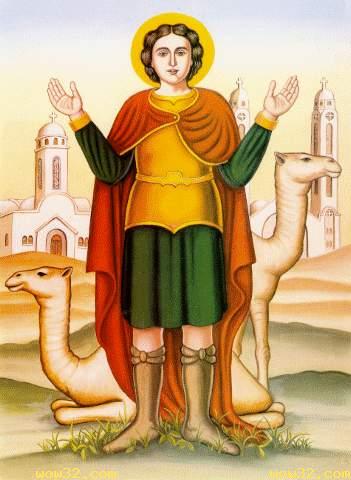
It is the name of a popular 2nd-century Coptic saint and martyr, known as Ⲁⲃⲃⲁ Ⲙⲏⲛⲁ (Abba Mina). According to legend, St. Menas’ parents were devout Christians who were having a hard time having children. His mother prayed to the Virgin Mary for a child, and she heard a response saying “amen,” this is where the name Menas supposedly derives from. It is speculated by some that the Western St. Christopher and the Eastern St. Menas are one and the same person. It is also borne by an Ethiopian saint of the 6th-century (CE) and a 16th-century CE Ethiopian emperor.

It was the name of 1st-century CE Roman admiral who features in Shakespeares, Antony & Cleopatra.

Other forms of the name include:

  • Minasə ሚናስ (Amharic)
  • Mina مينا; Мина ⲙⲏⲛⲁ Ми́на Міна (Arabic, Bulgarian, Coptic, Romanian, Russian, Ukrainian)
  • Minas Մինաս Μηνάς (Armenian, Greek)
  • Menna (Catalan)
  • Ménas (French)
  • Menas (German, Latin, Polish, Portuguese, Spanish)
  • Ménász, Mennasz, Mínász (Hungarian)
  • Mena (Italian)

Sources

Aya, Ayah, Aija, Aja

download (4)


Pronounced I-yah, this name has several different origins and meanings.

Aya is a popular Japanese female name, depending on the kanji used, it has several different meanings, the most popular being 彩 (aya) meaning “colour,” or 綾 (aya) meaning “design.” In the Japanese case, it is also occasionally used on males. Other meanings and kanji characters used to represent the name include:

  • 綾, “twill”
  • 理, “truth, logic”
  • 亜矢, “Asia, arrow”
  • 亜弥, “Asia, all the more”
  • 亜夜, “Asia, night”
  • 順, “order, sequence, turn”
  • 文, “writings”
  • 紗, “gauze”
  • 技, “technique”
  • 愛, “love”
  • 恵, “blessed”
  • 朱, “vermillion”
  • 藻, “algae”
  • 娃夜, “beautiful night”

It was borne by an Ancient Egyptian queen of the Thirteenth Dynasty (between 1803 and 1649 BCE). Its meaning and etymology in this case is unknown.

Aya is also an Akan name, denoting a girl born on a Thursday. Its masculine form being Yao.

In Hebrew, Aya is an acronym for ארץ ישראל היפה (the beautiful land of Israel) and allegedly from  איה, איא meaning “bird” or “to fly swiftly.” It is borne by a minor male character in the Bible but seems to exclusively be used on females in modern Israel. There is a famous Israeli pop-singer who bears this name, Aya Korem.

Ayah آية is Arabic meaning “sign; clue” and refers to Quranic verses. It is also sometimes transliterated as Aya or Aja among Bosnians, Albanian and Central Asians. Another variation is Ayat, sometimes spelled Ayaat.

In Akkadian, the name means dawn and was borne by an ancient Sumerian goddess, the consort of Shamesh. The name is still used among Assyrian Christians who trace their heritage back to the Akkadian peoples.

In Tamil, spelled ஆயா, it means “old woman,” “grandmother,” or ” caretaker” and in the Nepalese language of Raute it means “sister-in-law.”

In Scandinavia, Aija, Aja & Aya are offshoots of Maria, they started off as diminutive forms but are now used as independent names. Aya is currently the 22nd Most Popular Female Name in Denmark (2018). However, I am unable to determine if in this case, it is used by Muslim families in reference to the Arabic form or if it is used by non-Muslim families in reference to its Scandinavian form. Aija can also be a Finnish form of Eija, which is from an exclamation eijaa!

In Latvia, Aija is most likely derived from aijāt (to rock, to lull) and was popularized as a given-name at the turn of the 20th-Century when it was used by Latvian author Jānis Jaunsudrabiņš for the title character in his eponymous novel, Aija (1911).

Aja is a Bosnian, Albanian & Central Asian form of the Arabic, Ayah.

In Mongolian, it is derived from ая (aya), meaning “melody.”

In Europe, Aya appears on several popularity charts, most likely used in reference to its Arabic origins by Muslim immigrants, its rankings in other countries are as follows:

  • #46 (France, 2018)
  • #48 (Belgium, 2018)
  • #65 (Catalonia, Spain, 2018)
  • #95 (Spain, 2018)
  • #122 (Netherlands, 2018)
  • #184 (Italy, 2018)
  • #309 (Ayah, England & Wales, 2018)
  • #317 (England & Wales 2018)
  • #749 (United States, 2018)

Sources

Pakhom, Pacôme

Gender: Masculine
Origin: Ancient Egyptian
Meaning: “he-falcon.”
Fre (PAH-kome)

The name is composed of the ancient Egyptian elements, pa (he) and akhom (falcon).

The name was later hellenized to Pachomius and franconized to Pacôme.

The name is borne by a major Coptic Christian saint (circ.3rd-century C.E), who is also revered in the Roman Catholic and Eastern Orthodox Churches. Pakhom is credited for being the founder of Coptic Monasticism.

As of 2009, its French form of Pacôme was the 412th most popular male name in France.

Other forms of the name include:

  • Bakhoum باخوم (Arabic/Assyrian/Lebanese/Syrian)
  • Pacomi (Catalan)
  • Pacumi (Catalan)
  • Pakhom (Coptic)
  • Pacôme (French)
  • Pachôme (French)
  • Pakhomios Παχώμιος (Greek)
  • Pacomio (Italian/Spanish)
  • Pachomiusz (Polish)
  • Pacômio (Portuguese-Brazilian)
  • Pacómio (Portuguese-European)
  • Pahomie (Romanian)
  • Pahomij Пахомий (Russian/Slovene)
  • Pahomije (Serbian)
  • Paho (Slovene)
  • Paxomij Пахомій (Ukrainian)
The name was also borne by a 15th-century Serbian hagiographer and two patriarchs of Constantinople.
Pachomius is also the name of a genus of spider.

Seth

The name is found in the Old Testament, the Book of Mormon, the Qu’ran and in ancient Egyptian mythology, though the later may have a completely different etymology.

In both the Bible and the Qu’ran it is borne by the son of Adam and Eve, who was borne after the murder of Abel and the banishment of Cain. In this case, it may be derived from the Hebrew (syt) meaning “plant; seed” or it may be from another Hebrew source meaning “appointed.”

In the Book of Mormon, it is borne by the son of Lehi a Jaredite.

In Egyptian mythology it is the name of the god of chaos, the desert, foreigners and of the planet Mars. In this case, the etymology is uncertain.

Currently, Seth is the 165th most popular male name in the United States (2010) and the 217th most popular in the Netherlands, (2010).

Other forms of its Biblical counterpart include:

  • Shith  شيث‎ (Arabic)
  • Şeys (Azeri)
  • Set Сэт (Belarusian/Finnish/German/Italian/Russian/Scandinavian/Spanish)
  • Sif Сіф (Belarusian)
  • Šit (Bosnian)
  • Šet (Croatian/Czech/Serbian)
  • Seth Σηθ (Dutch/English/Greek/French/Plattdeutsch/Polish)
  • Sett (Estonian)
  • Shet  שֵׁת (Hebrew)
  • Séth (Hungarian)
  • Szet (Polish)
  • Sete (Portuguese)
  • Šét (Slovak)
Other forms of the Egyptian include:
  • Set (Ancient Egyptian/Coptic)
  • Setekh (Ancient Egyptian)
  • Setesh (Ancient Egyptian)
  • Sutekh (Ancient Egyptian)
  • Suty (Ancient Egyptian)
The name is borne by actor and comedian Seth Green (b.1974)
Sources