Aradhana

  • Origin: Sanskrit
  • Hindi: आराधना
  • Meaning: “worship; adoration.”
  • Gender: feminine
  • Pronunciation: depending on the dialect (uh-RAH-de-nah; uh-RAHD-na)

The name comes directly from the Sanskrit word आराधन meaning “worship, adoration.”

Sources

Asvika, Ashvika

  • Origin: Sanskrit अश्विका
  • Meaning: “little mare; drawn by horses; equestrian”
  • Gender: feminine
  • AHSH-vee-ka

The name comes from the Sanskrit अश्विका (azvika) meaning, “little mare; drawn by horses” or “equestrian.”

Sources

Nirav

  • Origin: Sanskrit नीरव
  • Spelling: Gujurati નીરવ, Marathi नीरव
  • Meaning: “calm; silent.”
  • Gender: masculine
  • (NEE-rav)

The name is derived from the Sanskrit नीरव (nirava), meaning, “calm; silent; noiseless.”

Another transliteration is Neerav.

Sources

Megha

  • Origin: Sanskrit मेघ, Hindi मेघपुंज
  • Meaning: “cloud.”
  • Gender: feminine
  • MAY-gah

The name comes directly from the Sanskrit word for “cloud.”

It is also the name of a raga in the Hindustani classical music tradition.

Sources

Dhruv, Dhruva

Vishnu appears before Dhruva – A painting by Raja Ravi Varma.
  • Origin: Sanskrit
  • Meaning: “constant, immovable, fixed; polar star.”
  • Gender: masculine
  • Pronunciation: DROOV; DROO-vah

The name is derived from the Sanskrit word dhruva, meaning, “constant; immovable, fixed” and is also synonymous with the polar star.

Dhruva appears in the Hindu text, Vishnu Parana as the name of the son of Uttānapāda’s second and less favored wife. Dhruva wants to sit on his father’s lap like his older brother, but is thrown off as he is the son of a second wife. Dhruva is heartbroken and is consoled by his mother to contemplate his fate in life and advises him to work hard for what he wants. Dhruva goes into the woods and prays to Vishnu, who eventually transform him into the polar star.

Other forms include:

  • Druwa (Indonesian/Javanese)

Dhruv entered the U.S. Top 1000 Male Names in 2019 and ranks in at #997

Sources

Opal

800px-Opal_from_Yowah,_Queensland,_Australia_2Gender: Feminine
Origin: English
(OH-pul)

The name comes directly from the name of the gemstone. October is the birthstone for the Opal. The origins of the word itself are derived from the Sanskrit word upala meaning “jewel.” The name does not appear in the U.S top 1000, and the highest it ever ranked in American naming history was back in 1911, coming in at # 81.

The Opal was often seen as a source of bad luck in modern superstition, this was most likely due to a book published in 1820, entitled Anne of Geierstein by Walter Scott, the novel recounts the story of the Baroness of Arnheim who wears a magical opal talisman, when holy water is poured on the stone, the stone turns into its signature opaque white and the baroness dies. In the Middle Ages, the stone had far more auspicious connotations, it was believed that the stone brought great luck, since it sparkled several different colours, it was believed to hold the powers of every precious stone, making it a very powerful amulet.

The name is borne by Opal Whitely (1897-1992), a curious woman who wrote a diary in which she reveals her true origins as the scion of French royalty. The story is a famous part of American unsolved mysteries and she has had people debunking her as a fraud to admiring fans who support her claims known as Opalites.

With the rising popularity of the name Ruby, this might make an appealing alternative. There is the French form Opaline.

Tola

autumn_d2ofFzMkZ601

The name can either be a Polish diminutive form of Antonina, a Sanskrit name meaning “balance” or a Khmer name meaning “October.” Coincidentally, spelled Tóla, it is an Irish male name meaning “flood” or “abundance” and is the name of a Saint, also known as Tolanus or Thola.

Wanda

Gender: Feminine
Origin: Polish
Pol (VAHN-dah); Eng (WAHN-duh).

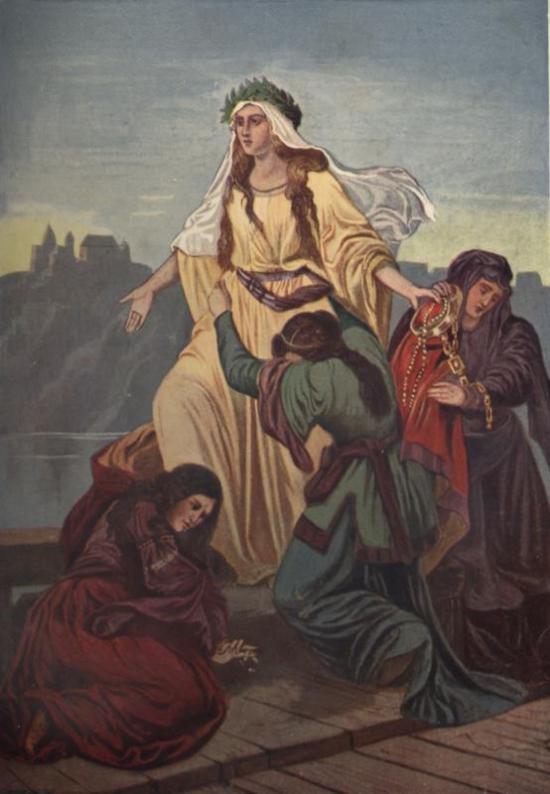
The name first appeared in a legend presented by Polish historian, Wincenty Kadlubek (12-13th century). In his version of the legend, Wanda was the daughter of a Polish king Krak, (founder of the city of Krakow), who inherited her father’s throne. An evil German prince wanted to marry her and take over the Polish lands, but the princess repelled him and drove him to suicide. The prince threw himself into the Vistula. Wanda went on to live a happy and long life, remaining a virgin and vowing to be married only to her country. The most famous account, however, is completely different. In the most beloved form of the tale, rather than have her country taken over by the German invaders, Wanda threw herself into the Vistula. In Poland, she is a symbol of the nation, representing the sacrifice and hardship of the nation of Poland throughout its history. She is a symbol of Polish independence and its victory over German imperialism.

Tradition has it that she is buried in one of the seven mounds of Krakow. Till this day, the Wanda Mound (Kopiec Wanda) rests on the outskirts of Krakow, (in what is now known as the suburb of Nowa Huta).

Wanda is probably one of the very few Polish names that became popular in the English speaking world. It was introduced via author Ouida who used it for heroine in the novel Wanda (1888). The name no longer ranks in the U.S. top 1000, but was once a fairly popular name, coming in at # 47 in 1934, the highest the name ever ranked in U.S. naming history.

Many sources list the name as being a derivative of the Ancient Germanic wend, a name for a group of people who lived near and around the Vistula, however, some Lithuanian sources have argued that it is derived from an ancient Baltic element vanduo meaning “water” while many others speculate that its true origins have been lost and that its true introduction into the world was through Kadlubek.

In Poland, a popular nickname option is Wadzia (VAHD-jah). An alternative is the Czech/Slovak, Italian and Lithuanian, Vanda. There is also the elaborated Swedish name Wendela, though it is speculated if she is truly related to Wanda or if  in fact she is a completely different name of Germanic origins. The name has experienced occasional usage in Germany, Spain, Brazil, Hungary and Russia.

Coincidentally, Vanda is the name of species of orchid indigenous to the Indian subcontinent and Indochina. In this case, Vanda is of Sanskrit origins.