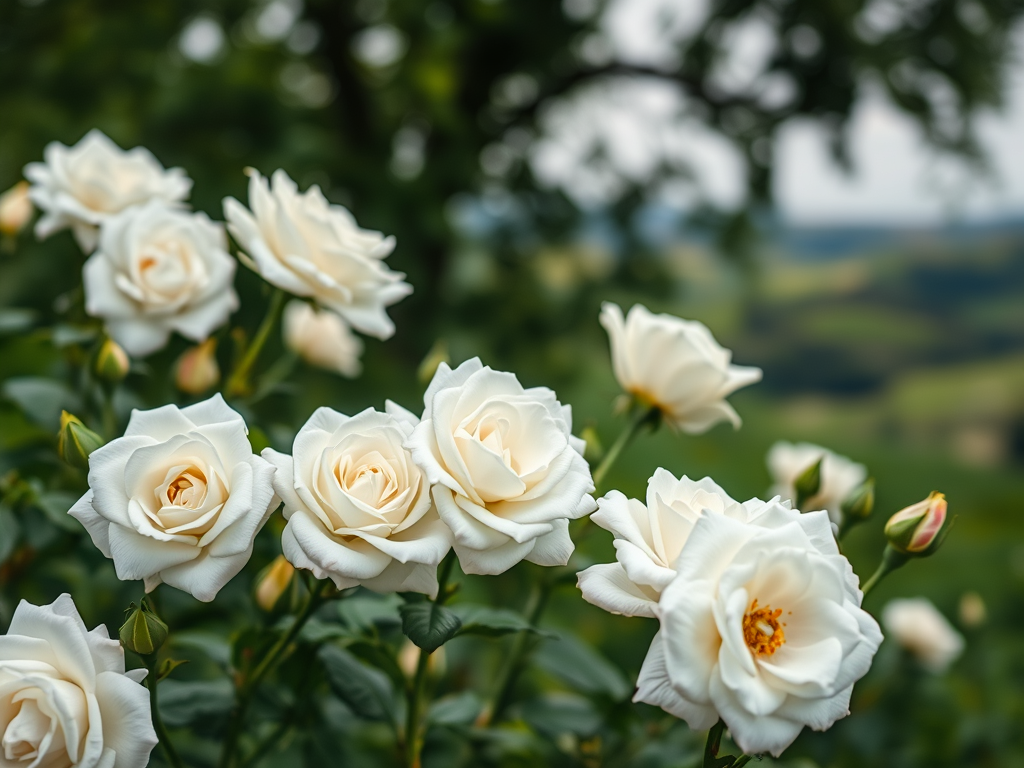
- Origin: Welsh
- Meaning: “white rose.”
- Gender: Female
- Pronunciation
The name is composed of the Welsh words, rhos (rose) and gwyn (white; blessed). As a given-name, it first came into use in the mid 19th-century.
Sources
The name is composed of the Welsh words, rhos (rose) and gwyn (white; blessed). As a given-name, it first came into use in the mid 19th-century.
Sources

Gender: Feminine
Origin: German
Meaning: debated
Germ: (hroze-VEET-tah; rōs-vē’tä); Eng (rahz-WITH-uh)
She feels a bit rosy and a bit vintage, once a popular German name now, now considered rather dated in its home country, it may make an appealing choice for American parents looking for a rose themed name, but want something that has more oomph, so to say. Though it has a rosy element, the name in actuality has no relation etymologically to the flower. The meaning is debated, the first part of the name Ros could be a derivative of the old Germanic element hros meaning “horse”, or the old Germanic hrod meaning “fame” and the second element being a derivative of swinþ meaning “strength”. According to Wikipedia as well as to the Catholic Encyclopedia, Roswitha of Gandersheim, attested that her name was Saxon for “strong voice; ” or “mighty voice.” Though a pleasant meaning, I could not find any evidence, (and not saying that its wrong), to back this up. Roswitha of Gandersheim was a Benedictine abbess, (935-1003), who was considered to be the first female poetess and playwright since Antiquity. Though originally a Saxon noblewoman, she wrote mostly in Latin. Her most pieces centered mostly around religious piety in the style of Greek tragedy, one of her most famous pieces was about Emperor Otto I. Till this day, the town from which she hailed from, Bad Gandershaim, is proud to call her their own, and since 1973, has awarded an annual prize called the Roswitha Prize to outstanding female writers. The name appears in older documents in such forms as Hrosvit, Hrotsvitha, and Hrotsvit. Possible nickname option for the parents who dare uses this is Rosie, Rose, Ros, Vita or Vitty. Roswitha of Gandershaim’s feast day is September 5th.

Gender: Feminine
Origin: Czech/Slovak
Meaning: “rose.”
(roo-ZHEH-nah)
The name is composed of the Czech/Slovak ruza meaning rose and the feminine suffix of –ena attached. Its usage is primarily in the Czech Republic and Slovakia. Its designated name day is August 30.
 Gender: Feminine
Origin: French
Meaning: “rose festival.”
(ROZE-uh-LEE-uh); (ROZE-uh-LEE)
Rosalie Cullen is described as an utterly beautiful yet cold creature. She is the more stand-offish of the Cullen bunch. If you don’t know what I am talking about, I am referring to a character in the popular Stephanie Meyer books, Twilight.
For a character that was supposedly born at the turn of the century, Ms. Meyer certainly named her character well, since Rosalie has not been in the top 1000 names since 1988, coming in at a mere # 942 when it was last seen. In fact, the highest the name ever reached was # 66 back in 1938!
If Rosalie Cullen doesn’t hold enough supernatural appeal for you, then you might want to look into the history of this rare little gem, as the name has enough gothic and romantic charm behind it to fit a beautiful vampire.
It is assumed that the name is just an elaboration of the name Rose, but in actuality, it comes directly from the name of an ancient Roman and Greek festival, the rosalia. Known to the Greeks as the Anthesteria, the celebrations usually took place around the 11th to 13th of January or February. It was basically the celebration of the maturing of the wine stored in previous years. During the festival, the vintages were opened, representing the beginning of Spring. Likewise, on these days, slaves and masters reversed their roles, it was the one and only festival where slaves were allowed to participate. It was also a day that celebrated the expulsion of the lost wondering souls of the dead. It had many similar aspects to Hallow e’en and Mardi Gras. Though a popular festival, the name was never used as a human moniker till perhaps the Middle Ages.
As a give name, it seems to have first appeared around the 1600s after the bones of a mysterious hermit saint were found in a cave in Sicily.
Known affectionately in Sicily as La Santuzza, (the Little Saint), all that is known of St. Rosalie is that she and her family were of noble blood and were French-Norman immigrants who had settled in the city of Palermo.
St. Rosalie chose to live a life as a hermit, and tucked herself away in a cave till she died.
Legend has it that she was lead to the cave by angels. On the cave wall, she wrote, “I, Rosalia, daughter of Sinibald, Lord of the Roses, and Quisquina, have taken the resolution to live in this cave for the love of my lord, Jesus Christ.” (http://en.wikipedia.org/wiki/Saint_Rosalia).
In the 1600s, Palermo had been struck by the plague, and, according to legend, the saint appeared to a hunter dying from the pestilence. She led him to the cave where her bones were found. Rosalia then instructed the hunter to transport her bones back to Palermo and to have them carried in a procession throughout the city. The hunter did what she asked and supposedly, the hunter, and the city, were cured of the plague. Since then, St. Rosalie is honoured as the patron saint of Palermo, and each July 15, a huge festival is held in her honour to commemorate the event.
Known as the festino, it is still a big holiday in Sicily, and even throughout the United States, the same festival is celebrated by Italian Americans, only it has been switched to honour Our Lady of Mt. Carmel, while St. Rosalie’s feast is held off till the beginning of September.
Another interesting side note is that St. Rosalie is also designated as the patron saint of evolutionary studies, due to the fact that a scientist by the name of G.E. Hutchinson conducted a study of a pool by the saint’s cave where he observed water boatmen.
The name was never really used in the English speaking world till the influx of Italian immigrants to the United States at the turn of the century.
In 2006 French popularity lists, Rosalie came in at # 342.
Currently, in Slovenia, its contracted form of Zala is the 8th most popular female name, (2008).
Other forms of the name include:
An Italian masculine form is Rosalio.
Gender: Female
Origin: Greek
Meaning “rose.”
(RO-dee); (ROH-dah)
The name of a sea nymph and also possibly an ancient primordial sea goddess, according to Greek mythology, Rhode was one of the oldest of the Oceanid nymphs and was said to be the daughter of Poseidon/Oceanus and Tethys. She is sometimes claimed to be the daughter of Halia and Poseidon, Amphitrite and Poseidon or the daughter of Aphrodite.
It is even suggested by some scholars that Rhode, Halia and Amphitrite might have been one and the same sea goddess who was later replaced by the Olympic pantheon and relegated to a sea nymph.
Rhode’s cult was especially popular on the Isle of Rhodes where it was believed she was the wife of the sun-god, Helios and one and the same with the goddess Athena. She was the mother of the Curetes of Crete. It is also suggested that the Island of Rhodes gets its names from her.
There is also the more modern Biblical form of Rhoda, (RO-dah).
In the New Testament it was the name of a maid who lived in the house of Mary, mother of John Mark. In the English speaking world, Rhoda came into usage in the 17th century, she has not ranked in the U.S. Top 1000 since 1975 when she came in at # 777. The highest she ever ranked in U.S. naming history was # 159 in 1881. In the 1970s Rhoda was the name of a character in the popular sitcom of the same name.