Callirhoë

Gender: Female
Origin: Greek
Meaning: “beautifully flowing.”
Καλλιρρόη
(KAL-lih-ROW-ee)

    Callirhoe, the sister of Castalia, was a naiad nymph who lived in a fountain in the town of Acarnarnia. She was the daughter of a minor river god, Achelaeus, and wife to the argive prophet, Alcmeon.

    Callirhoe talked her husband into stealing the peplus and necklace of the goddess Harmonia. Alcmeon was struck down by the goddess’ guards after he was caught stealing.

    To avenge his death, Callirhoe, pleaded with Zeus to induce her infant sons to be transformed into men so that they might avenge their father’s death, which Zeus granted.

    The name is also the scientific designation for the Prairie Poppy Mallow.

    Other forms of the name include:

    • Callirrhoé/Callirhoé (French)
    • Kalirojė (Lithuanian)

    Nicknames include: Cal, Callie, and Roe.

    Pontus

    Gender: Male
    Origin: Greek
    Meaning: “sea.”
    Πόντος
    (PAHNtus)

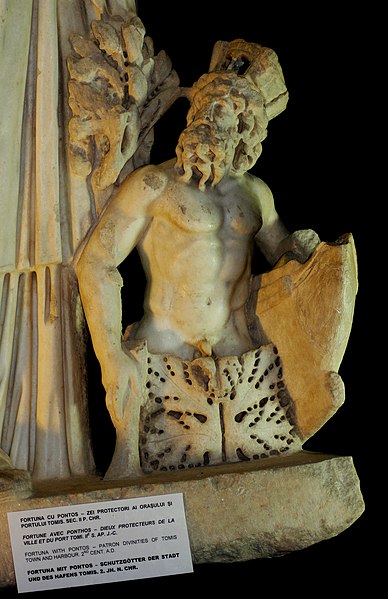
    The name is borne in Greek mythology by a pre-Olympian god of the sea. His mother was Gaia, who conceived Pontus without sex. He is the father of Nereus, Phorcys, and Ceto, and with his consort Thalassa, he fathered the fish and the crustaceans.

    The name is derived from the Greek pontos, meaning “sea.”

    In the classical era, he was superseded by the god Poseidon.

    It is also the name of a former Greek kingdom which was situated on coasts of the black sea, in what is now Turkey.

    The name has recently become extremely popular in Sweden, it recently came in at # 76 in the 2007 top 100 names in Sweden.

    Another form is Pontos.

    Other forms include:

    • Pont (Croatian/Slovene: rare)
    • Pontosz (Hungarian: rare)
    • Pontas (Lithuanian)
    • Ponto (Spanish/Italian/Portuguese: rare)

    Actaea

    Gender: Feminine
    Origin: Greek
    Meaning: “sea shore.”
    Ἀκταία
    (ahk-TAY-ah)

      In Greek mythology, the name is borne by both a Nereid, (known as the Nereid of the sea shore) and is also borne by a Danaid, a daughter of Danaus and Pereia. She became the wife of Periphas.

      It is also the name of a flower.

      Another form is the Lithuanian Aktaja.

      Carya

      Gender: Female
      Origin Greek
      Meaning: “hazelnut.”
      (KAR-yuh)

      In Greek mythology, this was the name of another girl who was transformed into a tree, (in this case a hazelnut tree), to avoid rape by Apollo.

      It is believed that the origins of the figure may have actually been a pre-classical nature goddess who presided over nut trees. The name was later used as an epithet for the goddess Artemis.

      Artemis Caryatis is sometimes believed to have gotten this epithet from the town of Karyai, still others contend that Artemis Caryatis was just a merger between the goddess Artemis, and the Carya of the nut-tree myth.

      Excavations in Greece have found open air communes that were used for the caryatids, or the priestesses of Carya. The caryatids were used to represent the columns which support the marble porches of the pantheon in Athens.

      Oźwiena

      Gender: Female
      Origin: Old Slavonic
      (oshe-VYEH-nah).

      The name is borne in Slavic mythology by a minor goddess who was similar to the Greek, Echo.

      Her role in the pantheon was connected to human communication and the divulgation of discourse and action. She was seen as the goddess of gossip, who was unable to keep secrets or private conversation. If she disliked someone, she would distort the meaning of their words.

      She was also the goddess of fame and glory, the one responsible for retelling the deeds of fallen heroes.

      The name is not in usage in any of the Slavonic countries. The above form is Polish. Other forms are:

      • Ozvěna (Czech)
      • Ozvena (Slovakian)

      Narcissus

      Gender: Male
      Origin: Greek
      Meaning: “sleep; numbness.”
      (nar-SIS-sus)

      The name is found in Greek mythology as that of the name of a young boy who thought himself so beautiful that he could not stop staring at his own reflection, until he eventually died.

      The name is also borne by several early Greek saints. The word “narcissim,” is derived from the story of Narcissus.

      • Narcís (Catalan)
      • Narcis (Croatian/Romanian/Serbian/Slovak/Slovene)
      • Narcissus (English/Latin/Dutch)
      • Narcisse (French)
      • Narziss (German/Lexbergerish)
      • Narkissos Ναρκισσος (Greek)
      • Narkisszosz (Hungarian)
      • Narciso (Italian/Spanish/Portuguese)
      • Narcisio (Italian)
      • Narcizas (Lithuanian)
      • Narcyz (Polish)

      Feminine forms are:

      • Nergiz (Azeri: also the Azeri word for daffodil)
      • Narcisa (Italian/Spanish/Portuguese)
      • Narcissa (Latin)
      • Narges نرگس (Persian: also the modern Farsi word for daffodil)
      • Nergis (Turkish: also the modern Turkish word for daffodil)

      Dryope

      Gender: Female
      Origin: Greek
      Meaning: “tree face; tree voice.”
      Eng (DRY-uh-PEE).
      Δρυόπη

      In Greek mythology the name is borne by the daughter of King Dryops. She was a shepherdess who had become a close companion of wood land nymphs.

      According to one legend, while Dryope was dancing in the meadows among the nymphs, she caught the attention of Apollo, who transformed himself into a tortoise in order to get close to her. The nymphs found the animal and made it into a pet. They brought it to Dryope to play with. When Dryope had placed the tortoise on her lap, it changed into a serpent, scaring the nymphs away. Apollo then raped Dryope who became pregnant with Amphissus.

      Amphissus later became a local king and built a temple in honor of Apollo, and Dryope was whisked away into the woods by the nymphs, where she herself became a nymph.

      In her place, a poplar tree and a spring appeared. Amphissus dedicated a shrine to the nymphs and his mother, a place where women were forbidden to enter.

      According to Ovid’s account, Dryope was craddling her newborn son Amphissus, by a lake, when she noticed a lotus tree. The lotus tree was the nymph Lotis, in disguise, who was trying to hide from the advances of Priapus.

      Dryope picked a flower from the tree, but when she did, the tree started to tremble and bleed. The blood of the tree made Dryope glued to the spot, and she gradually started to turn into a poplar tree. Just as the as the bark was about to entwine her neck, she called out to her husband, Andraemon, to warn him to care for her son and to never pick flowers.

      Other forms of the name include (NOTE: these forms exists but have not had a long history of usage):

      • Driope (Catalan/Italian)
      • Drüopé (Hungarian: phonetic spelling)
      • Dríope (Spanish/Portuguese: DREE-oh-pay)

      Daphne

      Gender: Female
      Origin: Greek
      Meaning: “laurel.”
      (DAF-nee).

        In Greek mythology, the name is borne by a nymph who transformed herself into a laurel tree rather than be overtaken by the sexual advances of the god, Apollo.

        In Greek religion,  the laurel became sacred to the god Apollo and the leaves were used to crown the victors of the Pythian Games.

        Daphne was the subject of Ovid’s Metamorphoses, which elaborated on the myth by claiming that Apollo’s lust was caused by an arrow shot by Eros. A quote from Ovid describing the transformation of Daphne, goes as follows:

        “a heavy numbness seized her limbs, thin bark closed over her breast, her hair turned into leaves, her arms into branches, her feet so swift a moment ago stuck fast in slow-growing roots, her face lost in the canopy. Only her shining beauty was left

        The virginity of Daphne was the subject of the Hellenistic poet, Parthenius, in the Erotica Pathemata. Throughout the centuries, Daphne, the nymph, has been the subject of artists. Other variations of the name include:

        • Dafna Дафне (Croatian/Serbian)
        • Dafné (Czech/Slovak: very rare)
        • Daphne (English/German/Dutch)
        • Daphné (French)
        • Daphne/Daphni Δὰφνη (Greek)
        • Daphnis (Greek: Ancient)
        • Dafne (Italian/Polish/Portuguese/Spanish/Turkish)
        • Dafnė (Lithuanian)
        • Dafni (Turkish)

        The name is borne by Daphne du Maurier (1907-1989) a famous British author and playwrite best known for such works as Rebecca and The Birds. Other notable Daphne’s include Daphne Blake of Scooby-Doo and Daphne Moon on the popular sitcom Frasier. It is also borne by actress Daphne Zuniga.

        The designated name-day in France is October 5.

        Asher

        Gender: Male
        Origin: Hebrew
        Meaning: “happy, blessed.”
        Eng (ASH-er); Heb (ah-SHAIR)

        The name is found in Genesis as the name of the son of Jacob and Zilpah. He was the founder of the tribe of Asher and had played a role in selling his brother, Joseph, into slavery. Asher had four sons and a daughter and had eventually settled in Canaan.

        The name, Asher is believed to come from the Hebrew, Osher meaning “happy,” or “blessing,” though some scholars have argued that the name is actually a male counterpart of the Assyrian, Asherah: said to mean “she who walks on the sea.” Others suggest that it could be a cognate of the Assyrian, male name, Ashur.

        Both Asherah and Ashur are related and were the names of an ancient Sumerian god and goddess, both of which I will go further into in another installment of Asherah in the near future.

        The name has always been popular among Jewish families. Ash is usually the prefered nickname. Due to the popularity of other Ash names such as Ashton, the name is increasing in popularity in the United States, currently he comes in at # 206 in the U.S. top 1000 and seems to be rising.

        Other forms include the

        • Aser (Biblical Greek/Latin/French/Spanish)
        • Asyer (Indonesian)
        • Anschell/ Anshel (Yiddish: diminutive forms)