Koknesis

  • Gender: Masculine
  • Origin: Latvian
  • Meaning: “cockney.”
  • (KOKE-neh-sis)

The name is derived from the Latvian word koknejs meaning “cockney.” The name appears in Latvian folklore as well as in a famous Latvian epic by the name of Lacplesis written by Andrejs Pumpurs (1851-1902). Koknesis is the sidekick to the legendary bear-slayer Lacplesis. In Latvia, its designated name day is September 14th. To read more about the story of Lacplesis, go here: http://www.balticsworldwide.com/news/features/bear_slayer.htm The name is not that common in Latvia, there was only one person with the name of Koknesis reported as of 2008.

Tyra, Týr


  • Gender: Feminine
  • Origin: Old Norse
  • Meaning: debated; theorized
  • Eng (TYE-ruh); Swe/Nor (TUEW-rah).

Surely you must think of the beautiful runway model, Tyra Banks, host of the Tyra Banks Show and America’s Next Top Model. When in Sweden or Norway, where the name is prevalent, an anglophone would not recognize the name by ear. Pronounced something like Teuw-rah, the name is actually of very ancient origins, a survivor of the original Indo-European language, Tyra is a feminine form of Tyr. Tyr itself, is a derivative of the ancient Germanic Tiwaz*.


In Norse Mythology, Tyr was the one handed god who got his hand bit off by the Fenrir wolf. He was revered as the god of single handed combat, victory, glory and honesty. According to the Icelandic Prose Eddas and the Poetic Eddas, he is either the son of Odin or Hymir. In the language of Old Norse, the word tyr was possibly synonymous with the word god, as tyr is found in many Norse poems and kennings as a poetic term for a god, referring either to Odin or Thor.
Scholars tend to believe that Tyr/Tiwas was a far more important god than he is portrayed in ancient Norse religion. Before the Migration Age, he was possibly the head of an Indo-European pantheon. In fact, it is suggested by archaeologists and anthropologists that his original name was*Dyeus. It is theorized that he later evolved into the Germanic Tiwas or Tyr, the Greek Zeus, and the Latin word for a god in general, Deus. Lingusts suggest that *Dyeus is related to a Pre-Indic root, deywos, which possibly means: “celestial being.” Even more fascinating is that the Sankrit word deva: “god” is closely related. After the varying Indo-European tribes separated and became more distinct from each other, Tiwas or Tyr became relegated in power under both Odin/Wodin and Thor. In other Germanic religions, he appears as Tiw, Tuisto, Teiws and Ziu. In the ancient Rune alphabet, the t-rune, named by modern scholars as the Tiwaz rune, is believed to have been associated with the above mentioned god. The rune looks very much like an arrow pointing upward.
He even survives in modern English lexicon. Our very own name of the week: Tuesday is from the Anglo-Saxon meaning “Tiu’s Day” Tiu being the Anglo-Saxon form of Tyr. The name also survives in many modern English, Swedish, Norwegian, Danish, German and Icelandic place names.

While Tyr has fallen out of usage, its feminine counterpart, Tyra, is still quite common in Sweden. She ranked in at # 43 in Sweden Top 100 Female Names of 2007. Meanwhile, in the States, despite the recognition of Tyra Banks, she was last seen in 2007, where she ranked in at a measly 939. As of last year of 2008, she completely fell out of the top 1000. In Sweden, the designated name day is September 12th.
So before you think of American Pop Culture when hearing the name Tyra, think twice, as the name actually has a primordial and colourful past.

Evanthe, Evanthia

Gender: Feminine
Origin: Greek
Meaning: “fair flower; good flower.”
Eng (eh-VAN-thee); Grk (ay-VAHN-thee-ah).

The name is derived from the Ancient Greek (Euanthe), which is composed of the elements ev meaning “good; fair” and anthos meaning “flower; blossom.”

In Greek mythology, Euanthe is the mother of Charites by Apollo.

In English literature, the name appears in one of John Fletcher’s novels A Wife for a Month as well as in Thomas Godfrey’s The Prince of Parthia.

Its modern Greek form of Evanthia, is still relatively popular. It is borne by a Greek Christian martyr, who was martyred, with her son in Rome, for proselytizing Christianity.

In Greece, the designated name day is September 11th.

Kaleva, Kalevi

Gender: Masculine
Origin: Estonian/Finnish
Meaning: unknown

According to Finnish myth and Folklore, Kaleva was the name of the ancestor of the Finns.

The Finnish epic Kalevala means “the land of Kaleva.”

Other forms include:

  • Kalev (Estonian)
  • Kalevi (Finnish)

To hear how Kalevi is pronounced go here: http://www.forvo.com/search/Kalevi/ Their designated name day is September 10.

Athene, Athena, Athina

Gender: Feminine
Origin: Greek
Meaning: debated
Αθηνα
Eng (uh-THEE-nah; uh-THEE-nee); Mod Grek (ah-THAY-nah; ah-THEE-nah).

The name is of debated origin, but is speculated to be composed of the elements ather meaning “sharp” and aine meaning “praise.” Others suggest that it is composed of pre-Greek elements, possibly constructed from the Lydian word ati meaning “mother” and combined with the name of a Hurrian goddess: Hannahanna or Ana. Plato himself claimed the name was derived from Atheonoa, a compound of the Greek theos meaning “the gods” and nous meaning “mind.”

In Greek mythology, the name is borne by the goddess of wisdom, reason, warfare and peace. She was also the patron goddess of the region of Attica and the city of Athens, which was named for her. I don’t believe I can do justice to the role Athena played for the ancient Greeks. But to be to the point, the Greeks so admired Athena that she appears as a recurrent figure in many Greek tragedies and epics. Athena was also the goddess of weaving and handicrafts. It is interesting to note, that unlike the other Greek goddesses, Athena remained a virgin, and was celebrated for her chastity. Though Greece no longer worships the ancient pantheon of Mt. Olympus, the names Athena and Athina still prevail in the small mediterranean country.

The name is borne by the grand-daughter of Greek shipping magnate, Aristotle Onassis, Athina Onassis Rousel (b. 1985).

In Greece, its designated name day is September 1st. Other interesting forms include: the Ancient Attic Athenaia and the Doric Athana.

Other modern forms include:

  • Atenea (Asturian/Spanish)
  • Afina (Azeri/Russian)
  • Atena (Catalan/Italian/Polish/Portuguese/Romanian/Serbo-Croatian/Slovene)
  • Athéna (Czech)
  • Athene (Danish/French/German)
  • Athéna/Athéné (French)
  • AÞena (Icelandic)
  • Atēna (Latvian)
  • Atėnė (Lithuanian)
  • Atene/Athene (Norwegian)
  • Aténa (Slovakian)


Hermione, Ermioni

Gender: Feminine
Origin: Greek
Ερμιόνη
Eng (/hərˈmaɪ.ɵniː/ hər-MYE-o-nee); mod Grk (air-MYOH-nee)

She probably reminds you of Hermione Granger, the character from J.K. Rowling’s Harry Potter series. The name is of ancient Greek origin and it is derived from the masculine name Hermes.

In Greek mythology, Hermione was the only daughter of Helen and Menelaus. The name is also found in the calender of Saints, Hermione of Ephesus was an early martyr, and as an interesting side note, the Hermione of Harry Potter is named for the saint and not for the maiden of Greek Legend.

Hermione of Sicily is a character featured in Shakespeare’s Play, A Winter’s Tale (1610).

The name, though quirky and a bit extravagent, seems to have been a common moniker in Britain prior to Harry Potter fame. It is borne by several British actresses, Hermione Baddeley (1906-1986), Hermione Cockburn (b.1973) Hermione Gulliford, Hermione Hannen (1913-1983) and Hermione Norris (b.1968). It is also borne by British painter, Hermione Hammond (1910-2005).

It is also the name of an Opera, based on the Hermione of Greek Mythology.

In modern Greece, the name is often transliterated as Ermioni and Ermione where its designated name day is September 4th. It is also the name of a town in the Peloponnese.

In Italy, Ermione is the prefered form.

Despite the charming associations with Harry Potter, the name has not ranked in the US top 1000. In Britain, it does not appear in their top 100, but I have seen many instances of babies with the middle name or even the first name of Hermione in the British birth announcements. Other forms Herminie and Hermia. To hear the way the name is pronounced in Italian, you can listen to it here: http://www.forvo.com/search/Ermione/

Other forms include:

  • Hermiona (Croatian/Czech/Serbian)
  • Hermioné (Czech/Hungarian)
  • Hermelien (Dutch: could also be a feminine form of Herman)
  • Hermine (German/Norwegian)
  • Hermione (French)
  • Ermione (Italian: air-MYOH-nay)
  • Hermiona (Lithuanian/Polish)
  • Ermion (Piedmontese)
  • Hermiuona (Saimogaitian)
  • Hermíone (Spanish/Portuguese)

Antigone, Antigoni

Gender: Feminine
Origin: Greek
Meaning: debated
Greek Pronunciation: http://www.forvo.com/search/Antigoni/
English: http://www.forvo.com/search/Antigone/

The name is a feature in Greek tragedy, and the story of Antigone’s origins are not too pretty.

Despite it’s rather unsavory connotations, the name is still a regular in Greece and Albania. The Greeks tend to favor the more modern form of Antigoni, while the Albanians like the elaborated version of Antigona.

The meaning of the name is debated. Some say it is composed of the elements anti meaning “against” or “opposed to” and gon meaning “corner, bend, angle.” Others argue that the second part is actually derived from gonē which refers to semen and signifies motherhood. So in either case, the name may mean “against the bend” or “against motherhood.”

Back to its associations:

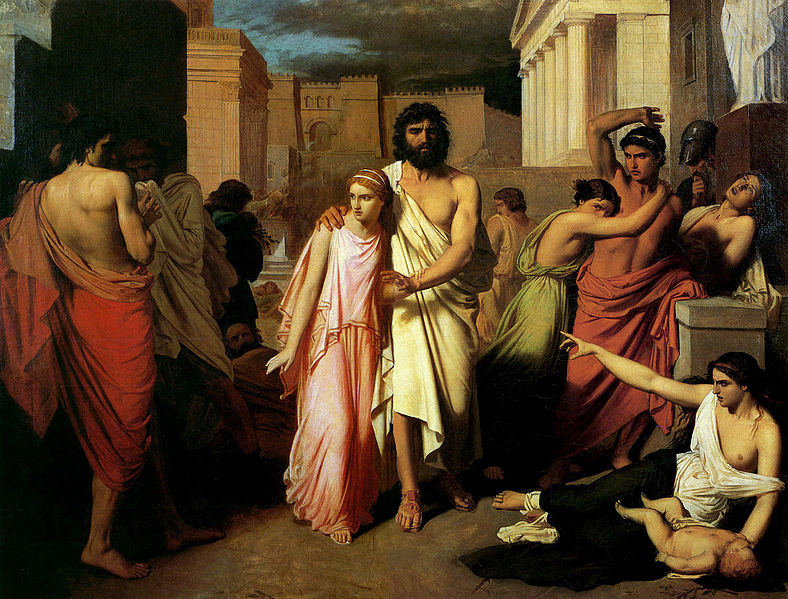
Antigone is the daughter of Oedipidus and Jocasta, she is the product of an incestuous relationship, Oedipidus accidentally married his biological mother.

Antigone is known for trying to secure a proper burial for her brother Polynieces even though he was a traitor to the small Greek city state, Thebes. She is the subject of many ancient classical Greek plays, the most widely known being the one written by Sophocles in 442 B.C.E.

It is also the name of a few other women in Greek Mythology.

Other forms of the name include: (Note: many of these forms are very rare in their home countries)

  • Antígona (Catalan/Galician/Portuguese/Spanish)
  • Antigoné (Hungarian)
  • Antygona (Polish)
  • Antigona (Romanian/Serbo-Croatian/Slovakian)


Alfhild, Alvilde

Gender: Feminine
Origin: Old Norse
Meaning: “elf battle.”

The name comes from the Old Norse elements alf meaning elf and hildr meaning “battle.” In Norse Mythology, it is the name of a beautiful maiden who was guarded by two deadly dragons. Any suitor who approached the dragons were instantly killed, except for King Alf. Alfhild ran away from Alf and disguised herself as a male warrior. Alf eventually found her while fighting her in battle, when he knocked her helmet off, he realized who it was. Alfhild eventually married Alf. Other forms include the Icelandic Alfhildr, the Danish Alvilda, and the Norwegian Alvilde.

Currently, Alvilde (ahl-VEEL-deh) comes in as the eleventh most popular female name in Norway. In Sweden, Alfhild’s designated name-day is September 3rd, but is very rare in Sweden.

Vidar

Gender: Masculine
Origin: Old Norse
Meaning: “forest warrior or; wide or large warrior.”
(VEE-dahr)

The name is derived from the Old Norse male name Víðarr, which is composed of the elements víðr which can either mean “forest” or “wide; large” and arr meaning “warrior.” In Norse Mythology the name is borne by the son of Odin and the giantess Grid. He is fated to avenge his father’s death at the time of Ragnarök (the end of the world in Norse Mythology). Odin is fated to die by being devoured by the wolf. Vidar appears in both the Poetic Edda and the Prose Edda and is also a subject featured on the carvings of the Gosforth Cross in England. Traditionally, it is believed that Vidar will kill the wolf by pulling his jaws apart. Ouch! After the great battle of Ragnarök is to pass, Vidar will survive and rule his own hall in the Viking netherworld, upon the remains of Asgard. He is said to don a powerfully made leather shoe, which will help him kill the wolf in the future. He is said to be extremely powerful. Other forms of the name include Vithar and Vitharr. The name is currently popular in Norway where it came in as the 9th most popular male name of 2008. Its designated name day in Sweden is August 31, while in Norway it is on December 29.

Medeinė

Gender: Feminine
Origin: Lithuanian
Meaning: “sapling.”
(meh-DAY-nay)

The name is an evolution of an ancient Baltic female name Medeina (meh-DAY-nah). Medeina was the name of the Baltic goddess of forests and hunting, derived from the element mede meaning “sapling” Medeina was somewhat akin to the Greek and Roman goddess Diana. Not much else is written about her, but she often included in modern Lithuanian symbolism. Her name is fairly popular in the small Baltic country. The designated name day in Lithuania is August 21st.