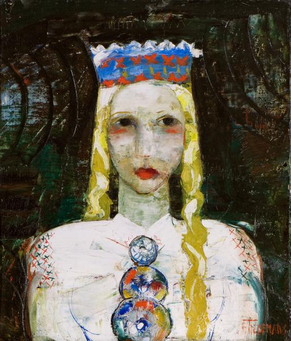
Vīksna

  • Origin: Latvian
  • Meaning: “elm tree.”
  • Gender: Female
  • Pronunciation: VEEKS-nah

A rare autumnal Latvian female name, it comes directly from the Latvian word for “elm tree.” It was recorded in use in the 16th-century but is now obsolete.

Source

Sārta

  • Gender: Feminine
  • Origin: Latvian
  • Meaning: “reddish; rosy; glowing; bonfire”
  • Pron: SAHR-tuh

From the Latvian adjective sārts, which has two closely related meanings, either “reddish, rosy, flushed with color” or “bonfire, blaze.”

An extremely rare traditional Latvian female name, it was first and only recorded in Zemgale (Dobele) in 1929, even though it had already appeared in the Latvian name calendar of 1879.
(Source: Kalnājiņa & Švābe, KS 285.)

A rare masculine form is Sārtis, documented only once in Riga in the 1930s.

Sārtone is another variation, which is also only been record one time in Latvia in the 1920s.

Sources

Brīva

  • Origin: Latvian
  • Meaning: “free; freedom.”
  • Gender: Female
  • BREE-vah

The name is derived from the Latvian words, brīvs (free) and brīvība (freedom). It is ultimately derived from the Middle Low German vri, vrie (free).

It was first recorded in Riga in 1931, during a period of strong national consciousness and cultural renewal in independent Latvia.

According to Latvian population records, as of 2008, there were only three women known by this name.

Another form is Brive and its designated name-day is November 18th.

Sources

Urdze

  • Origin: Latvian
  • Meaning: “brook, stream; to stir up, to move, to urge.”
  • Gender: Female

Urdze is a rare Latvian feminine given name derived from the noun urga, meaning “stream” or “brook,” and the verb urdzēt, meaning “to stir up, to move, or to urge.”

Urdze was added to the official Latvian name calendar in 1966 and was first recorded in Vidzeme (Valmiera district) in 1975. It remains exceptionally uncommon — as of 2008, records note only one bearer of the name in Latvia.

The designated name-day is November 17th.

Source

  • Pauls Balodis, Latviešu personvārdu etimoloģiskās semantikas teorētiskais modelis un tā realizācija (Rīga: Latvijas Universitāte, 2008), p. 312. Available via the University of Latvia Digital Repository

Ojārs

  • Origin: Latvian
  • Meaning: “rascal; mischievous; lively man.”
  • Gender: Male
  • (oh-YARHZ)

The name comes directly from the Latvian word meaning, “rascal, mischievous; lively man.” The word itself may be connected to the Old Polish ogier (stallion), or the Estonian oja (stream). The Polish ogier – stallion – rascal, seems more likely.

It likely came into use thanks to the Latvian eponymous short story, Ojārs (1892) by Ānsis Lerhis-Puškaitis. It was first recorded as a given-name in Riga in 1903, inducted into the Latvian name-day calendar in 1908, and started to experience relative popularity between the 1920s-1970s.

Notable bearers include, Latvian sculptor, Ojārs Arvīds Feldbergs (b. 1947); Latvian singer, Ojārs Grīnbergs (1942-2016); Latvian politician, Ojārs Ēriks Kalniņš (1949-2021); and Latvian author, Ojārs Vācietis (1933-1983).

The designated name-day is November 11th.

Source

  • Siliņš, Kārlis. Latviešu personvārdu vārdnīca. Rīga: Avots, 1990.

Daila, Daile

  • Origin: Latvian, Lithuanian, Estonian
  • Meaning: “beauty, grace, artistic refinement.”
  • Lithuanian form: Dailė
  • Gender: Female
  • Pron: DYE-lah; DYE-leh

Derived from the Latvian poetic word daile, meaning, “beauty, grace, or artistic refinement.”
The noun daile itself was standardized by linguist and writer Atis Kronvalds in 1868, who likely modeled it on Lithuanian dailė (“art, artistic creation”). Both words share the Baltic root dail-, conveying ideas of beauty, craftsmanship, and aesthetic harmony.

As a personal name, Daila and its variant Daile first appeared in Latvian name calendars in the late 19th century, but did not come into regular use until the 1920s, during the national revival when many symbolic native words were adopted as given names.

Regional and Linguistic Variants

  • Daile – an older or alternative Latvian form, also used in Estonia.
  • Dailė – Lithuanian form (still occasionally used).
  • Dailīte – rare Latvian diminutive (dye-LEE-teh).
  • Dailis – masculine form used in both Latvian and Lithuanian (DYE-lis).
  • Dailonis – rarer Latvian masculine variant (DYE-loh-nis).

The designated name-day for Daila is February 4th (Latvia); and December 3 for Daile (Latvia).

Sources

Zīle, Zīlīte

  • Origin: Latvian
  • Meaning: “acorn; titmouse; pupil of the eye.”
  • Gender: female
  • Pron: ZEE-leh; zee-LEE-teh

Zīle and Zīlīte are speculated to be ancient Latvian females names that survived Christianization.

Zīle is from the Latvian word for acorn or the name of a type of passerine bird known as the titmouse in English. It is first recorded in Riga as early as 1544 (1).

Zīlīte is also a Latvian word, derived from Zīle, with a diminutive suffix attached, also mean “titmouse” or “pupil.” Its usage is recorded as early as 1499 in Riga (2).

Sources

Zintis, Zinta

  • Origin: Latvian
  • Meaning: “witchcraft, wizardry, magic, charms”
  • Zintis (m); Zinta (f)

From the Latvian word, zinte, meaning, “witchcraft, wizardry, magic, charms.” As a female given-name, it was first recorded in 1922. Its designated name-day is April 6th.

The male form of Zintis came into use in 1940. Its designated name-day is January 7th.

Zintis itself is a Latvian slang term meaning “imp” or “devil.”

Its designated name-day in Latvia is April 6th.

Sources

Corinna

Gender: Feminine
Origin: Greek
Meaning: “little maiden.”
Germ/Eng (koh-RIN-nah); Grk (koh-REEN-nah)

The name is from the ancient Greek Κοριννα (Korinna) which is derived from the Greek, κορη (kore), meaning “maiden.” There is the diminutive sufix of -inna attached, so it more likely means “little maiden” “little girl.” The name is related to Cora, a name which I will go further into in a seperate entry.

The name was borne by a 5th-century BCE Greek poetess and it is the name of the title character in Ovid’s Amores. It is also the name of the title character in Robert Herrick’s 17th-century poem Corinna’s going a-Maying.

Its French form of Corinne was popularized via the eponymous novel by Madame de Staël (1807)

As of 2009, Korina was the 73rd most popular female name in Croatia. While its French form of Corinne ranked in as the 728th most popular female name in the United States, (2010).

The designated name-day in Germany is October 22. The Corinna form is also used in Italy.

Other forms of the name include:

  • Korilla (Boetian)
  • Corinna (Catalan/English/Italian)
  • Korina Корина (Croatian/Czech/Latvian/Greek/Serbian/Slovakian/Slovene)
  • Corine (Dutch/French: koh-REEN)
  • Korinna Коринна  (German/Greek/Hungarian/Russian)
  • Corinne (French:  koh-RIN)
  • Corina (German/Italian/Portuguese/Romanian/Romansch/Spanish)
  • Coranna (Italian)
  • Corilla (Italian)
  • Korynna (Polish)
  • Koryna (Polish/Lithuanian)

There is a modern Greek masculine form: Korinos and an Italian masculine version of Corinno.

Amir

Gender: Masculine
Origin: Arabic أمير Амир
Meaning: “prince; commander”
(uh-MEER)
The name is derived from the Arabic word for a prince, ruler, commander or admiral. In the Islamic world, it is used as an honorific title of nobility, office or someone of high eminence. The word itself is derived from the Arabic root amr meaning, “to command.”
The early Islamic caliphs used the title Amir al-Muninin meaning, “Commander of the Faithful”, a reference of their leadership over the adherants of the Islamic faith.
The title was assumed by other Islamic rulers, including sheiks and sultans throughout Central Asia all the way into Saudi Arabic.
The leader of a group of pilgrims to Mecca is often referred to as an amir.
It is used as a given name throughout the Islamic world.
As of 2010, Amir was the 20th most popular male name in Kazakhstan, (2010). His rankings in other other countries are as follows:
  • # 13 (Emir, Bosnia & Herzegovina, 2010)
  • # 28 (Emir, Turkey, 2010)
  • # 66 (Bosnia & Herzegovina, 2010)
  • # 155 (the Netherlands, 2010)
  • # 221 (France, 2009)
  • # 278 (United States, 2010)
Other forms of the name include:
  • Emir (Albanian/Bosnian/Turkish)
  • Əmir (Azeri)
  • Amirs (Latvian)
Feminine forms include, Emira (Albanian/Bosnian/Turkish) and Amira.
Amir can also be a Hebrew male אָמִיר name meaning, “tree top.”