Manoah

  • Origin: Biblical Hebrew מָנ֫וֹחַ
  • Meaning: “rest.”
  • Gender: Male

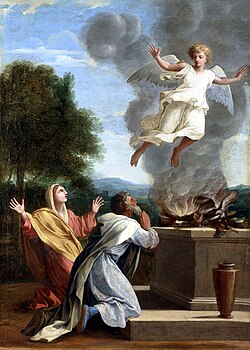
Manoah appears in Judges 13, described as a man from Zorah of the tribe of Dan. His wife is unnamed, but together they become the parents of Samson after an angelic visitation.

The name itself is derived from the Hebrew root נוּחַ (nuach) meaning “to rest, to settle, to repose, to be at ease.”

Between the 18th-century to early 20th-century, Manoah experienced some use in the U.S. and England. Common short forms were Manny, Menno and Noah.

In 2023, it appeared in the Netherlands charts for the most popular male names, though it did not rank in very high, coming in at #422.

International Variations

  • Manué (French)
  • Manoach (German)
  • Manoa (Spanish)

Sources

Kemuel

  • Origin: Biblical Hebrew קְמוּאֵל
  • Meaning: “God has raised; raised by God.”
  • Gender: Male
  • Diminutive: Kem.
  • Eng (KEM-yoo-el)

From the Biblical Hebrew קוּם qum (to rise) and אֵל  ‘el (God).

It is borne by at least three Biblical figures, including the nephew of Abraham in Genesis 22:21, a leader of the tribe of Ephraim in Numbers 34:24; and the ruler of the tribe of Levi in Book of Chronicles 27:17.

It was in use in 19th-century America among Protestant families with the short form of Kem.

A Dutch form is Kemuël.

Sources

Erez

  • Origin: Hebrew אֶרֶז
  • Meaning: “cedar.”
  • Gender: masculine
  • Pronunciation: ER-ehz

The name comes directly from the Hebrew word for the cedar tree אֶרֶז. This name did not come into use as a masculine given-name among Jews until after the creation of the State of Israel in 1945. It may have been popularized by Aleksander Zederbaum (1816-1893), a Polish-Jewish journalist who founded the Hebrew language newspaper, Ha-Melitz who often used “Erez” as a pseudonym in his writings.

It is also the name of a Kibbutz and of Erez Crossing, the latter being the name of a border crossing on the Israeli-Gaza border.

Sources

Katriel

  • Origin: Hebrew כתריאל
  • Meaning: “God is my crown.”
  • Gender: Masculine

The name is a Medieval Ashkenazi creation, composed of the Hebrew words keter (כֶּתֶר) “crown” and el (אֵל) “god.” It may have been a masculinized form of the popular Yiddish female name Kreindel (crown) or the Hebrew female name Atarah (crown).

  • Kadriel
  • Kasriel
  • Katsriel
  • Katzriel

There are the modern Israeli feminized forms of Katrielle, Katriella & Katriela.

A notable bearer was Israeli ambassador to the Soviet Union, Katriel Katz (1908-1988).

Sources

Bezalel

  • Origin: Hebrew בְּצַלְאֵל
  • Meaning: “in the shadow of God; under the protection of God.”
  • Gender: masculine
  • Pronunciation Eng: beh-ZAH-lel

The name is borne in Exodus 31:1-6 by the chief artisan assigned by Moses to build the Tabernacle, Ark of the Covenant, priests’ vestments and other equipment with the assistance of Aholiab. In Exodus 31:1, he is listed as the son of Uri.

The name itself is believed to share a similar etymological construction with the Akkadian male names ina-ṣilli-Bēl and ina-ṣilli-Nabu (in the shadow of Baal or Nabu).

The name has always been used in the Jewish diaspora in Europe and the Middle East. It was borne by the 16th-century Ottoman rabbi and talmudist Bezalel Ashkenazi, and it was the name of the father of the Maharal of Prague,(Judah Loew ben Bezalel circ. 17th-century).

The Bezalel Academy of Arts and Design & the Jewish art movement known as the Bezalel School both take their name from the character in the Bible.

Among Russian-Jews, Vasily would have been used as a Russified form, though the names do not share an etymological relationship.

Other forms include:

  • Bezaleël (Dutch)
  • Bezalel (English, German)
  • Béséléel (French)
  • Beseleel Βεσελεήλ (Greek)
  • Bezaleèl (Italian)
  • Becalel (Polish)
  • Besaliel (Portuguese)
  • Veseleíl Веселеи́л (Russian)
  • Becalél’, Becal’ї́l Бецале́ль, Бецал’ї́л (Ukrainian)

Sources

Cassiel

  • Origin: Hebrew פצִיאֵל
  • Meaning: “God is my cover; cover of God; speed of God.”
  • Gender: masculine
  • Pronunciation: Eng KAS-see-el

The name is derived from the Hebrew פצִיאֵל (Qaftzi’el), which is likely to mean “cover of God” or “God is my cover.” Other sources claim this name means “speed of God.” According to Judeo-Christian apocrypha, Cassiel is one of the 7 archangels. In the Hekhalot Rabbati, he is the one of the guardians of the doors of the 7th Heaven. In the Sefer Raziel, he is described as the Prince of Saturn, while in the Zohar, he is credited as being one of the aides of the Archangel Gabriel. He is also mentioned in the rabbinic literature of the Kabbalah. In Christian literature, he is mentioned in the grimoire known as The Sworn Book of Honorius as well as in Peter Abano’s Heptameron. He is mentioned in a Byzantine text regarding exorcism. He also appears as an archangel in mystic Islamic literature under the name كسفيائيل‎, Kasfiyāʼil.

Cassiel was traditionally believed to not have much input on the things that occur in the world of man, he was also considered the angel who presided over the death of kings as well as the angel of tears and the angel of temperance. His days are sometimes Thursday or Friday.

As a given-name, it has only come into occasional use the last century. It may have become even more widespread after its use in the Wim Wender 1987 film, Wings of Desire.

I could not find any strong evidence that this name has ever been used as a given-name among Jews or Muslims, though I don’t believe it is considered a forbidden name in either religion, more likely, the obscurity of the angel in the general populace of both religions has left the name obsolete.

Other forms include: Cafziel, Kafziel, Caphziel,Captiel, Cassael, Castiel, Qaspiel, Qephetzial, & Quaphsiel.

Forms in other languages include:

  • Kasfiyāʼil كسفيائيل‎, (Arabic)
  • Cassiël (Dutch)
  • Cassiel (English, French, German, Portuguese, Spanish)
  • Qaftzi’el קפציאל‎ (Hebrew)

Feminine forms include: Kasiela, Casiel(l)a, Qaftiziela (modern Hebrew); Cassielle (English, French), Cassiëlle (Dutch), Casiele (Brazilian-Portuguese).

Sources

Lieba, Liba, Lieber

Liba can have a few meanings, it is firstly a polonized form of the Yiddish ליבאַ Lieba (love), which is identical to the German word. It may have also been influenced by the Czech word libý (nice; pleasant). It was popular among Eastern-European Jews as it also coincided with the Czech-Slovak name Líba, which is a contracted form of names like Libuše & Liběna.

Also sometimes spelled Liebe.

It was sometimes anglicized by Jewish immigrants to Leeba.

A Yiddish masculine form is Liber or Lieber.

In Latvia, the designated name-day is April 19, though in this case, it is probably a borrowing from the Czech & Slovak use.

Sources

Nava

  • Origin: Hebrew נָאוָה
  • Meaning: “pretty; pleasant; desirable; enticing.”
  • Gender: feminine
  • NAH-vah

The name comes directly from the Hebrew adjective meaning “pretty; pleasant,” and a Hebrew verb meaning “to want; to desire.”

It may be a direct translation of the traditional Ashkenazi name Shayna or the Mizrahi/Sephardi name, Jamila. However, the word has more of the meaning of someone who is “enticing” or “alluring” vs just “beautiful” as other sites have translated.

The term is found in the Song of Songs 2:14, but was not used as a given-name until after the creation of the modern state of Israel.

Sources

Eliel

  • Origin: Hebrew
  • Meaning: “my God is God.”
  • Gender: Masculine
  • Pronunciation: Eng (EL-ee-yel; ee-LYE-yel)

The name is composed of the same Hebrew word אל (‘el) meaning “God,” hence, some translate it to mean “my God is God.” The name is borne by several minor characters in the Old Testament.

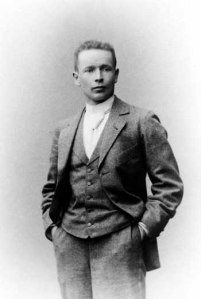
A notable bearer was Finnish Architect, Eliel Saarinen (1873-1950).

Though an obscure Jewish name, it experienced a peak in popularity in Finland and other Scandinavian countries at the end of the 19th-century.

Eliel recently entered the U.S. Top 1000 Most Popular Male Names in 2019, currently ranking in at #664.

The designated name day in Finland is April 9th

A Dutch form is Eliël.

Sources

Ethan

Gender: Masculine
Origin: Hebrew
Meaning: “strong; enduring; solid.”
Eng (EE-then); Heb (ay-TAHN)

Currently the 3rd most popular male name in the United States, Ethan is a Biblical Hebrew name that is mentioned eight times in the Bible.

Not much is known about the Biblical Ethan, other than that it was the name of a possible magi or cymbal player of King David.

The name’s popularity is relatively recent. It was not used much outside the Jewish community until after the Protestant Reformation, even then, the name was still very uncommon.

In 1880, Ethan did not appear in the U.S. top 1000, in 1884, he suddenly appeared coming in at # 613, then fell out of the top 1000 the next year, coming in again at # 846 in 1886.

For the next 80 or so years, Ethan had had a history of disappearing from the top 1000 every few years, and then reappearing, but never ranking very high. It wasn’t until, starting in 1956, that Ethan remained steadily in the top 1000 each year.

For ’56, he was the 948th most popular male name.

Ethan jumped several places towards the end of the 1980s. He came in at # 236 in 1988 and then jumped a couple hundred spots the following year, cracking the top 100, he came in at # 87 for 1989.

In 2002, he hit the top 10, coming in at # 5.

His popularity in other countries are as follows:

  • # 10 (Australia, 2007)
  • # 36 (Belgium, 2006)
  • # 1 (Canada, B.C., 2008)
  • # 15 (England/Wales, 2008)
  • # 24 (France, 2006)
  • # 46 (Ireland, 2007)
  • # 31 (Scotland, 2008)

Other forms of the name include:

  • Etan (German/Polish)
  • Aithan Αιθαν (Greek: Biblical)
  • Eitan/Eytan אֵיתָן (Hebrew: Modern)

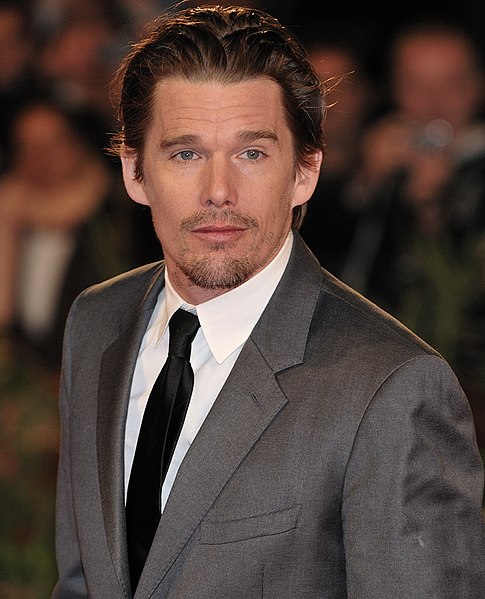
The name is also borne American revolutionary Ethan Allen (1738-1789) and by actor, Ethan Hawke (b. 1970).

It is also the name of the protagnostis in Edith Wharton’s novel Ethan Frome (1911)